What Is a Functional Resume? Your 2026 Format Guide
A functional resume is a skills-based document that places your professional competencies at the center, pushing your chronological work history to a secondary role. Career changers, job seekers with employment gaps, and recent graduates use this format to frame their qualifications around what they can do rather than where they have been. Understanding what is a functional resume, and when it works against you, is the difference between a document that gets read and one that gets filtered out by an applicant tracking system before a human ever sees it.
What is a functional resume, and how does it differ from other formats?
A functional resume is defined as a skills-based format that prioritizes competencies over a traditional reverse-chronological work history. It groups your experience under skill categories rather than job titles. That structure suits career changers, people with employment gaps, and anyone whose job titles do not reflect their actual abilities.
The three main resume formats each serve a different purpose. Knowing the difference helps you pick the right one.

| Format | Primary focus | Best for |
|---|---|---|
| Functional | Skills and competencies | Career changers, employment gaps, non-linear careers |
| Chronological | Reverse-order work history | Steady career progression in one field |
| Combination | Skills summary plus dated work history | Experienced professionals switching industries |
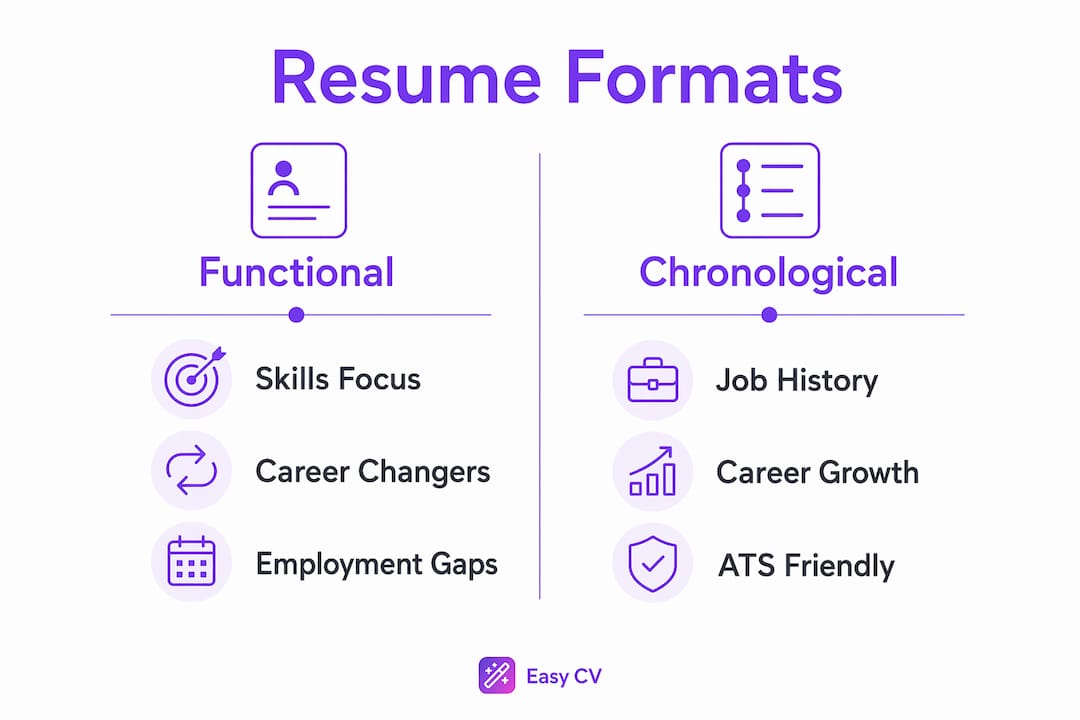
A chronological resume lists your jobs from most recent to oldest. Recruiters prefer it because it shows career growth at a glance. A combination resume opens with a skills summary and then follows with a dated work history. According to career experts, combination resumes balance skill summaries with dated work history, making them the format most preferred by recruiters and applicant tracking systems alike. The functional format is the most specialized of the three. Use it deliberately, not by default.
How to write a functional resume that gets noticed
A well-built functional resume follows a clear structure. Skipping any section weakens the document and raises red flags with hiring managers.
-
Contact header. Include your full name, phone number, professional email address, LinkedIn profile, and city or region. Keep this block clean and easy to scan.
-
Professional summary. Write two to three sentences that state your core expertise and the role you are targeting. This is not a career objective from 1995. It is a concise pitch that tells the recruiter exactly what you bring.
-
Skills section. This is the longest and most important part of a functional resume. Effective functional resumes include three to four primary skill categories, each supported by three to five bullet points that quantify results. For example, a “Client Relations” category might include a bullet like “Reduced customer complaints by 30% through a structured follow-up process.” Generic duties have no place here.
-
Condensed work history. List your job titles, employers, and dates of employment. Nothing more. Omitting work history entirely triggers suspicion from hiring managers. A brief timeline reassures them without drawing attention to gaps.
-
Education and certifications. Place your degree, institution, and graduation year here. Including relevant certifications or coursework that bridges your background to your target role reduces hiring red flags and supports your career narrative.
-
Keywords from the job description. Scan the posting and mirror its language inside your skill categories. Tailoring with job description keywords is the single most effective way to pass automated screenings. Applicant tracking systems score your resume against the posting, so generic language costs you interviews.
Pro Tip: Use a resume checklist before submitting. Verify that every skill bullet contains a measurable result, not a vague description of duties. “Managed social media accounts” is weak. “Grew Instagram engagement by 40% over six months” is what gets you called.
What are the advantages and drawbacks of using a functional resume?
The functional resume format has real strengths. It also has real weaknesses that job seekers frequently underestimate.
Benefits worth knowing
- Hides employment gaps. The skills section dominates the page, so a two-year gap in your work history does not appear until the reader reaches the condensed timeline near the bottom.
- Highlights transferable skills. A teacher moving into corporate training can group classroom management, curriculum design, and public speaking under relevant skill categories. The format makes the pivot logical.
- Works for non-linear careers. Freelancers, contractors, and people who have held many short-term roles can present a coherent professional identity through skills rather than a fragmented job list.
- Supports recent graduates. When you have limited work experience, leading with skills, coursework, and project results gives recruiters something concrete to evaluate.
Drawbacks that can cost you the interview
The functional format carries a credibility risk. Experts warn that functional resumes remove the context of where and when skills were applied, leading some recruiters to doubt the depth of your experience. That skepticism is real and widespread.
“Functional resumes deemphasize gaps but can cause recruiter skepticism due to the lack of context on when and where skills were used.” — Career experts cited by Resumly.ai
Applicant tracking systems compound the problem. Many ATS platforms are built to parse chronological data. A resume that buries dates and employers can confuse the parser and drop your score. Combination resumes are preferred for ATS compatibility and background checks because they provide both the skills narrative and the dated work history the system needs.
The fix is straightforward. Never omit your work history entirely. Keep the condensed timeline, add measurable results to every skill bullet, and consider whether a combination format serves you better. The benefits of tailored resumes apply to functional formats too. A generic skills list will not outperform a targeted one.
When should you use a functional resume vs. a chronological one?
The right format depends entirely on your career situation. There is no universal answer, but there are clear signals pointing you toward each option.
Choose a functional resume when:
- You are changing industries and your job titles do not reflect your target role. Functional format works best when prior job titles do not clearly align with future goals.
- You have a significant employment gap, whether from caregiving, illness, education, or a layoff.
- Your career has been non-linear, with freelance work, contract roles, or multiple short-term positions.
- You are a recent graduate with strong skills but limited formal work history.
Choose a chronological resume when:
- You have steady, continuous experience in the same field.
- Your job titles tell a clear story of growth and increasing responsibility.
- You are applying to roles where recruiters expect a traditional career path, such as finance, law, or medicine.
Choose a combination resume when:
- You have strong skills to highlight but also a solid work history worth showing.
- You are switching industries but have enough relevant experience to support a dated timeline.
- You want ATS compatibility without sacrificing your skills narrative.
A useful way to think about it: the types of resumes you choose from are tools, not identities. Pick the one that presents your strongest case for the specific role you want.
Key Takeaways
A functional resume works best when your skills tell a stronger story than your job titles, but it requires a condensed work history and measurable results to hold up under recruiter scrutiny.
| Point | Details |
|---|---|
| Skills-first structure | Group experience under three to four skill categories, each with quantified bullet points. |
| Never omit work history | Always include a condensed list of job titles, employers, and dates to avoid recruiter suspicion. |
| ATS keyword alignment | Mirror language from the job description inside your skill categories to pass automated screening. |
| Combination as an alternative | When in doubt, a combination resume offers skills focus plus chronological context that recruiters prefer. |
| Format matches situation | Use functional for career changes and gaps; use chronological for steady career progression. |
The format is a tool, not a workaround
I have reviewed hundreds of functional resumes over the years, and the most common mistake is using the format to hide something rather than to highlight something. Job seekers treat it as a shield against scrutiny. Recruiters know that. They have seen enough functional resumes to recognize when the format is being used defensively, and it makes them more suspicious, not less.
The functional resumes that actually work do the opposite. They lead with specific, measurable accomplishments that make the reader want to know more. A bullet that says “Increased quarterly revenue by 22% through targeted outreach campaigns” does not need a company name attached to it to be convincing. The number does the work. The format just gives it the right stage.
My honest recommendation: if you have any meaningful work history at all, consider a combination format before committing to a purely functional one. The resume optimization strategies that consistently produce results in 2026 involve matching your format to the job, not picking a format and hoping it fits every application. Tailor the structure the same way you tailor the content. And always, always include resume keywords pulled directly from the job posting. That single habit will do more for your ATS score than any formatting choice.
— Andras
Build your functional resume with Easy-cv
Choosing the right resume format is only half the work. Building it well is the other half.
Easy-cv gives you a full set of ATS-friendly templates, including layouts that work for functional and combination formats. The AI writing assistant helps you turn vague job duties into specific, results-oriented bullet points. You can tailor your resume to each job posting in minutes, with keyword suggestions pulled directly from the listing. Whether you are a career changer, a recent graduate, or someone returning to work after a gap, the Easy-cv AI CV builder handles the heavy lifting so you can focus on the application itself. Free and premium plans are available, with no commitment required to get started.
FAQ
What is a functional resume in simple terms?
A functional resume is a skills-based document that leads with your competencies rather than your job history. It groups your experience under skill categories instead of listing jobs in reverse chronological order.
Is a functional resume bad for ATS?
Functional resumes can score lower in applicant tracking systems because many ATS platforms are built to parse chronological data. Including keywords from the job description inside your skill categories improves your score significantly.
Should I include work history on a functional resume?
Yes. Omitting work history entirely raises red flags with hiring managers. Include a condensed list of job titles, employers, and dates, even if it appears near the bottom of the document.
When is a functional resume the right choice?
A functional resume works best for career changers, job seekers with employment gaps, recent graduates, and anyone whose job titles do not reflect their target role. For steady career progression, a chronological resume is the stronger choice.
What is the difference between a functional and a combination resume?
A functional resume focuses almost entirely on skills, with minimal work history. A combination resume opens with a skills summary and then follows with a full, dated work history, making it more ATS-friendly and more trusted by recruiters.