Resume Trends 2026: What Actually Gets You Hired
Resume trends in 2026 are defined by one core shift: employers now screen for measurable evidence, not job descriptions. 91% of employers use AI screening tools in hiring this year. That number means your resume must satisfy an algorithm before a human ever reads it. Tools like Grammarly help with language polish, but the bigger challenge is structural. Your resume needs to speak the language of ATS systems, prove your value with numbers, and be tailored to each specific role. The role of resume trends 2026 plays in your job search is not cosmetic. It determines whether you get an interview or get filtered out.
What are the essential resume content trends for 2026?
The modern resume is a forward-looking sales pitch, not a historical log. The World Economic Forum’s 2025 Future of Jobs Report found that 50% of employees require reskilling. That shift means hiring managers want to see what you can do next, not just what you did before.
The most effective content change you can make is replacing vague responsibility statements with quantified achievements. According to Jobscan’s 2024 Resume Performance Study, quantified achievements boost interview requests by 40%. Recruiters respond to specifics because specifics are credible.

The PAR method (Problem, Action, Result) is the standard framework for writing these bullets. Each bullet should name the problem you faced, the action you took, and the result you produced. “Reduced customer churn by 18% over two quarters by redesigning the onboarding email sequence” beats “Responsible for customer retention” every time.
Key content priorities for 2026:
- Action verbs first: Start every bullet with a strong verb. “Led,” “Built,” “Reduced,” “Generated,” “Negotiated.”
- AI skills as baseline: Listing AI literacy is now expected, not impressive. Show how you applied AI tools to produce results.
- Skills-first structure: Place a core competencies section near the top, especially if you are changing industries or roles.
- Evidence over adjectives: “Detail-oriented” says nothing. “Reduced reporting errors by 23% through a new QA checklist” says everything.
Pro Tip: Build an evidence bank in a separate document. After every project or win, write one PAR bullet immediately. You will never scramble to remember metrics when updating your resume.
How is resume formatting evolving in 2026?
Clean formatting wins. ATS systems fail to parse complex designs that include columns, tables, images, or decorative fonts. A resume that looks beautiful in PDF can appear as a scrambled block of text inside an ATS database.
The one-page rule is officially relaxed for experienced professionals. 77% of employers say experienced professionals should not feel restricted to one page. The average resume length in 2026 is 2.59 pages, and recruiters are 2.9 times more likely to prefer two-page resumes for managerial roles. Exceeding two pages, however, does hurt interview rates. Two pages is the ceiling for most candidates.
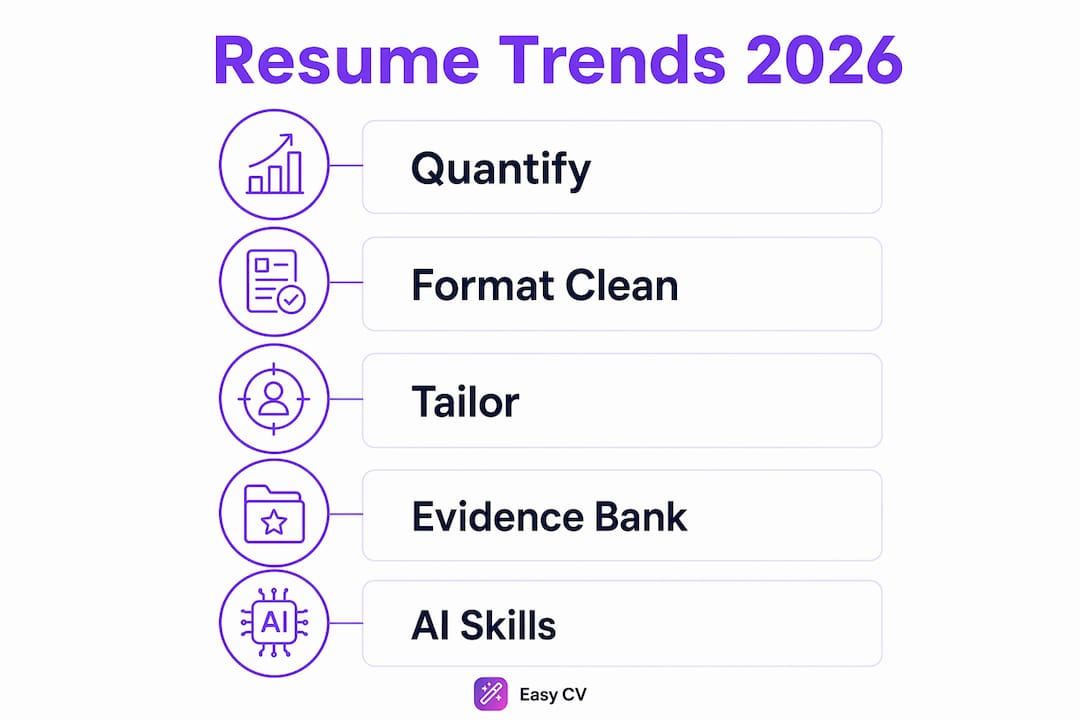
What formatting actually works in 2026
Follow these rules to pass both ATS and human review:
- Use a single-column layout with clear section headers.
- Stick to standard fonts: Calibri, Arial, or Georgia at 10–12 point size.
- Use standard section labels: “Work Experience,” “Education,” “Skills.”
- Save and submit as a PDF unless the job posting specifies otherwise.
- Add portfolio or GitHub links as plain text URLs, not embedded hyperlinks inside ATS-submitted documents.
What to avoid entirely:
- Tables and text boxes (ATS cannot read them)
- Headshots or graphics (irrelevant in most U.S. markets and harmful to parsing)
- Headers and footers containing key contact information
- Fancy resume templates with sidebars or color-coded skill bars
Pro Tip: Test your resume by copying and pasting it into a plain text editor. If the content reads clearly and in order, your ATS formatting is solid. If it looks scrambled, fix the layout before applying.
For a deeper look at CV formatting best practices that balance ATS safety with visual appeal, the standards have shifted significantly this year.
Why tailoring your resume for each role is non-negotiable
62% of employers reject generic resumes outright. High application volumes mean recruiters spot a copy-paste job instantly. Tailored resumes using PAR formulas and keyword optimization can increase interview rates by 40–60%. That gap is too large to ignore.
Tailoring does not mean rewriting your entire resume for every application. It means making three targeted changes:
- Rewrite your professional summary. Pull two or three keywords directly from the job posting and work them into your opening paragraph. Mirror the employer’s language, not your own.
- Reorder your skills section. Move the skills that match the job description to the top of your list. ATS systems weight early placement.
- Swap one or two bullets. Replace your weakest bullets with ones that directly address the role’s stated priorities.
Maintaining an evidence bank makes this process fast. You pull the most relevant PAR bullets from your bank, drop them in, and adjust the summary. A full tailoring pass should take 20–30 minutes, not two hours.
Modern ATS systems prioritize evidence over keyword stuffing. Mismatched buzzwords without supporting metrics actually hurt your ATS ranking more than missing keywords. Recruiters also infer seniority by matching the scale of your past work to the role. A candidate who claims “strategic leadership” but lists no team size, budget, or outcome signals a mismatch.
Save each tailored version with a clear filename. “Resume_MarketingManager_Salesforce_2026.pdf” is far more useful than “Resume_Final_v3.pdf” when you are tracking multiple applications.
Traditional vs. modern resume styles: what’s out and what’s in
The contrast between 2026 resume writing tips and advice from five years ago is stark. Here is a direct comparison:
| Feature | Traditional (Out) | Modern 2026 (In) |
|---|---|---|
| Opening section | Objective statement (“Seeking a role where…”) | Professional summary with keywords and one quantified win |
| Bullet structure | Responsibilities listed (“Managed social media accounts”) | PAR-based achievements (“Grew Instagram engagement 34% in 90 days”) |
| Skills section | Generic traits (“Team player,” “Hard worker”) | Specific tools and technologies (“Python, Tableau, Salesforce, GPT-4 workflows”) |
| Resume length | One page regardless of experience | One to two pages based on career stage |
| Design | Creative layouts, columns, infographics | Single-column, clean, ATS-safe |
| Remote work | Not addressed | Explicitly framed (“Led fully remote team of 8 across 3 time zones”) |
| AI skills | Not applicable | Listed with context and outcomes |
The shift toward remote work framing is one of the more underappreciated 2026 resume developments. Employers hiring for distributed teams want proof you can operate independently and communicate across time zones. Calling that out explicitly in your bullets signals self-awareness and relevance.
AI skills deserve the same treatment. Do not just list “AI tools.” Write “Used ChatGPT and Midjourney to reduce content production time by 30%.” That is a result. Results get interviews.
For guidance on applying targeted keywords effectively, the approach has evolved well beyond simple keyword matching.
Key takeaways
Tailored, evidence-backed resumes with ATS-safe formatting are the single most effective strategy for securing interviews in 2026’s AI-screened hiring environment.
| Point | Details |
|---|---|
| Quantify every achievement | Use PAR bullets with numbers; quantified achievements boost interview rates by 40%. |
| Format for ATS first | Single-column layouts with standard fonts pass ATS parsing; complex designs fail silently. |
| Tailor each application | Adjust your summary, skills order, and two bullets per role; generic resumes are rejected by 62% of employers. |
| Build an evidence bank | Log PAR bullets after every win so tailoring takes minutes, not hours. |
| Two pages is the ceiling | Experienced professionals can use two pages; exceeding that hurts interview rates regardless of experience level. |
The uncomfortable truth about resume advice in 2026
Most resume advice focuses on what to add. The harder lesson I have learned is that subtraction matters just as much. Candidates consistently over-explain early career roles and under-explain their most recent, most relevant work. A resume from 2026 should give 70% of its space to the last five years and compress everything before that.
The AI screening shift has also created a counterintuitive trap. Job seekers stuff their resumes with keywords to beat the algorithm, then fail the human review because the document reads like a keyword list. The evidence-backed approach solves both problems at once. A bullet that names a tool, describes the action, and states the result contains the keyword naturally and reads well to a human.
My strongest recommendation: treat your master resume as a living document. Update it within 48 hours of completing a project or hitting a metric. Waiting until you are actively job searching means you will forget the specifics that make your bullets credible. I have seen candidates reconstruct six months of work from memory and produce vague, unverifiable bullets as a result.
The future resume styles that will dominate are not about design. They are about specificity. The candidates who win interviews in 2026 are the ones who can prove, in two pages or less, exactly what they did and what it produced.
— Andras
How Easy-cv helps you apply every one of these trends
Knowing what 2026 resume trends demand is one thing. Executing them efficiently across multiple applications is another challenge entirely.
Easy-cv brings the full application workflow into one place. Its AI writing assistant generates PAR-structured bullets, mirrors job description language in your professional summary, and checks keyword alignment before you submit. The ATS-friendly resume builder uses clean, single-column templates that pass automated screening without sacrificing visual clarity. You can maintain a master resume, create tailored versions for specific roles, and track every application inside the same platform. For professionals applying to multiple roles simultaneously, that structure removes the friction that causes most people to send generic resumes out of time pressure. Easy-cv also supports AI-powered resume features including a headshot generator, cover letter builder, and 30-plus language support for global job seekers.
FAQ
What is the ideal resume length in 2026?
The average resume length in 2026 is 2.59 pages, and two pages is the standard for experienced professionals. Exceeding two pages negatively impacts interview rates regardless of experience level.
How do ATS systems rank resumes in 2026?
Modern ATS systems prioritize evidence over keyword density. Resumes that show scale, tools used, and measurable results rank higher than those that repeat buzzwords without supporting metrics.
How much does tailoring a resume actually improve results?
Tailored resumes using PAR formulas and keyword optimization increase interview rates by 40–60%. Generic resumes are rejected by 62% of employers, making customization one of the highest-return actions a job seeker can take.
Should i include AI skills on my 2026 resume?
Yes, but with context. Listing AI tools without outcomes adds no value. Write a bullet that names the tool, describes how you used it, and states the result it produced.
How often should i update my master resume?
Update your master resume within 48 hours of completing a project or hitting a measurable outcome. Waiting until job search mode leads to lost data and vague, unverifiable bullets that hurt your credibility with both ATS systems and recruiters.