10 Proven Ways to Improve Your Job Search in 2026
The most effective ways to improve your job search in 2026 center on one principle: targeted quality beats volume every time. Generic mass applications are filtered out by AI screening tools before a human ever reads them, while tailored, specific applications consistently reach hiring managers. Platforms like LinkedIn, tools like Easy-cv, and research from Robert Half confirm that job seekers who treat each application as a custom pitch, build warm referral networks, and master interview dynamics land offers faster than those who spray and pray.
1. Ways to improve job search: target fewer companies, win more interviews
Applying to hundreds of roles feels productive. It is not. Targeting 25 to 40 companies with tailored applications produces better outcomes than mass submissions, because recruiters and AI systems both reward specificity. That number is small enough to research deeply and large enough to generate real pipeline.
Before you apply anywhere, spend 20 minutes on each company. Read their recent press releases, LinkedIn posts, and job description language. Then mirror that language in your resume and cover letter. A cover letter that names a specific company challenge, such as entering a new market or scaling a product team, signals genuine interest in a way that a generic career summary never can.

AI-generated applications are a growing problem for recruiters. 65% of hiring managers report difficulty with AI-written submissions, which means authenticity is now a competitive advantage. Use tools like ChatGPT or Easy-cv’s AI writing assistant to brainstorm bullet points and identify gaps, then rewrite the output in your own voice.
Pro Tip: Write your cover letter around one specific challenge the company faces, then explain how your past work addresses it directly. This approach takes 15 extra minutes and separates you from 90% of applicants.
2. How referrals and networking multiply your hiring odds
A referral is not just a nice-to-have. Candidates with referrals are approximately five times more likely to be hired, and 40% to 50% of hires at major employers come through employee referral programs. That means the most powerful job search improvement technique available to you costs nothing except a few thoughtful messages.
Warm up your network before you need it. Reach out to former colleagues, managers, and classmates with specific, low-ask messages. Share an article relevant to their industry, congratulate them on a recent promotion, or ask a genuine question about their current role. These micro-interactions rebuild relationships without the awkwardness of a cold “do you know of any openings?” request.
Career fairs have also regained relevance. Attendance at career fairs increased by 15% as employers actively seek authentic human interactions beyond AI-filtered applications. Showing up in person, prepared with a tight pitch and printed materials, signals the kind of initiative that online applications cannot convey.
Key networking moves that consistently work:
- Reconnect with your three most recent managers before you need a referral, not after
- Join two or three industry-specific LinkedIn groups and comment substantively on posts
- Attend one in-person event per month, whether a meetup, conference, or career fair
- Ask for a 15-minute informational call, not a job lead, to reduce pressure on both sides
Pro Tip: When reaching out to a contact, ask for their advice on breaking into a specific team or company. People love giving advice. It opens the door naturally and often leads to a referral without you ever asking for one.
3. How to optimize your resume and LinkedIn profile for ATS and recruiters
Applicant Tracking Systems, known as ATS, filter resumes before any human sees them. Well-optimized LinkedIn profiles are the single biggest driver of recruiter outreach in 2026, which means your digital presence is now as important as your resume. Both documents need to speak the same language as the job description.
Mirror exact keywords from each job posting in your resume. If the role says “cross-functional collaboration” and your resume says “worked with multiple teams,” the ATS may not match them. Copy the precise phrasing, then back it up with a concrete achievement. “Led cross-functional collaboration between engineering and marketing to launch a product three weeks ahead of schedule” beats “responsible for team coordination” every time.
LinkedIn activity signals seriousness to hiring managers, who often check profiles early in the screening process. An inactive or thin profile can disqualify you before a single conversation. Update your headline to reflect the role you want, not just your current title. Add a professional photo. A quality LinkedIn headshot increases profile views significantly and signals professionalism at a glance.
Here is how resume and LinkedIn optimization compare across the factors that matter most:
| Factor | Resume | LinkedIn profile |
|---|---|---|
| Keyword matching | Mirror job description language exactly | Use role-family keywords in headline and About section |
| Formatting | Clean, single-column, ATS-safe layout | Complete all sections; avoid leaving fields blank |
| Achievements | Lead with metrics: revenue, percentages, timelines | Feature top 3 accomplishments in the About section |
| Photo | Not applicable | Professional headshot, neutral background |
| Activity | Static document, updated per application | Post or comment weekly to signal engagement |
For resume building at scale, Easy-cv’s ATS-friendly templates let you create multiple tailored versions without rebuilding from scratch each time. That matters when you are targeting 30 companies with 30 different keyword sets.
4. What makes interview performance and negotiation actually work
The interview starts before you walk in the room. Most hiring decisions are made in the first quarter of the first interview, which means the opening minutes are your highest-leverage window. Prepare a 90-second pitch that covers who you are, what you have accomplished, and what you are looking for. Deliver it confidently in the first seven minutes.
Treat the interview as a two-way evaluation. Asking specific questions about team culture, success metrics, and management style signals that you are selective, not desperate. Questions like “How does this team measure success in the first 90 days?” or “What separates the people who thrive here from those who struggle?” show strategic thinking and genuine interest simultaneously.
Here is a practical framework for interview preparation:
- Write out three specific stories using the Situation, Action, Result format, each under 90 seconds
- Research the interviewer on LinkedIn before the call and reference one relevant detail
- Prepare two questions about team dynamics and one about performance expectations
- Practice your opening pitch out loud, not just in your head, at least five times
- After the interview, send a follow-up note within 24 hours that references a specific moment from the conversation
On negotiation: wait for a written offer before discussing compensation. Anchor your counter with market data from sources like the Bureau of Labor Statistics or industry salary surveys, not personal financial needs. Offers in 2026 often include flexibility on base salary, equity, remote work terms, and start dates, so negotiate the full package, not just the number.
Pro Tip: Record yourself answering common interview questions on your phone and watch it back. Most people are surprised by filler words and pacing issues they never noticed. One session of self-review is worth more than ten practice runs in your head.
5. Why contract and temporary roles are underrated job search strategies
Contract roles are not a consolation prize. 55% of companies are expanding contract hiring in the first half of 2026, even as permanent headcount remains flat in some sectors. That means temporary positions are a real entry point, not a detour.
The practical advantages of contract work go beyond a paycheck. You build relationships inside companies that are actively hiring. You demonstrate current, relevant skills on a live project. And many contract assignments convert to permanent roles once the team sees your work firsthand. Staffing agencies like Robert Half specialize in placing professionals in contract-to-hire roles across finance, technology, and operations.
Contract work also solves a resume gap problem. A six-month gap reads as uncertainty to recruiters. A six-month contract at a recognizable company reads as initiative. When you list contract roles, treat them the same as permanent positions: lead with measurable outcomes, not just responsibilities.
Benefits of pursuing contract and temporary roles:
- Immediate income while continuing your permanent job search
- Access to companies that are not posting permanent openings publicly
- Cross-industry experience that broadens your skill set and resume appeal
- A built-in network of colleagues who can refer you to future roles
- Proof of adaptability, which hiring managers increasingly value
Pro Tip: When a contract ends, ask your manager for a brief LinkedIn recommendation before you leave. That recommendation carries more weight than a reference call because it is public, permanent, and searchable.
Key takeaways
Improving your job search in 2026 requires targeting the right companies, building warm referral networks, and optimizing every touchpoint from your resume to your negotiation timing.
| Point | Details |
|---|---|
| Target, don’t spray | Apply to 25 to 40 companies with tailored materials rather than hundreds with generic ones. |
| Referrals are your fastest path | Candidates with referrals are five times more likely to be hired; warm up your network before you need it. |
| ATS optimization is non-negotiable | Mirror exact job description keywords in your resume and keep formatting clean and single-column. |
| Own the first 7 minutes | Prepare a 90-second pitch and deliver it early; most hiring decisions form in the opening quarter of the interview. |
| Contract roles open permanent doors | 55% of companies are expanding contract hiring; temporary assignments frequently convert to full-time offers. |
What I’ve learned about job searching that most guides won’t tell you
Most job search advice treats the process as a numbers game. Send more applications, attend more events, follow up more aggressively. In my experience, that framing produces anxiety and mediocre results in equal measure.
The job seekers I have seen succeed treat the search like a research project, not a sales funnel. They spend more time understanding what a company actually needs than they spend polishing their resume. They reach out to people with genuine curiosity, not transactional intent. And they walk into interviews ready to evaluate the employer as much as they are being evaluated.
The hardest part is mental stamina. Rejections are not data points about your worth. They are data points about fit, timing, and factors you often cannot see. Scheduling your search like a job, with fixed hours and defined weekly goals, prevents the spiral of checking email obsessively and losing momentum.
AI tools like Easy-cv’s writing assistant are genuinely useful for speeding up the tailoring process. But the candidates who use them as a starting point, then rewrite in their own voice, consistently outperform those who submit the raw output. Authenticity is not a soft skill in 2026. It is a filter that separates candidates who get callbacks from those who do not.
The 2026 job search playbook has changed more in the last two years than in the previous decade. The candidates who adapt to that reality, rather than applying the same tactics that worked in 2019, are the ones landing offers in competitive markets.
— Andras
How Easy-cv helps you put these strategies into practice
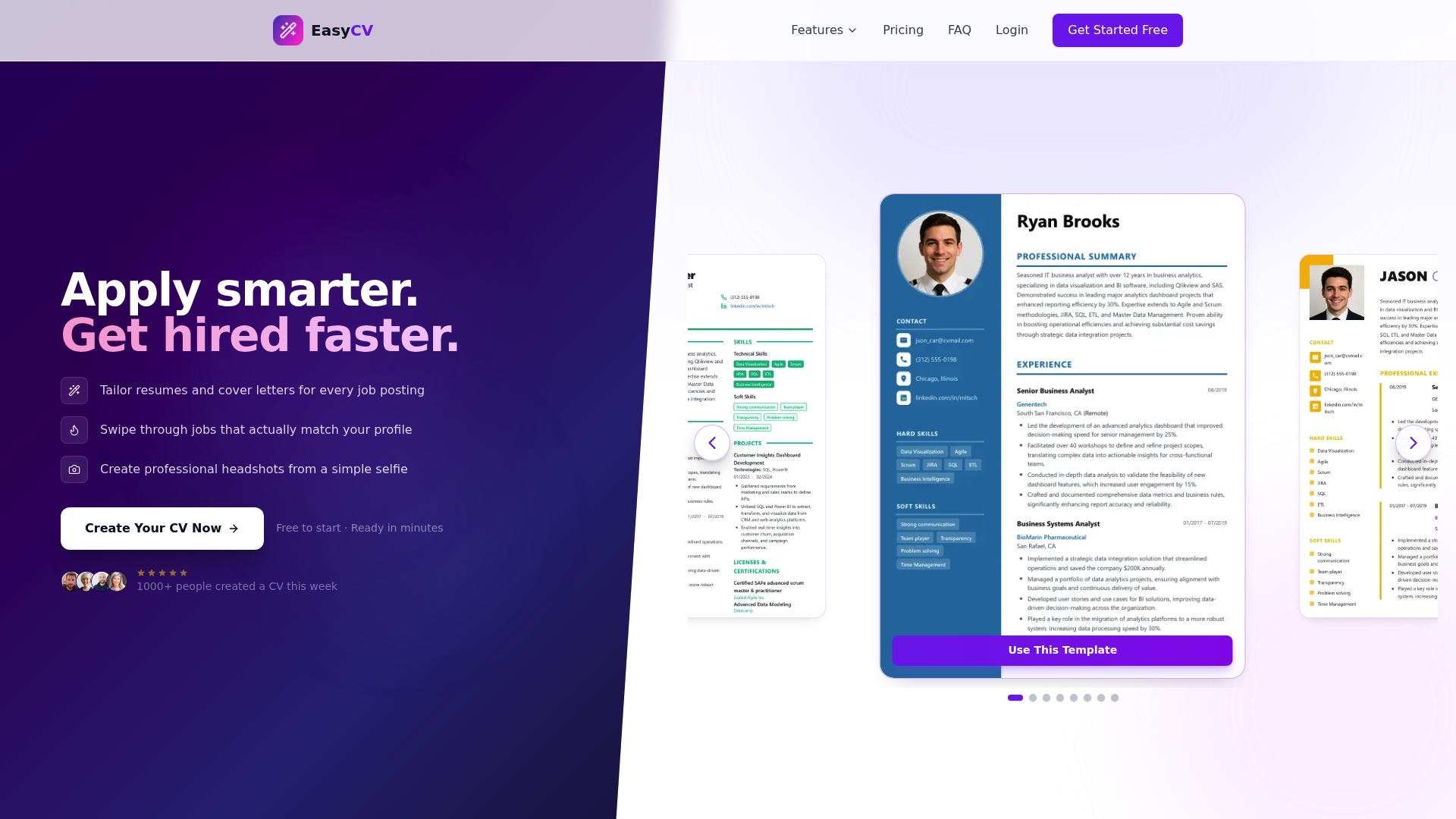
Every strategy in this article requires one thing: applications that are tailored, ATS-ready, and fast to produce. Easy-cv brings that entire workflow into one place. You can browse over 10 million job listings aggregated from major job boards, generate a role-specific CV and cover letter with AI assistance, and track every application without switching between tools.
The AI-powered CV builder handles keyword optimization, clean formatting, and professional layout across 30-plus languages. Whether you are targeting five companies this week or fifty this month, Easy-cv lets you customize each application without starting from scratch. The built-in job tracker keeps your pipeline organized so nothing falls through the cracks. Start your search with the tools that match the market you are actually competing in.
FAQ
How many jobs should I apply to per week?
Quality outperforms quantity in modern job searches. Targeting 25 to 40 companies total with tailored applications produces better results than applying to hundreds with generic materials.
Do referrals really make that big a difference?
Yes. Candidates with referrals are approximately five times more likely to be hired, and referrals bypass AI screening filters that reject generic applications before a recruiter ever sees them.
How do I make my resume pass ATS screening?
Mirror the exact keywords from each job description in your resume, use a clean single-column format, and lead every experience entry with a measurable achievement rather than a list of duties.
When should I negotiate salary?
Wait until you have a written offer before discussing compensation. Anchor your counter-offer with market data from salary surveys or the Bureau of Labor Statistics, and negotiate the full package including remote work terms and start date.
Are contract roles worth pursuing during a job search?
Contract roles provide immediate income, real networking access, and a direct path to permanent positions. With 55% of companies expanding contract hiring in 2026, temporary assignments are a legitimate and often faster route to full-time employment.