10 Cover Letter Tips to Boost Your Interview Chances

Your resume gets you in the database, but your cover letter gets you in the room. While most candidates submit nearly identical resumes for any given role, 83% of hiring managers say a tailored cover letter makes a candidate stand out, and personalized cover letters produce a 61% increase in interview offers. The gap between a generic letter and a targeted one is measurable and significant. This guide walks you through 10 practical, research-backed tips that apply across industries so you can approach every application in 2026 with confidence and a real competitive edge.
Table of Contents
- Know the ideal cover letter structure
- Tailor your cover letter for every job
- Avoid clichés and vague language
- Leverage AI tools without losing your human touch
- When does your cover letter matter most?
- What most guides miss about cover letter impact
- Simplify your job search with Easy CV
- Frequently asked questions
Key Takeaways
| Point | Details |
|---|---|
| Personalization is crucial | Tailored cover letters dramatically increase interview and hire rates. |
| Structure matters | A clear, concise format with 250-400 words shows professionalism and focus. |
| Avoid jargon | Replace clichés and vague claims with measurable, specific achievements. |
| Use AI wisely | AI tools help streamline drafting, but always edit for authenticity. |
| Context is key | Cover letters are most valuable for career changes, non-tech roles, and resume gaps. |
Know the ideal cover letter structure
Before you write a single word, you need a framework. Think of your cover letter like a short business pitch: every section has a job to do, and nothing should be wasted.
A well-structured cover letter follows a clear three-part pattern. The opening paragraph hooks the hiring manager and states the role you want. The body paragraphs connect your specific experience to the employer’s needs. The closing paragraph asks for the interview and thanks the reader. That’s it. No elaborate wind-up, no lengthy life story.
According to Grammarly’s career guide, cover letters should be 250 to 400 words, one page, and three to four paragraphs. Hiring managers are busy. A letter that exceeds one page signals that you struggle to edit yourself, which is a soft skill most employers value greatly.
Here’s a quick overview of what each section should accomplish:
| Section | Word target | Primary goal |
|---|---|---|
| Opening paragraph | 50-70 words | State the role, hook with a specific accomplishment or insight |
| Body paragraph(s) | 120-200 words | Connect skills to job requirements with concrete examples |
| Closing paragraph | 40-60 words | Call to action, gratitude, professional sign-off |
Common formatting errors that undermine even strong content include:
- Using a font smaller than 10.5pt to squeeze in more text
- Writing a generic subject line that doesn’t reference the job title
- Forgetting to update the company name when reusing a template
- Starting every sentence with “I,” which creates a monotone, self-centered tone
- Leaving the hiring manager’s name blank when it’s findable with a quick search
There are actually several types of cover letters worth knowing, from prospecting letters to referral-based ones, and each calls for slight structural adjustments.
Pro Tip: Write your cover letter, then cut 20% of it. If you started at 500 words, edit down to 400. The tighter version is almost always stronger.
Tailor your cover letter for every job
Structure sets the stage, but personalization is where the real results happen. Submitting the same letter to 50 employers is one of the most common and costly mistakes job seekers make.
Here’s a step-by-step process for tailoring every letter:
- Read the job description twice. On the second read, highlight every skill, tool, and quality mentioned. These are your keywords.
- Research the company. Find their mission statement, recent news, a product launch, or a cultural value they emphasize publicly.
- Find the hiring manager’s name. Check LinkedIn, the company website, or the job posting itself. “Dear Ms. Chen” outperforms “Dear Hiring Manager” every time.
- Mirror their language. If the job description says “cross-functional collaboration,” use that phrase rather than “teamwork.” Applicant tracking systems (ATS) and human reviewers both respond to it.
- Name something specific. Reference a company initiative, a recent award they received, or a challenge their industry is facing. This signals genuine interest, not just job hunger.
As Harvard Business School’s career advice confirms, using keywords from the job description, referencing company specifics, and addressing the hiring manager by name are among the most effective moves a candidate can make.
“Personalized cover letters produce a 61% increase in interview offers and drive 35% higher hire rates in competitive fields.” Cover Letter Statistics
The difference between generic and tailored letters shows up clearly in outcomes:
| Factor | Generic cover letter | Tailored cover letter |
|---|---|---|
| Keyword match | Low | High |
| Interview rate | Baseline | Up to 61% higher |
| Hiring manager perception | Forgettable | Stands out to 83% of managers |
| ATS pass rate | Lower | Significantly higher |
| Time to write | Fast | 15-30 minutes extra |
The 15 to 30 extra minutes per application pays dividends. For more on making personalization systematic, see this guide on optimizing cover letters and browse cover letter templates that give you a personalization-ready starting point.
Avoid clichés and vague language
With personalization in place, the next layer is language quality. Generic phrases don’t just waste space. They actively work against you by signaling low effort.
According to Forbes, phrases like “To Whom It May Concern,” “I’m applying for,” and vague claims like “I’m a hard worker” rank among the most damaging cover letter habits. Hiring managers read hundreds of letters. These phrases make yours invisible.
Here are the most common offenders and what to replace them with:
- “I’m a hard worker” → Replace with a metric: “I reduced onboarding time by 30% by creating a reusable training module.”
- “Passionate about this opportunity” → Replace with specificity: “Your company’s shift toward renewable supply chains aligns with the sustainability audit work I led at [Company].”
- “Team player” → Replace with a story: “I coordinated a five-department product launch that shipped two weeks ahead of schedule.”
- “Detail-oriented” → Replace with evidence: “I caught a $40,000 billing discrepancy during a routine data audit.”
- “To Whom It May Concern” → Find the name. If you truly cannot, use “Dear [Job Title] Hiring Team.”
- “I believe I would be a great fit” → State it factually: “My background in enterprise SaaS sales maps directly to the three core requirements in your job posting.”
Specificity does more than avoid clichés. It answers the hiring manager’s actual question: “Can this person do the job and will they produce results?” Numbers and named outcomes answer that question in a way adjectives never can.
When choosing your cover letter type, keep in mind that the format changes but the language standard stays the same. Vague claims hurt every format equally.
Pro Tip: Keep a running document of your measurable wins, including project outcomes, performance metrics, and revenue impact. When you sit down to write a cover letter, pull directly from that file. It makes specific language effortless.
Leverage AI tools without losing your human touch
Strong language advice leads naturally to the tools that can help you execute it faster. AI writing assistants have become a real part of the modern job search, and used correctly, they save time without sacrificing authenticity.
Here’s a practical four-step process for using AI in your cover letter workflow:
- Compose a first draft with AI. Feed the tool your resume and the job description. Ask it to draft a tailored cover letter using specific keywords and requirements from the posting.
- Review for accuracy. AI sometimes invents details or overstates claims. Check every sentence against your actual experience.
- Personalize the content. Add the hiring manager’s name, the specific company detail you researched, and the company-specific language that AI won’t know unless you supply it.
- Humanize the tone. Read the letter out loud. If it sounds stiff, robotic, or like a press release, rewrite those sentences in your own voice.
Research published at arxiv.org shows that while AI tools improve tailoring significantly, cover letters that are less informative or overly templated signal post-AI generation and can reduce impact. The goal is AI-assisted, not AI-authored.
| Approach | Speed | Personalization | Hiring manager impact |
|---|---|---|---|
| AI-only (no edits) | Very fast | Low | Weak, often generic-feeling |
| Human-edited AI draft | Fast | High | Strong when well-executed |
| Fully manual | Slow | High | Strong but unsustainable at scale |
The human-edited AI draft is clearly the sweet spot for most job seekers. For broader guidance on this approach, explore using AI for resumes, how AI tools for CVs improve job board performance, and what resume automation looks like in a modern job search.
Pro Tip: After any AI draft, add one paragraph that contains a personal story only you could tell. A moment of professional growth, a specific challenge you solved, or a value that shapes how you work. This detail is what human reviewers remember.
When does your cover letter matter most?
Technology tools are only valuable when you know where to deploy them. Not every role treats cover letters the same way, and knowing the difference helps you prioritize your effort.
Cover letters matter most in these situations:
- Career changers. Your resume may not tell the full story. Your cover letter is the place to connect past experience to a new direction.
- Roles with resume gaps. A brief, confident explanation in your cover letter prevents assumptions and shows self-awareness.
- Non-technical roles. Marketing, communications, HR, education, nonprofit, and similar fields tend to weight cover letters more heavily.
- Relationship-based industries. Law, consulting, finance, and creative fields often use cover letters to assess writing ability and cultural fit.
- Smaller companies. A 10-person startup has time to read your letter. A 50,000-person corporation may not.
- Roles where you don’t fully meet every requirement. Your letter can address the gap directly and make the case for potential.
For software engineering and other strong-resume tech roles, Harvard Business Review notes that cover letters are sometimes optional and may not be read at all, especially when the resume clearly meets technical requirements. That said, even in tech roles, a strong cover letter helps when you’re transitioning specializations or applying to a company you genuinely want to work for.
The baseline rule: if the role involves writing, communication, persuasion, or relationship-building, your cover letter carries significant weight. Invest accordingly.
For more on how strong application materials create a competitive edge, see these professional resume templates designed specifically for 2026 job seekers.
What most guides miss about cover letter impact
Most cover letter guides stop at formatting rules and keyword tips. That’s useful, but it misses what actually moves a hiring manager.
The uncomfortable truth is that most cover letters are just resumes wearing a different outfit. They list the same accomplishments in prose form, use the same job titles and dates, and ask for the job in the last line. This adds no new information and makes no lasting impression.
The real function of a cover letter is to answer three questions the resume cannot: Why you? Why now? Why here? These questions require narrative, not bullet points. They require you to connect your experience to the employer’s current situation in a way that feels relevant and urgent.
A hiring manager reading your letter should finish it thinking, “This person actually understands what we need.” That reaction doesn’t come from a clean format. It comes from a sentence like: “Your company just entered the mid-market segment, and I spent the last three years building exactly the kind of sales motion you’ll need to compete there.”
Storytelling and specific metrics together answer all three questions at once. A single sentence that says “I rebuilt a broken onboarding process that was costing us two hires a quarter” tells a hiring manager who you are, what you can do, and why your timing is relevant.
We also see job seekers underestimate emotional resonance in professional contexts. Hiring decisions are made by people. People respond to clear thinking, genuine enthusiasm, and specific knowledge about their business. None of those things require a perfect resume. They require an honest, well-crafted letter.
Explore more on this through our deeper look at cover letter insights and what separates letters that generate interviews from the ones that disappear into applicant tracking systems.
Simplify your job search with Easy CV
Writing tailored, compelling cover letters for every application sounds like a lot of work, and it can be without the right tools.
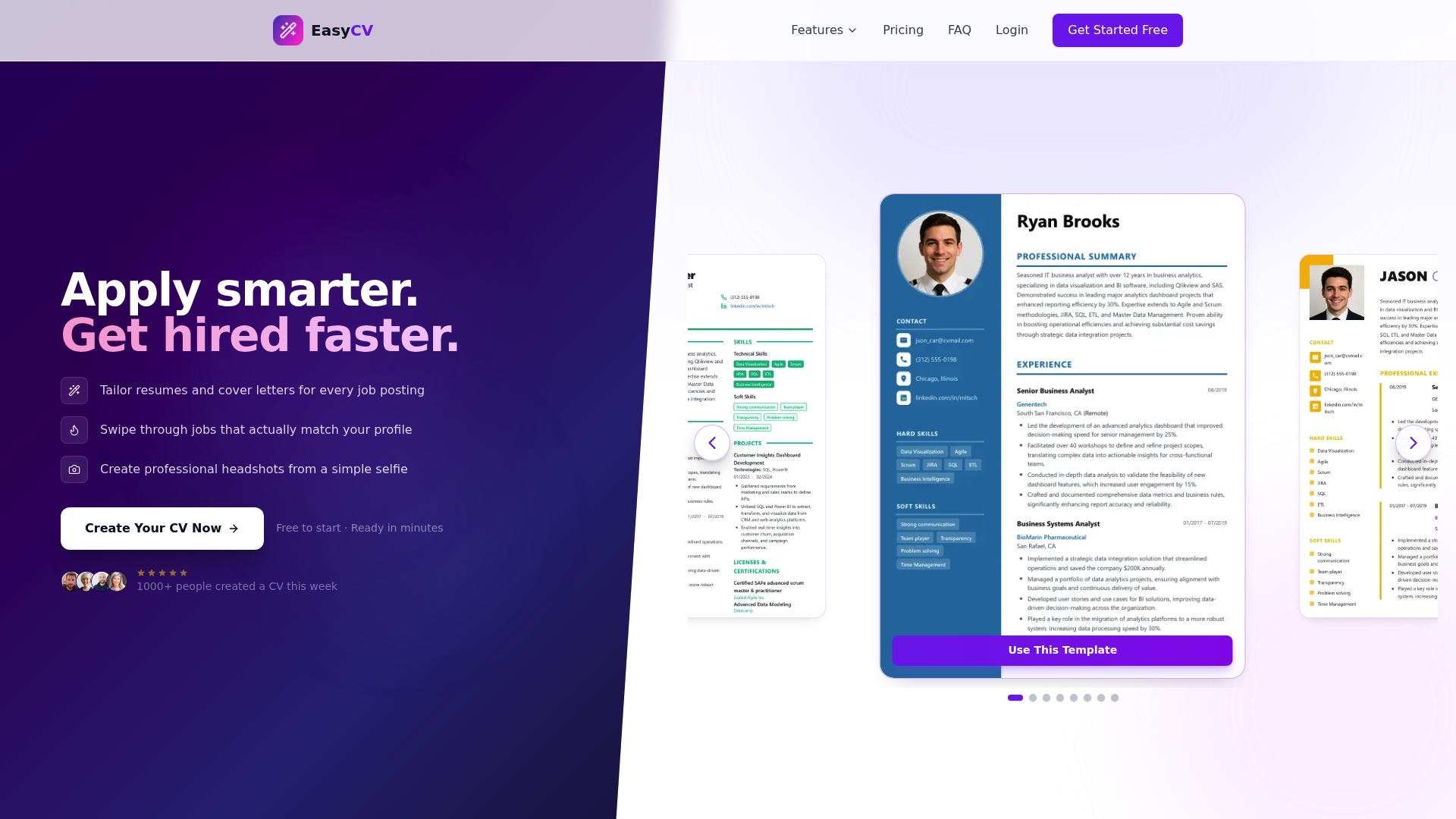
EasyCV.ai is built for exactly this challenge. The platform’s AI cover letter generator uses your resume and the specific job description to produce a personalized, keyword-matched draft in seconds. You can then edit it, adjust the tone, and add your personal stories before sending. Explore the full range of Easy CV features including job matching, resume translation, AI headshots, and multi-version CV management, all designed to reduce the manual work of applying without sacrificing quality. Start building stronger applications today with the AI CV builder that adapts to every job you pursue.
Frequently asked questions
How long should a cover letter be in 2026?
Aim for 250 to 400 words, kept to one page and three to four paragraphs. Anything longer risks losing the hiring manager’s attention before the close.
What keywords should I use in my cover letter?
Extract keywords from the job description and mirror the company’s own language from their website, mission statement, or recent announcements for the best results.
Do hiring managers really read cover letters?
83% of hiring managers say tailored cover letters make candidates stand out, and they’re especially valued in competitive fields and roles requiring strong communication skills.
Should I use AI to write my cover letter?
AI can help you personalize cover letters quickly, but editing for your own voice is essential to avoid sounding generic or overly templated.
Is a cover letter necessary for tech roles?
In strong-resume tech engineering roles, cover letters may not be read, but they remain crucial for career changers, candidates with employment gaps, and anyone targeting companies where culture and communication matter.