Resume automation: how AI transforms your job search

Picture this: you spend three hours crafting what feels like the perfect resume, hit submit, and hear nothing back. No email. No call. No acknowledgment. You’re not alone, and the problem likely isn’t your qualifications. 75% of employers use ATS, and 80% of resumes get filtered out before a human ever reads them. Resume automation is the answer millions of job seekers didn’t know they needed. In this article, you’ll learn exactly what resume automation is, how the technology works, what results it actually delivers, and how to use it without losing the personal touch that gets you hired.
Table of Contents
- What is resume automation and why does it matter?
- Core technologies behind resume automation
- How resume automation impacts job hunting success
- When to use automation, and when to review manually
- Expert perspective: Resume automation only works with your authentic story
- Ready to launch your job search with resume automation?
- Frequently asked questions
Key Takeaways
| Point | Details |
|---|---|
| Resume automation defined | AI-powered tools generate, keyword-optimize, and tailor resumes to boost job application success. |
| Boosts application success | Automated resumes have higher ATS pass rates and lead to more interview callbacks. |
| Tech with human touch | Combining automation with personalized edits is the best way to stand out authentically. |
| Speeds up the process | Resume automation reduces time spent on applications by up to 85 percent compared to manual writing. |
What is resume automation and why does it matter?
Let’s start with the most important question. What is resume automation, and how is it different from just downloading a Word template?
Resume automation refers to AI-powered tools and systems that automatically generate, optimize, and tailor resumes to specific job descriptions, ensuring ATS compatibility and keyword alignment to improve application success rates. That’s a meaningful distinction. A template gives you a blank structure. Resume automation fills it intelligently, reading the job posting, identifying the exact keywords a recruiter’s software is looking for, and reshaping your experience to match.
Think about what that means in practice. You paste in a job description for a marketing manager role. The tool reads that the company wants someone experienced with “content strategy,” “campaign analytics,” and “cross-functional collaboration.” It then pulls those exact phrases into your resume where they naturally fit, matching the language the hiring software is programmed to detect.
This solves real pain points. Most job seekers apply to dozens of roles, and rewriting a resume for each one takes hours. Others don’t know how ATS systems work and wonder why their strong background never seems to land them interviews. Modern resume automation closes that gap, making what was once a time-consuming process fast and strategically sound.
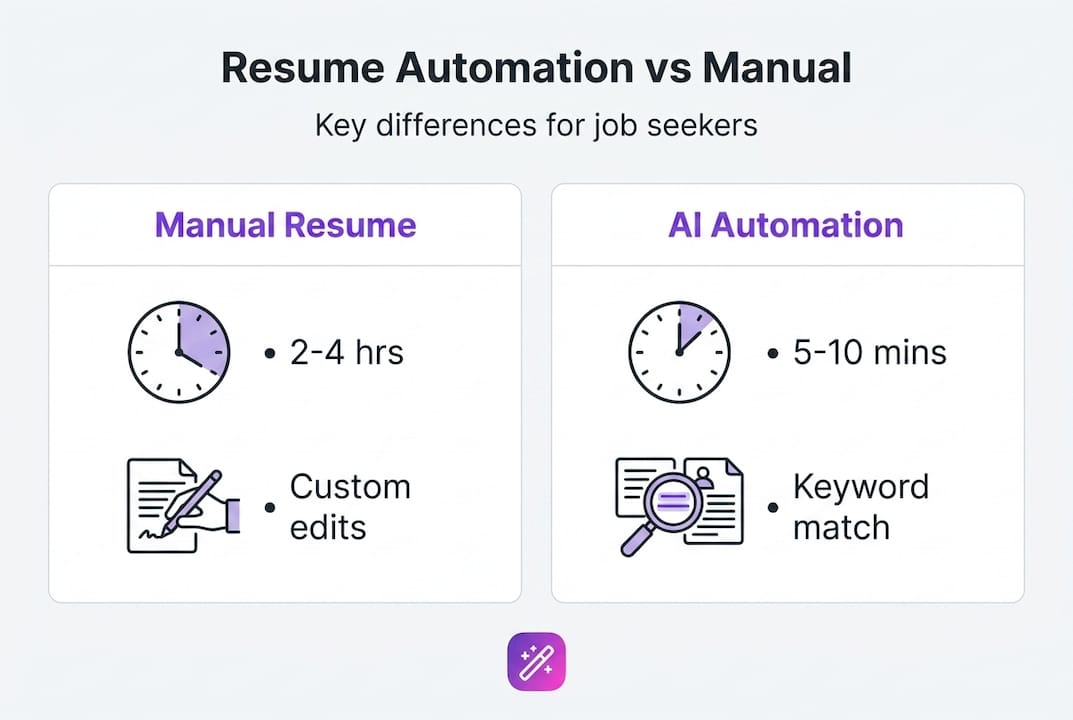
Here’s a side-by-side comparison that shows why it matters:
| Factor | Manual resume writing | Resume automation |
|---|---|---|
| Time to create | 2 to 4 hours per resume | 5 to 15 minutes per resume |
| ATS keyword matching | Inconsistent, often missed | Systematic and thorough |
| Tailoring per job | Rarely done fully | Automatic for every application |
| Formatting accuracy | Varies by user skill | Standardized and error-free |
| Consistency across versions | Hard to maintain | Maintained automatically |
The efficiency difference is staggering. But beyond speed, the real win is strategic accuracy. Recruiters and their software systems are looking for specific signals. Manual resume writing guesses at those signals. Automation reads the data and responds precisely.
Key features you’ll find in modern resume automation tools include:
- ATS keyword scanning that matches your resume language to job postings
- Auto-tailoring that adjusts your resume content for each unique role
- Formatting templates that are both visually clean and machine-readable
- Grammar and clarity optimization that tightens your language automatically
- Multiple version management so you can keep a library of tailored resumes
- Export options in PDF, Word, and other formats recruiters request
“The biggest resume mistake job seekers make isn’t lying about credentials. It’s writing a resume for a human when the first reader is always a machine.”
That’s the core insight. Once you understand that your resume needs to pass a digital filter before it ever reaches a person, automation stops being a shortcut and starts being the logical, strategic choice.
Core technologies behind resume automation
Now that you know what resume automation does, it’s worth understanding how it actually works under the hood. You don’t need a computer science degree for this. But knowing the basics will help you use these tools more effectively and set realistic expectations.
The most important technology is Natural Language Processing, or NLP. NLP allows AI systems to read and understand human language, not just search for exact keywords but understand meaning and context. So if a job posting says “data-driven decision making” and your resume says “analytics-based strategy,” a good NLP system recognizes those phrases mean roughly the same thing and can bridge the gap intelligently.
Beyond NLP, the best tools use several interconnected technologies: NLP for semantic matching, persistent memory for voice consistency, and company research integration. Advanced agents use APIs for workflow automation. This combination is what separates a basic keyword-stuffing tool from a sophisticated resume automation platform.
Here’s what each core technology does in plain terms:
| Technology | What it does for your resume |
|---|---|
| NLP (Natural Language Processing) | Matches your skills to job requirements by understanding meaning, not just exact words |
| Persistent memory | Remembers your previous work history, style, and preferences across multiple sessions |
| Semantic search | Finds related terms and industry synonyms to broaden keyword coverage |
| GPT or Claude language models | Generates natural, professional sentences from raw bullet points or job data |
| API integrations | Connects the resume tool to job boards, company databases, and HR systems |
Persistent memory is particularly underrated. Without it, you’d have to re-enter your entire work history every time you apply for a new job. With it, the system knows your voice, your career narrative, and your strongest accomplishments. It applies those consistently across every tailored version it creates.
Here’s how the process works step by step when you use a quality AI resume tool:
- You input your background. Work history, education, skills, and accomplishments go in once.
- You paste the job description. The AI reads and analyzes the posting.
- The system performs semantic matching. NLP compares your experience against the role’s requirements.
- Keywords are integrated naturally. Relevant terms from the job description appear in your resume where they fit.
- The resume is formatted. ATS-friendly structure is applied automatically.
- You review and personalize. You check the output, add your story, and tweak tone.
- You export and submit. The resume is ready in your preferred format.
Pro Tip: Before you paste in a job description, highlight the three to five most repeated phrases in the posting. These are almost always the keywords the ATS is most heavily weighted to detect. Confirm they appear in your final resume output.
Exploring the full range of AI resume tool features before you commit to a platform helps you find one that matches your career stage and application volume. Some tools are built for high-volume applications, others for highly specialized roles.
How resume automation impacts job hunting success
Here’s where things get concrete. Knowing that automation is smart and fast is one thing. Seeing what it actually does for your application results is another.
The numbers are hard to ignore. AI tools reduce resume creation time by 60 to 85%, increase ATS pass rates by 40 to 45%, and users report 67% more interview callbacks. Think about that last figure. Nearly two thirds more interviews simply by using AI to tailor and optimize the resume. For most job seekers, getting more interviews is the single biggest bottleneck in their search.

That 40 to 45% improvement in ATS pass rates matters enormously. If you’re currently applying to 20 jobs and hearing back from 2, improving your ATS pass rate by 45% means you could be hearing back from nearly 3. Over time, across hundreds of applications, that difference is the gap between a three-month job search and a six-month one.
The impact looks different depending on where you are in your career:
Entry-level job seekers often lack the vocabulary to describe their skills in industry-standard language. Automation bridges that gap instantly. It takes your part-time jobs, internships, and coursework and surfaces the language employers are actively searching for. A recent graduate might not know to say “stakeholder communication” instead of “teamwork,” but an AI tool does.
Mid-career professionals benefit most from the tailoring function. At this level, you have plenty of experience, but applying the right slice of it to each new role is where most people struggle. Automation reads the role and surfaces your most relevant accomplishments automatically.
Senior professionals use automation primarily for efficiency and ATS compliance. At the executive level, a poorly formatted resume that a machine can’t read is a real risk. Automation ensures the structure is clean while leaving room for the leader to add their strategic narrative.
The benefits of resume automation aren’t limited to getting through filters faster. The long-term picture includes:
- Consistent branding across every version of your resume
- Reduced anxiety about whether you’ve covered the right keywords
- More applications completed in less time, increasing your overall odds
- Better preparation for interviews, since a well-tailored resume mirrors the language you’ll hear in the room
- A library of versions you can reuse, refine, and update quickly
One outcome that’s easy to overlook: when your resume closely mirrors the language of the job description, you walk into the interview better prepared. The interviewer’s questions will naturally follow the themes in the job posting, and you’ve already shown fluency in those exact areas. The resume automation benefits extend well beyond the application stage.
When to use automation, and when to review manually
Automation is powerful. But it’s not a replacement for judgment. The smartest job seekers use a hybrid approach, letting AI handle the structure, keywords, and ATS compliance, then applying their own voice, story, and accuracy check before submitting.
Research consistently shows that a hybrid approach works best: AI for speed and ATS alignment, human editing for voice and storytelling. Entry-level applicants can often rely on AI output almost entirely, but mid-career and senior professionals tend to get better results by treating the AI draft as a first pass rather than a final product.
Why the difference? Senior roles are evaluated holistically. A recruiter at a senior level isn’t just scanning for keywords; they’re reading for leadership presence, strategic thinking, and narrative coherence. Automation gets your resume into the room. Your authentic story is what closes the deal.
Here’s how to use hybrid resume writing effectively:
- Use AI to draft. Let the tool generate the first version based on your background and the job description.
- Read it aloud. If a sentence doesn’t sound like you, rewrite it. Authenticity is detectable, even in text.
- Check every claim. AI tools can occasionally over-inflate achievements. Verify every number and title is accurate.
- Add one or two personal details. A sentence about a project you’re proud of, or a specific result from a unique situation, signals humanity.
- Have someone else read it. Fresh eyes catch awkward phrasing the AI missed and that you’ve become blind to.
Common pitfalls to watch for and avoid:
- Over-optimization: Stuffing too many keywords makes the resume read unnaturally, which hurts you when a human finally sees it
- Generic summaries: AI-generated summary statements often sound like every other resume. Rewrite yours in your own voice
- Inaccurate metrics: If the AI suggests you “increased revenue by 30%,” make sure that number is real and defensible
- Ignoring formatting on export: Always open the exported file to confirm the formatting survived the conversion
- Applying without a final read: Even a two-minute review catches errors that cost you opportunities
Pro Tip: Keep a simple spreadsheet tracking every application you submit. Note which resume version you used, the job title, and whether you got a response. After 20 to 30 applications, patterns will emerge showing which tailoring decisions are working and which aren’t.
Expert perspective: Resume automation only works with your authentic story
Here’s the uncomfortable truth most resume advice won’t tell you: automation makes everyone look the same. Every keyword covered, every section in the right place, every bullet point starting with an action verb. The machine scores it perfectly. And then it sits in a pile with 200 other perfectly scored resumes.
The job seekers who win interviews aren’t the ones with the most optimized resumes. They’re the ones with optimized resumes that also tell a recognizable human story. Automation earns you the right to be read. Your story is what earns you the call.
We’ve seen this play out in hiring decisions repeatedly. A resume that passes every ATS check but reads like a job description gets passed over. A resume that passes ATS and also includes one specific, memorable result (“rebuilt the onboarding process that cut new hire ramp time from 90 days to 45”) gets a second look every time.
The contrarian lesson here is that speed and automation are necessary but not sufficient. The fastest resumes get seen. Only the authentic ones get callbacks. That’s why AI-human collaboration is the real strategy, not AI as a replacement for thinking about your own career story. Use the technology to remove every obstacle between you and the recruiter’s attention. Then use your own voice to make that attention count.
Ready to launch your job search with resume automation?
If you’ve made it this far, you now know more about resume automation than most job seekers ever will. The next step is putting that knowledge to work.
Easy CV gives you everything covered in this article in one place. Tailored resumes generated in minutes, ATS keyword optimization built in, and tools designed for every career stage from first job to executive. You can start for free and only upgrade when you’re ready for advanced features. Take a look at Easy CV Features to see exactly what’s included, and check Easy CV Pricing to find the plan that fits your search. Your next interview is closer than you think.
Frequently asked questions
What exactly does resume automation do?
Resume automation uses AI to generate and tailor your resume for specific job descriptions, ensuring it passes ATS filters and stays relevant for every application, so your qualifications actually reach a human reader.
Can resume automation really increase my chances of interviews?
Yes. Studies show that tailored, AI-generated resumes lead to 67% more interview callbacks by dramatically improving the rate at which applications pass through automated screening systems.
Is resume automation better for entry-level or experienced professionals?
Entry-level seekers benefit from pure automation, while mid and senior professionals typically get the best results by combining AI output with a personal review that adds strategic narrative and authentic voice.
How much time can resume automation save me?
AI-powered resume tools cut creation time by 60 to 85% compared to writing from scratch, meaning you can submit more applications in less time without sacrificing quality.
Do AI-generated resumes look generic?
Not when you review them. Automation handles structure and keywords reliably, but reviewing for personal voice and adding specific, memorable accomplishments is what transforms a competent draft into a resume that actually stands out.