Best job application tips: Stand out and land interviews

The average job posting attracts 250 applicants, yet only 2 to 3% of those candidates land an interview. That means recruiters are scanning hundreds of resumes in seconds, and most applicants never hear back. If you’ve been sending out applications and getting silence in return, the problem usually isn’t your qualifications. It’s your strategy. This article walks you through proven, evidence-backed techniques to sharpen every part of your job application, from targeting the right roles and building smarter resumes to writing cover letters that actually get read.
Table of Contents
- Assess before you apply: Quality beats quantity
- Build a master resume and use templates
- Tailor every resume for ATS and recruiters
- Strategic cover letters: When and how to write them
- Special strategy: Career changers and transferable skills
- Why most job application advice misses the point
- Streamline your applications with Easy CV
- Frequently asked questions
Key Takeaways
| Point | Details |
|---|---|
| Target the right roles | Focusing on jobs that genuinely match your skills leads to more interviews than applying everywhere. |
| Master resume system | A master resume and templates let you quickly customize each application and beat automation filters. |
| Tailor with keywords | Incorporating exact language from the job description is essential for passing ATS and recruiter scans. |
| Show results, not buzzwords | Good resumes highlight quantifiable results and transferable skills, especially for career changers. |
| Customize cover letters | Well-targeted cover letters boost your odds for competitive or senior-level roles. |
Assess before you apply: Quality beats quantity
Once you understand just how competitive the market is, the instinct is to apply everywhere and hope something sticks. That instinct will work against you. Mass applying is one of the most common and costly mistakes job seekers make, and the data backs this up.
Applying to fewer, well-matched jobs consistently outperforms sending out generic applications at high volume. When you apply to a role that genuinely fits your skills and experience, you write a stronger, more specific application. Recruiters feel that specificity immediately. Contrast that with a generic resume blasted out to 50 companies: high-volume generic applications fail 98% of the time, wasting your effort and often damaging your confidence in the process.
So how do you decide which openings are worth your time? Before submitting anything, ask yourself:
- Do you meet at least 70 to 80% of the listed requirements?
- Does the role match your career direction, not just your past titles?
- Is the company’s culture, size, or industry a reasonable fit for you?
- Can you point to specific past results that directly address the role’s core responsibilities?
- Have you researched the company enough to write a tailored application?
If you can answer yes to most of these, it’s a strong candidate for your effort. If you’re stretching or guessing on most of them, move on.
When to skip an opening: If the required qualifications are significantly beyond your current level, if the role is in a field you’re not genuinely interested in, or if you can’t identify a single concrete example from your experience that maps to the job, that’s a signal to pass.
Pro Tip: Keep a simple spreadsheet tracking every role you apply to, the date, the job URL, the version of your resume you submitted, and any follow-up steps. This prevents duplicate applications, keeps you organized during follow-ups, and reveals patterns in where you’re getting traction.
Being selective sounds counterintuitive when you’re eager to find work, but it pays off. The time you save by skipping poor-fit roles goes directly into crafting better applications for the ones that count.
Build a master resume and use templates
After targeting the right roles, your application process gets easier with the right tools. One of the smartest systems any job seeker can build is a master resume combined with role-specific templates.

A master resume is not the document you send to employers. Think of it as a private inventory, a comprehensive record of every job you’ve held, every achievement, every skill, every certification, every project, and every metric you can recall. Nothing gets cut. It can be four pages long. Its entire purpose is to give you a deep pool of material to draw from when customizing each application.
Building a master resume with all your achievements, then creating two to three templates organized by role type, is a strategy used by career coaches and hiring consultants at top institutions. From that master, you build lean, targeted templates: one for project management roles, one for marketing positions, one for leadership or senior roles. Each template already has the right structure and emphasis for that category.
Here’s how to build this system:
- Create your master resume first. Write down every position, every responsibility, and every accomplishment you can think of. Include numbers wherever possible: revenue generated, costs reduced, projects delivered, teams led.
- Identify two or three role categories you’re targeting. Look at the types of jobs you’re applying for and group them by function or level.
- Build a template for each category. Pull only the most relevant experience and skills from your master resume to fill each template. Keep each template to one or two pages.
- For each new application, start from the relevant template. You only need to make targeted edits, swapping in keywords from the specific job description and adjusting the summary.
- Save each customized version with a clear filename. Include the company name and role so you can reference it during follow-ups or interviews.
This system, supported by template tools that streamline formatting, can save you 10 to 15 minutes per application. Multiply that across 20 applications, and you’ve freed up hours for research, networking, or interview prep.
Pro Tip: Never submit your master resume. It’s an internal working document. Always send a targeted, trimmed version matched to the specific role.
Tailor every resume for ATS and recruiters
Templates get you started, but tailoring your resume for each application is non-negotiable. Most large employers and many mid-size companies now use Applicant Tracking Systems (ATS), which are software programs that scan resumes for keywords before a human ever reads them. If your resume doesn’t match the language in the job description, it may never reach a recruiter’s desk.
Recruiters scan resumes in an average of 7.4 seconds. That’s not enough time to read, only enough to recognize signals. Keywords are those signals. Optimizing for ATS means reading the job posting carefully and identifying the exact phrases used for required skills, tools, and responsibilities, then mirroring that language in your resume.
Here’s where to place keywords for maximum effect:
- Professional summary: Open with a two to three sentence summary that uses the job title and one or two core skills directly from the posting.
- Skills section: List hard skills and tools using the exact terminology from the description. If they say “Google Analytics,” don’t write “web analytics tools.”
- Experience bullets: Weave keywords naturally into your accomplishment statements. Frame them around results, not tasks.
| Vague skill | Keyword-rich version |
|---|---|
| “Good communicator” | “Cross-functional stakeholder communication” |
| “Team player” | “Collaborated with 6-person agile development team” |
| “Managed social media” | “Led LinkedIn and Instagram strategy, growing followers 34%” |
| “Handled budgets” | “Managed $1.2M annual marketing budget” |
“The key is incorporating keywords contextually, so they appear naturally within strong accomplishment statements rather than as a disconnected list at the bottom of the page.” This is what separates candidates who pass ATS filters from those who get buried.
What NOT to do when tailoring:
- Don’t stuff keywords without context. ATS systems now use natural language processing (NLP) and can flag keyword stuffing as suspicious.
- Don’t use irrelevant terms just because they appeared in the posting.
- Don’t change your formatting drastically for every application. Stick to your template structure; only the content should shift.
Understanding how recruiters screen applications gives you a real advantage. They’re looking for immediate evidence that you’ve done the job before and can do it again, in their specific context. Give them that evidence in the first half of the page.
Strategic cover letters: When and how to write them
Beyond resumes, cover letters give you the chance to show fit and initiative, if used wisely. Not every application needs one, but knowing when to write a strong cover letter and how to do it can make a real difference.
A cover letter is most important in these situations:
- The job posting specifically requests one
- You’re applying for a senior or leadership role
- You’re making a career change and need to explain your transition
- You have a gap in employment or an unusual background
- The role is highly competitive or at a company you deeply want to work for
When you do write one, make it count. Cover letter phrases that ruin applications are more common than you’d think. Weak openers like “I am writing to express my interest in…” or vague claims like “I’m a passionate team player” do nothing. Recruiters have read those lines thousands of times.
Instead, open with a specific result. For example: “In my last role, I reduced customer churn by 18% in six months by redesigning the onboarding process. That’s exactly the kind of problem I’d love to solve at [Company Name].” That opening is specific, confident, and immediately relevant.
“Quantifiable accomplishments in a cover letter do more work than any adjective. Numbers give recruiters something concrete to remember and something to verify in an interview.”
More things to avoid in cover letters:
- Restating your entire resume in paragraph form
- Explaining what the company can do for you rather than what you bring to them
- Using generic praise like “I’ve always admired your company” without specifics
- Writing more than one page
- Sending the same letter to multiple companies without customizing the details
A well-crafted, one-page cover letter tailored to the role and company signals effort, communication skills, and genuine interest. For competitive roles, that signal matters.
Special strategy: Career changers and transferable skills
If you’re shifting fields, some application techniques become even more important. Career changers face a specific challenge: their resume often doesn’t look like a typical candidate’s background for the new role. The key is framing, not fabrication.
Career changers should emphasize transferable skills, be transparent about their transition in both the resume summary and cover letter, and keep the resume to one page if they have under 10 years of total experience. This approach, backed by career experts at Harvard Business School, helps hiring managers see your value clearly rather than getting distracted by unfamiliar job titles.
Key transferable skills to highlight, depending on the role you’re targeting:
- Project management: Planning, coordinating teams, managing timelines and budgets
- Communication: Presenting to leadership, writing reports, client-facing work
- Data analysis: Working with spreadsheets, interpreting metrics, driving decisions with data
- Leadership and mentorship: Training team members, leading meetings, resolving conflicts
- Customer focus: Understanding user needs, improving satisfaction, retention work
Here’s how framing makes a difference:
| Generic career-changer summary | Targeted career-changer summary |
|---|---|
| “Former teacher looking for a corporate role in training and development.” | “Instructional design professional with 8 years of curriculum development experience, now transitioning into corporate L&D to bring evidence-based learning strategy to fast-growth teams.” |
| “Retail manager seeking office job.” | “Operations leader with expertise in team scheduling, inventory management, and customer experience, bringing structured process thinking to an operations coordinator role.” |
The targeted version tells a story. It connects the past to the future in a way that makes sense for the hiring manager reading it.
Don’t hide your transition. Address it directly in your summary with a single, confident sentence. Something like: “After seven years in hospitality management, I’m bringing my operational expertise and people leadership skills into the healthcare administration field.” Honesty with framing always works better than leaving the reader confused.
Why most job application advice misses the point
Here’s a take you won’t read in most career guides: the job application problem isn’t tactical. It’s psychological. Most candidates are playing a numbers game because volume feels productive, and productivity feels like progress. It isn’t.
The conventional wisdom that years of experience signal readiness is also weaker than most people believe. Years of experience rank low as a predictor of job performance, while structured skills assessments and job knowledge tests show validity scores of 0.4 to 0.42 on a scale where 0 means no prediction and 1 is perfect. Recruiters and hiring managers who understand this are already moving toward skills-based hiring. Candidates who lead with demonstrated results instead of tenure are better positioned.
What actually separates candidates who get interviews from the rest is not a clever trick or a perfectly formatted resume header. It’s a shift in how they think about applications. Every application is a custom argument that you are the right person for this specific problem. The moment you treat it as a form to fill out, you’ve already lost the attention of the person reading it.
Volume-applying doesn’t just produce poor results. It burns candidates out, erodes their confidence, and leads to a cycle of vague applications and vague rejections. Relentless, thoughtful customization, even if you apply to fewer roles, is what gets results.
Streamline your applications with Easy CV
If these strategies sound like a lot to manage manually, the right tool makes all the difference.
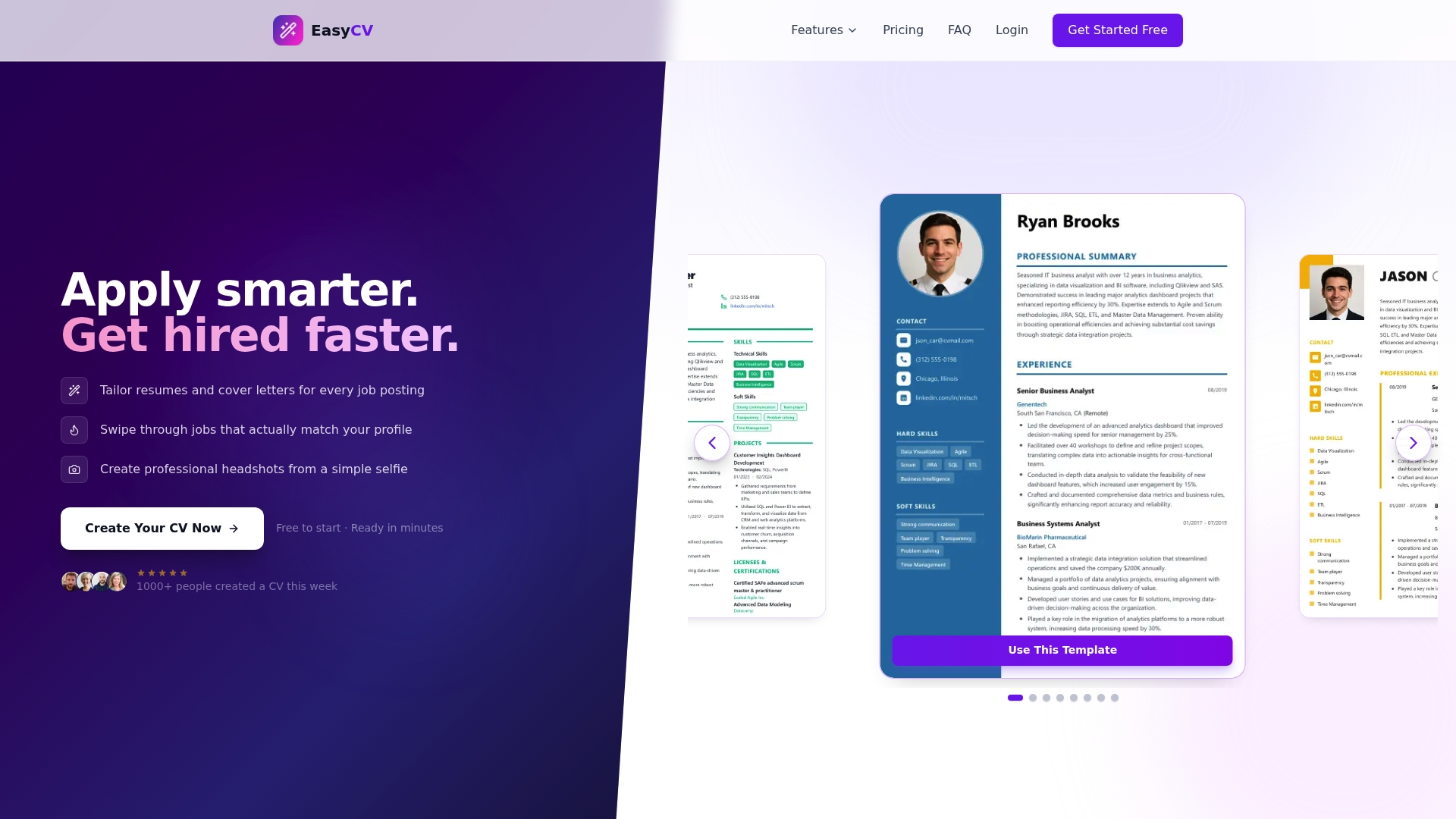
Easy CV is built specifically to help job seekers put every one of these tips into practice without the friction. From AI-powered keyword optimization that tailors your resume to each job description, to built-in cover letter generation and application tracking, the platform handles the heavy lifting so you can focus on the roles that matter. You can create multiple resume versions from a master template, access formatting that passes ATS filters, and even generate a professional headshot from a selfie. Whether you’re a first-time applicant or a seasoned professional making a career pivot, you can explore features designed for every stage of the job search, with options to see pricing that fit your needs.
Frequently asked questions
How many jobs should I apply to at once?
Focus on a small group of well-matched roles rather than applying broadly. Fewer, targeted applications consistently produce better results because each one is stronger and more specific.
How long should my resume be if I’m switching careers?
If you have fewer than 10 years of experience, keep your resume to one page and focus on transferable skills and achievements relevant to the new field.
Does tailoring my resume really make a difference?
Absolutely. Incorporating job description keywords into your resume’s summary, skills, and experience sections significantly improves your chances of passing ATS filters and catching a recruiter’s eye.
Should I always include a cover letter?
Not always, but for competitive or senior roles, a tailored cover letter with specific accomplishments adds real value and shows genuine interest.
What makes a resume stand out from other applicants?
Quantifiable achievements, naturally integrated keywords from the job description, and results-focused experience bullets are the clearest differentiators between a resume that gets noticed and one that doesn’t.