Cover letter templates: Save time and land more interviews
Writing a cover letter from scratch is one of the most dreaded parts of job hunting. You stare at a blank page, unsure where to start, and end up either writing too little or producing a wall of text that no one reads. The reality is that most cover letters get ignored because they lack structure, sound too generic, or miss key elements recruiters actually look for. Cover letter templates change that equation. They give you a proven framework so you can focus on what matters most: showing why you are the right fit for the role.
Table of Contents
- What are cover letter templates and why do they matter?
- Core benefits of using cover letter templates
- Potential drawbacks: Avoiding generic and AI-detected cover letters
- How to choose and customize the right template for your job search
- Success stories: How templates transformed real job searches
- Why the best cover letters mix structure and personality
- Ready to upgrade your applications? Try our cover letter templates
- Frequently asked questions
Key Takeaways
| Point | Details |
|---|---|
| Templates save time | Cover letter templates give structure, helping you write faster and more effectively. |
| Customization is key | Personalizing each template boosts interview chances and prevents generic, AI-flagged content. |
| ATS and recruiter friendly | Properly designed templates help your letter pass through applicant tracking systems and impress hiring managers. |
| Blending structure with your voice works best | Use templates as a base, but add your own stories and enthusiasm for the best results. |
What are cover letter templates and why do they matter?
A cover letter template is a pre-built document structure that outlines where each section of your letter should go. Think of it like a floor plan for a house. The template defines the rooms (your opening, body paragraphs, and closing), and you fill in the details with your own story.
For beginners, this structure is invaluable. If you’ve never written a professional cover letter before, knowing what to include and in what order is half the battle. Templates eliminate guesswork and help you produce a letter that reads like a professional wrote it, even on your very first try. To get started, understanding cover letter basics before diving into templates will help you use them more effectively.
One of the most underappreciated benefits of templates is their impact on Applicant Tracking System (ATS) compatibility. ATS software is a tool that companies use to automatically scan and filter job applications before a human ever sees them. If your cover letter doesn’t follow a clean, readable format, the ATS may flag it or skip it entirely. ATS-compatible templates provide structured formats that ensure consistent layouts and scannable content, helping recruiters evaluate candidates faster.
Here’s what a solid template typically includes:
- A strong, personalized opening line that hooks the reader immediately
- A paragraph connecting your skills to the role with specific examples
- An achievement-driven section that shows measurable impact
- A confident closing paragraph with a clear call to action
- Professional formatting that matches industry standards
“Cover letter templates provide structured formats that ensure ATS compatibility, consistent layouts, and scannable content, helping recruiters evaluate candidates faster.” — Recruitment.com
That structure isn’t just about looking organized. It’s about making sure your letter passes through both automated filters and human reviewers without losing its punch.
Core benefits of using cover letter templates
Understanding what templates offer, let’s explore the tangible benefits you get by incorporating them into your job search.
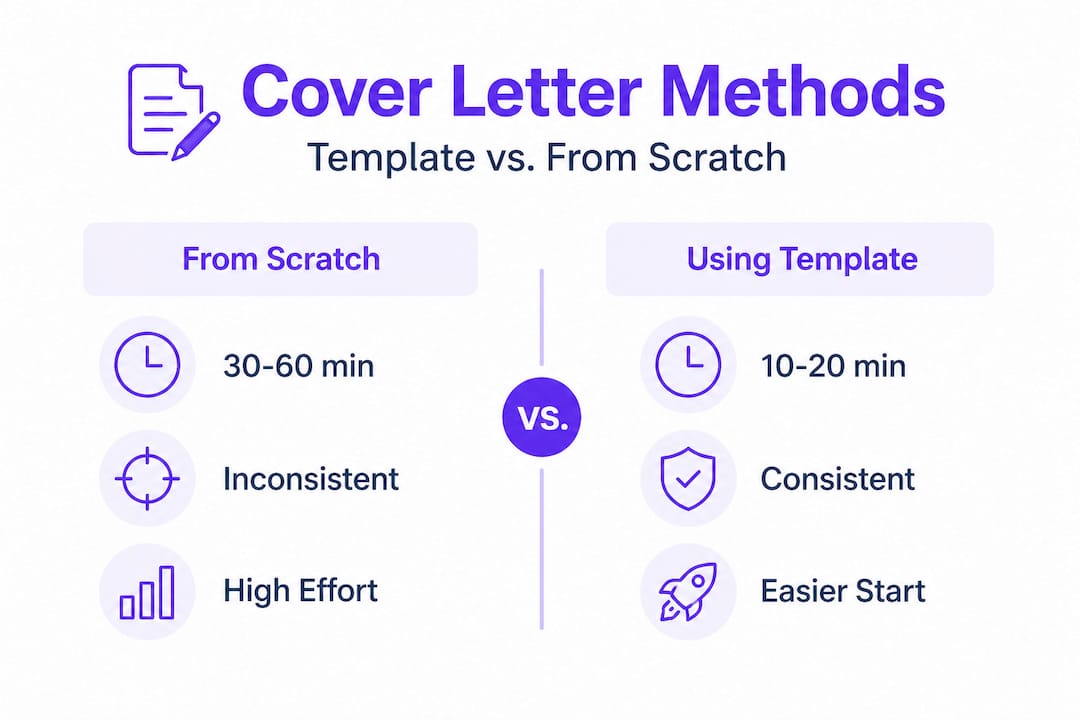
The most immediate benefit is time savings. Crafting a cover letter from scratch for every job application can take 30 minutes to an hour per letter. Multiply that by 20 or 30 applications, and you’re looking at days of your life spent on formatting instead of content. Templates slash that time dramatically. You pick a structure, plug in your details, and focus your energy on tailoring the message rather than building a document from zero.
The second major benefit is quality consistency. When you write from scratch every time, the quality of your letters varies wildly depending on your energy level, confidence, and how much you actually want the job. Templates create a baseline. Even on your worst writing day, a template keeps your letter from falling below a professional standard.

Here’s a quick breakdown of what templates provide compared to writing from scratch:
| Factor | Writing from scratch | Using a template |
|---|---|---|
| Time per letter | 30 to 60 minutes | 10 to 20 minutes |
| ATS compatibility | Often inconsistent | Usually built in |
| Key sections included | Easy to forget one | Structured to include all |
| Quality on a bad day | Low | Consistent baseline |
| Personalization | Full control | Requires deliberate editing |
Third, templates specifically help people who aren’t strong writers. Not everyone has a background in writing persuasive content, and that’s okay. Templates guide users to include key elements like strong openings, achievement-driven paragraphs, and calls to action, improving overall quality especially for those with limited writing experience.
Here’s a simple process to get the most value from any template:
- Choose a template that fits your industry (creative fields often use less formal layouts; corporate roles prefer clean, minimal designs)
- Read the job description carefully before editing anything
- Replace placeholder text with real achievements and specific skills
- Rewrite the opening line so it reflects your genuine enthusiasm for this particular role
- Add one company-specific detail such as a recent project, value, or product they launched
Pro Tip: After filling in a template, read your letter out loud. If it sounds stiff or robotic, that’s a sign it still sounds too templated. Adjust the phrasing until it sounds like you having a real conversation.
The data backs this up. 83% of hiring managers still read cover letters to assess a candidate’s motivation and communication skills. That means a well-edited template that reflects your personality has real power. The combination of template structure and human editing is what produces the letters that actually get callbacks. You can also explore how cover letter optimization ties directly into landing more interviews.
Potential drawbacks: Avoiding generic and AI-detected cover letters
While templates have clear benefits, it’s crucial to recognize where they can go wrong. Here’s what to avoid.
The biggest risk is what hiring professionals call “over-templating.” This happens when a job seeker takes a template, swaps out the company name, and sends it off without any real customization. The letter ends up reading like every other application in the pile. It has zero personality, no specific connection to the role, and does nothing to differentiate the sender.
The numbers are striking. Unedited, over-templated letters produce an interview rate of around 8%, compared to 13 to 14% for customized letters. That gap might not sound huge, but it represents a nearly doubled chance of getting called back simply by spending an extra 15 minutes personalizing your letter.
There’s also the growing issue of AI-detected content. As AI writing tools became mainstream, recruiters adapted quickly. Many now use their own detection tools, and others simply recognize AI-generated phrasing on sight. Approximately 68% of submitted cover letters are now either generic or clearly AI-generated, which means a personalized, human-edited letter immediately stands out from the majority of applications.
Here’s a direct comparison of what customized versus generic template letters look like in practice:
| Element | Generic template | Customized version |
|---|---|---|
| Opening line | “I am writing to apply for the Marketing Manager position…” | “After three years growing organic traffic by 120%, I’d love to bring that momentum to [Company Name]…” |
| Body paragraph | “I have strong communication and leadership skills…” | “In my last role, I led a team of five to launch a product that hit $500K in sales within 90 days…” |
| Company mention | “Your company is a leader in the industry…” | “I’ve followed your work on the new sustainability initiative and would love to contribute…” |
| Closing | “I look forward to hearing from you…” | “I’d welcome the chance to show you what this team can accomplish together…” |
“Templates democratize access to professional structures, benefiting beginners by focusing on content personalization over design, but must be heavily customized to avoid generic AI-detected output that recruiters spot.” — Recruitment.com
The fix is straightforward but requires discipline. Treat every template as a rough draft, not a finished product. For practical advice on balancing AI assistance with authentic personalization, AI and personalization tips offer actionable guidance for modern job seekers.
How to choose and customize the right template for your job search
With the risks in mind, here’s how to pick a template and, more importantly, how to make it truly yours for every application.
Choosing the right template starts with knowing your audience. A template designed for a corporate finance role will look very different from one built for a creative director position. The former should be clean, minimal, and formal. The latter can afford a bit more personality in its formatting and tone. Match the template’s energy to the culture of the company you’re applying to.
Once you’ve chosen a template, follow these steps to fully customize it:
- Swap out the opening sentence entirely. Write something original that reflects your specific motivation for this role.
- Replace every generic phrase like “team player” or “results-driven” with concrete examples of what you actually did.
- Pull three to five keywords from the job description and weave them naturally into your letter. This helps with ATS and shows you read the posting.
- Add one specific company reference that shows you researched them. Mention a product, recent news, or a value from their website.
- Quantify your achievements wherever possible. Numbers tell a story that adjectives never can.
- Rewrite the closing to be specific about the next step you’d like to take.
Templates guide users to include key elements like strong openings, achievement-driven paragraphs, and calls to action, but the customization you layer on top is what transforms a template from ordinary to compelling.
Pro Tip: Keep a “personal brag file” of your top five career achievements with real numbers. Every time you use a new template, pull from this file to instantly add specific, credible content without having to recall details under pressure.
For a deeper look at formats that match different career situations, exploring the types of cover letters available will help you pick the right structure from the start.
Success stories: How templates transformed real job searches
Seeing these strategies in action brings the process to life. Here’s how real job seekers made templates work for them.
Templates aren’t just a shortcut for lazy applicants. They’re a strategic tool that levels the playing field, especially for people who are new to the job market or switching industries. Consider these scenarios that reflect what happens when templates are used intelligently:
- The recent graduate: A 22-year-old with no full-time work experience used a template designed for entry-level candidates. By customizing the achievements section with internship wins and class projects, she landed three interviews in two weeks. Without the template’s structure, she had been submitting rambling letters that buried her strongest points.
- The career changer: A former teacher moving into corporate training struggled to explain the connection between his background and his target roles. A template gave him a clear framework to translate his classroom accomplishments into business language. By quantifying outcomes like “improved student performance by 40%,” he reframed his teaching experience as proof of coaching and facilitation skills.
- The time-strapped professional: A senior marketer applying to 15 roles in one month used a base template and a personal brag file to cut her per-letter time from 45 minutes to 12. She still customized every letter, but the template handled the structural thinking so she could focus entirely on content.
Templates democratize access to professional structures, benefiting beginners by focusing on content personalization over design. And in an increasingly noisy hiring environment, the combination of templates plus human edits creates authentic letters that stand out, which matters when most applications are generic.
The pattern across all three cases is the same: the template provided the skeleton, but the personal details brought it to life. For more practical guidance on standing out, job application tips offer a broader playbook for the full application process.
Why the best cover letters mix structure and personality
Here’s an uncomfortable truth that most job search advice skips over: a template used without editing isn’t just ineffective. It’s actually worse than not sending a cover letter at all.
The data makes this clear. Over-templated letters produce interview rates around 8%, lower than the baseline for many applicants who either send a well-crafted note or skip the letter entirely. Generic content signals something specific to a recruiter: this person didn’t care enough to customize. That impression, once made, is very hard to undo.
What actually works is treating the template as scaffolding, not the building itself. The structure tells you where to put things. Your story tells you what to put there. These two elements are not in competition. They work together.
We’ve seen this balance play out consistently in the best applications we review: strong format, specific achievements, and a voice that sounds like a real person who genuinely wants this job. AI tools can help with structure and phrasing, but the human insight you bring about your own career, your motivations, your actual results, that’s what no automation can replicate. For a practical look at how cover letter results improve with the right approach, the evidence strongly favors customized letters every time.
The challenge we’d put to you is this: don’t just fill in a template and hit send. Read your finished letter and ask yourself, “Could this have been written by anyone else applying for this job?” If the answer is yes, keep editing until it couldn’t.
Ready to upgrade your applications? Try our cover letter templates
If you’re ready to put this advice into practice, here’s a smart next step.
At EasyCV.ai, we built our cover letter tools specifically for job seekers who want professional results without spending hours on formatting. Our Easy CV templates are designed to be ATS-friendly, industry-specific, and easy to customize in minutes. Whether you’re applying for your first job or pivoting into a new career, you can test different formats, adapt them to match company cultures, and export polished letters instantly. Explore all the more features available on the platform, including AI-powered content suggestions that help you say the right thing in the right way, every time.
Frequently asked questions
Are cover letter templates ATS-friendly?
Yes, the best templates use formats readable by applicant tracking systems, helping your application get seen. Structured template formats ensure consistent layouts and scannable content that ATS software can process without errors.
Can I use the same template for every application?
You should customize each template to reflect the specific job and company, since generic letters perform worse than tailored ones. Over-templated letters produce interview rates around 8% compared to 13 to 14% for customized versions.
How do I personalize a template without losing structure?
Edit specific details like achievements, the company’s name, and your opening paragraph while keeping the proven format and section order intact. Key elements like strong openings and calls to action should stay in place while your unique details replace the generic placeholders.
Do hiring managers still read cover letters?
Yes, 83% of managers review cover letters to gauge a candidate’s motivation and communication skills, making them a meaningful part of most applications.