What Is Resume Tracking? A Job Seeker's 2026 Guide

Resume tracking is the use of Applicant Tracking Systems (ATS) to collect, parse, and screen resumes automatically during the hiring process. ATS software like Workday automates recruiting workflows by storing applications in a searchable database, extracting candidate information, and moving applicants through each stage of the hiring pipeline. For job seekers, understanding what is resume tracking means understanding the gatekeeping technology that decides whether a human recruiter ever sees your application. Get this wrong, and a perfectly qualified candidate disappears before any person reads a single line.

What is resume tracking and how does ATS work?
ATS is the backbone of modern recruitment, replacing fragmented spreadsheets and email inboxes with a centralized hiring hub that manages every stage from job posting to offer letter. The system collects resumes submitted through job boards, career pages, and portals, then converts each one into a structured candidate profile stored in a searchable database. Recruiters query that database rather than reading raw files, which means your resume must survive the conversion process intact.
Here is how the ATS workflow operates step by step:
- Collection. Every application submitted through a job board or company career page feeds directly into the ATS database. The system timestamps the entry and assigns it a unique candidate record.
- Parsing. The ATS reads your resume and extracts fields like job titles, employers, dates, education, and skills. It uses natural language processing to interpret meaning, so phrases like “managed team of five” and “led five-person team” are treated as equivalent.
- Screening. The system scores or filters candidates against the job’s required criteria. Keywords, years of experience, certifications, and education level all factor into whether your profile surfaces in a recruiter’s filtered search results.
- Ranking. AI algorithms analyze the structured profiles and rank candidates by fit. AI-based screening goes beyond simple keyword counting to evaluate contextual relevance and overall candidate quality.
- Pipeline tracking. Once a candidate advances, the ATS logs every interaction: interview scheduling, feedback notes, offer status, and final disposition. This is what resume application tracking looks like from the employer’s side.
Pro Tip: Test your resume by pasting it into a plain text editor. If the structure collapses or fields become unreadable, an ATS parser will likely struggle with it too. Fix the formatting before you apply.
ATS tracking vs. resume view tracking: what is the difference?
These two concepts share a name but serve completely different purposes, and confusing them costs job seekers real insight into their applications.
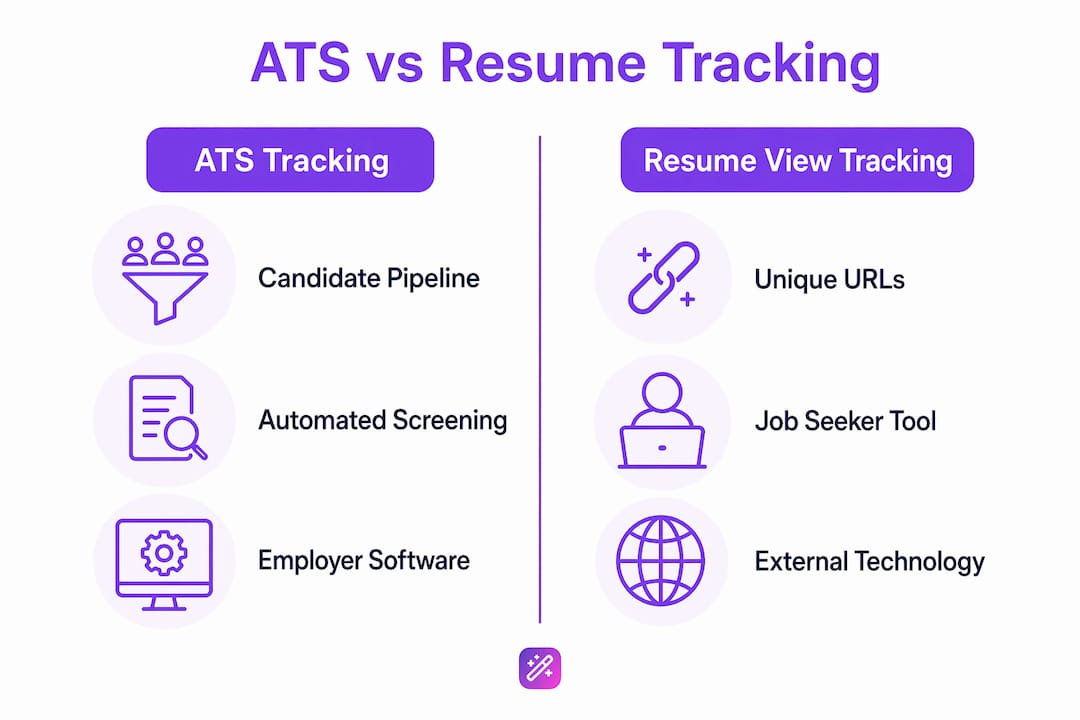
ATS tracking happens inside the employer’s software. It records where a candidate sits in the hiring pipeline, what screening score they received, and whether a recruiter has reviewed their profile. You have no direct visibility into this data. The employer owns it entirely.
Resume view tracking is a separate technology used by job seekers. External tools generate unique URLs that you attach to your resume or portfolio. When a recruiter clicks that link, you receive a notification. Tools like ResuTrack operate on this model, giving candidates data on when and how often companies access their documents.
| Feature | ATS tracking | Resume view tracking |
|---|---|---|
| Who controls it | Employer | Job seeker |
| What it measures | Candidate pipeline stage and screening score | Link clicks and document access timestamps |
| Visibility for job seeker | None | Real-time notifications |
| Key limitation | Opaque to applicants | Downloads bypass link clicks, so views can go unregistered |
| Best use | Employer workflow management | Prioritizing follow-up outreach |
The practical takeaway for job seekers:
- Use ATS optimization strategies to survive the employer-side screening process.
- Use view tracking tools to gauge recruiter interest after you apply and decide when to follow up.
- Treat early views within 24 to 72 hours as a signal of active interest, and multiple views as a stronger indicator worth acting on.
- Recognize that neither tool gives you a complete picture. Combining both with direct networking produces the most reliable signal.
How to optimize your resume for ATS success
The most common reason a qualified candidate fails ATS screening is not a lack of experience. It is a parsing failure caused by nonstandard formatting. Tables, text boxes, images, headers and footers, and decorative columns all break the extraction process. The ATS either misreads the data or drops it entirely, leaving your profile incomplete in the recruiter’s database.
Follow these practices to give your resume the best chance of parsing correctly and ranking well:
- Use a single-column layout. Multi-column designs look polished to the human eye but confuse most parsers. A clean, linear format reads reliably across every major ATS platform.
- Match keywords to the job description. Read the posting carefully and mirror the exact language used for required skills and qualifications. If the posting says “project management,” do not substitute “program oversight.” Different ATS interpret resumes differently, and keyword matching remains a primary filter.
- Spell out abbreviations alongside acronyms. Write “Search Engine Optimization (SEO)” rather than just “SEO.” Some systems recognize the acronym; others do not. Including both covers every scenario.
- Use standard section headings. Labels like “Work Experience,” “Education,” and “Skills” are universally recognized. Creative alternatives like “My Journey” or “What I Bring” confuse parsers and cause data to land in the wrong fields.
- Save as a .docx or PDF, but check the job posting. Some ATS handle PDFs poorly. When the posting does not specify, .docx is the safer default.
For keyword strategy, the Easy CV blog covers resume keyword selection in depth, including how to identify the highest-value terms from any job description. Tools like Jobscan also let you upload your resume and a job posting to receive a match score before you apply, which removes the guesswork from keyword optimization.
Pro Tip: Small differences in how your resume fields are extracted significantly affect whether your application appears in recruiter queries. Run your resume through an ATS simulator before submitting to any role you care about.
What job seekers need to know about ATS screening
Large employers can receive up to 2,000 applications per day for a single role. No recruiter reads all of them. ATS filters that volume down to a manageable shortlist, and candidates who do not clear the threshold may never receive human attention at all. This is not a flaw in the system. It is the intended function.
ATS may screen and rank applicants before any human ever views the resume, depending on the screening thresholds the employer sets. A candidate can be fully qualified on paper and still fail to surface if their resume does not parse cleanly or match the system’s criteria. Understanding this reality removes the mystery from application silence and points toward concrete fixes.
Here is how to approach the ATS screening process strategically:
- Tailor every application. A generic resume sent to fifty jobs performs worse than a targeted resume sent to ten. The importance of resume optimization compounds when ATS screening is involved, because each system scores against that specific job’s criteria.
- Include certifications and credentials explicitly. ATS screening criteria goes beyond keywords to include experience, certifications, and contextual relevance. List credentials clearly in a dedicated section rather than burying them in paragraph text.
- Follow up strategically. If view tracking data shows a recruiter accessed your resume, a brief, professional follow-up email within 48 hours is appropriate. Reference the role and express continued interest without demanding a status update.
- Supplement ATS applications with direct outreach. LinkedIn connections, employee referrals, and networking events bypass the ATS entirely. Recruiters who already know your name search for your profile in the system rather than waiting for it to surface through filters.
- Build an ATS-ready resume template you can customize quickly. The goal is a clean base document that parses reliably, with a skills and keywords section you update for each application. This approach cuts tailoring time without sacrificing ATS performance.
Key takeaways
Resume tracking succeeds when job seekers treat ATS optimization as a technical skill, not an afterthought, because formatting failures eliminate qualified candidates before any human review occurs.
| Point | Details |
|---|---|
| ATS is the primary gatekeeper | Most employers use ATS to parse, screen, and rank resumes before a recruiter reads anything. |
| Formatting causes most failures | Tables, images, and multi-column layouts break ATS parsing and drop candidates from search results. |
| Two tracking types exist | ATS tracking is employer-side pipeline management; resume view tracking is job-seeker-side engagement data. |
| Keywords must match the posting | Mirror the exact language from job descriptions to score well against ATS screening criteria. |
| Networking bypasses the filter | Referrals and direct outreach reach recruiters without passing through ATS screening thresholds. |
Why most job seekers misread the ATS problem
Most people I talk to about ATS assume the system is rejecting them outright. That framing is wrong, and it leads to the wrong fixes. The real issue is almost always a parsing failure, not a rejection. Your resume enters the database but lands in a broken or incomplete state, so it never surfaces when a recruiter runs a filtered search. You were not rejected. You were invisible.
That distinction matters because the fix is technical, not personal. You do not need a different career history. You need a cleaner document. I have seen candidates with genuinely strong backgrounds spend months rewriting their accomplishments when the actual problem was a two-column layout that scrambled their job titles.
The second misconception is that ATS optimization means stuffing keywords until the resume reads like a job posting. That approach backfires. Modern systems like those built on Workday’s platform use contextual analysis, not raw keyword counts. A resume that reads naturally and uses the right terminology in context outperforms one that repeats “project management” eight times. The structured profiles recruiters rely on are built from clean, well-organized data, not keyword density.
My honest recommendation: spend 20% of your optimization effort on keywords and 80% on formatting and structure. Use a proven ATS-friendly resume checklist to audit your document before every application cycle. Then use networking to create a parallel path that does not depend on the ATS at all.
— Andras
How Easy CV takes the guesswork out of ATS optimization
Easy CV gives you ATS-friendly templates built to parse correctly across every major system, paired with an AI writing assistant that generates professional resume content tailored to each job description. You do not need to manually audit your formatting or guess which keywords to include. The platform handles both, so you spend your time applying rather than troubleshooting. Every template in Easy CV’s library is designed to survive ATS parsing without sacrificing visual quality for human reviewers. Start building a resume that clears every filter at Easy CV, or explore the full feature set at Easy CV Features to see exactly what the AI tools can do for your next application.
FAQ
What is resume tracking in simple terms?
Resume tracking refers to the use of ATS software to collect, parse, and manage job applications automatically. Employers use it to screen candidates and track their progress through the hiring pipeline.
How does ATS decide which resumes to show recruiters?
ATS scores resumes against the job’s required criteria using keyword matching, experience filters, and AI-based ranking. Candidates who score above the employer’s threshold appear in the recruiter’s filtered search results.
Can a recruiter see my resume if ATS filters it out?
If your resume does not meet the ATS screening threshold, it typically does not surface in recruiter searches. Candidates may never receive human review if the system ranks them below the cutoff.
What is the difference between ATS tracking and resume view tracking?
ATS tracking is employer-side software that manages candidate pipeline stages. Resume view tracking uses unique URLs to notify job seekers when a recruiter accesses their document, giving candidates engagement data the ATS does not share.
What formatting mistakes hurt ATS parsing the most?
Tables, images, text boxes, and multi-column layouts are the most common causes of ATS parsing errors. A single-column layout with standard section headings parses reliably across all major systems.