Resume checklist: Build an effective, AI-optimized resume

Missing a single detail on your resume can quietly push you out of the running before a recruiter ever reads your name. Applicant tracking systems (ATS) reject roughly 75% of resumes before they reach human eyes, which means even strong candidates get filtered out over formatting errors or missing keywords. A thorough, organized checklist combined with modern AI tools gives you a real edge, catching what you might overlook when you’re deep in the process. This guide walks through every essential section, common pitfalls, and the smartest ways to use AI to strengthen your application at every career stage.
Table of Contents
- Core sections every resume needs
- The ultimate resume checklist: What to include and what to avoid
- How AI tools supercharge your resume
- Tailoring your checklist for different industries and job boards
- Why the best resumes go beyond the checklist
- Accelerate your job search with Easy CV
- Frequently asked questions
Key Takeaways
| Point | Details |
|---|---|
| Cover all essentials | Every resume should include contact info, summary, skills, experience, and education. |
| Use a checklist | Review each section with a detailed checklist to avoid costly mistakes. |
| Leverage AI optimization | Modern AI tools help catch errors and optimize keywords for better job matches. |
| Tailor for each application | Customize your resume for the specific industry and job to maximize impact. |
Core sections every resume needs
Think of your resume as a structured argument for why you deserve an interview. If any part of that argument is missing, the case falls apart. Before you worry about design or phrasing, make sure these core sections are present and doing their job.
Here are the building blocks every resume must include:
- Contact information: Full name, professional email address, phone number, city and state, and a LinkedIn profile URL or portfolio link. Recruiters need to reach you without effort.
- Professional summary: A 3 to 4 sentence snapshot of who you are professionally, what you bring to the table, and what kind of role you’re targeting. This replaces the outdated “objective statement.”
- Core skills: A concise section listing your most relevant hard and soft skills. Keep it aligned with the job description so it passes ATS filters.
- Work experience: Listed in reverse chronological order, with job title, company name, employment dates, and bullet points that describe what you accomplished rather than what you were responsible for.
- Education: Degree, institution, and graduation year. For recent graduates, you can also include GPA, relevant coursework, or academic honors.
- Certifications and licenses: Any industry-recognized credentials that strengthen your candidacy. This is especially important in fields like IT, healthcare, and finance.
- Projects or portfolio: Optional but powerful for roles in tech, design, marketing, or creative fields where output is the proof of ability.
Understanding the essential resume sections that hiring managers expect is the foundation for everything else. If you’re unsure whether your format suits the role or the region, it helps to review resume versus CV formats before you start drafting.
Pro Tip: Adding a custom “Projects” or “Volunteer Work” section can dramatically increase your relevance for specialized roles. If a project shows your skills better than a job title does, lead with it.
The ultimate resume checklist: What to include and what to avoid
Once you know what sections belong on your resume, the next step is auditing each one for quality. A structural checklist covers whether something is there. A quality checklist tells you if it’s actually working for you.
Your action checklist for a strong resume:
- Update your contact details and remove anything outdated, including old email addresses or phone numbers.
- Write a professional summary that uses language from the job posting without copying it word for word.
- Quantify your achievements wherever possible. Instead of “managed a team,” write “managed a team of 8 and reduced project delivery time by 20%.”
- Tailor your skills section to reflect the specific keywords in the job description.
- Check employment dates for accuracy and consistency across all entries.
- Confirm your education details are complete and correctly formatted.
- Remove personal information that’s irrelevant, including age, marital status, or a photo (unless the industry or country requires one).
- Proofread for grammar, spelling, and punctuation errors. Read it backward to catch typos your brain skips.
- Save and export in the format the employer requests, usually PDF or Word.
- Test your resume through a free ATS scanner to see how it performs before submitting.
For AI resume improvements and adapting this checklist for different positions and industries, understanding what to cut is just as important as knowing what to include.
Here’s a side-by-side look at common mistakes versus best practices:
| Resume area | Common mistake | Best practice |
|---|---|---|
| Contact info | Old email or missing LinkedIn | Current, professional email plus LinkedIn URL |
| Summary | Generic “results-driven professional” | Specific value statement with target role |
| Skills | Listing every skill you have | 8 to 12 targeted, relevant skills |
| Work experience | Listing duties and responsibilities | Quantified accomplishments with impact data |
| Education | Missing graduation year | Full details including year and honors if applicable |
| Formatting | Multiple fonts and inconsistent spacing | Clean, single font with consistent layout |
| File format | Submitting as JPEG or pages file | PDF or Word as requested by the employer |
Pro Tip: Avoid vague buzzwords like “team player,” “go-getter,” or “results-oriented.” Every candidate uses them. Replace them with specific, result-oriented language that actually describes what you did and what it produced.
How AI tools supercharge your resume
Manual resume writing takes hours, and it’s easy to miss things you’re too close to notice. AI tools solve both problems. They work faster, catch errors you overlook, and apply optimization logic that would take most job seekers months to learn on their own.
Here’s what AI tools actually do for your resume:
- ATS keyword optimization: AI scans the job description and identifies which keywords are missing from your resume, then suggests where and how to add them naturally.
- Grammar and clarity editing: Beyond spell-check, AI catches awkward phrasing, passive voice, and wordy sentences that weaken your impact.
- Formatting assistance: AI tools help you apply consistent formatting across sections, which matters more than most people realize since ATS software misreads poorly structured documents.
- Tailoring suggestions: For each new job you apply to, AI can recommend which sections or bullet points to adjust to better match the posting.
- Cover letter generation: Many platforms extend the same optimization logic to cover letters, saving you the blank-page problem.
- Translation and localization: If you’re applying across borders, AI can translate and localize your resume so it reads naturally to employers in other countries.
The difference between a manual resume and an AI-optimized one is measurable. According to data on resume automation, job seekers using AI tools see meaningful improvements across every key application metric.
| Attribute | Manual resume | AI-optimized resume |
|---|---|---|
| Time to complete | 4 to 8 hours | 20 to 45 minutes |
| ATS keyword match rate | 40 to 55% | 75 to 90% |
| Grammar and formatting errors | Moderate | Near zero |
| Interview callback rate | Baseline | Up to 40% higher |
| Consistency across versions | Variable | Standardized |
AI doesn’t just help entry-level job seekers. Executives benefit from AI’s ability to surface the highest-impact accomplishments and present them with precision. Mid-career professionals use it to bridge gaps in their experience narratives. New graduates use it to frame academic projects and internships in the language employers actually respond to. Whatever stage you’re at, exploring the AI resume features available today can genuinely cut down the time and stress of job searching.

Tailoring your checklist for different industries and job boards
A one-size-fits-all resume doesn’t exist. The same resume you use for a software engineering role at a startup won’t land you an interview at a hospital system or a financial services firm. Every industry has its own expectations, terminology, and priorities, and your checklist needs to reflect that.
Tech roles prioritize hard technical skills, GitHub links, specific programming languages, and software frameworks. Bullet points should reference system performance improvements, scale of projects, or specific tools used. Certifications like AWS or Google Cloud carry real weight.
Healthcare roles require precise credential listings, relevant licensure, and clinical experience framed around patient outcomes or compliance standards. Ambiguity here signals risk to employers. Clarity and accuracy matter more than creative phrasing.
Business and finance roles reward quantified impact, especially around revenue, cost savings, portfolio size, or team performance. Keywords like “P&L management,” “stakeholder reporting,” and “cross-functional leadership” signal fluency in the field.
When adjusting your checklist for specific industries and job boards, focus on these areas:
- Use the exact terminology from the job posting rather than your own preferred phrasing.
- Identify the top 5 keywords that appear in multiple listings for your target role and make sure they appear naturally in your resume.
- Adjust the order of your sections based on what matters most. A new graduate in healthcare should lead with education and clinical rotations, not work experience at a retail job.
- Review job board requirements carefully. Some platforms like LinkedIn have profile sections that differ from a traditional resume format.
- For improving for job boards, formatting your resume for digital parsing is just as important as content quality.
Tailoring matters more than most job seekers realize. Resumes customized to the job description and industry requirements consistently show higher callback rates compared to generic submissions. Platforms with built-in crucial resume keywords guidance make this process faster and more accurate than trying to reverse-engineer job postings manually.
Statistic callout: Job seekers who tailor their resumes to individual job descriptions are significantly more likely to hear back from employers. Some studies report callback rate improvements of 30% or more compared to sending a generic resume to multiple listings.
Why the best resumes go beyond the checklist
Here’s a perspective most resume guides won’t give you: a completed checklist is the floor, not the ceiling. It ensures you haven’t made obvious mistakes. It won’t make you memorable.
The resumes that actually generate interviews do something different. They tell a coherent professional story. Every section connects to the next. The summary sets up the experience section. The experience section supports the skills. The skills reflect the job requirements. When a recruiter reads it, they understand not just what you’ve done, but what kind of professional you are and where you’re headed.
This is called personal branding in the resume context, and it’s the detail that separates a solid resume from a standout one. Most people treat their resume as a record of the past. The best resumes frame the past as evidence for a compelling future.
Employers are inundated with applications. A checklist gets you past the ATS. A strong narrative gets you the phone call. Consistency in tone, voice, and language signals that you know who you are professionally and you can communicate it clearly under pressure. Those are qualities employers want in a candidate regardless of the role.
We’ve seen job seekers with objectively weaker experience outperform stronger candidates because their resume communicated clarity and intent. Following advanced job application tips that go beyond structural checklists is what creates that edge. Don’t settle for complete. Aim for compelling.
Accelerate your job search with Easy CV
You now have the checklist, the strategy, and the perspective. The next move is applying it without spending days on formatting and guessing which keywords matter.
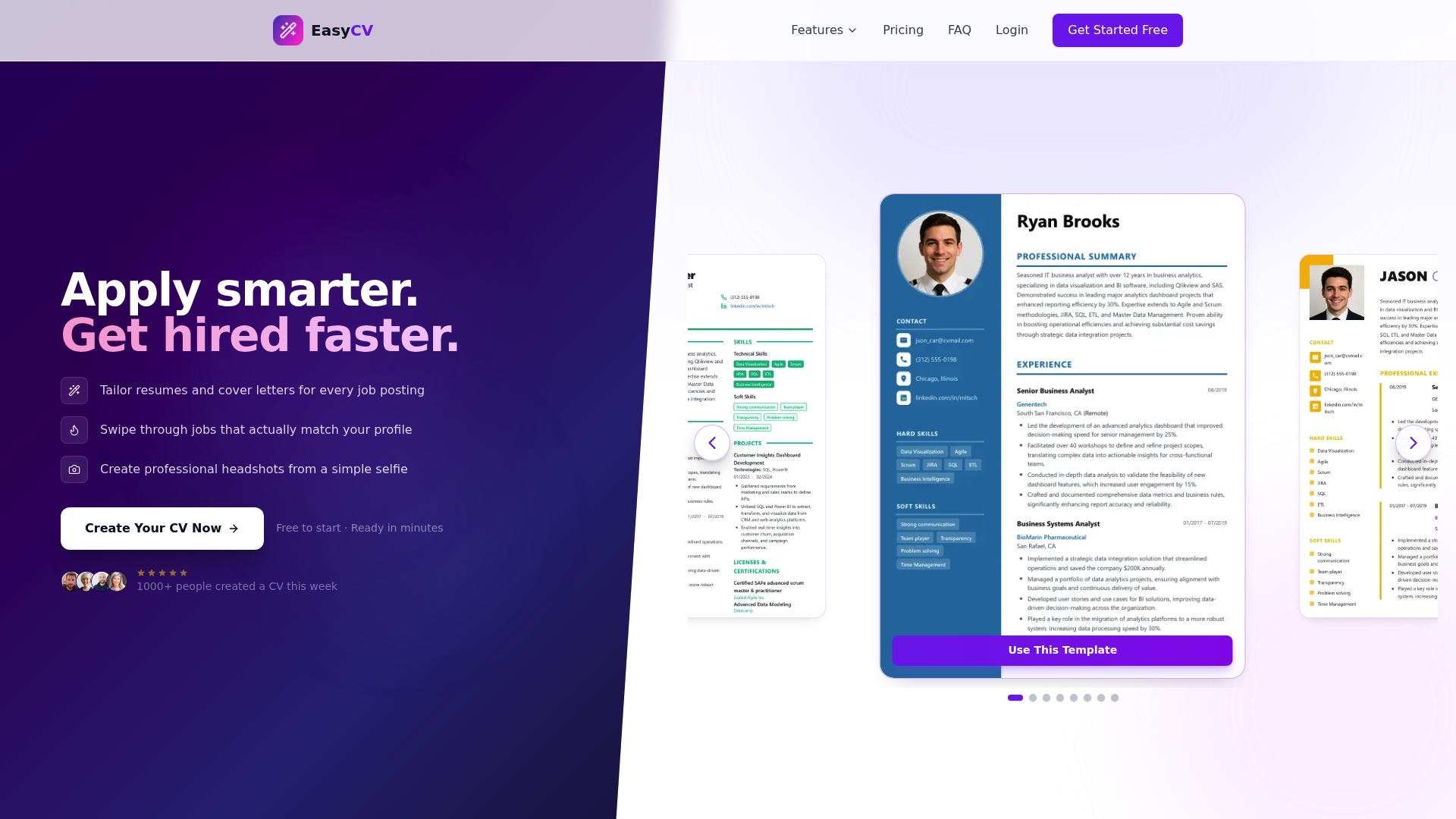
The Easy CV platform is built specifically to take the friction out of every step described in this guide. It uses AI to match your resume to job descriptions, optimize for ATS keywords, and generate tailored cover letters in minutes. Whether you’re refreshing an existing resume or starting from scratch, the AI-powered resume tools handle the technical optimization so you can focus on the content that represents you best. With access to over 10 million job listings and features like AI headshots, resume translation, and application tracking, Easy CV gives you a complete job search system rather than just a document builder. Start with a free plan and see how much faster a well-optimized resume gets results.
Frequently asked questions
What are the essential sections every resume must have?
Every resume must include your contact info, professional summary, core skills, work history, and education. Depending on your field, certifications and projects can significantly strengthen your application as well.
How can AI help improve my resume?
AI tools quickly identify missing keywords, correct formatting errors, and help you tailor each resume version to a specific job posting. According to insights on resume automation, this can increase your interview callback rate by up to 40%.
What is the most common resume mistake?
Generic bullet points that describe duties instead of accomplishments are the most damaging mistake most job seekers make. Outdated contact details and inconsistent formatting are also frequent errors that hurt your chances before a recruiter reads a word.
Should I tailor my resume for every job application?
Yes, every application deserves a tailored resume. Customizing your keywords, summary, and highlighted skills to match each posting dramatically improves how ATS filters and human recruiters respond. Guidance on adapting your resume checklist for different roles and platforms makes this process faster than you might expect.