The Real Role of Online Resume Platforms in 2026
Most job seekers treat resume platforms like a nicer version of Microsoft Word. Pick a template, paste in your experience, download as PDF, and done. That mental model is costing people interviews. The role of online resume platforms has shifted fundamentally. These tools now handle ATS compatibility, AI-driven content analysis, keyword optimization, and application tracking in ways that directly affect whether your resume gets seen at all. This article breaks down what these platforms actually do in 2026, how they compare to LinkedIn and personal websites, and how to use them in a way that genuinely improves your odds.
Table of Contents
- Key takeaways
- The role of online resume platforms in ATS and AI compatibility
- Beyond formatting: AI-powered feedback and career strategy
- How resume platforms compare to LinkedIn and personal websites
- Practical tips for maximizing resume platform benefits
- My honest take on where resume platforms actually help
- Build smarter applications with Easy-cv
- FAQ
Key takeaways
| Point | Details |
|---|---|
| ATS controls visibility | Resumes that fail ATS parsing are hidden from recruiters, not rejected outright. |
| AI tailoring beats manual editing | Platforms can adjust keywords and bullet order for each job description in seconds. |
| LinkedIn and platforms serve different purposes | LinkedIn helps recruiters find you; resume platforms make your application ATS-ready. |
| Multi-channel presence matters | Combining a resume platform, LinkedIn, and a personal website gives you the strongest edge. |
| Human voice still wins | AI-optimized resumes need your authentic detail to stand out once they pass screening. |
The role of online resume platforms in ATS and AI compatibility
Here is the statistic that should change how you think about your resume: over 90% of mid-to-large employers use Applicant Tracking Systems, and most now layer AI screening on top. Your resume reaches a human only after it clears this automated filter. That means a beautifully designed PDF with poor structure can disappear before any recruiter lays eyes on it.
Most people misunderstand what ATS actually does. It does not automatically reject resumes. Instead, ATS acts as a searchable database, storing every application and surfacing only the ones that match a recruiter’s keyword search. A resume that is invisible in that search is effectively excluded from consideration, not flagged or rejected. The distinction matters because the fix is not about passing a test. It is about being findable.
This is where online resume platforms deliver real value. Here is what a quality platform handles for you:
- Structured formatting. ATS parsers struggle with tables, graphics, text boxes, and unusual fonts. Resume platforms that offer ATS-compatible templates use clean, single-column or clearly sectioned layouts that parse correctly every time.
- Keyword alignment. Platforms with AI features scan the job description you are targeting and flag which keywords are missing from your resume or underrepresented in your bullet points.
- Real-time ATS scoring. Some platforms score your resume against a specific job posting before you submit, telling you exactly where you fall short.
- Section labeling. ATS systems look for standard headers like “Work Experience” and “Education.” Custom headers like “My Career Story” can cause parsing failures that bury your credentials.
Pro Tip: When using any resume platform, always run your finalized resume through its ATS checker with the exact job description pasted in. Generic scores are less useful than job-specific ones.
Understanding resume keywords is not optional anymore. Platforms that teach you which terms to include, and why, are doing more than formatting. They are teaching you how hiring systems think.
Beyond formatting: AI-powered feedback and career strategy
There is a meaningful gap between a resume template tool and what the best platforms for resumes offer today. The latter category functions more like what researchers now call a career operating system, providing feedback, tracking, and strategy alignment alongside document creation.
Here is how the advanced feature set actually works in practice:
- Job description analysis. You paste a job posting, and the platform’s AI compares it to your current resume. It identifies missing skills, underused keywords, and bullet points that could be reordered for stronger relevance. AI can generate a tailored resume based on a specific job description in roughly sixty seconds.
- Real-time content suggestions. As you edit, the platform flags weak phrasing, quantification opportunities, and passive language. Instead of wondering if your bullet points are strong, you get specific rewrites to consider.
- Gap analysis. If you are targeting a role that requires skills you have not listed, better platforms identify those gaps explicitly. You can then decide to add missing context or recognize that a role may not be the right fit.
- Application tracking. This is the underrated feature. Tracking which version of your resume you sent to which company, along with the job description and application date, prevents the chaos of a serious job search.
Pro Tip: Keep a master resume with every skill, role, and achievement you have ever had. Let the platform’s AI create tailored versions from that master document. Never start from scratch for each application.
The difference between a simple template builder and an AI-enhanced platform is the difference between a word processor and a writing coach. Knowing how to use AI for resume writing properly, not just letting it generate content, is where the real advantage comes from.

How resume platforms compare to LinkedIn and personal websites
None of these tools do the same job. Conflating them leads to gaps in your strategy.
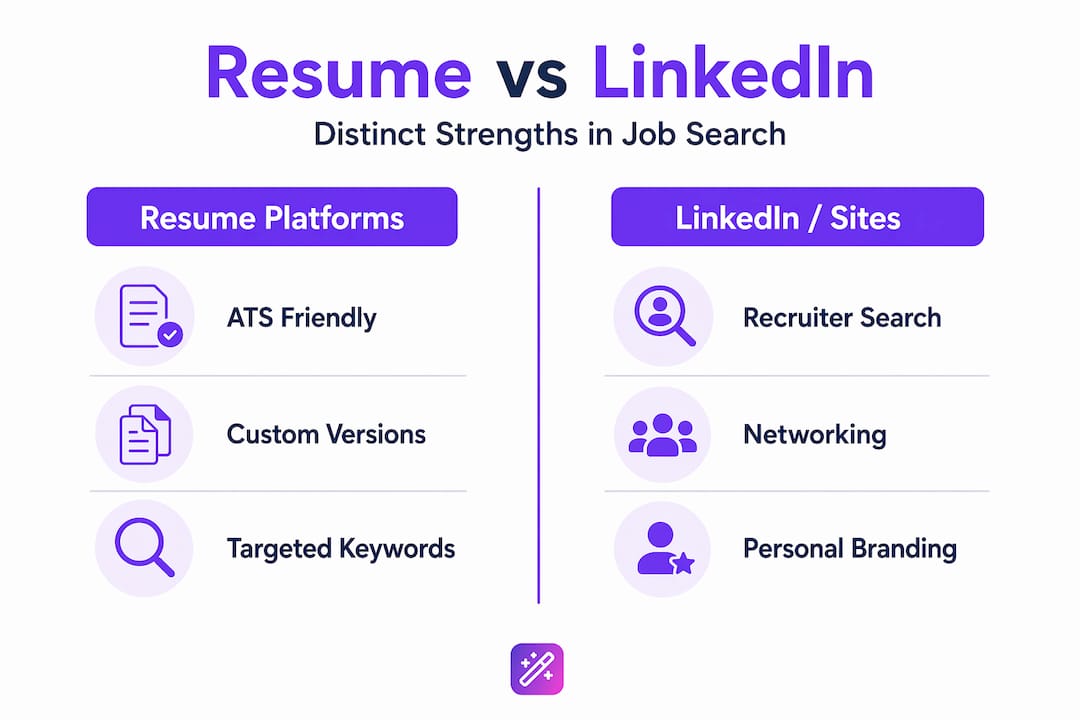
| Tool | Best for | Weakness |
|---|---|---|
| Resume platform | ATS optimization, tailored applications, version control | Not a discovery tool for recruiters |
| Recruiter discovery, professional networking, endorsements | LinkedIn resumes parse poorly for ATS; retired its dedicated builder in 2021 | |
| Personal website | Google search visibility, portfolio display, narrative control | Requires time to build and maintain |
LinkedIn excels at getting recruiters to find you. 77% of recruiters Google candidates before interviews, and a strong LinkedIn profile with a professional photo significantly shapes that first impression. That said, LinkedIn was never built for ATS submission. When you export your LinkedIn profile as a PDF and attach it to an application, you are sending a document with a layout that most ATS systems cannot parse cleanly.
Personal websites add a layer that neither LinkedIn nor resume platforms provide: full narrative control in a Google-searchable format. Maintaining a personal website alongside LinkedIn improves how recruiters perceive you during their research phase. You control what they find, and you can showcase work samples, writing, or projects that a one-page resume cannot hold. It is worth pairing that with a strong LinkedIn profile photo to create a consistent professional impression across both channels.
The practical takeaway is this: use LinkedIn to be found, use a resume platform to submit applications that actually get read, and use a personal website to control the story a recruiter reads when they search your name.
Practical tips for maximizing resume platform benefits
Selecting the right platform matters, but using it correctly matters more. These are the habits that separate job seekers who get interviews from those who keep applying without results.
- Choose platforms with ATS scoring and AI feedback. A platform with templates but no ATS analysis is useful for design. It is not useful for getting past automated screening. Make sure the platform you choose offers job-specific feedback, not just a generic quality score.
- Tailor every application, but work smart. AI-driven resume tailoring adjusts keywords and repositions bullet points without inventing experience. Use this feature for every application instead of sending the same document repeatedly.
- Link your LinkedIn and personal website. Add your LinkedIn URL and personal site to every version of your resume. This gives recruiters a path to discover more about you after the ATS delivers your application to their desk.
- Avoid over-relying on AI for content generation. Platforms that write your bullet points entirely from scratch produce generic outputs. The risk of AI-generated homogeneity is real. The candidate who gets hired is both machine-readable and distinctly human. Use AI to refine and optimize what you have written, not to replace your voice entirely.
- Revisit your master resume regularly. Every new project, skill, or achievement should go into your master document immediately. You cannot tailor a resume from a document that is already a year out of date.
The impact of digital resumes comes down to consistency and precision. Sending a tailored, ATS-optimized resume to every role takes more initial setup than sending one generic document everywhere. But the conversion rate difference is not marginal.
My honest take on where resume platforms actually help
I have seen a lot of professionals treat online resume tools as a formatting shortcut. They spend twenty minutes picking a template, hit download, and call it done. What they are leaving on the table is substantial.
What I have found after watching hundreds of job search cycles is that the biggest mistake is not using the wrong platform. It is using the right platform badly. People activate AI tailoring once, get something that sounds professional, and stop there. They never check whether the tailored version actually scores well against the job description they are targeting. They never update their master resume. They never track which version they sent where.
The platforms that work best are the ones that treat the resume as a living document connected to a larger search strategy. That means application tracking, version history, and real-time optimization tied to specific job postings. That is the benefits of online resumes at their highest level.
My other honest observation: AI optimization creates a paradox. The more people use AI to pass ATS, the more recruiters on the other side are scanning for authentic human detail that cuts through polished sameness. The solution is not to avoid AI tools. It is to use them to clear the gate and then make sure your actual personality, voice, and specific experience are visible once a human reads the document. The technology handles structure. You handle substance.
— Andras
Build smarter applications with Easy-cv
If you want a platform that handles both sides of that equation, Easy-cv was built for exactly this kind of job search.
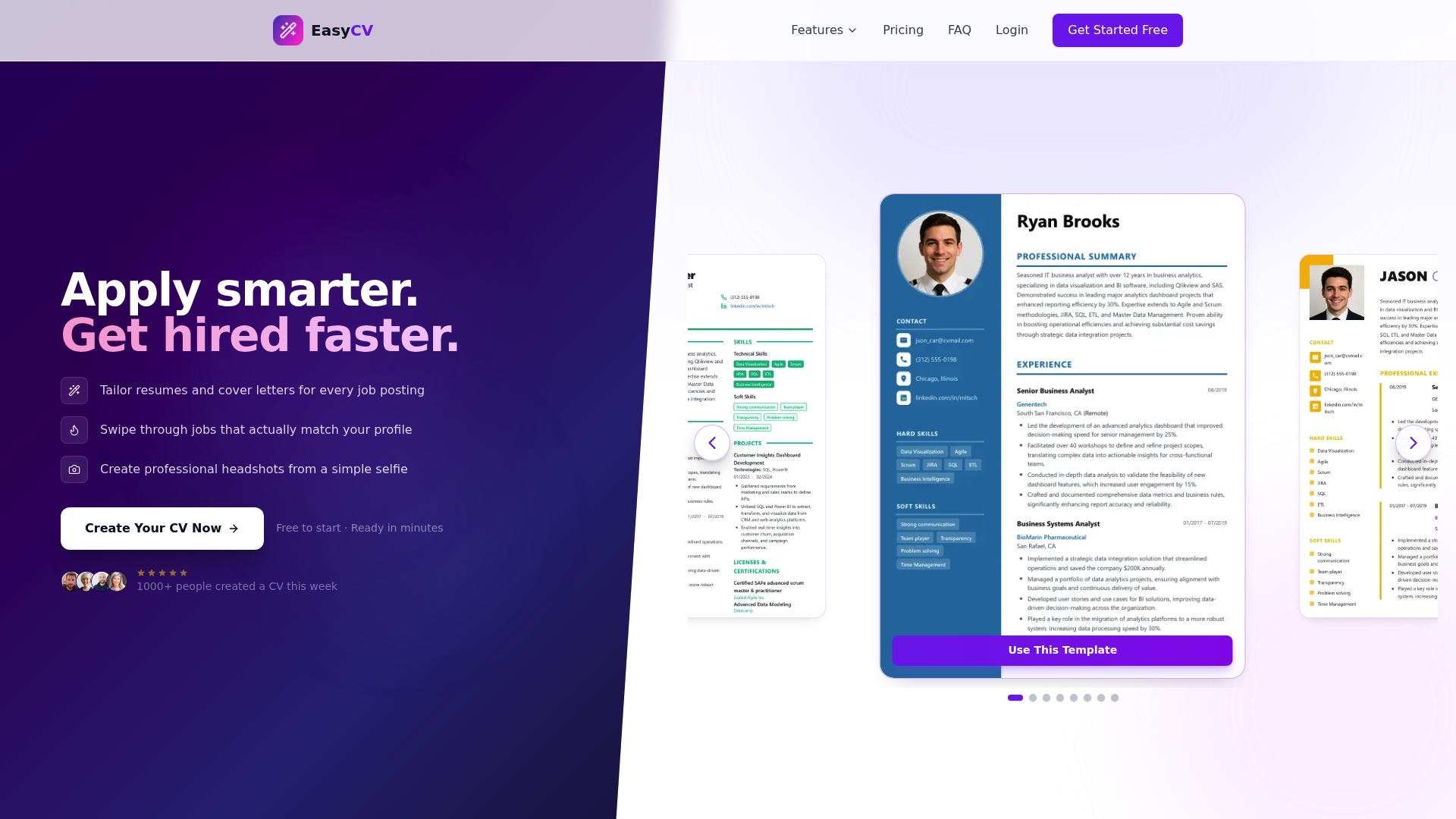
Easy-cv aggregates over 10 million job opportunities per month from major job boards, so you are not hunting across five different sites. Its AI writing assistant tailors your CV and cover letter to each specific job description, adjusting keywords and structure without losing your voice. The built-in ATS optimization tools score your resume against each posting before you submit. A built-in job tracker keeps your applications organized so you always know which version went where. You can build and translate resumes in 30-plus languages, and the AI headshot generator handles your profile photo. Start building on Easy-cv today, free, and see the difference a purpose-built platform makes.
FAQ
What is the role of online resume platforms?
Online resume platforms help job seekers create ATS-compatible resumes, optimize keywords for specific job postings, and track applications. Modern platforms go beyond formatting to provide AI-driven content feedback and career strategy tools.
How do online resumes help job seekers get past ATS?
ATS systems work as searchable databases, not rejection filters. Platforms that offer ATS-compatible templates and keyword alignment make resumes findable when recruiters search their applicant pool.
Is LinkedIn enough, or do I need a separate resume platform?
LinkedIn is strong for recruiter discovery but poor for ATS submission. LinkedIn retired its dedicated resume builder in 2021, and exported profiles parse poorly for most ATS systems. A dedicated resume platform handles what LinkedIn cannot.
What features should I look for in the best platforms for resumes?
Prioritize platforms that offer job-specific ATS scoring, AI tailoring tied to actual job descriptions, and application tracking. Template variety matters, but optimization features are what drive interview rates.
Can AI-generated resumes hurt my chances?
Over-relying on AI to write your entire resume creates generic content that looks polished but lacks distinctive detail. The best approach is to use AI to optimize and refine your own writing, not replace it entirely.