How resume builders make job applications smarter

Most job seekers assume AI resume builders do all the heavy lifting. You click a few buttons, paste in a job description, and out comes a perfect resume ready to send. That assumption is costing people interviews. The truth is that resume builders are powerful accelerators, but they work best when paired with strategic human input. This article breaks down exactly how to use these tools at every career stage, what mistakes to avoid, and how to turn AI-generated drafts into applications that actually get responses.
Table of Contents
- What makes resume builders valuable for job seekers
- How AI resume builders adapt to experience levels
- Common mistakes and how to maximize success with resume builders
- Turning resume builder outputs into winning applications
- Our take: Why resume builders are only the start
- Ready to build a better resume?
- Frequently asked questions
Key Takeaways
| Point | Details |
|---|---|
| AI speeds resume tailoring | Resume builders help job seekers quickly adapt resumes for different applications. |
| Human review is essential | Editing AI resumes adds impact and prevents errors. |
| Different benefits by experience | Entry-level and senior candidates use AI tools differently for maximum results. |
| ATS optimization with builders | Resume builder formatting improves chances with applicant tracking systems. |
| Personalization drives success | Resumes must be tailored and authentic to stand out to employers. |
What makes resume builders valuable for job seekers
After setting the stage, let’s clarify why resume builders are so popular and how they differ from manual resume creation.
Building a resume from scratch is slow and frustrating. You stare at a blank page, second-guess every word choice, and spend hours reformatting after each edit. Resume builders solve that problem by giving you a structured starting point, consistent formatting, and a framework that works across industries. That alone saves hours per application.
The bigger advantage is speed at scale. When you’re applying to 20 or 30 jobs, manually tweaking your resume for each one becomes a full-time job. Using AI for resume writing allows you to generate tailored versions of your resume quickly, adjusting keywords and emphasis to match each job description. Research confirms that resume builders speed iterative tailoring across multiple applications, which matters enormously in competitive hiring markets.
Formatting is another area where builders shine. Most companies use applicant tracking systems, or ATS, to filter resumes before a human ever reads them. ATS software scans for keywords, clean formatting, and standard section headers. Resumes with unusual fonts, tables, or graphics often fail this scan entirely. Professional resume templates built for ATS compliance remove that risk by defaulting to clean, parseable layouts.
Here’s what resume builders do well:
- Generate structured first drafts in minutes
- Suggest relevant keywords based on job descriptions
- Enforce consistent formatting across sections
- Flag missing sections like skills, certifications, or summaries
- Offer pre-made template benefits that reduce formatting errors
- Help beginners understand what a strong resume looks like
“AI tools can accelerate resume creation and help with formatting, but submitting AI-generated text without personalization can actually hurt your chances. The best outcomes come from using these tools as a foundation, then adding your own voice and specific accomplishments.”
That last point matters. Resume builders are not a substitute for thinking. They provide structure and speed, but the details that make a resume memorable, your specific achievements, your unique career story, your quantified results, those still come from you.
How AI resume builders adapt to experience levels
Now that the overall advantages are clear, let’s explore how resume builders should be used based on your career stage.
Not every job seeker uses a resume builder the same way, and they shouldn’t. The value you get from these tools depends heavily on where you are in your career. Job seekers should use resume builders differently depending on their experience level, and understanding that difference is key to getting results.
For entry-level candidates and career changers, the biggest challenge is structure. You may not know what sections to include, how to frame limited experience, or what employers in a new field expect to see. AI builders solve this by providing a proven framework. They prompt you to fill in relevant sections, suggest skills categories, and help you frame internships, volunteer work, or transferable skills in professional language. Resources on getting a job with no experience consistently emphasize that structure and clarity matter more than volume of experience, which is exactly what builders provide.
For experienced professionals, the challenge is different. You likely have plenty of content, but the question is how to optimize it for each role. AI builders help by identifying keyword gaps between your resume and a job description, suggesting stronger action verbs, and reorganizing sections to lead with your most relevant experience. The goal shifts from building a resume to sharpening one.

| Career stage | Primary challenge | How AI builders help | What you still need to do |
|---|---|---|---|
| Entry-level | No structure or starting point | Provides framework and prompts | Add real examples and transferable skills |
| Career changer | Framing unrelated experience | Suggests relevant language and skills | Reframe your story for the new field |
| Mid-level | Standing out among similar candidates | Keyword optimization and formatting | Add measurable outcomes to each role |
| Senior/executive | Demonstrating strategic impact | ATS optimization and section prioritization | Lead with metrics and leadership evidence |
Tailoring strategies also differ by stage. Entry-level candidates should focus on skills, education, and any relevant projects or activities. Mid-level professionals should prioritize quantified achievements, promotions, and cross-functional contributions. Senior candidates need to demonstrate business impact, not just job duties. An AI builder can flag when your resume reads more like a job description than a record of accomplishments, which is one of the most common resume mistakes at every level.
Following job application tips for your specific career stage makes the difference between a resume that gets filtered out and one that earns a callback. AI tools can guide you toward the right structure, but you need to fill that structure with evidence that is specific to your experience.
Pro Tip: Never accept the default text an AI builder generates for your summary or bullet points. Treat those suggestions as placeholders. Replace them with language that reflects your actual experience, your real results, and your genuine voice.
When you improve your CV with AI, the goal is to use the tool’s output as a scaffold, not a finished product. The candidates who get hired are the ones who take that scaffold and build something real on top of it.
Common mistakes and how to maximize success with resume builders
With tailored approaches in mind, let’s address the real-world pitfalls and how to get the most from these tools.
The single most damaging mistake job seekers make is submitting AI-generated resumes without any edits. It feels efficient. It’s actually counterproductive. Hiring managers read hundreds of resumes. They recognize generic AI language immediately, and it signals a lack of effort. Best results come from human review of AI-written resumes rather than submitting AI-written text verbatim.
The second most common mistake is ignoring measurable outcomes. AI builders can suggest bullet points like “managed a team” or “improved customer satisfaction,” but those phrases mean nothing without numbers. How large was the team? By what percentage did satisfaction improve? Over what time period? Vague language makes your resume blend into the pile. Specific numbers make it stand out.
A third mistake is treating all resume builders as equal. Some tools focus purely on formatting. Others use AI to analyze job descriptions and suggest targeted edits. The latter category, which includes tools built around resume automation strategies, gives you a much stronger competitive advantage because they help you match your language to what each employer is actually looking for.
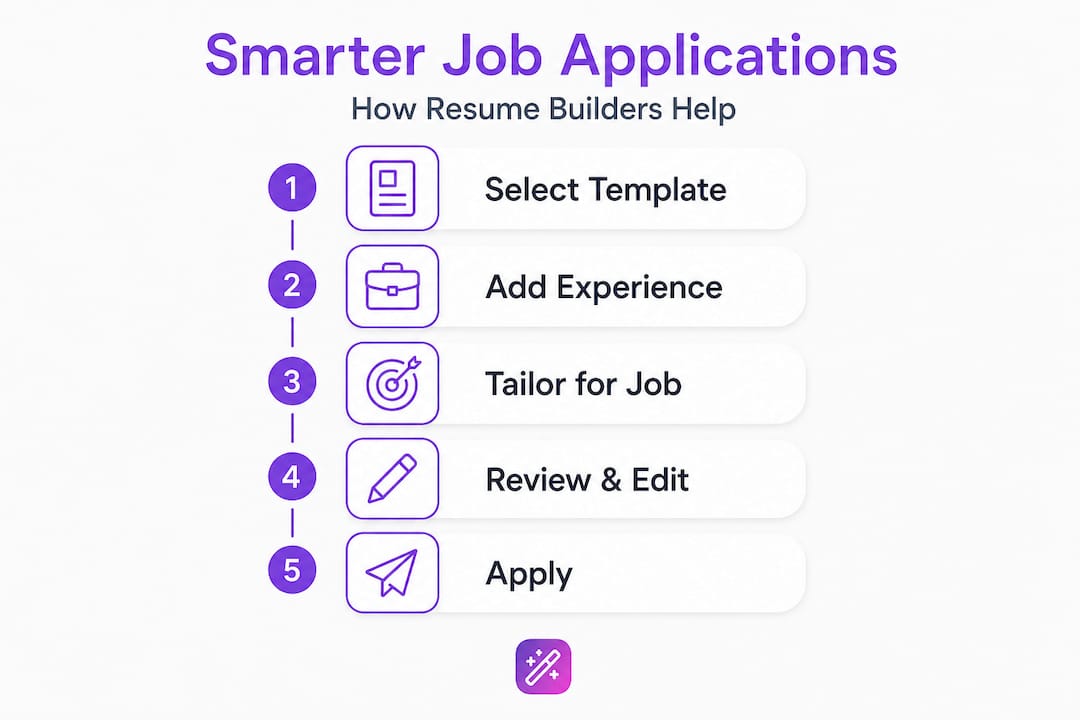
Here are four steps to optimize your resume builder process:
- Start with a complete brain dump. Before opening any builder, list every job, project, skill, achievement, and certification you want to include. The more raw material you give the AI, the better its output.
- Input the actual job description. Don’t just build a generic resume. Paste the specific job posting into the builder so it can tailor keywords and emphasis to that role.
- Review every suggestion critically. Read each AI-generated bullet point and ask: is this specific to me? Does it include a measurable result? Does it sound like something I would actually say?
- Run the final version through an AI-optimized resume checklist. Verify ATS compatibility, check for keyword coverage, and confirm that formatting holds up when exported to PDF.
Studies consistently show that resumes tailored to specific job descriptions receive significantly more callbacks than generic ones. Some research puts the difference at over 40% in callback rates. That gap is exactly what resume builders are designed to close, but only if you use them strategically rather than passively.
Pro Tip: Use your builder for speed during the drafting phase, but budget at least 20 to 30 minutes for final edits on every application. That editing time is where your resume goes from average to competitive.
Turning resume builder outputs into winning applications
Having learned how to avoid mistakes, let’s focus on transforming builder-ready resumes into winning job applications.
A resume builder gives you a strong draft. What you do with that draft determines whether it lands in a recruiter’s inbox or an automated rejection folder. The final review phase is not optional. AI can help condense and eliminate errors, but it should not replace the human applicant. That means you need to own the final product.
Here’s what a strong final review looks like:
- Proofread for tone and voice. Does the resume sound like a real person or like a machine? Replace stiff, generic phrases with natural language that reflects how you actually talk about your work.
- Add specific metrics to every achievement. Review each bullet point and ask whether you can add a number, a percentage, a timeframe, or a scale. “Increased sales” becomes “increased quarterly sales by 23% over six months.”
- Verify keyword alignment. Compare your resume against the job description one more time. Are the most important skills and qualifications represented? Are they in the right sections?
- Check formatting for ATS compatibility. Avoid text boxes, headers in unusual positions, and images that ATS systems can’t read. Knowing what to include on a resume and what to leave out is just as important as formatting.
- Export and review the PDF version. Formatting that looks clean in a builder can break when exported. Always check the final file before submitting.
Understanding resume template impact on application outcomes helps you make smarter choices about which templates to use and how to preserve their structure during editing.
| Resume version | ATS compatibility | Callback rate | Recruiter impression |
|---|---|---|---|
| Raw AI output, unedited | Moderate | Low | Generic, impersonal |
| AI output with keyword edits only | High | Moderate | Better but still thin |
| AI output with full human review | High | High | Specific, credible, compelling |
| Manually written, no AI | Variable | Variable | Depends entirely on writer skill |
The data is clear. The combination of AI structure and human refinement consistently outperforms either approach alone. Think of the builder as a very skilled first draft writer. Your job is to be the editor who turns that draft into something worth reading.
Our take: Why resume builders are only the start
Here’s a perspective you won’t find in most guides, and it comes from watching thousands of job seekers interact with AI tools.
Resume builders are genuinely powerful. They eliminate blank-page paralysis, enforce structure, and make keyword optimization accessible to people who have never heard of ATS. For someone applying to their first job or switching careers at 40, that kind of scaffolding is invaluable. We believe in these tools deeply.
But here’s the uncomfortable truth: the job seekers who rely on builders most heavily are often the ones who get the fewest callbacks. Not because the tools fail them, but because they mistake structure for substance. A perfectly formatted resume with generic bullet points is still a weak resume. It just looks better while being ignored.
The candidates who win are the ones who treat AI output as a starting point for their own thinking. They use the builder to handle formatting and keyword suggestions, then they sit down and ask harder questions. What did I actually accomplish in this role? What would my manager say about my impact? What specific problem did I solve, and what was the measurable result? Those answers don’t come from AI. They come from honest self-reflection.
There’s also a storytelling dimension that builders can’t replicate. Your career has a narrative arc. The choices you made, the skills you built, the direction you’re heading. A great resume tells that story in a way that makes a hiring manager think “this person makes sense for this role.” AI can suggest language, but it can’t construct your narrative for you.
The best approach we’ve seen is to use AI resume writing strategies for the mechanical work, then invest your own time in the strategic work. Use AI to format, optimize, and draft. Use your own judgment to personalize, quantify, and refine. That combination is what separates a resume that gets filed from one that gets a phone call.
Pro Tip: Treat every AI suggestion as a question, not an answer. When the builder suggests a bullet point, ask yourself: is this actually true of my experience? Can I make it more specific? Can I add a number? That habit alone will dramatically improve your results.
Ready to build a better resume?
If you’ve made it this far, you now know more about using resume builders strategically than most job seekers ever will. The next step is putting that knowledge to work.
EasyCV.ai brings together everything covered in this guide into one platform built for real job seekers. Whether you’re just starting out or targeting a senior role, Easy CV’s features include ATS-optimized templates, AI-powered keyword matching, cover letter generation, and job board integration across millions of listings. You can create multiple resume versions tailored to different roles, track your applications, and export clean, professional PDFs in minutes. Head to Easy CV and start building a resume that works as hard as you do.
Frequently asked questions
Is it safe to use an AI resume builder for job applications?
Yes, as long as you review and personalize the output before submitting. Best results come from human review of AI-written resumes rather than sending AI-generated text verbatim.
How do resume builders help experienced professionals?
They streamline ATS formatting and surface keyword gaps, letting experienced candidates focus their editing time on metrics and strategic impact. Job seekers should use resume builders differently based on their experience level to get the most value.
Can resume builders improve chances of getting hired?
Yes, especially when you use them to tailor each application to a specific job description. Resume builders speed iterative tailoring across multiple applications, which directly improves your chances of passing ATS filters.
Should I use AI resume templates for entry-level jobs?
Absolutely. AI templates give beginners a proven structure and prompt them to include the right sections, making it much easier to present limited experience in a professional format. AI assistance is most helpful when you need structure and a strong starting point.
Do I need to manually edit AI-generated resume content?
Yes, every time. Manual editing replaces generic language with specific, credible detail that reflects your real experience. Human review of AI-written resumes consistently produces better outcomes than submitting unedited AI output.