Why Optimize Your CV: Land More Interviews in 2026

Your CV may be getting rejected before any human ever reads it. That’s the uncomfortable reality for millions of job seekers right now, and it explains why optimize your CV has become one of the most searched questions in the job hunting world. Applicant tracking systems filter out unqualified or poorly formatted applications automatically, and even a strong candidate can get cut. This guide breaks down exactly how those systems work, what recruiters want to see, and how to give your CV the best possible shot at making it through both rounds of review.
Table of Contents
- Key Takeaways
- Why optimizing your CV changes everything
- Practical strategies to optimize for ATS and recruiters
- Using AI tools without losing your voice
- Managing multiple CV versions effectively
- My take: CV optimization is bigger than keywords
- Put your CV optimization on autopilot with Easy-CV
- FAQ
Key Takeaways
| Point | Details |
|---|---|
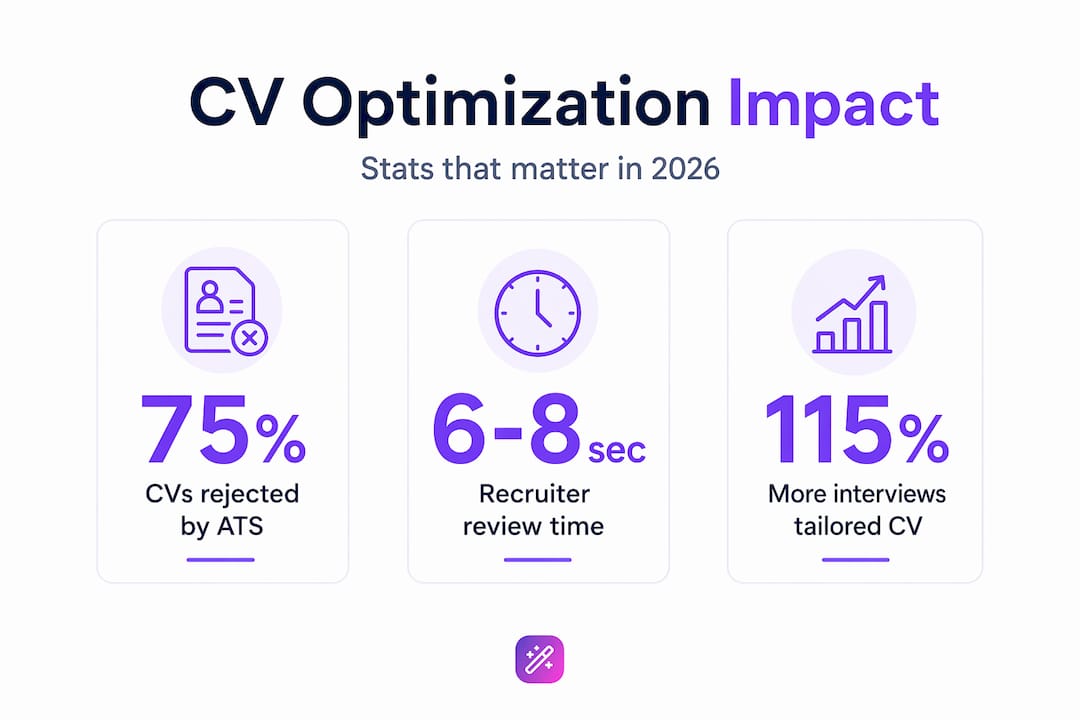
| ATS rejects most CVs first | Up to 75% of resumes are filtered out by automated systems before a recruiter sees them. |
| Tailoring doubles interview rates | Applicants who customize their CV per role see dramatically more interview opportunities. |
| Simple formatting beats creativity | Single-column layouts and standard headings get parsed more accurately by ATS. |
| AI tools help but need human review | Use AI to polish language and spot keywords, then verify everything for accuracy and authenticity. |
| Multiple targeted versions win | Maintaining a master CV and 2-3 role-specific versions keeps applications relevant and competitive. |
Why optimizing your CV changes everything
Most people treat their CV like a one-time document. They write it once, maybe tweak a job title here and there, and send the same file to fifty different employers. The problem is that up to 75% of resumes are rejected by applicant tracking systems (ATS) due to formatting issues and missing keywords, never reaching a human reader at all.
ATS software scans your CV and converts it into structured data. It looks for specific section labels, keywords that match the job description, and a layout it can actually read. If your CV uses tables, text boxes, headers in the page margin, or graphics, the system often fails to parse that content correctly. Critical information vanishes. You look like a blank slate.
Here is what ATS software is actually doing when it receives your file:
- Extracting text from each section and sorting it under categories like Experience, Education, and Skills
- Comparing your keywords against the job posting’s required terms
- Scoring your relevance and either passing or filtering you out
- Flagging formatting anomalies that cause parsing failures
“Your CV is not just a document. It is a data input. If the data is unreadable, the candidate does not exist.”
Recruiters who do get past ATS shortlists operate under extreme time pressure. Recruiters spend only 6 to 8 seconds scanning a CV before deciding whether to keep reading. That means your name, your most recent role, and one or two achievements need to land immediately. Generic objective statements and dense blocks of text get skipped entirely.
Standard section headings like Summary, Experience, Education, and Skills are not just conventions. They are functional labels that tell both the ATS and the recruiter exactly where to look. Creative alternatives like “My Journey” or “What I Bring” might feel distinctive, but they actively reduce findability.

Practical strategies to optimize for ATS and recruiters
Knowing why optimization matters is only half the battle. The real work is in applying specific techniques that make your CV score higher and read better. Here is how to do it.
-
Choose a single-column layout. Multi-column designs look polished in Word but become garbled when an ATS tries to parse them left to right. Keep the structure linear and clean. Use standard fonts like Arial, Calibri, or Georgia at a readable size.
-
Mirror the exact language in the job posting. Using the exact keywords from a job description, including both the acronym and the full term (for example, “SEO” and “search engine optimization”), increases your match score significantly. Do not paraphrase when you can match precisely.
-
Quantify every achievement you can. “Managed social media accounts” is weak. “Grew Instagram following by 40% in six months through weekly content strategy” is specific and credible. Quantified achievements improve both ATS scoring and recruiter confidence.
-
Use strong action verbs at the start of every bullet. Led, delivered, reduced, built, and negotiated signal ownership and impact. Passive phrases like “was responsible for” add length without adding weight.
-
Check your keyword density without overdoing it. Repeating a keyword naturally two or three times across your CV is fine. Stuffing the same phrase into every sentence reads as dishonest to recruiters and can actually flag your application as suspicious in some systems.
-
Use standard date formatting throughout. Inconsistent dates, like mixing “Jan 2023” with “01/23” in the same document, confuse parsing. Stick to one clear format across every entry.
Pro Tip: After updating your CV, paste the plain text into a blank document and read through it. If the content still flows and the key information is obvious, your formatting is likely ATS-safe.
Tailoring your CV to each role is not just a nice touch. Applicants who tailor their resumes for specific roles see a 115% higher success rate and twice as many interview opportunities compared to those sending generic documents.
Using AI tools without losing your voice
AI writing tools have changed the CV optimization process dramatically. They can scan job postings, suggest relevant keywords, rephrase weak bullet points, and even generate full draft sections in seconds. That speed is genuinely useful when you are applying to multiple roles at once. However, there are real risks if you hand the wheel over entirely.
Here is how to use AI well, and where to draw the line:
- Use AI to generate keyword lists. Paste the job description into a tool and ask it to identify the top ten skills and phrases the employer emphasizes. Then check which ones you genuinely have and add them to your CV where they are accurate.
- Let AI suggest stronger phrasing. If you have a bullet point that feels flat, ask an AI tool to rewrite it with more impact. Then read the output critically. Does it still sound like you? Is it still accurate?
- Never let AI fabricate experience. Employers are increasingly alert to AI-generated resumes that lack personalization. Overly polished, generic language that does not reflect the actual person behind the CV is a red flag in interviews.
- Always run a final human review. Check for tone, factual accuracy, and whether the CV still tells your genuine story. AI cannot know your career context the way you do.
Pro Tip: Treat AI output as a first draft, not a final product. Rewrite at least one or two sentences in your own voice before sending, and double-check every claim the AI includes against your actual experience.
The best use of AI for CV improvement is as a highly informed editor, not a ghostwriter. You bring the facts and the story. AI brings the polish.
Managing multiple CV versions effectively
One of the most overlooked advantages of resume optimization is what happens when you stop sending the same document everywhere. The concept is simple: you build one thorough master CV that includes everything relevant from your career. Then you create two or three targeted versions, each shaped around a specific role type or industry.
| CV version | Purpose | What changes |
|---|---|---|
| Master CV | Full record of your experience | Nothing removed, used as your source file |
| Targeted version A | Applications in marketing roles | Highlights campaigns, metrics, brand work |
| Targeted version B | Applications in project management | Emphasizes coordination, timelines, delivery |
| Targeted version C | Applications in data analysis | Foregrounds tools, reporting, and quantified outputs |
Job seekers managing 2-3 base CV versions tailored for different roles improve both their ATS scores and overall application relevance. The effort per application drops sharply once the targeted versions exist. You are mostly swapping keywords in the summary and reordering bullet points in the experience section.
This approach also keeps you honest. When you tailor a version for a specific role, you are forced to ask: do I actually have what this employer is looking for? That question saves you time and targets your energy toward roles where you are genuinely competitive.
Staying on top of keeping your CV updated matters as much as the initial optimization. Add new achievements, certifications, or tools as you gain them. A CV that reflects your current skill set always outperforms one built around who you were two years ago.
Beyond ATS scoring, networking and visibility complement your CV work by moving applications faster through human review stages. Referrals and verified skills build the credibility that no formatting trick can manufacture on its own.
My take: CV optimization is bigger than keywords
I’ve reviewed hundreds of CVs over the years, and the ones that fail rarely fail because of bad grammar or thin experience. They fail because the person who wrote them assumed the reader would give them the benefit of the doubt. They used vague language, buried their biggest wins halfway down the page, and sent the same version to every employer in their industry.
What I’ve found is that the job seekers who get interviews consistently are not always the most qualified. They are the ones who took the time to present what they know in a way that is easy to verify and impossible to ignore. A CV that is easy to parse, clear in language, and truthful does not just score better in ATS. It shapes how hiring algorithms learn, influencing how your profile is ranked in future searches.
My honest advice: stop thinking of your CV as a biography and start treating it as a case for why you are the right person for one specific role. Write it with that frame in mind, and the optimization almost takes care of itself.
— Andras
Put your CV optimization on autopilot with Easy-CV
If the process of tailoring, formatting, and updating your CV for every application sounds like a lot of work, that is because doing it manually usually is. Easy-CV exists to remove that friction. The platform’s AI CV builder analyzes job descriptions, suggests targeted keywords, and helps you produce a professionally formatted CV in minutes, not hours. Every template is ATS-friendly by design, so you never have to guess whether your formatting will parse correctly. You can build and manage multiple CV versions inside the same workspace, track your applications, and generate matching cover letters without switching between tools. Whether you are a recent graduate sending out your first applications or a career changer repositioning your entire professional story, Easy-CV’s full feature set is built to get you to more interviews, faster.
FAQ
What does it mean to optimize your CV?
CV optimization means structuring, formatting, and tailoring your document so it scores well with applicant tracking systems and reads clearly to human recruiters. It includes keyword matching, clean formatting, and quantified achievements.
Why do so many CVs get rejected before a recruiter reads them?
Most ATS reject up to 75% of resumes due to formatting problems like tables, graphics, and headers that prevent the system from parsing the content correctly. A missing or mismatched keyword can also push your score below the threshold.
How often should you update your CV?
Update your CV every time you complete a significant project, earn a new certification, or change roles. Waiting until you need it means you will likely forget key details and send something outdated to employers.
Is tailoring your CV for every job worth the time?
Yes. Applicants who tailor their resumes see a 115% higher success rate and twice as many interviews compared to those sending generic versions. Once you have a master CV, tailoring each version takes far less time than building from scratch.
Can AI tools really help with CV optimization?
AI tools are useful for keyword analysis, phrasing improvements, and formatting checks. The key is treating their output as a starting point and applying your own review to keep the content accurate, personal, and genuinely representative of your experience.