Why keeping your CV updated gives you a real edge

Most job seekers don’t realize their CV is working against them. You could be the strongest candidate in the room, but if your resume still reflects who you were two years ago, recruiters and automated systems may never give you a chance. Keeping your resume accurate and representative of your most recent work, education, certifications, and skills is the single most overlooked step in a job search. This article walks you through why updates matter, what to change, how often to do it, and how modern AI tools can make the whole process faster and smarter.
Table of Contents
- Why CV updates matter more than ever
- What to update: More than just job titles
- How often should you update? Establishing a cadence
- AI tools and the smarter way to update your CV
- Why proactive CV updates beat reactive scrambling every time
- Upgrade your CV with next-generation AI tools
- Frequently asked questions
Key Takeaways
| Point | Details |
|---|---|
| Stay application-ready | Regular CV updates ensure you can seize new career opportunities as soon as they appear. |
| ATS optimization is vital | Proper formatting and current keywords increase your chances of passing automated screenings. |
| Integrated use of AI | AI tools can speed up updates, but human insight guarantees relevance and authenticity. |
| Proactive beats reactive | Updating your CV before you need it reduces stress and improves your job search results. |
Why CV updates matter more than ever
The job market moves fast. New roles appear, old titles disappear, and the skills employers value shift dramatically from one quarter to the next. Your CV is an employer’s first snapshot of your professional value. When that snapshot is outdated, you lose the opportunity to make the right first impression, even if your actual experience is exactly what they need.
Here’s what makes this especially urgent: most companies now use applicant tracking systems, or ATS, before a human ever sees your application. These systems scan for specific structure, keywords, and formatting. Resume updates improve alignment with ATS screening and recruiter expectations because they help your document match evolving job requirements and language. If your CV uses outdated terminology or misses key phrases from a job posting, the ATS may eliminate your application automatically.
There’s another layer here that doesn’t get enough attention. Career opportunities rarely announce themselves in advance. A recruiter might reach out unexpectedly, a former colleague might refer you to a new opening, or your company might go through a restructure. In all of these scenarios, your readiness depends entirely on whether your CV is current. An updated CV means you can act within hours instead of scrambling for days.
Key reasons to keep your CV consistently fresh:
- Matches current job requirements and industry keywords
- Passes through ATS filters without being incorrectly rejected
- Reflects your most recent accomplishments and promotions
- Signals to recruiters that you are active and career-aware
- Reduces the stress and rushed work during an actual job search
“A CV that’s six months out of date is like showing up to an interview in last year’s strategy. You might know your stuff, but you don’t look ready.”
Pro Tip: Every time you complete a major project or receive a promotion, add a quick note to a personal achievements file. This habit makes CV updates take minutes rather than hours.
If you want deeper guidance on getting more from every application, explore CV improvement with AI tools to understand how technology can actively sharpen your approach.
What to update: More than just job titles
Most people think updating a CV means swapping in a new job title and calling it done. That’s not enough. A truly effective update touches multiple layers of your document and brings every section in line with where your career is right now.
Keeping your document accurate means reflecting your most recent work, education, certifications, and skills, not just a current employer. Recruiters notice when your skills section lists tools you learned five years ago while your most recent role required entirely different expertise. That gap signals inattention to detail.
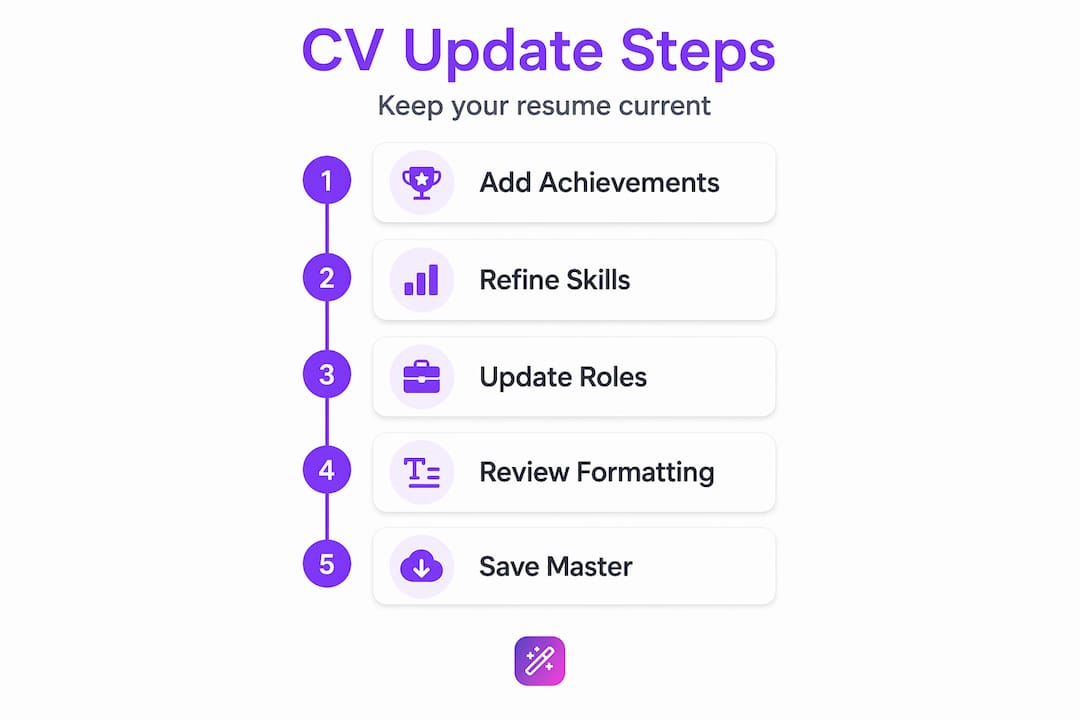
Poorly structured CVs cause ATS failures before a recruiter reads a single word, which means formatting is as important as content. Graphics-heavy layouts, tables with merged cells, and non-standard fonts confuse automated parsers. Updating your CV is also your chance to audit its structure and ensure it will actually be read.
Here’s a breakdown of what deserves your attention during every review:
- Work experience: New roles, expanded responsibilities, measurable achievements (numbers and percentages always outperform vague descriptions)
- Skills section: Remove obsolete tools, add technologies or methodologies you now use regularly
- Education and certifications: Include new credentials, completed courses, or industry licenses
- Professional summary: Rewrite to reflect your current career level and the type of role you’re targeting
- Contact details: Verify your email, phone, LinkedIn profile, and portfolio links are current
- Formatting: Confirm single-column layout, standard fonts, and no embedded images or charts
| CV element | Stagnant version | Updated version |
|---|---|---|
| Work experience | Lists duties only | Highlights measurable achievements per role |
| Skills section | Includes outdated software | Reflects current tools and certifications |
| Professional summary | Generic and vague | Targeted to current career goals |
| Formatting | Tables, graphics, fancy fonts | ATS-friendly, clean, parsable layout |
| Certifications | Missing or expired credentials | Includes recent completions with dates |
Pro Tip: Use an AI-optimized resume checklist to audit your current document section by section. It removes guesswork and ensures nothing slips through.
How often should you update? Establishing a cadence
This is where most job seekers fall short. They update their CV reactively, meaning only when they desperately need a new job. By that point, they’re trying to recall projects they completed 18 months ago, reconstruct metrics they never tracked, and rewrite an entire document under pressure. The result is almost always weaker than it could be.

Professionals benefit from a quarterly or biannual update schedule because it keeps them application-ready at all times, especially when industries shift quickly or opportunities arise without warning. This isn’t about overhauling your document constantly. It’s about small, regular maintenance that keeps everything accurate and sharp.
| Update frequency | Best suited for |
|---|---|
| Monthly | Active job seekers applying to multiple roles |
| Quarterly | Professionals in fast-changing industries (tech, finance, marketing) |
| Every 6 months | Stable careers with occasional new projects or skills |
| Annually | Senior professionals in slower-moving fields |
| Event-driven | Everyone, regardless of frequency, after major milestones |
Here’s a practical system you can build right now:
- Set a calendar reminder every three months with the label “CV check.” Keep it short, around 30 minutes.
- Track achievements in real time. Use a notes app or a simple spreadsheet to log wins, completed projects, new skills, and recognition as they happen.
- Update immediately after key events. Promotion, certification, completed initiative, new tool adoption. Don’t wait for the quarterly check.
- Review your target role’s job postings during each update to ensure your language still matches what employers are searching for.
- Get a second perspective. Share your updated CV with a trusted contact or use an AI tool to catch what you might have missed.
Pro Tip: Treat your CV like a living document stored in the cloud. Use professionally designed resume templates that make reformatting and updating painless, so there’s no friction stopping you from making quick changes.
The professionals who move fastest when opportunities arise are the ones who never let their CV go stale. That edge compounds over a career.
AI tools and the smarter way to update your CV
AI has changed what’s possible when it comes to maintaining and improving a CV. What used to take hours of rewriting, research, and formatting work can now happen in minutes. But AI tools are only as good as the input you give them, and there are real pitfalls to avoid.
AI tools speed up keyword alignment and formatting checks, but human-quality validation is still essential because the goal of updating is evidence: specific impact, accurate dates, real achievements, and clarity. Not just the right buzzwords sprinkled in.
Here’s what AI can realistically do well for your CV update process:
- Identify missing keywords by comparing your CV against a specific job description
- Flag outdated phrasing and suggest modern language that resonates with current recruiters
- Check ATS compatibility by analyzing formatting, fonts, section headers, and structure
- Generate or refine bullet points based on your input about your responsibilities and accomplishments
- Create multiple tailored versions of your CV quickly for different roles or industries
- Suggest skills gaps based on trending requirements in your field
“AI is the analyst. You are the storyteller. The best resumes happen when both show up.”
Where it gets risky: relying entirely on AI without adding your authentic voice and verified data creates generic documents. Recruiters who read hundreds of CVs per week recognize AI-generated filler instantly. The tool should sharpen your story, not replace it.
Explore using AI for resume writing to see how to build a smart workflow, and review the broader picture of resume automation benefits to understand where technology adds the most real value across your entire job search.
Pro Tip: Always review every AI-generated suggestion manually. Add a specific number, a project name, or a concrete outcome to each bullet it creates. That specificity is what makes a CV memorable.
Why proactive CV updates beat reactive scrambling every time
Here’s an uncomfortable truth most career advice avoids: the majority of job seekers only update their CV when they have no choice. They lose a job, feel stuck in a role, or get a recruiter message that forces their hand. That reactive approach puts you at a genuine disadvantage, and not just because the document is outdated.
Reactive updating creates pressure, which leads to poor decisions. You rush the formatting. You forget key achievements. You write a professional summary targeting a role you’re not even sure you want anymore. The whole document reflects someone in crisis mode rather than someone in control of their career.
Regular resume updates reduce time and stress when you need to apply quickly, because you’re adding new achievements to an already solid foundation rather than rewriting from scratch. That’s not just a time-saving tip. It’s a strategic advantage.
The concept of a master CV changes the game entirely. A master CV is a living document that contains every role, project, certification, accomplishment, and skill you’ve accumulated. It’s not what you send to employers. It’s your complete record. When an opportunity arises, you pull the most relevant pieces from your master CV and build a targeted version fast.
This approach works best when combined with the right tools. Smart resume builders let you maintain a master version, create role-specific variants, and ensure every version is formatted and optimized without starting over each time.
The professionals who seem effortlessly prepared when opportunities arise aren’t lucky. They’ve done the maintenance work consistently. Their CV doesn’t need to be rebuilt. It just needs to be aimed.
Upgrade your CV with next-generation AI tools
Staying ahead in a competitive job market is easier when you have the right infrastructure behind you.
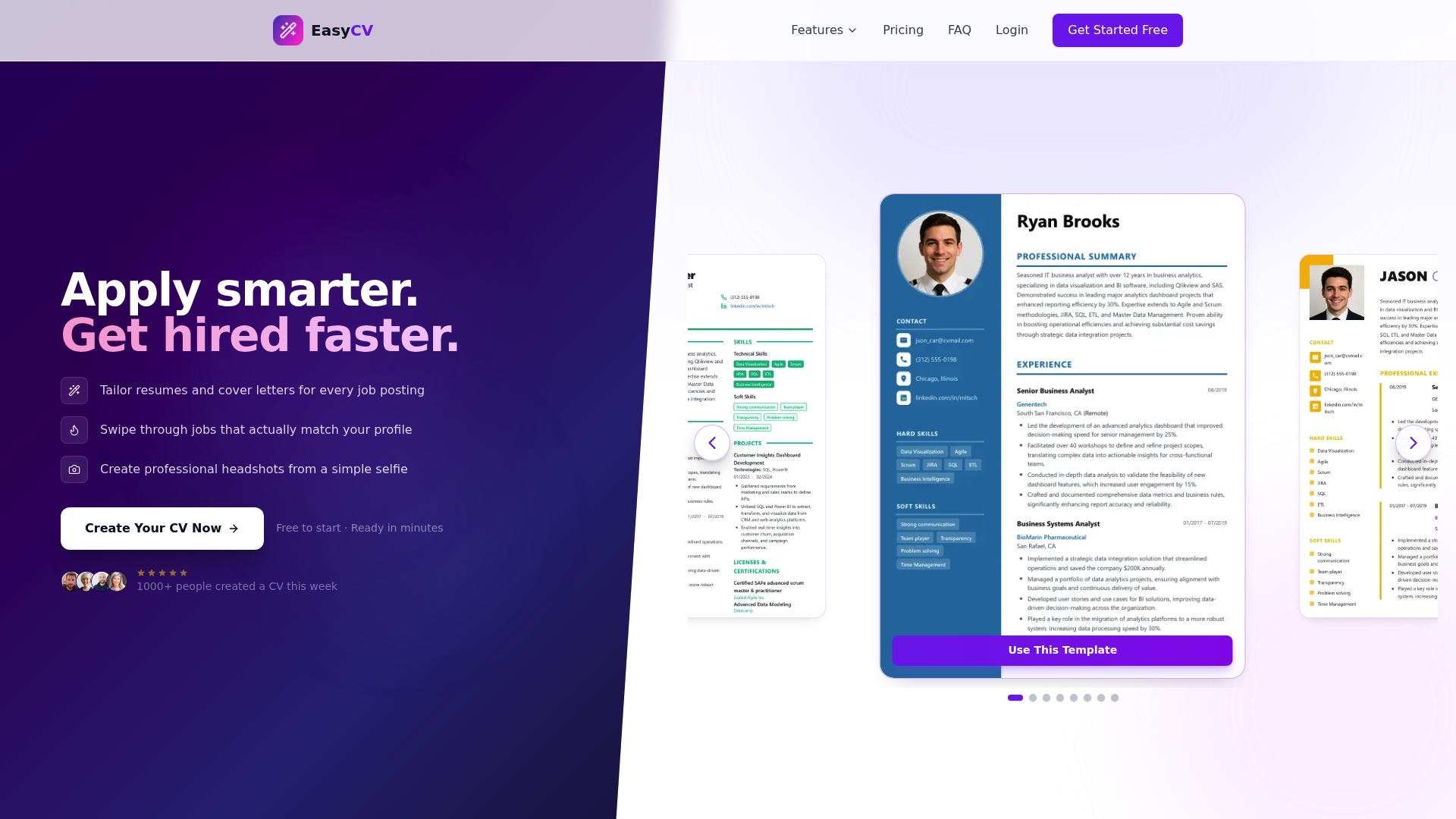
EasyCV.ai is built for exactly the kind of proactive, ongoing CV management this article describes. The platform lets you maintain a master CV, create multiple tailored versions for different roles, and use real-time AI feedback to check keyword alignment, formatting, and ATS compatibility. You don’t need to be a resume expert to produce a polished, recruiter-ready document. Whether you’re updating quarterly or preparing for a specific application, the Easy CV AI CV builder handles the heavy lifting so you can focus on telling your story. Check out the full suite of Easy CV advanced features to see how automation, job matching, and smart optimization work together to keep you consistently competitive.
Frequently asked questions
How often should I update my CV if I’m not actively job hunting?
Aim to refresh your CV every 3 to 6 months, or whenever you complete a major project, get promoted, or learn a significant new skill. Quarterly or biannual updates keep you application-ready without requiring a full rewrite every time an opportunity appears.
What happens if my CV formatting isn’t ATS friendly?
A non-ATS friendly CV may not be parsed correctly, meaning the system misreads your experience or skips your application entirely before a recruiter sees it. Poor CV structure causes parsing failures that eliminate strong candidates through no fault of their actual qualifications.
Should I tailor my CV for every single job application?
You don’t need to start from scratch for every role. Maintain a strong master CV and adjust your summary, top skills, and key achievement bullets to match the specific position. Most candidates benefit from targeted edits to role-relevant sections rather than a complete rewrite each time, which is a recognized best practice in modern job search strategy.
How do AI tools check my CV?
AI tools analyze your CV for missing keywords, structural issues, outdated experience descriptions, and formatting problems that affect ATS readability. As Indeed’s guidance confirms, you still need to verify every detail personally because accuracy of impact, dates, and achievements cannot be automated away.