How job boards shape your application success

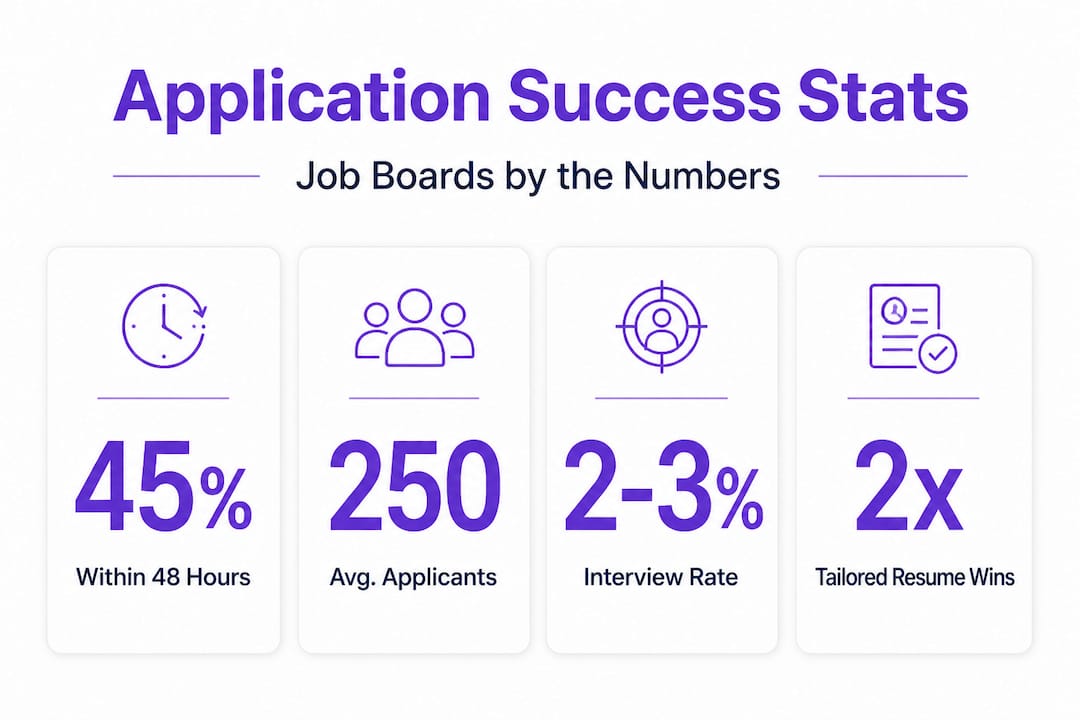
Most job seekers treat job boards like a search engine: type in a role, hit apply, repeat. But the data tells a very different story. Research shows that 45% of all applications land within the first 48 hours of a posting going live, and 60% arrive within 96 hours. That recency rush creates a hidden competitive dynamic that most applicants never account for. In this article, you’ll learn exactly how job boards influence hiring outcomes, why the funnel is more brutal than you think, and what concrete steps you can take to dramatically improve your results.
Table of Contents
- Why job boards matter: Their true impact on applications
- Understanding the applicant funnel: Competition and filtering
- Tailoring your application: The secret to standing out
- Strategic application timing and quality signals
- The uncomfortable truth: Automation and recency aren’t everything
- Next steps: Enhance your applications with Easy CV
- Frequently asked questions
Key Takeaways
| Point | Details |
|---|---|
| Recency matters | Applying within the first two days of a posting gives you the best shot at employer attention. |
| Tailoring boosts results | Resumes matched to specific job keywords double interview chances compared to generic ones. |
| Competition is fierce | Expect around 250 applicants per job posting, so standing out is critical. |
| Quality over quantity | Focused, high-quality applications consistently outperform large-scale mass submissions. |
| Use quality signals | Profiles with robust LinkedIn connections dramatically increase interview rates. |
Why job boards matter: Their true impact on applications
Job boards are not passive notice boards. They are active, algorithm-driven systems that shape who gets seen and who gets buried. Platforms like LinkedIn, Indeed, and Glassdoor collectively channel millions of applications every week, and the mechanics underneath the surface matter enormously to your success.

The recency bias is one of the most underappreciated forces in the hiring process. When a role posts, employers receive a surge of applications almost immediately. Recruiters often review those early submissions first, and their attention naturally fades as the pile grows. This means applying on day five or six of a posting window often puts you at a structural disadvantage, regardless of how strong your resume is.
| Application timing | % of total applications received |
|---|---|
| Within 48 hours | 45% |
| Within 96 hours | 60% |
| Day 5 and beyond | 40% |
As research confirms, early applicants benefit from a real recency advantage that late applicants simply cannot recover. This makes monitoring job boards daily, not weekly, a foundational habit rather than an optional extra.
Beyond timing, job boards remain central because they aggregate demand in one place. Employers post there because candidates are there, and candidates are there because employers post there. It’s a self-reinforcing ecosystem. Even as AI-powered job search tools evolve and direct outreach gains popularity, the vast majority of formal hiring still flows through these boards.
“Job boards aren’t just where jobs live. They’re where hiring decisions begin to take shape, based on who shows up early, who communicates fit clearly, and who has a profile that signals credibility at a glance.”
Key reasons job boards remain essential:
- Volume and visibility: Employers use boards to reach the widest qualified pool quickly.
- Searchability: Keyword-driven algorithms surface candidates who use the right language.
- Employer branding: Company pages and reviews on boards influence candidate trust.
- ATS integration: Most boards feed directly into applicant tracking systems, shaping how your data is parsed before a human ever reads it.
If you’re serious about improving your CV for job boards, understanding this ecosystem is step one.
Understanding the applicant funnel: Competition and filtering
Understanding how job boards drive applicants is one side of the equation. Now, let’s look at what happens once applications are submitted. The answer is sobering but essential to understand.
The average job posting receives 250 applications, yet only 2 to 3% of those applicants ever reach an interview. That means for every 100 people who apply, roughly two or three get a callback. And even before a recruiter sees your resume, there’s a significant chance an ATS (Applicant Tracking System) has already filtered it out. Studies estimate that 75% of resumes are rejected by ATS before any human review occurs.
How the funnel narrows
- You submit your application. It enters the employer’s ATS, which immediately scans for keywords, formatting compatibility, and required qualifications.
- ATS filters run. Any resume that lacks the exact terminology from the job description, or uses formatting the system can’t parse, gets automatically deprioritized or removed.
- Recruiter review. The surviving resumes land in a recruiter’s queue. They typically spend six to ten seconds on an initial scan before deciding to keep reading or move on.
- Shortlisting. A much smaller pool is shortlisted for phone screens, typically 10 to 20 candidates from the original 250.
- Interviews. Only two to five candidates often make it to a formal interview stage.
| Stage | Approximate pass rate |
|---|---|
| ATS filter | 25% pass through |
| Recruiter initial review | ~12% of original applicants |
| Shortlist | ~8% of original applicants |
| Interview | 2 to 3% of original applicants |
The comparison table above makes one thing clear: the biggest drop in the funnel happens before any human decision is made. ATS rejection is not a minor obstacle, it is the primary barrier for most applicants. Understanding the resume vs CV distinction also matters here because formatting conventions differ, and an ATS built for one format may struggle with another.
Statistic spotlight: 75% of resumes are eliminated before a recruiter ever reads them. If your application isn’t ATS-optimized, you’re competing at a severe disadvantage from the moment you click submit.
This data should shift your mindset entirely. The goal isn’t to send as many applications as possible. The goal is to engineer each application to survive the filter, catch the recruiter’s eye, and present a precise fit for the role.
Tailoring your application: The secret to standing out
Now that you understand the funnel, the next challenge is making your application cut through the noise. The single most effective lever you have is customization, and the data on this is unambiguous.
Tailored resumes that use exact keywords from the job description generate twice as many interviews compared to generic submissions. Specifically, tailored applicants average 6 interviews per 100 applications, while generic applicants average fewer than 3. That difference compounds dramatically over a full job search.
Mass applying feels productive. Sending 50 applications in a week creates a sense of momentum. But if those applications are generic or only lightly edited, you’re likely generating very little return. Recruiters can tell immediately when a candidate has used a template and changed nothing but the company name. It signals low interest, low attention to detail, and low fit.
Practical customization tactics
- Mirror the job description language. If the posting says “cross-functional collaboration,” use that phrase exactly rather than synonyms like “teamwork across departments.” ATS systems are literal.
- Reorder your bullet points. Put the experiences most relevant to this specific role at the top of each section, not the ones you personally find most impressive.
- Edit your professional summary for each role. A two to three sentence summary that directly echoes the job’s priorities takes five minutes to rewrite and dramatically increases relevance signals.
- Customize your cover letter. Reference the specific company, the specific team, and the specific problem the role is solving. Generic openers like “I am excited to apply for this position” waste the most valuable real estate in your document.
- Check for required credentials. If the posting lists a certification or tool as required, make sure it appears prominently in your resume, not buried in a footnote.
Pro Tip: Run your tailored resume through a free ATS checker tool before submitting. These tools simulate how an ATS reads your document and flag missing keywords or formatting issues that could get you filtered out automatically.
Optimizing your cover letter is just as important as the resume itself. Many applicants treat the cover letter as an afterthought, but recruiters who receive a well-constructed, specific cover letter immediately place that candidate in a higher-consideration tier. For more detailed tactics, the standout job application tips resource covers additional angles worth exploring.
The uncomfortable math: a thoughtful, tailored application that takes 45 minutes to prepare is worth more than 15 rushed generic submissions. That’s the ROI reality of customization.
Strategic application timing and quality signals
Maximizing your customized applications means choosing not just what you apply to, but when and how you show up across the entire process. Timing and profile quality work together in ways most job seekers significantly underestimate.
Empirical data on job search duration reveals how long this process typically takes. Research benchmarks show that job seekers send between 32 and 200 or more applications before receiving an offer, with a median time to offer of 68.5 days, up 22% compared to prior years. That’s a long runway, and it means your strategy needs to be sustainable and systematic, not just frantic.
“Candidates who maintain strong digital profiles alongside tailored applications consistently outperform those who rely on volume alone. Quality signals compound over time in ways raw quantity never does.”
How to apply strategically
- Set job board alerts. Configure daily alerts on your target boards for the roles and locations you’re pursuing. Applying within 24 hours of a posting going live positions you in that critical early window.
- Apply in focused batches. Rather than randomly applying throughout the day, designate specific time blocks for researching roles and submitting tailored applications. This protects quality.
- Prioritize your LinkedIn profile. Data shows that 71% of interviewed candidates had complete, keyword-rich LinkedIn profiles. Recruiters cross-reference your profile even when you apply through another board.
- Track every application. A simple spreadsheet tracking company, role, date applied, and current status helps you follow up appropriately and avoid reapplying to the same role twice.
- Follow up strategically. A brief, professional follow-up email five to seven business days after applying can differentiate you from the majority of applicants who submit and go silent.
Pro Tip: Use resume automation tips to speed up the tailoring process without sacrificing quality. AI tools can help you match keywords quickly, freeing up your time to focus on the parts of customization that require human judgment, like personalizing your summary and cover letter.
The 68.5-day median offer timeline also carries a psychological message: this process is a marathon, not a sprint. Maintaining consistent, quality-focused effort over weeks rather than expecting rapid results leads to better outcomes and better decisions about which offers to accept.
The uncomfortable truth: Automation and recency aren’t everything
We’ve covered the major evidence and tactics. Now it’s time for a candid take on what’s missing from most job board success stories.
The current wave of job search advice celebrates automation heavily. Apply early. Tailor your keywords. Use AI tools. Optimize your LinkedIn. All of that is sound advice. But here’s the part most guides skip: hyper-automation without authentic positioning often produces a resume that’s technically perfect and humanly forgettable.
When every candidate is using the same AI tools to mirror the same job descriptions, keyword matching becomes table stakes rather than a differentiator. Recruiters are increasingly trained to spot AI-generated language that sounds competent but says nothing distinctive. If your resume reads like a list of industry buzzwords stitched together, it passes the ATS and bores the human reviewer.
AI CV improvement tools are genuinely powerful, but they work best when they’re amplifying your authentic story rather than replacing it. The strongest applications use AI to handle formatting, keyword alignment, and structural optimization while preserving the candidate’s specific voice, specific accomplishments, and specific perspective on their work.
Recency bias is real, but it’s not destiny either. A weak profile that arrives early still loses to a strong profile that arrives on day three. Applying within the first 48 hours matters most when your application is also genuinely competitive. If your resume has fundamental gaps, timing won’t save it.
The third piece most guides undervalue is direct networking alongside job board applications. A referral from someone inside the company can effectively bypass the ATS entirely, placing your resume directly in front of a decision-maker. Data consistently shows that referred candidates are hired at significantly higher rates and often move through the process faster. Job boards and networking aren’t competing strategies, they’re complementary layers of a serious job search.
The honest framework: use job boards as your sourcing engine, use customization to survive the funnel, use timing to gain early visibility, and use your network to create shortcuts that no algorithm can replicate.
Next steps: Enhance your applications with Easy CV
If you want to streamline and supercharge everything you’ve learned, here’s your best next step.
EasyCV.ai is built specifically to solve the challenges this article describes. The platform uses AI to help you tailor your resume to each job description quickly, surfacing the right keywords, restructuring your content for ATS compatibility, and generating customized cover letters in minutes rather than hours.
Beyond resume building, Easy CV’s features for job seekers include application tracking, multiple CV versions for different roles, AI-generated professional headshots, and access to a database of up to 10 million job listings sourced from major job boards. Whether you’re applying to five roles a week or fifty, the platform helps you maintain quality at scale without sacrificing the personalization that actually gets interviews. If the data in this article made one thing clear, it’s that showing up well, on time, and with a tailored application is the formula that works. Easy CV is designed to make that formula repeatable.
Frequently asked questions
How soon should I apply after a job is posted?
Apply within the first 48 hours for maximum visibility, as 45% of applications arrive in this window and recruiters tend to review early submissions first.
Do generic resumes hurt my chances on job boards?
Yes. Tailored resumes double interview rates, averaging 6 interviews per 100 applications compared to fewer than 3 for generic submissions, making customization one of the highest-ROI actions you can take.
What is the typical competition for a job board posting?
Each posting receives around 250 applications on average, but only 2 to 3% of applicants make it to an interview, making early, tailored applications essential.
Should I focus on quality or quantity when applying?
Quality consistently outperforms volume. Tailored applications with strong profiles and a complete LinkedIn presence produce far better results than mass generic submissions, even when the raw number of applications is lower.