How multiple CV versions maximize your job prospects

You send out 30 applications. You hear back from two. Sound familiar? The problem usually isn’t your experience or your qualifications. It’s that your CV reads like it was written for everyone, which means it resonates with no one. Hiring managers spend an average of seven seconds scanning a resume before deciding whether to keep reading. A generic CV won’t survive that cut. Creating targeted versions of your CV for each role you pursue is one of the most effective moves you can make in a competitive job market.
Table of Contents
- Why you need multiple CV versions for your job search
- Getting started: Tools and planning for multiple CVs
- Step-by-step guide: Creating tailored CV versions
- Managing, updating, and avoiding pitfalls with multiple CVs
- The overlooked opportunity: How multiple CVs unlock professional growth
- Streamline your job applications with Easy CV’s AI tools
- Frequently asked questions
Key Takeaways
| Point | Details |
|---|---|
| Tailored CVs get noticed | Customizing your CV for each job targets employer needs and boosts response rates. |
| Stay organized | Track, name, and store your CV versions carefully to avoid mix-ups and lost opportunities. |
| Leverage digital tools | Using AI-driven or cloud-based tools streamlines version management and updates. |
| Keep CVs up to date | Regularly review and adjust each version as your skills, experience, or goals change. |
| Detail matters | Small adjustments to keywords or achievements can make a big difference in job outcomes. |
Why you need multiple CV versions for your job search
Most job seekers treat their CV like a fixed document. They write it once, update it occasionally, and fire it off to every open role they find. The problem is that a data analyst position at a startup and a senior analyst role at a financial institution may share the same job title but require completely different emphasis, language, and skills on your application.
Hiring managers aren’t looking for a general candidate. They’re looking for their candidate. A CV that speaks directly to their job description, mirrors their language, and highlights exactly the experience they need gets read. One that doesn’t gets skipped.
Using professional resume templates and customizing each version for a specific role meaningfully boosts your hireability. This isn’t just common sense. It’s backed by how applicant tracking systems (ATS) work. These are the automated software tools companies use to filter resumes before a human ever reads them. ATS software scans for keywords that match the job description. If your CV doesn’t include those exact terms, it may never reach a recruiter’s desk.
Industries where tailored CVs make the biggest difference include:
- Consulting: Different firms value different methodologies and client-facing skills. A strategy consulting CV should look very different from one aimed at IT consulting.
- Law: Practice areas require specific language and case experience. A corporate law CV needs different emphasis than one targeting public interest work.
- Finance: Investment banking, asset management, and fintech each have distinct cultures and skill sets worth reflecting in your application.
- Creative fields: A portfolio-driven industry like design or content marketing demands a CV that shows creative output aligned with the brand’s aesthetic.
- Technology: Frontend development, machine learning, and product management each require different keyword sets and project descriptions.
According to research on job application effectiveness, candidates who tailor their resumes to individual roles see significantly higher interview callback rates compared to those who send a single generic version. Some studies suggest the improvement can be as high as 40% in competitive sectors.
Getting a competitive edge with templates is no longer optional in 2026. With more applicants than ever using AI tools to apply faster, standing out requires precision, not volume.
Key benefits of maintaining multiple CV versions:
- Higher response and callback rates from recruiters
- Better ATS keyword optimization for each specific posting
- Stronger alignment with company culture and values
- Demonstrates genuine interest in each specific role
- Allows you to highlight the most relevant achievements for each position
- Reduces the chance of missing critical requirements listed in job descriptions
Getting started: Tools and planning for multiple CVs
Before you start building five different versions of your CV, you need a solid foundation. Jumping in without a plan leads to confusion, version errors, and inconsistency. Think of this phase as setting up your workshop before you start building.
What you need to get started
- A master CV that lists every role, skill, project, and achievement you’ve had
- A collection of target job descriptions you plan to apply for
- A core skills inventory that maps your abilities to different role categories
- A chosen set of tools for managing files and edits
Digital solutions and AI-powered platforms simplify managing multiple CV versions dramatically compared to manual methods. Here’s how the two approaches compare:
| Feature | Manual (spreadsheets, Word docs) | Digital/AI tools (AI CV builders) |
|---|---|---|
| Version control | Requires manual naming and folders | Automated version tracking |
| Keyword optimization | Done by hand, easy to miss | AI-driven keyword matching |
| Time per update | 30 to 60 minutes per version | 5 to 15 minutes with AI suggestions |
| Risk of errors | Higher, especially with file confusion | Lower with built-in checks |
| Accessibility | Limited to your device | Cloud-based, accessible anywhere |
| Collaboration | Difficult | Easy to share or export |
The contrast is clear. If you’re applying to multiple roles across different industries, manual tools will slow you down and increase the chance of mistakes.
Pro Tip: Use a cloud-based AI CV builder to store all your versions in one place. Label each version by role type and date created, for example “Marketing_Manager_2026_v2.” This simple habit saves hours when you need to update or resubmit.
When planning your CV versions, map out the sectors you’re targeting before you start writing. If you’re applying to project management roles in both construction and tech, list the three to five core skills and keywords each sector values most. AI tools for CVs can scan job descriptions and flag which terms appear most frequently, giving you a data-driven starting point.
It’s also worth considering how you present yourself across different touchpoints. Just as digital business cards for HR professionals serve different networking contexts, your CV should serve different professional contexts depending on where and how you’re applying.
Step-by-step guide: Creating tailored CV versions
Now you’re ready to build. The process is straightforward once you break it down into repeatable steps.
Building your tailored CV versions
- Create your master CV. Include every job, skill, certification, project, and accomplishment. Don’t filter yet. This is your complete professional record.
- Duplicate the master file. Never edit the master directly. Always work from a copy. Name it clearly with the role and date.
- Read the job description carefully. Highlight the top five skills, repeated keywords, and any specific qualifications the employer emphasizes.
- Rewrite your professional summary. Tailor the opening paragraph to reflect exactly what this employer is looking for. Mirror their language where appropriate.
- Adjust your skills section. Move the most relevant skills to the top. Remove ones that don’t apply to this role.
- Rephrase your achievements. Use numbers and outcomes that matter to this specific industry. A logistics firm cares about efficiency metrics. A marketing agency cares about campaign results.
- Check for ATS keywords. Use your target job description as a checklist. Make sure your CV includes the exact phrases the employer used.
- Proofread and save. Read the final version aloud. Check for inconsistencies and save with a clear file name.
Different CVs require targeted adjustments to language, skills, and achievements. The same principle applies to cover letters and every other part of your application package.
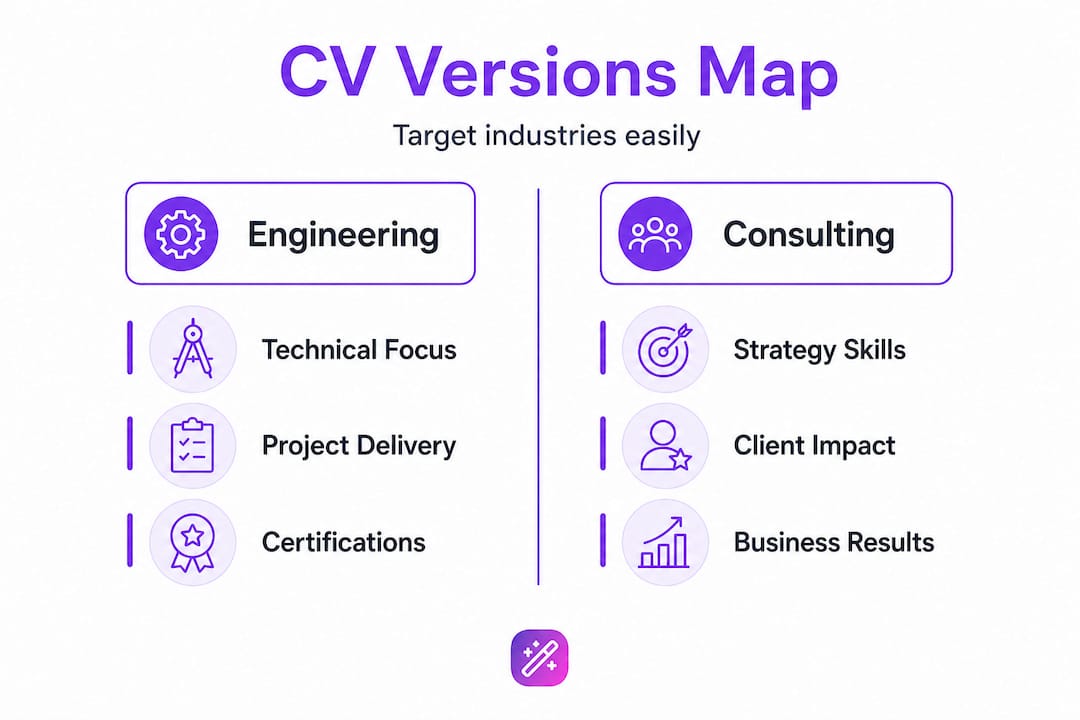
Here’s a practical example of how two versions of the same person’s CV might shift focus:
| Element | Engineering project management CV | Consulting CV |
|---|---|---|
| Summary focus | Delivering technical projects on time and under budget | Driving client value through structured problem-solving |
| Key skills listed | Agile methodology, resource allocation, risk management | Stakeholder management, strategic analysis, client relations |
| Achievement example | “Delivered $2M infrastructure project 3 weeks early” | “Advised 12 clients on operational efficiency, saving 20% in costs” |
| Keywords emphasized | Gantt charts, milestone tracking, cross-functional teams | Frameworks, deliverables, executive presentations |
| Tone | Technical, precise | Strategic, advisory |

This table shows how the same professional can present themselves very differently depending on the role. Neither version is false. Both are true. They’re just focused.
Pro Tip: Create a simple tracking spreadsheet with columns for the employer name, role title, CV version used, date sent, and current status. This prevents you from ever accidentally submitting the wrong version and helps you analyze which CV styles get the best responses.
For specialized roles, looking at consultant CV templates can give you a strong sense of the language and structure that resonates with senior hiring managers in advisory fields. Use the resume checklist approach to verify each version before sending.
Managing, updating, and avoiding pitfalls with multiple CVs
Creating multiple CVs is only half the battle. Keeping them organized, current, and error-free is what separates a systematic job seeker from one who creates chaos for themselves.
Best habits for CV version control:
- Use a consistent naming convention such as “Firstname_Lastname_RoleType_Company_Date”
- Store all versions in clearly labeled folders, sorted by industry or role
- Keep a changelog or notes document for each version, noting what was changed and why
- Set a calendar reminder every three months to review and refresh each active version
- Archive outdated versions in a separate folder rather than deleting them
- Always keep the master CV in a separate, clearly labeled location and never edit it directly
Sending the wrong CV to an employer, especially one that references a competitor or highlights irrelevant skills, can immediately disqualify you. Worse, it signals a lack of attention to detail, one of the most valued traits across almost every profession.
Regularly reviewing CV versions and tracking which ones are sent prevents version confusion and protects your professional reputation. One small slip, like sending your “creative agency” CV to a risk-averse financial firm, can leave a lasting negative impression.
Before you hit send on any application, run through this final checklist:
- Does the CV title and summary match this specific role?
- Are the keywords aligned with the job description?
- Do the listed skills prioritize what this employer asked for?
- Is the file named correctly and is it the right version?
- Have you removed any references to roles or skills irrelevant to this application?
It’s also worth thinking about how employers view your application holistically. Tools that help you avoid common resume pitfalls remind us that small presentation errors carry outsized weight in competitive hiring.
Leveraging an AI-powered CV manager means you don’t have to hold all of this in your head. Smart platforms flag inconsistencies, suggest keyword updates when job descriptions change, and remind you when versions haven’t been reviewed recently. That’s working smarter, not harder.
The overlooked opportunity: How multiple CVs unlock professional growth
Here’s a perspective most articles skip. Building and maintaining multiple CV versions isn’t just a job search tactic. It’s one of the most underrated tools for professional self-awareness.
When you sit down to write a “consulting version” of your CV versus an “operations version,” you’re forced to identify what skills actually transfer across fields, and which ones are specific to a single context. That process is clarifying in a way that casual career reflection rarely is. It reveals gaps you didn’t know existed and strengths you’ve been underselling.
Most people treat tailored CVs as extra work. We’d argue it’s actually the opposite. Every hour you spend sharpening a targeted CV saves you hours of networking, follow-ups, and interviews that go nowhere because you were never the right fit on paper. The signal-to-noise ratio of your job search improves dramatically.
There’s another angle worth considering. Your CV “portfolio” is also a record of your professional identity as it evolves. The version you wrote for a marketing role in 2022 shows you something concrete about who you were professionally then versus who you are now. That historical visibility is genuinely useful for career planning, performance reviews, and even negotiating promotions.
The best job application tips aren’t always about sending more applications. Often, they’re about sending better, more targeted ones, and understanding yourself clearly enough to know which opportunities are actually worth pursuing.
Pro Tip: Even when you’re happily employed and not actively searching, revisit and update each of your CV versions quarterly. The market shifts, your skills grow, and keeping your versions current means you’re never scrambling when an opportunity appears unexpectedly.
Streamline your job applications with Easy CV’s AI tools
Managing and customizing multiple CVs can feel overwhelming when done manually. That’s exactly what Easy CV was built to solve. The platform’s AI-driven features automatically tailor your content to match specific job descriptions, track multiple versions in one place, and optimize your resume for ATS keywords across different industries and roles.
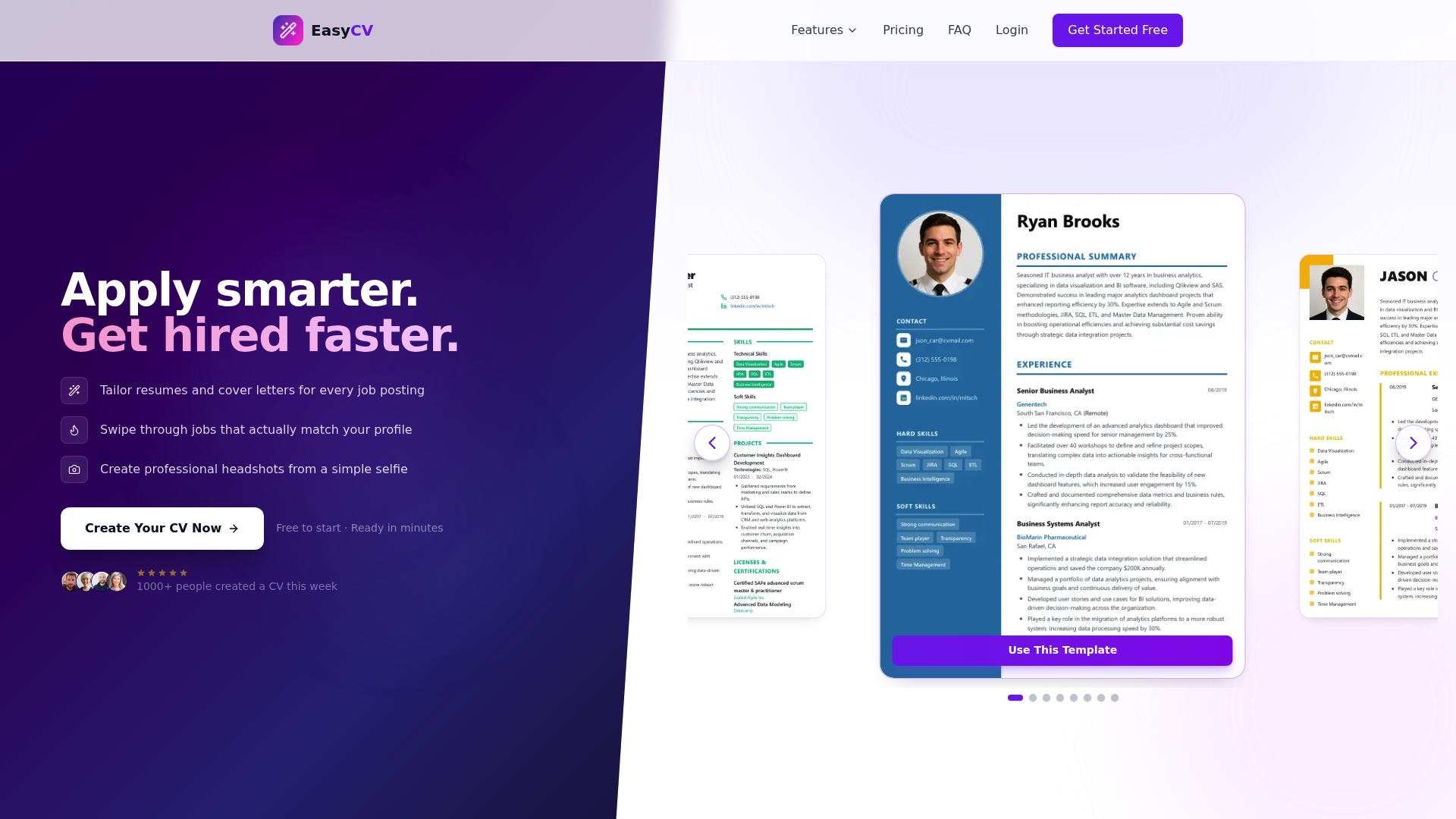
Whether you’re targeting five roles or fifty, Easy CV gives you the infrastructure to do it efficiently. From instant CV duplication and smart keyword suggestions to cover letter generation and job board matching across 10 million listings, every feature is designed to reduce manual work and improve your results. Explore Easy CV’s features to see how quickly you can go from one generic resume to a full, optimized library of targeted CVs ready to send.
Frequently asked questions
How many CV versions should I create for my job search?
Create at least one unique version for each distinct role type or industry you’re targeting. Tailored CVs for different roles consistently boost your overall job search success by increasing relevance and ATS performance.
What’s the best way to organize and manage multiple CV files?
Store each version with a clear, consistent naming convention and organize them in folders by job type or industry. Digital solutions like AI CV builders simplify tracking updates and submissions across all your versions.
How do I update all my CV versions efficiently?
Start by updating your master CV with new skills or experience, then adjust each version’s keywords and section emphasis to match current target job descriptions. Regular updates keep your CVs accurate and competitive across all platforms.
Is it worth making a different CV for every application?
Yes, especially when roles differ meaningfully in required skills or company culture. Tailored resumes significantly improve response rates because they show employers you understand their specific needs.
What happens if I send the wrong CV version by mistake?
You risk appearing generic or even misaligned with the role, which can disqualify you quickly. Always double-check the version name and content before submitting, and use tracking tools to manage your submissions accurately.