Resume keywords: boost your job application success

You spend hours crafting the perfect resume. The formatting is clean, your experience is relevant, and your accomplishments are clearly stated. Yet the callbacks never come. The frustrating truth is that 75% of resumes never reach a human recruiter because they fail an automated screening step most job seekers don’t even know exists. Resume keywords are the hidden layer that separates applications that move forward from those that get quietly discarded, and understanding how to use them changes everything about your job search.
Table of Contents
- What are resume keywords and why do they matter?
- How applicant tracking systems (ATS) scan for keywords
- Smart strategies for choosing and placing keywords
- Avoiding keyword stuffing and common resume pitfalls
- Our take: why resume keywords aren’t just technical tricks
- Take your resume to the next level with Easy CV
- Frequently asked questions
Key Takeaways
| Point | Details |
|---|---|
| Keyword precision | Use keywords exactly as described in the job posting for better ATS matching. |
| Context over quantity | Avoid keyword stuffing; use keywords naturally within your resume’s flow. |
| Strategic placement | Include keywords in multiple sections such as skills, experience, and education. |
| Abbreviations matter | Use both abbreviations and full forms of industry-relevant terms. |
| Authenticity wins | Keywords should authentically reflect your real skills and experience, not just game ATS filters. |
What are resume keywords and why do they matter?
Let’s start with a clear definition. Resume keywords are the specific words and phrases recruiters and ATS systems use to filter and search candidates for job-relevant skills, tools, certifications, and related experience. They function like a matching code between what employers need and what your resume communicates.
Think of it this way: a recruiter posting a job for a “Digital Marketing Manager” has a very specific picture in mind. They want someone who knows SEO, Google Analytics, paid social campaigns, and content strategy. When they (or the software they rely on) scan your resume, they’re looking for those exact terms. If your resume says “online advertising” instead of “paid social” or “website traffic” instead of “SEO,” you may be describing the same skills but speaking a different language.
“Resume keywords are the specific words and phrases recruiters and ATS systems use to filter and search candidates for job-relevant skills, tools, certifications, and related experience.” — Indeed Career Advice
Keywords typically fall into a few key categories:
- Hard skills: Software, tools, programming languages, platforms (e.g., Python, Salesforce, Adobe Premiere)
- Soft skills: Communication, leadership, cross-functional collaboration
- Certifications and credentials: PMP, CPA, AWS Certified, Six Sigma
- Job titles: Senior Analyst, Product Manager, UX Designer
- Industry terms: Agile methodology, HIPAA compliance, financial modeling
The reason these matter so much comes down to how modern hiring works. Most companies with more than 50 employees use some form of ATS, or applicant tracking system, to manage the flood of incoming applications. These systems filter, rank, and organize candidates before a human ever reads a single line. Good job application tips always start with making sure your resume speaks the language these systems understand.
How applicant tracking systems (ATS) scan for keywords
ATS software doesn’t read your resume the way a human does. It parses text, searches for specific strings of words, and assigns your application a relevance score based on how well it matches the job description. This is why exact wording matters far more than most applicants realize.
Here’s a simple example. A job posting asks for experience with “project management” and lists “PMP certification” as a preferred qualification. If your resume says “managed projects” but never mentions “project management” or “PMP,” the ATS may rank you lower than a candidate who used the exact terms, even if your actual experience is stronger.
Exact wording matters for ATS matching, including abbreviations versus full forms. For example, writing “MFA” and “Master of Fine Arts” means different things to some systems, so using both versions is often the safest approach. The same applies to job titles: “VP of Sales” and “Vice President of Sales” may or may not match the same query depending on how the ATS is configured.
| Issue | What goes wrong | Quick fix |
|---|---|---|
| Abbreviation only | ATS misses full-form searches | Include both: “SEO (Search Engine Optimization)” |
| Synonym mismatch | Your word differs from job post | Mirror job posting language exactly |
| Spelling variation | Typos or alternate spellings | Proofread and use consistent standard spelling |
| Missing job title | ATS can’t confirm role match | Use the exact job title from the posting |
| Generic soft skills | Too vague to trigger match | Add specific context (“cross-functional team leadership”) |
Pro Tip: Copy the job description into a word frequency tool or simply highlight repeated terms. The words that appear most often are the keywords the employer values most.
Formatting also affects how well the ATS can read your resume. Unusual fonts, text boxes, headers in the document’s header/footer sections, and tables can confuse parsing software. Your AI-optimized resume checklist should always include a clean, ATS-friendly layout before worrying about keyword density. You can also improve your CV with AI tools that automatically flag formatting conflicts, and choosing the right resume templates for job search success means picking designs that look professional to humans without confusing the machines.
Smart strategies for choosing and placing keywords
Now that you understand the mechanics, let’s talk about building a keyword strategy that actually works. This isn’t about gaming a system. It’s about communicating your real qualifications in the language employers use to search for candidates.
The most reliable source of keywords is the job posting itself. Read it carefully and note:
- Required skills and tools listed in the qualifications section
- Repeated phrases that appear in multiple parts of the posting
- Job title variations mentioned in the role description
- Certifications and education requirements specifically named
- Action verbs used to describe responsibilities (“led,” “developed,” “implemented”)
Beyond individual job postings, research the broader industry. Look at 10 to 15 job descriptions for the same role across different companies. The terms that show up consistently are your core keywords. These are non-negotiable for your resume. Terms that appear in only some postings are secondary keywords worth including if they apply to your background.
Resume keywords should be positioned where ATS systems and recruiters both look first. Here’s how to think about placement:
- Resume headline or summary: Use 3 to 5 high-priority keywords here. This section gets read by both humans and ATS immediately.
- Skills section: This is your keyword hub. Group relevant technical and functional skills clearly.
- Work experience bullet points: Weave keywords naturally into achievement-based descriptions.
- Education and certifications: Spell out degree names and certifications in full, plus add abbreviations if commonly used.
A statistic worth knowing: recruiters spend an average of just 7 seconds on an initial resume review. That means the keywords in your headline and skills section carry enormous weight in those first moments.
Solid job board strategies always emphasize tailoring your resume for each application. A single master resume with a generic keyword set won’t perform as well as a version tuned to each specific posting. It takes more effort but dramatically improves your hit rate.
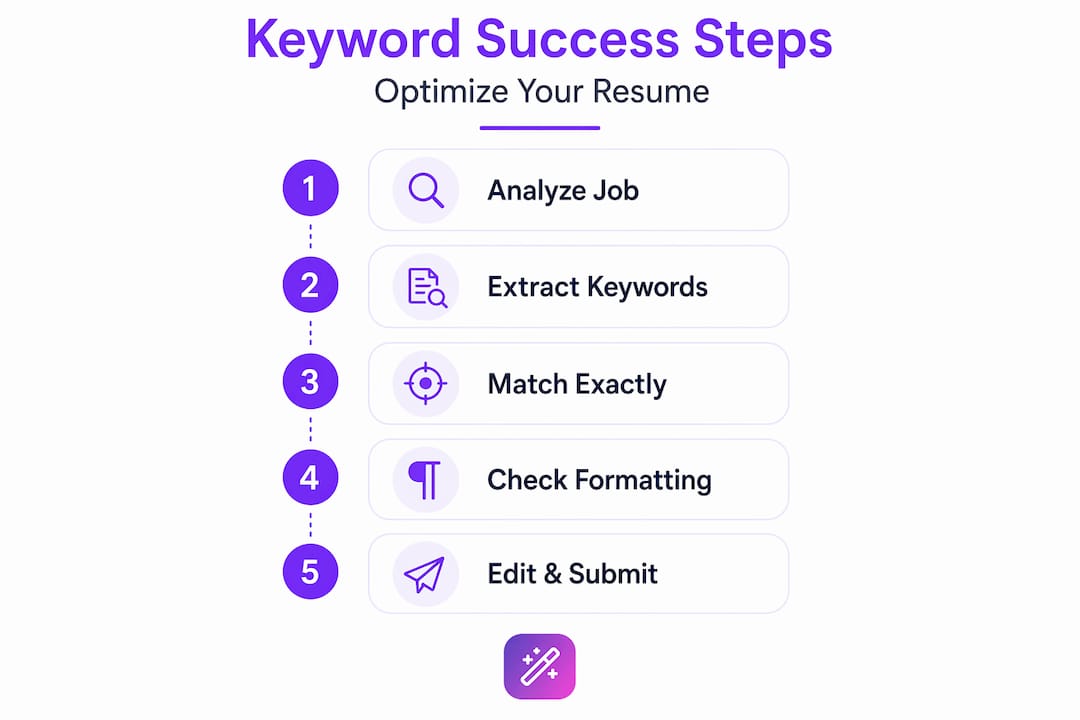
Pro Tip: Don’t rely solely on job postings. LinkedIn job posts, professional association websites, and industry publications all use the terminology hiring managers recognize. Mining these sources gives you a broader, more accurate picture of what keywords matter in your field.
Avoiding keyword stuffing and common resume pitfalls
Here’s where many job seekers overcorrect. Once they discover keywords matter, they start packing their resume with every relevant term they can think of, repeating phrases in every section, and sometimes even hiding white-text keywords on their resume in hopes of tricking the ATS. This approach backfires badly.

Keyword stuffing, which means repeating keywords unnaturally or using hidden text, is actively discouraged and can harm both ATS parsing and human perception. Modern ATS software is sophisticated enough to detect unnatural repetition. And if your resume does reach a recruiter, a clunky, keyword-stuffed document reads as unprofessional and even dishonest.
The better approach is what some recruiters call “keywords plus proof.” Here’s what that looks like in practice:
- State the keyword, then back it up. Instead of “project management, project management, PMP,” write “Led cross-departmental projects using Agile methodology, delivering results 15% under budget.”
- Use natural synonyms. If a keyword appears three times in your resume already, find a contextually accurate synonym for additional mentions.
- Anchor keywords to measurable results. “Improved SQL query efficiency” is far more credible than “SQL, SQL database management, SQL optimization” crammed into a skills list.
- Keep your skills section focused. List genuinely relevant tools and competencies, not every buzzword you’ve ever encountered.
- Read your resume out loud. If a sentence sounds awkward or robotic when spoken, it probably reads that way too. Revise it.
“Better practice is ‘keywords + proof’ in context. Provide evidence of skills rather than simply listing terms repeatedly.” — Indeed Career Advice
Common mistakes job seekers make include using only generic soft skills (“hard worker,” “team player”) without specific context, copying and pasting entire sections of the job description into their resume, and failing to update keywords when applying to roles in different industries or at different seniority levels.
Leveraging AI resume automation tools helps you catch these mistakes before they cost you an interview. Smart platforms analyze your resume against the job description, flag missing keywords, and suggest natural ways to include them without forcing awkward phrasing. When you’re ready to present your polished result, choosing from strong resume templates for 2026 ensures your formatting reinforces rather than undermines your carefully optimized content.
Our take: why resume keywords aren’t just technical tricks
We want to offer a perspective you won’t find in most keyword guides: the best resume keywords aren’t chosen to fool an algorithm. They’re chosen because they accurately describe who you are as a professional.
Here’s the uncomfortable truth about keyword optimization that most career blogs won’t say plainly. A perfectly keyword-matched resume gets you the interview. But if your actual experience doesn’t back up those keywords, you’ll fail the interview, sometimes painfully. The candidates who succeed long-term are the ones whose keyword choices reflect genuine expertise.
What does this mean practically? When you look at a job description and decide which keywords to include, you’re also performing a self-assessment. If the posting heavily emphasizes “data-driven decision making” and your experience doesn’t include meaningful examples of that, adding the phrase to your resume is a short-term gambit that leads to a long-term problem. But if you genuinely do this work and simply haven’t used that exact phrase on your resume, adding it is accurate and essential.
We also think there’s a broader benefit to keyword research that most people overlook. The process of studying job descriptions and identifying patterns teaches you what the market actually values right now. If you’re seeing “machine learning” mentioned across every data analyst posting, that’s a signal about where the industry is heading. That information is useful for your career development, not just your resume writing.
Finally, don’t forget that keywords matter beyond just your resume. Cover letter optimization with the same targeted language reinforces your candidacy at every stage of the screening process. Recruiters who see consistent, professional terminology across your full application package feel more confident that you’re a genuine match, not just someone who gamed a checklist. Connect your keywords to real stories, real results, and real skills, and the algorithm becomes a gateway rather than a gatekeeper.
Take your resume to the next level with Easy CV
Understanding keywords is one thing. Implementing them quickly and accurately across every application is another challenge entirely, especially when you’re applying to multiple positions at once.
EasyCV.ai is built specifically to close this gap. The platform uses AI to analyze job descriptions, identify the keywords that matter most for each role, and help you incorporate them naturally into your resume without keyword stuffing. Whether you’re applying to your first job or targeting a senior leadership role, the Easy CV features include ATS optimization, tailored resume generation, cover letter creation, and access to over 10 million job listings so you’re always working from the most relevant job language. Stop guessing which keywords matter and start building resumes that get noticed.
Frequently asked questions
What are the best types of resume keywords to use?
Include job-specific skills, tools, certifications, and relevant experience taken directly from the job description for maximum ATS visibility, as these terms are exactly what recruiters and automated systems search for.
Should I use both abbreviations and full forms of keywords?
Yes, using both versions increases your chances to match ATS search criteria because exact wording including abbreviations versus full forms directly affects whether your resume gets flagged as a match.
How many keywords should I include in my resume?
Use enough to accurately describe your skills and fit the job, but keyword stuffing harms both ATS performance and recruiter perception, so place them in context rather than overloading your resume.
Do resume keywords change depending on the industry?
Yes, industry-specific terms are crucial and should match the jargon and required skills of each sector because different phrasing can cause you to miss ATS matches even when your real experience is a strong fit.