How job boards shape your job application success

You submit your resume, wait a week, and hear nothing. No rejection, no interview, no acknowledgment that you even exist. This isn’t bad luck. It’s the predictable result of how job boards actually work. Applications are often mediated by automated tracking systems that filter, sort, and sometimes discard resumes before a single human being reads them. Understanding this reality is the first step toward building an application strategy that actually gets results.
Table of Contents
- How job boards facilitate the application process
- Understanding how search behavior influences results
- Sector-specific shifts: When and where to apply
- Optimizing your CV and cover letter for application success
- Job boards vs. personalized recruitment experiences
- A fresh perspective: Why job board applications often disappoint—and what actually works
- Take your next step: Tools and resources for better job board outcomes
- Frequently asked questions
Key Takeaways
| Point | Details |
|---|---|
| Job boards are intermediaries | Most job boards distribute and collect applications but rely on ATS systems that can reduce feedback to candidates. |
| Strategic application behavior matters | Sending relevant, well-timed applications improves your chances of getting interviews and job offers. |
| Adapt strategy by sector | Competitiveness and volume differ by industry, so tailor your job board approach accordingly. |
| Personalized documents stand out | Optimized resumes and cover letters mapped to job descriptions are more likely to clear ATS filters. |
| Personalized journeys outperform generic boards | Guided application experiences with landing pages often yield higher conversion than traditional job boards. |
How job boards facilitate the application process
Job boards are essentially digital marketplaces. They aggregate job postings from thousands of employers, make them searchable, and allow candidates to submit applications in one place. That convenience is real and valuable. But the process behind the scenes is far more complex than most job seekers realize.
When you click “Apply,” your resume doesn’t land on a recruiter’s desk. It typically enters an Applicant Tracking System, or ATS, which is software that parses your document, extracts information, and scores your fit against the job description. The ATS might reformat your resume, strip out design elements, or flag missing keywords before a human ever sees it.
Here’s what that means in practice:
- Your formatting matters less than your keywords. A beautifully designed resume can actually confuse an ATS if it uses unusual fonts, tables, or graphics.
- Context gets lost. A career change that makes perfect sense in conversation looks confusing to a machine scanning for job titles.
- Feedback rarely comes. Most candidates receive an automated confirmation email and nothing else.
As research on job board impact confirms, job boards primarily distribute listings and collect large volumes of applications, but the transaction between candidate and recruiter is often mediated by ATSs, which can strip context and reduce feedback to candidates.
“Job boards are not hiring platforms. They are application collection platforms. The hiring still happens between humans, but only after the machines have done their filtering.”
This distinction matters enormously. When you treat a job board as a direct line to a recruiter, you set yourself up for frustration. When you treat it as a first filter to pass, you start making smarter decisions about how you present yourself.
Understanding how search behavior influences results
Understanding job board mechanics is only step one. Let’s explore how your approach to search and application volume can make or break your results.

A common instinct is to apply to as many jobs as possible. The logic seems sound: more applications mean more chances. But the data tells a more nuanced story. Job finding probabilities and interview and offer outcomes depend heavily on search behavior and the timing and number of applications across an unemployment spell, not just raw volume.
This finding comes from a dataset covering 58,000 job diaries, more than 600,000 applications, and 15,000 job seekers. The scale of this research makes it one of the most credible sources on real application behavior available today.
| Search behavior | Impact on outcomes |
|---|---|
| High volume, low relevance | Lower interview conversion rate |
| Moderate volume, high relevance | Higher interview and offer rate |
| Early application timing | Better outcomes before posting saturation |
| Consistent search activity | More stable job finding probability |
What this data reveals is that quality and relevance consistently outperform sheer quantity. Applying to 50 loosely matched jobs produces worse results than applying to 15 well-matched ones. The reason is simple: when your resume closely matches a job description, it scores higher in the ATS, and it resonates more with the recruiter who eventually reviews it.
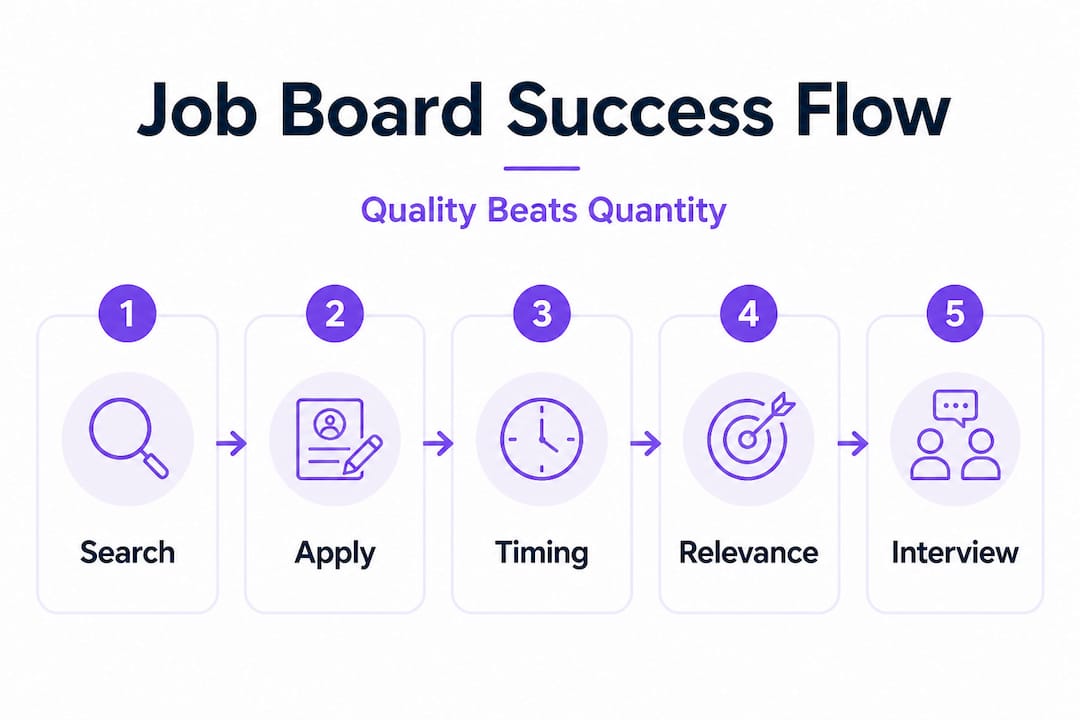
Timing also plays a significant role. Jobs posted within the last 24 to 48 hours tend to receive the most recruiter attention. Applying early, before a posting accumulates hundreds of responses, puts you in a smaller pool and increases your visibility.
Here are the behaviors that actually move the needle:
- Apply within 48 hours of a posting going live. Early applicants face less competition and often get faster responses.
- Match at least 70 to 80 percent of the listed requirements. Applying to jobs where you meet fewer qualifications wastes time and lowers your overall conversion rate.
- Track your applications systematically. Knowing which roles you’ve applied to, when, and with which version of your resume helps you identify patterns in what’s working.
- Revisit and refine your approach every two weeks. If you’re not getting responses, something in your materials or targeting needs to change.
For more targeted guidance on building applications that actually get noticed, the stand-out application tips at EasyCV.ai break down the process step by step.
Sector-specific shifts: When and where to apply
Once you’ve planned your search behavior, the next step is to recognize how labor market shifts affect competitiveness and approach.
Not all job boards perform equally across industries. The number of applications per job posting varies dramatically depending on the sector, the platform, and current economic conditions. Sector-level shifts in the average number of applications started per job posting show that some industries are becoming more competitive while others are seeing declining candidate interest.
| Sector | Application trend | Competitiveness level |
|---|---|---|
| Technology | Increasing applications per posting | Very high |
| Healthcare | Moderate growth, persistent shortages | Moderate |
| Retail and hospitality | Declining applications in some markets | Lower |
| Finance and accounting | Stable with seasonal spikes | High |
| Manufacturing | Mixed, varies by region | Moderate |
Understanding these dynamics helps you calibrate your expectations and your effort. If you’re applying in a high-competition sector like technology, you need to be more aggressive about tailoring your resume and applying early. In sectors with labor shortages, a well-structured resume may be enough to get you noticed even without perfect keyword optimization.
Platforms matter too. LinkedIn, Indeed, Glassdoor, and niche job boards each attract different candidate pools and employer types. A role posted on a specialized engineering platform will attract fewer but more qualified applicants than the same role posted on a general job board. Choosing the right platform for your industry is a strategy decision, not just a convenience choice.
For a broader view of how nearshore recruiting strategies are reshaping talent acquisition, it’s worth understanding that employers are increasingly looking beyond traditional job boards to find candidates, which means your visibility across multiple channels matters more than ever.
Pro Tip: Set up job alerts on two or three platforms specific to your industry rather than monitoring every major job board. This keeps your search focused and ensures you see relevant postings early enough to apply before the competition builds up.
Practical guidance on using AI CV tips to adapt your materials for different sectors can save significant time while improving your match rate across platforms.
Optimizing your CV and cover letter for application success
Having understood application dynamics, here’s how you can make your application materials stand out in ATS-mediated environments.
Because ATSs mediate job board submissions and can remove context, candidates benefit from submitting documents that explicitly map their experience to the job description using keywords, structure, and evidence, rather than relying on generic resumes. This is one of the most actionable insights available to job seekers today.
Here’s a step-by-step approach to optimizing your resume and cover letter for each application:
- Read the job description carefully and highlight every specific skill, tool, and qualification mentioned. These are the keywords the ATS is scanning for.
- Mirror the language used in the posting. If the employer says “project management,” use that exact phrase, not “managing projects” or “coordinating teams.”
- Structure your resume with clear, standard section headings. Use “Work Experience,” “Education,” and “Skills” rather than creative alternatives like “My Journey” or “What I Bring.”
- Quantify your achievements wherever possible. “Increased sales by 23 percent over six months” tells a much clearer story than “improved sales performance.”
- Tailor your cover letter to address the specific role and company. A generic cover letter signals low effort and reduces your chances of standing out.
- Remove graphics, photos, and unusual formatting from your resume. These elements often confuse ATS parsers and can cause your information to be misread or lost entirely.
- Save your resume as a standard PDF or Word document. Some ATSs struggle with other file formats, and a formatting error at this stage can cost you the opportunity.
The AI-optimized resume checklist at EasyCV.ai walks through each of these steps in detail, with specific examples of what works and what doesn’t in modern ATS environments.
Your cover letter deserves equal attention. Many job seekers treat it as an afterthought, but a well-crafted cover letter can compensate for gaps in your resume and provide the context that the ATS strips away. Strong cover letter optimization tips focus on connecting your specific experience to the employer’s stated needs, not just summarizing your resume in paragraph form.
Pro Tip: Create a master resume with all your experience and skills, then build tailored versions for each application by selecting and reordering content to match the specific job description. This approach saves time while ensuring every submission is genuinely customized.
Job boards vs. personalized recruitment experiences
To wrap up the main body, let’s contrast job boards with newer, personalized alternatives and their impact on the candidate experience.
Generic job boards are efficient for employers who want to reach large numbers of candidates quickly. But efficiency for employers doesn’t always translate into a good experience for candidates. For application systems to be effective, they must be integrated into a candidate journey that reduces friction. Some recruitment professionals argue that generic job boards underperform personalized landing page experiences in terms of conversion and candidate quality.
Personalized recruitment experiences work differently. Instead of a generic “Apply Now” button on a job board, candidates are guided through a process that explains the role, the company culture, and the specific expectations in detail. This context helps candidates self-select more accurately, which means fewer mismatched applications and higher quality conversations.
Here’s what sets personalized recruitment experiences apart from generic job boards:
- Focused information architecture. Candidates see only what’s relevant to the role they’re applying for, reducing distraction and confusion.
- Guided application flows. Step-by-step prompts help candidates provide the information employers actually need, rather than submitting a one-size-fits-all resume.
- Faster response times. Employers using personalized systems tend to move candidates through the process more quickly because the initial screening is more accurate.
- Better candidate experience. When applicants feel informed and respected during the process, they’re more likely to complete the application and accept offers.
Pro Tip: When you encounter a job posting that links to a dedicated career page or personalized application portal rather than a generic job board, treat it as a higher-quality opportunity. These employers have invested in their candidate experience, which often signals a more organized and respectful hiring process overall.
Exploring the full range of Easy CV features can help you prepare materials that work effectively in both traditional job board environments and more personalized application systems.
A fresh perspective: Why job board applications often disappoint—and what actually works
Here’s the uncomfortable truth that most job search advice avoids: job boards are designed to serve employers, not candidates. They make money by selling access to large pools of applicants. The more applications submitted, the better the platform’s value proposition to hiring companies. Your experience as a candidate is largely incidental to this business model.
This explains why candidates often hear nothing after submitting applications, with feedback stripped by ATSs. The system isn’t broken. It’s working exactly as designed, just not in your favor.
The job seekers who get the best results from job boards are the ones who understand this dynamic and work around it. They don’t rely on job boards as their only strategy. They use job boards as one channel among several, combining online applications with direct outreach to hiring managers, networking through professional contacts, and building a visible online presence.
They also invest time in resume automation insights and AI-powered tools that allow them to tailor documents quickly without sacrificing quality. The goal isn’t to apply to more jobs. It’s to apply to the right jobs with materials that are genuinely optimized for each specific opportunity.
The candidates who struggle most are those who submit the same generic resume to dozens of postings and wait for the phone to ring. Volume without strategy is just noise. The job market rewards precision, relevance, and persistence, not just effort.
Take your next step: Tools and resources for better job board outcomes
Knowing the mechanics of job boards is one thing. Having the tools to act on that knowledge is another.
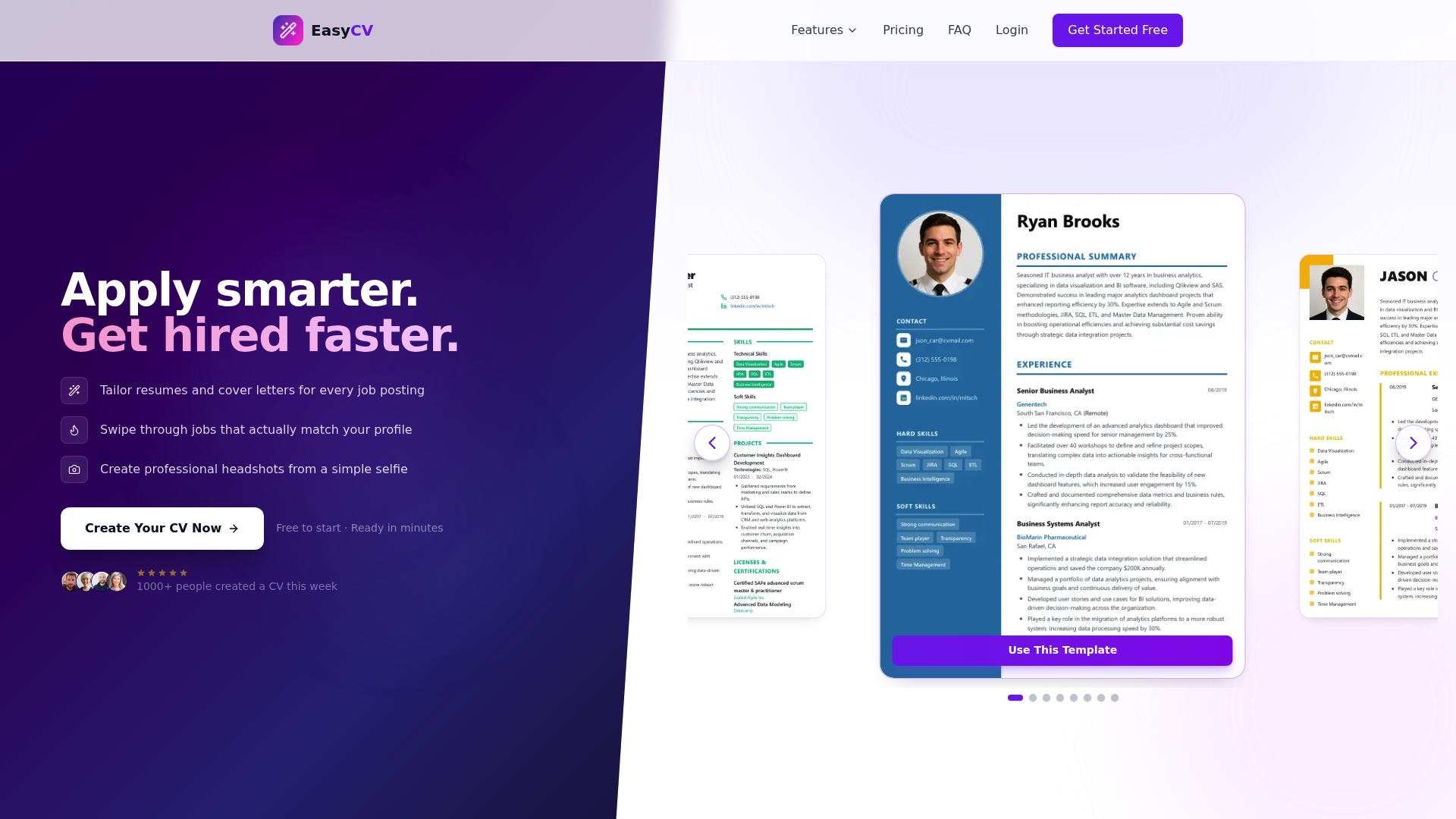
EasyCV.ai gives you everything you need to build application materials that perform in ATS-mediated environments. The Easy CV resume builder uses AI to analyze job descriptions and suggest targeted edits to your resume in real time, ensuring your keywords, structure, and content align with what each specific employer is looking for. You can create multiple tailored resume versions, generate optimized cover letters, and track your applications all in one place. The platform’s full feature set also includes AI headshots, resume translation, and job matching across millions of live postings, giving you a genuine edge at every stage of the process.
Frequently asked questions
Do job boards guarantee that recruiters see my application?
No. Applications are typically filtered by ATSs before reaching a recruiter, and many are screened out automatically without any human review.
Is sending more applications through job boards always better?
Not necessarily. Job finding outcomes depend more on the quality, relevance, and timing of your applications than on raw volume.
How can I tailor my resume for job board applications?
Align your resume and cover letter with the job description by using relevant keywords, clear structure, and specific evidence, since candidates who map their experience directly to job requirements consistently outperform those using generic documents.
Do some industries see better results from job boards than others?
Yes. Sector-level application trends vary significantly, with some industries seeing rising competition per posting and others experiencing declining candidate interest, so adjusting your strategy by sector is essential.
Recommended
- How job boards shape your application success | Easy CV
- Easy CV Blog
- Best job application tips: Stand out and land interviews | Easy CV
- How to Improve Your CV for Job Boards with AI Tools | Easy CV
- Job Search Tips to Win in 2026’s Brutal Hiring Market
- Best AI Career Tools for Developers | Accelerate Your Pivot to AI Engineering