Why use a resume builder: land more job interviews faster

You send out application after application, and the silence is deafening. Your qualifications match the job description, your experience is relevant, and yet the callbacks never come. This frustrating experience is remarkably common, and the reason is rarely what most people think. Modern hiring relies on semantic similarity models that evaluate how well your resume aligns with a job description at a conceptual level, not just a keyword level. Understanding this shift is the first step toward fixing it.
Table of Contents
- The hidden complexity of modern resume screening
- How resume builders solve these challenges
- Tailoring for every job: Beyond templates and keywords
- Who benefits most from using a resume builder?
- What most job seekers miss about resume builders
- Build your winning resume today with Easy CV
- Frequently asked questions
Key Takeaways
| Point | Details |
|---|---|
| AI screens your resume | Applicant tracking systems use advanced models that go beyond keywords, so proper structure and relevance are critical. |
| Resume builders boost success | A resume builder makes it easy to produce ATS-friendly, job-targeted resumes, saving you time and raising your chances of being noticed. |
| Personalize your impact | To stand out, use builder tools as a foundation but refine your content with measurable achievements and your unique story. |
| Works for all job seekers | Whether you’re a new grad or switching careers, resume builders streamline the process and close key gaps. |
The hidden complexity of modern resume screening
Having set the stage, let’s look at why so many applicants don’t make it past the first cut.
Applicant Tracking Systems, or ATS, have been part of hiring for years. But what most job seekers don’t realize is that these systems have evolved dramatically. An ATS no longer simply scans for exact keyword matches. Today’s screening tools use AI in resume screening that applies machine learning and natural language processing to judge whether your resume semantically aligns with a job posting. In plain terms, the software understands context, not just words.
Here’s what that means for you:
- A resume that says “led cross-functional initiatives” may score lower than one that says “managed collaboration across product, engineering, and marketing teams” simply because the second phrasing is closer to the job description’s language.
- Formatting errors like unusual fonts, text boxes, graphics, or non-standard section headers can cause an ATS to misread your content entirely.
- Resumes without clear structure (distinct sections for experience, education, and skills) confuse parsing engines, resulting in partial data being captured and a lower overall match score.
- Using outdated terminology in your field can signal a skills gap even when no such gap exists.
“ATS and AI screening tools don’t just count keywords anymore. Transformer-based models evaluate the full context of your resume, comparing it to job descriptions at a semantic level. Even highly qualified candidates can fail this filter if their language doesn’t mirror the employer’s framing.”
The research backs this up. Transformer-based embeddings for resume-to-job description matching show improvements of up to 15.85% in nDCG and 15.94% in RBO over conventional keyword-based ATS approaches. Those are not small margins. That gap in performance directly translates to the gap between candidates who get interviews and those who don’t. Most applicants have no idea this is happening to them.
Skilled professionals are filtered out daily because their resumes are formatted incorrectly, use slightly different phrasing than what the employer posted, or lack the structural clarity these tools expect. It’s a technical problem hiding as a confidence problem.

How resume builders solve these challenges
Now that you know what stands in your way, let’s see how a resume builder changes your odds.
A resume builder is software that guides you through creating a professional resume with pre-structured formatting, AI-driven content suggestions, and built-in ATS optimization. The difference between a manually crafted resume and a builder-crafted one becomes clear when you compare them on the factors that matter most.
| Factor | Manual resume | Builder-crafted resume |
|---|---|---|
| ATS-safe formatting | Often inconsistent | Guaranteed clean output |
| Keyword optimization | Depends on job seeker’s awareness | AI-assisted alignment |
| Section structure | Varies widely | Standardized and complete |
| Time to create | 3–6 hours average | 15–30 minutes |
| Multiple versions | Time-consuming to manage | Easy to duplicate and edit |
| Export formats | Limited by your tools | PDF, Word, and more |
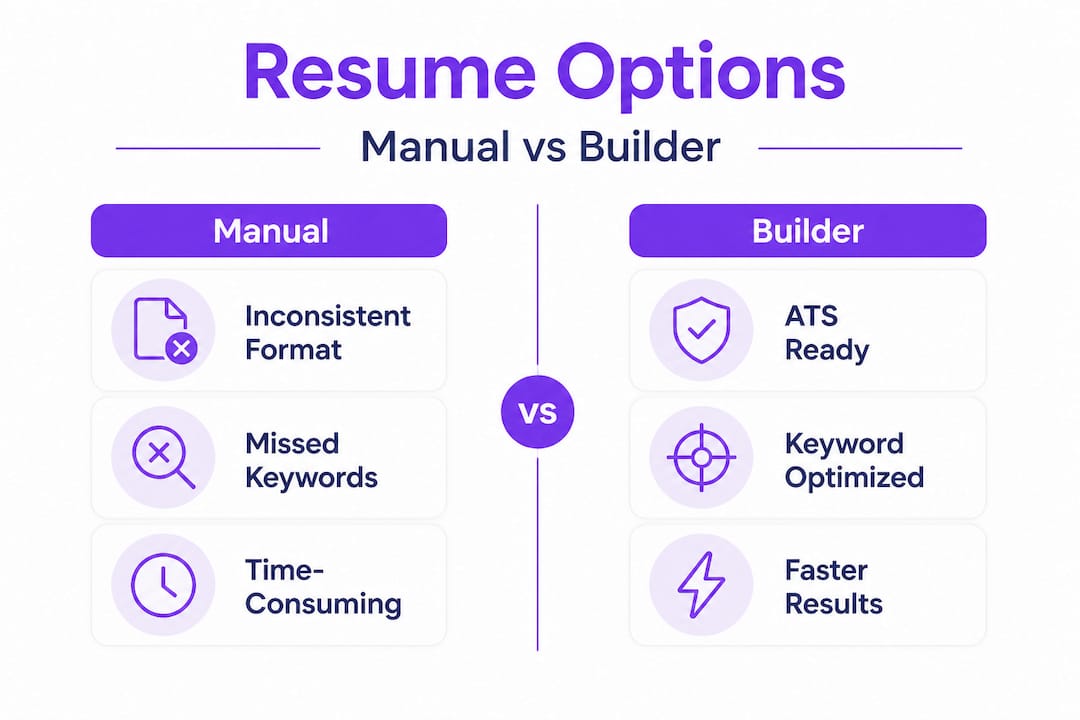
The improvements don’t stop at formatting. Because matching resumes to job descriptions now involves semantic similarity models rather than simple keyword overlap, builders that use AI to suggest and refine language give you a measurable edge. These tools can analyze the job posting and prompt you to include the right terminology, phrasing, and skill framing that aligns with what the employer’s system is actually evaluating. An AI-optimized resume checklist can help you confirm each element is properly covered.
Here’s a step-by-step look at how a quality resume builder works in practice:
- Import the job description. Paste the posting directly into the platform. The AI analyzes the language, required skills, and role-specific terminology.
- Select a template. Choose from using professional resume templates that are pre-tested for ATS parsing and visual clarity.
- Fill in your experience. The builder prompts you for the right information in the right places. No guesswork about what sections to include or how to label them.
- Optimize your language. AI suggestions help you align your descriptions with the job posting’s vocabulary and tone.
- Export and apply. Download in the format the employer requests, whether that’s a PDF, Word document, or plain text.
Pro Tip: Don’t accept every suggestion the builder generates. Replace generic filler phrases like “responsible for managing projects” with specific, measurable achievements such as “reduced project delivery time by 22% over six months.” Builders set the structure; you provide the substance that makes the difference.
Tailoring for every job: Beyond templates and keywords
While builders tackle the technical gaps, let’s explore how to go beyond the basics for a compelling, unique application.
Resume builders are excellent at solving the structural and formatting problems that cause automated rejections. But the best candidates combine tool efficiency with genuine personalization. Understanding what builders get right and where they stop is key to maximizing your results.
What resume builders get right:
- Clean, parseable formatting that no ATS will reject on structure alone
- Section completeness, ensuring you don’t accidentally omit skills, education, or a professional summary
- Language prompts that push you toward job-specific terminology
- Version control, making it easy to maintain separate tailored resumes for different industries or roles
What you still need to bring yourself:
- Your personal story: why you moved from one role to another, what drives your career decisions, and where you’re heading
- Quantified evidence of your impact: percentages, dollar amounts, team sizes, timelines
- Industry-specific nuance that generic templates can’t anticipate
- An authentic tone that sounds like a real person, not a list of buzzwords
| Resume element | What a builder handles | What you must add |
|---|---|---|
| Formatting and structure | Complete | N/A |
| Keyword alignment | Partial to complete | Verify against specific posting |
| Work experience bullets | Framework provided | Metrics and specific results |
| Professional summary | Template generated | Your unique career narrative |
| Skills section | Suggested categories | Honest and accurate entries |
The practical approach for recent grads and career switchers is clear: use a builder to quickly generate an ATS-safe structure and job-specific keyword coverage, but replace generic language with evidence-driven bullets and a clear explanation of your transferable value. That “narrative” step, telling the reader who you are and why you’re a strong fit beyond what a checklist can show, is something no builder will do for you automatically.
Think about adapting your CV for job boards as a two-phase process. Phase one is the technical pass: correct formatting, right keywords, complete sections. A builder handles that efficiently. Phase two is the human pass: would a real hiring manager read this and feel excited to meet you? That requires editing with intention.
Pro Tip: After generating your resume with a builder, read it out loud. If a sentence sounds robotic or vague, that’s your cue to rewrite it. Hiring managers often spend less than 10 seconds on an initial read, so every bullet needs to earn its place. The tips for standing out go beyond formatting and into the mindset of the recruiter.
Storytelling doesn’t mean writing a novel in your experience section. It means that each bullet point builds a coherent picture of someone who creates results and solves problems. “Managed a team” becomes “led a five-person team that shipped a product update two weeks ahead of schedule, increasing user retention by 18%.” That single sentence tells a story, includes evidence, and speaks the language of business outcomes.
Who benefits most from using a resume builder?
Knowing how to tailor your resume, let’s pinpoint who stands to gain the most from these tools.
Resume builders are not one-size-fits-all, but they do deliver measurable value across a wide range of job seekers. The common thread is this: anyone who wants to send more applications, get more responses, and spend less time reformatting the same document over and over will benefit.
-
Recent graduates entering the job market. A new grad often has little formal experience but may have internships, projects, volunteer work, and coursework that are genuinely valuable. The challenge is presenting that material in a way that reads as professional and complete. A builder provides the scaffold, prompting you to include a skills section, a summary, relevant coursework, and project descriptions in a format employers actually expect. The ATS-safe structure and keyword coverage a builder generates means your application won’t be dismissed before a human ever sees it.
-
Career changers pivoting to a new industry. If you’re moving from teaching to instructional design, from retail management to operations, or from military service to corporate work, you have transferable skills that are genuinely valuable but hard to communicate in traditional formats. A resume builder helps you restructure your experience around skills and outcomes rather than job titles and chronology. You can quickly generate a targeted version for each type of role you’re pursuing, saving hours of reformatting and reducing the risk of sending a resume that reads like it belongs to a different industry. Pairing this with competitive resume templates designed for specific fields gives you an immediate visual and structural edge.
-
Experienced professionals targeting advancement. A senior professional aiming for a director or VP-level role faces a different problem: their resume is often too long, too broad, or written for the job they have rather than the job they want. Resume builders help focus content, suggest stronger language, and ensure that a decade or more of experience is organized in a way that communicates leadership and strategic thinking rather than just task completion. They also make it easy to create targeted versions for different companies without losing your master document.
-
Anyone applying at high volume. If you’re sending 10, 20, or 30 applications in a short period, manually customizing each resume is exhausting and impractical. A builder dramatically reduces the time per application, letting you maintain quality and personalization at scale. This matters most during competitive job markets when speed and volume both count.
The time savings across all these scenarios are not trivial. The difference between spending three hours on a single resume and 20 minutes on a targeted, polished version is the difference between applying to five jobs a week and applying to 25.
What most job seekers miss about resume builders
Most guides treat resume builders as either magic solutions or oversimplified shortcuts. Neither framing is accurate, and both lead job seekers to use these tools incorrectly.
The honest perspective: resume builders are productivity multipliers, not story generators. They eliminate the friction of formatting, reduce the risk of ATS rejection, and help you cover the structural bases that most people miss. That’s genuinely valuable, and it’s not nothing. But the candidates who get interviews are not those who used a builder. They’re the ones who used a builder and brought something real to the content.
Here’s what we’ve seen repeatedly: job seekers generate a clean, well-formatted resume using a builder, feel satisfied with how professional it looks, and then wonder why callbacks remain sparse. The reason is almost always that the content inside the clean container is still generic. “Experienced in project management” is not an achievement. “Delivered 14 consecutive projects on time and under budget across a two-year period” is. One sounds like a job description restatement; the other sounds like a result.
The most common mistake is treating the builder’s output as finished rather than as a strong first draft. A detailed resume checklist after you finish building is not optional. It’s the step where you audit each bullet for specificity, remove vague language, confirm your narrative is coherent, and check that the overall document tells the story of someone who delivers value.
The people who get the best results from resume builders use them the same way a skilled carpenter uses power tools. The tool accelerates the work and ensures precision. The carpenter still needs to know where to cut, what shape to build, and why the design matters. No tool makes those decisions for you.
Build your winning resume today with Easy CV
You now understand why resumes get filtered, what builders actually solve, and where your personal input makes the biggest difference.
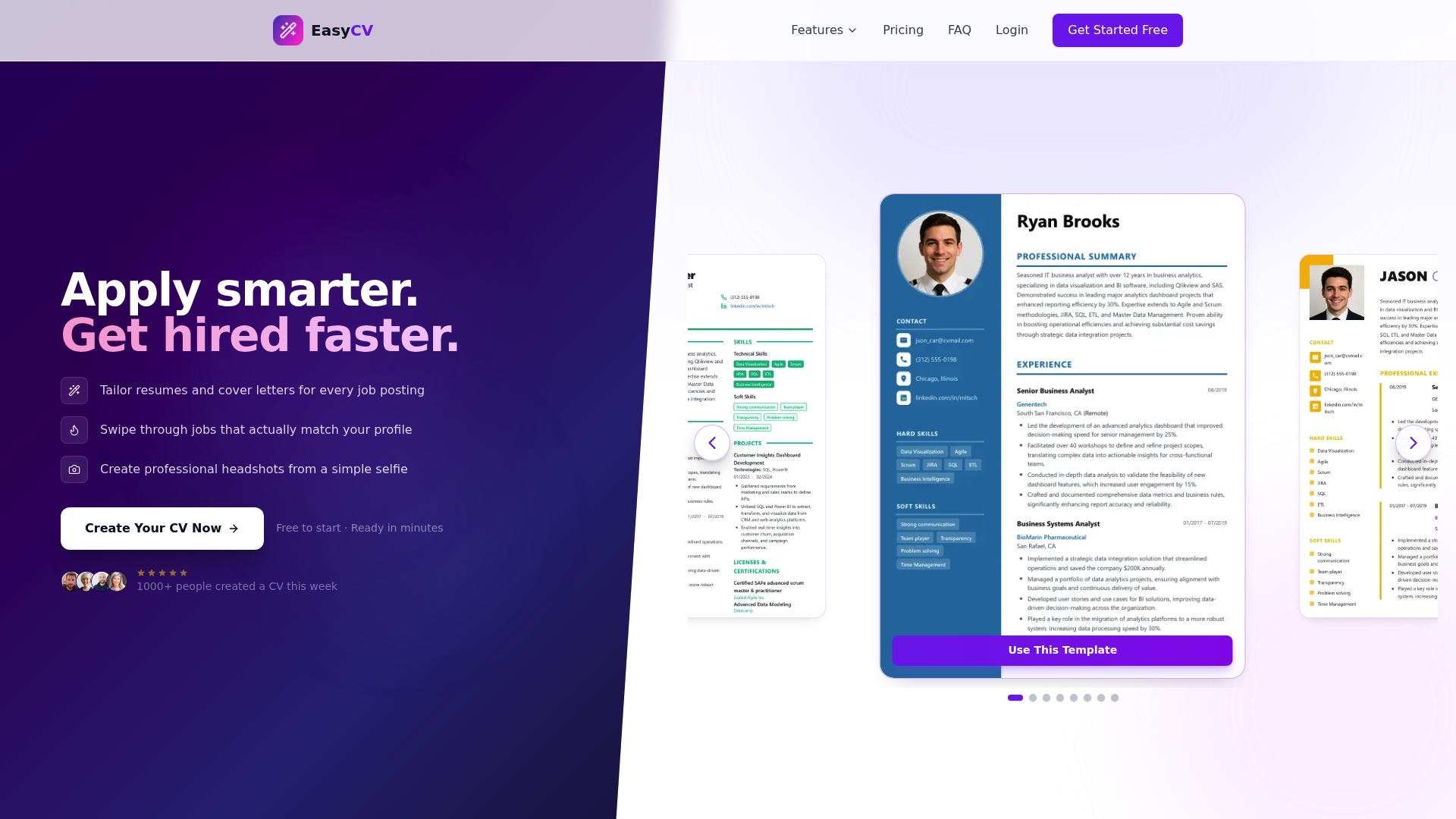
EasyCV.ai’s features are built around this exact workflow: fast, AI-powered resume generation with templates that pass ATS screening, keyword optimization that aligns your language to specific job postings, and easy version management so you can tailor applications without starting from scratch. You can generate a cover letter in the same session, access AI headshots, and browse matched jobs across major boards, all in one place. Whether you’re a first-time applicant or a seasoned professional targeting your next promotion, the AI CV Builder gives you the technical foundation you need. Your story is what seals the deal. Let the platform handle the rest.
Frequently asked questions
Are resume builders really ATS-friendly?
Yes, reputable resume builders design templates to meet ATS formatting and keyword requirements, increasing your chances of passing initial automated screenings. Modern screening tools use semantic similarity models that go beyond keywords, making AI-powered builders particularly effective.
Should I still customize my resume after using a builder?
Absolutely. You should personalize descriptions, achievements, and your overall narrative, since builders can’t fully convey your unique value. The best results come when you replace generic language with evidence-driven bullets and clear explanations of your transferable skills.
Do resume builders work for career changers?
Yes, resume builders make it easier to reformat skills and experiences for new industries, but adding tailored evidence is essential. Using a builder to generate ATS-safe structure and then personalizing your narrative for the target role gives you the best shot.
How long does it take to make a resume with a builder?
Most resume builders let you create a formatted draft in 10 to 20 minutes. Customizing your content with specific achievements and tailored language may take additional time but is worth the investment for stronger results.
Is using a resume builder considered unprofessional?
No. Using a resume builder is a practical and widely accepted approach among professionals at all career stages, as long as you tailor the final result to accurately represent your experience and goals.
Recommended
- Best job application tips: Stand out and land interviews | Easy CV
- Easy CV | AI CV Builder for Resumes & Cover Letters
- Cover letter templates: Save time and land more interviews | Easy CV
- Resume automation: how AI transforms your job search
- Streamline candidate evaluation: proven steps for better hiring | Testask Blog | testask