Job Search Strategies That Actually Work in 2026

Sending out 50 generic applications and hearing nothing back is one of the most demoralizing experiences a job seeker can have. The hard truth is that job search strategies built around volume stopped working years ago. The average job opening attracts 200+ resumes, and most of those get filtered by automated systems before a human ever reads them. What actually works in 2026 is a focused, quality-first approach: targeted applications, tailored materials, smart networking, and treating your search like the project it is. This guide covers all of it.
Table of Contents
- Key Takeaways
- 1. Define your job search criteria before you apply to anything
- 2. Build a master resume and then tailor it every time
- 3. Write cover letters that address the company’s problem
- 4. Optimize your LinkedIn profile as a second resume
- 5. Network before you need a job, not after
- 6. Use AI tools as a thinking partner, not a ghostwriter
- 7. Treat your job search like a project with a command center
- 8. Prepare proof stories before your interviews, not during
- My honest take on what actually separates successful job seekers
- How Easy-cv makes this whole process faster
- FAQ
Key Takeaways
| Point | Details |
|---|---|
| Quality beats volume | A few tailored applications outperform dozens of generic ones sent to any open role. |
| Define your target first | Knowing exactly what role and industry you want sharpens every other part of your search. |
| Networking opens hidden doors | Most jobs are filled through referrals before they are ever publicly posted. |
| Track everything like a project | Using a structured system to manage applications and follow-ups prevents burnout and missed opportunities. |
| Interviews require proof stories | Framing your experience as measurable outcomes gives hiring managers a reason to choose you over equally qualified candidates. |
1. Define your job search criteria before you apply to anything
The single biggest mistake job seekers make is starting their search at the job board instead of starting with themselves. Before you write a single bullet point on your resume, you need to know exactly what you are targeting. Not “a marketing role” but “a B2B content marketing manager position at a mid-size SaaS company in the fintech space.”
That level of specificity changes everything downstream. Your resume tells a different story. Your cover letters connect to real company challenges. Your networking conversations have a clear purpose. Without it, you are just generating noise.
Set SMART goals for your search. That means defining how many targeted applications you will submit per week, how many networking conversations you will have, and what your realistic timeline looks like. Vague intentions produce vague results.
- List your top 10 to 15 target companies, not just industries
- Identify two or three specific job titles that fit your background and goals
- Assess which of your skills are transferable and which need development
- Write a one-sentence professional positioning statement you can use in networking conversations
Pro Tip: Before applying anywhere, spend one hour mapping your last three roles to a list of target job descriptions. Where do your achievements match what employers are asking for? That overlap is your targeting zone.
2. Build a master resume and then tailor it every time
Your resume is not a static document. Think of it as a living asset. The most effective approach is to build a comprehensive master resume that contains every accomplishment, project, metric, and skill from your career. You never send this master version. It is your raw material.

From there, you tailor a version for each application by selecting the most relevant bullets and adjusting language to match the job description’s exact keywords. This is how you pass ATS filters without keyword stuffing. You are not fabricating anything. You are curating.
Outcome-first bullet points are non-negotiable. “Managed social media accounts” tells a recruiter nothing. “Grew LinkedIn engagement by 140% in six months by shifting to a video-first content calendar” tells a story. Recruiters prefer accomplishments framed as measurable business outcomes. Give them that.
Pro Tip: Use the actual language from the job posting in your resume. If the posting says “cross-functional collaboration” and you say “interdepartmental teamwork,” an ATS may not connect the two. Pull keywords directly from the description and use them naturally. Here’s a guide on matching your CV to a job description that makes this process faster.
For professional resume formatting that works with modern ATS systems, check out resume templates for 2026 aligned with current hiring expectations.
3. Write cover letters that address the company’s problem
Most cover letters are just resumes in paragraph form. They recap experience, mention enthusiasm, and end with a call to interview. Hiring managers have read thousands of them and find them forgettable.
A cover letter that works does something different. It names a specific challenge the company is facing and then connects your experience directly to solving it. If a company just launched a new product line and is hiring a sales manager, your cover letter should address what that expansion requires and how your track record maps to it.
Tailored cover letters show research, strategic thinking, and genuine interest. They demonstrate that you did not just find the role on a job board and click apply. That matters to hiring managers more than you might expect. Keep them tight: three focused paragraphs, no longer than one page.
4. Optimize your LinkedIn profile as a second resume
LinkedIn is not just a place to list your job history. For recruiters actively sourcing candidates, it is often the first filter. A profile that reads like a bare-bones resume with no activity gets ignored. A profile that shows recent accomplishments, uses a strong headline, and has genuine engagement in your field gets noticed.
Update your headline to describe the value you deliver, not just your current title. “Financial Analyst” is forgettable. “Financial Analyst | FP&A and Scenario Modeling for High-Growth Startups” is targeted. Your about section should read like a compelling professional pitch, not a job description.
Turn on the “Open to Work” signal if you are actively searching. It is visible only to recruiters by default, so it will not flag your current employer. Add recent accomplishments, relevant projects, and any certifications or courses you have completed in the past year.
5. Network before you need a job, not after
Networking provides the highest success rate when it comes to converting contacts to interviews. This is not opinion. It is consistently supported by hiring data. Referred candidates get faster responses, more senior-level attention, and significantly higher offer rates than cold applicants.
The most effective networking is not transactional. You are not collecting contacts or begging for referrals. You are building real professional relationships where value flows both ways. Here is how to approach it methodically:
- Reconnect with former colleagues. Send a brief, personal message referencing a shared project or experience. Ask how they are doing before you mention your search.
- Request informational interviews. Reach out to people working in roles or companies you are targeting. Ask for 20 minutes to learn about their experience. Most people are glad to help.
- Attend industry events. Virtual or in-person, showing up in your professional community creates warm introductions that cold applications never will.
- Use LinkedIn strategically. Comment thoughtfully on posts by people at your target companies. Show expertise before you make an ask.
- Tell your network specifically what you are looking for. “I’m open to opportunities” is not useful. “I’m targeting senior product manager roles at fintech companies in the Southeast” gives people something to work with.
The hidden job market is real. Many roles are filled through LinkedIn and mentor referrals before a public posting ever goes live.
6. Use AI tools as a thinking partner, not a ghostwriter
AI writing tools can absolutely help your job search. They can help you brainstorm bullet points, improve awkward phrasing, generate cover letter drafts to react to, and spot gaps in your materials. Used well, they save significant time.
The risk is delegation. AI-generated applications often fail because they produce generic, unverified content that sounds polished but says nothing specific. Recruiters notice this immediately. A cover letter that could apply to any company at any time signals zero genuine interest.
Use AI to generate a first draft, then rewrite it with your specific experiences, voice, and knowledge of the company. Add the detail that only you would know: the metric from your last campaign, the specific challenge you solved, the reason you actually want to work there. That combination of efficiency and authenticity is the sweet spot.
7. Treat your job search like a project with a command center
Applying to jobs without a tracking system is how good opportunities fall through the cracks. You forget to follow up. You lose track of which version of your resume you sent. You apply to the same company twice. None of this signals professionalism.
Job search tracking using a simple spreadsheet or dedicated tool transforms a stressful scramble into a manageable workflow. Your command center should capture at minimum: company name, role, application date, contact person, current status, and next action.
- Block specific time slots for applications, networking, and research each week
- Review your tracker every Friday to identify follow-ups needed
- Apply the 80/20 rule to resume tailoring: 80% of your master resume stays the same, 20% gets customized per role in under five minutes
- Treat each rejection as data, not defeat. Adjust your targeting or materials if a pattern emerges
Pro Tip: Schedule a weekly 30-minute “search audit.” Ask yourself: which types of applications are getting responses, which are not, and why. Iterating on what works is the fastest way to improve results.
Treating your search as a project with defined phases and milestones also protects your mental health. It gives you the sense of forward progress even during the slow stretches.
8. Prepare proof stories before your interviews, not during
Interview preparation is not about rehearsing answers to common questions. It is about developing a library of specific, outcome-focused stories you can pull from on demand. The most effective format is what, how, and impact.
What was the situation or challenge? How did you address it specifically? What was the measurable impact? Build proof stories focused on outcomes you could deliver in the first 90 days of a new role. Hiring managers in 2026 prioritize candidates who can demonstrate rapid, clear impact.
Here is how to navigate the full offer and interview process:
- Research the company deeply. Read recent news, leadership interviews, and Glassdoor reviews before your first conversation. Show that knowledge naturally during the interview.
- Assess culture and decision speed. Ask specific questions about how decisions get made and what success looks like in the first six months. This tells you whether you will thrive there.
- Benchmark total compensation. Base salary is only part of the picture. Factor in bonuses, PTO, remote work flexibility, healthcare, and equity when comparing offers.
- Negotiate with data. Frame your ask around market research and the specific value you bring. “Based on similar roles in this market and my track record of X, I’m targeting Y” is far stronger than “I was hoping for more.”
- Send a personalized thank-you note. Reference a specific part of the conversation and reinforce one key contribution you would bring in the first 90 days.
Candidates who articulate rapid, ownership-driven impact consistently stand out to decision-makers more than those who simply list qualifications. Be specific, be concrete, and tie everything back to business outcomes.
My honest take on what actually separates successful job seekers
I have watched a lot of job searches play out, and the pattern is consistent. The people who land faster are almost never the most qualified on paper. They are the most strategic about their time and energy.
In my experience, the single biggest shift is treating the search as a project. When you define a scope, set weekly goals, and track progress, you stop feeling like you are throwing things at a wall. You start feeling like someone running a campaign with data behind it.
I will also say this: most people dramatically underestimate how much recruiter relationships matter. One genuine connection at a company you are targeting does more than 30 cold applications. Quality matching beats volume every time, and the numbers consistently back that up.
My contrarian take on AI tools is that they are most dangerous when they make you lazy. The best use I have seen is using AI to get past the blank page faster, then investing real effort into making the output genuinely yours. Generic polish is not a competitive advantage. Specific, credible, personal writing is.
The resilience piece is also real. Rejection is information. If your applications are not converting to interviews, something needs to change, but that does not mean you are not good enough. It means your targeting, positioning, or materials need a refresh. Stay curious about what the data is telling you.
— Andras
How Easy-cv makes this whole process faster
Pulling off a quality-first job search takes real effort, but the right tools cut the manual work down significantly. Easy-cv was built specifically for this.
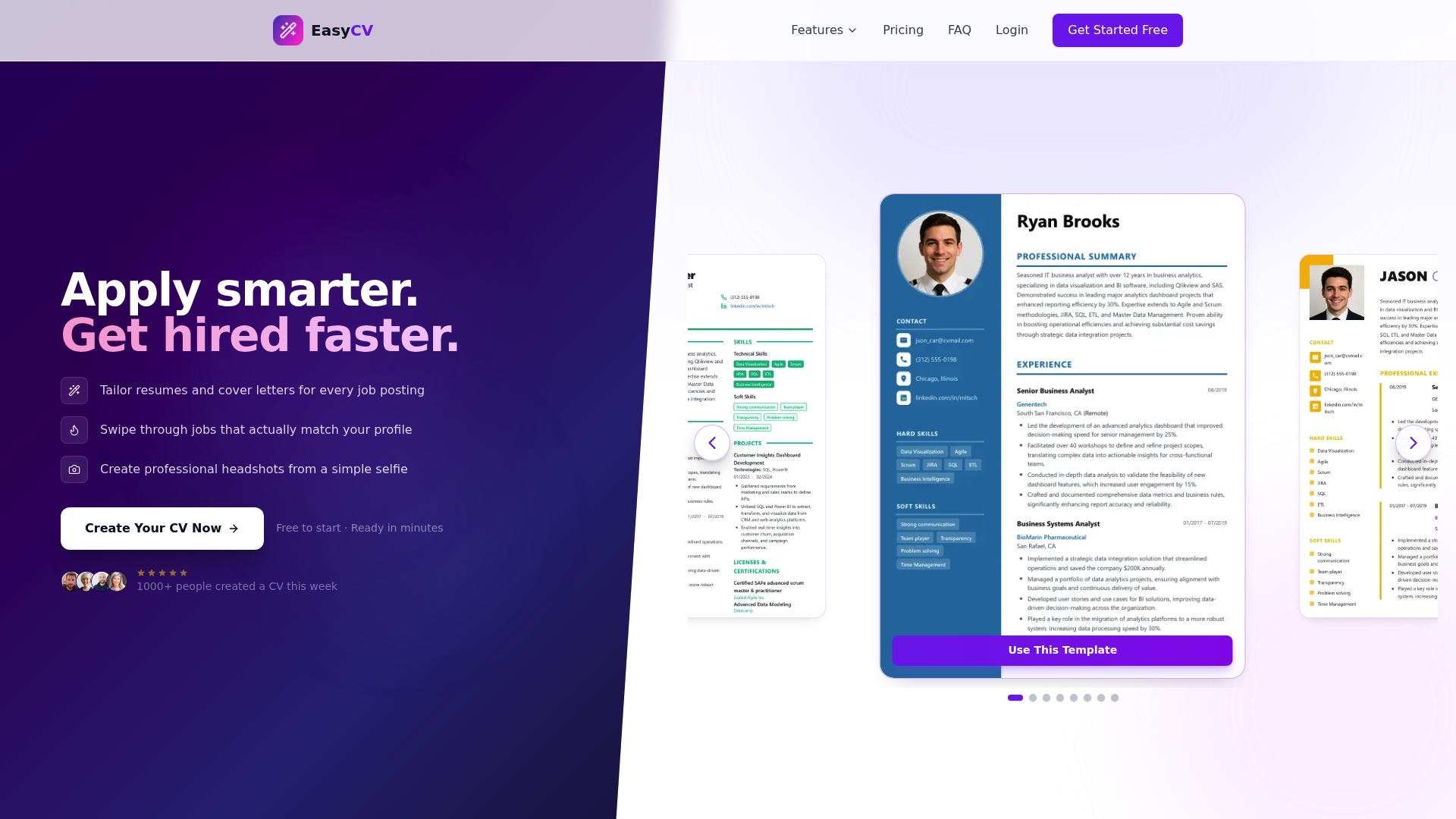
With Easy-cv’s AI CV builder, you can tailor your resume and cover letter to each role in minutes, not hours. The platform aggregates over 10 million job listings per month from major job boards, so you are not bouncing between tabs. The built-in job tracker keeps your applications organized automatically. AI-powered writing assistance helps you sharpen bullet points and cover letter language, while ATS-friendly templates give your materials a professional edge from the start. Whether you are just beginning your search or deep in the process, Easy-cv’s features and pricing plans are built to match where you are and what you need.
FAQ
How many jobs should I apply to per week?
Quality matters more than volume. Most career advisors recommend five to ten highly targeted applications per week rather than dozens of generic ones, since tailored applications convert to interviews at a significantly higher rate.
What is the most effective job search strategy for getting interviews?
Networking consistently produces the highest interview rate. Combined with tailored application materials and active use of job boards with alerts, a multi-channel approach gets the best results.
How do I get past ATS filters on my resume?
Use the exact keywords from the job description naturally throughout your resume, particularly in your summary and bullet points. Building a keyword-rich master resume that you customize per role is the most reliable method.
Should I use AI to write my resume and cover letter?
Use AI as a drafting assistant, not a ghostwriter. Start with AI-generated content, then rewrite it with specific metrics, personal voice, and company-specific knowledge. Generic AI output is easy for recruiters to spot and rarely converts to interviews.
How long does a strategic job search typically take?
It varies widely by industry, role level, and market conditions. Most targeted searches for professional roles take two to four months. Treating your search as a structured project with weekly goals and regular reviews tends to shorten that timeline considerably.