How to Match Your CV to a Job Description
Sending out the same CV to every role is one of the most common and costly job search mistakes you can make. Generic applications carry a response rate of roughly 2%, which means 98 out of every 100 applications go nowhere. Learning how to match your CV to a job description changes that equation dramatically. Tailored resumes have been shown to deliver a 115% higher success rate compared to generic ones. This guide walks you through the entire process, from reading job postings with precision to verifying your CV clears ATS filters before you ever hit submit.
Table of Contents
- Key takeaways
- How to match your CV to a job description: start with the posting
- Building your master resume
- A step-by-step process for tailoring your CV
- Common mistakes that hurt your CV match rate
- Verifying your CV before you submit
- My honest take on CV tailoring
- Let Easy-CV do the heavy lifting
- FAQ
Key takeaways
| Point | Details |
|---|---|
| Generic CVs underperform | A response rate of about 2% means tailoring your CV is not optional. It is the baseline. |
| Read job descriptions analytically | Identify repeated keywords and distinguish required skills from preferred ones before editing. |
| Build a master resume first | Keep one comprehensive document to pull from so tailoring each role takes minutes, not hours. |
| Use exact terminology | ATS systems match literally, so write “Amazon Web Services (AWS)” not just “AWS.” |
| Verify with ATS tools | Aim for a 70% keyword match score before submitting any application. |
How to match your CV to a job description: start with the posting
Before you change a single word on your CV, you need to understand what the job description is actually telling you. Most people skim postings and miss the signals hiding in plain sight.
Start by reading the entire description twice. On the first pass, read for context. What does this company actually do? What problem does this role solve? On the second pass, read like an analyst. Grab a copy of the posting and start marking it up.
Here is what to look for:
- Required vs. preferred skills. “Must have” language signals non-negotiable qualifications. “Nice to have” or “preferred” language signals bonus points. Focus your CV on the required column first.
- Repeated keywords. When a phrase appears more than once, that is not an accident. Repeated keywords in job postings signal employer priorities and should be mirrored in your resume.
- Hard skills vs. soft skills. Technical tools, certifications, and platforms are hard skills. Communication, leadership, and adaptability are soft skills. Both matter, but hard skills are easier for ATS systems to match on.
- Company culture signals. Phrases like “fast-paced environment,” “self-starter,” or “collaborative team” tell you how to frame your professional summary and accomplishments.
- Job title and department terminology. Companies use different titles for similar roles. Mirror their exact language rather than your previous employer’s phrasing.
Pro Tip: Copy the job description into a free text analysis tool or word cloud generator. The largest words are the keywords you absolutely cannot leave out of your CV.
Learning to read job postings this way is one of the most practical ways to match job descriptions to what you genuinely bring to the table.
Building your master resume
Before tailoring for any specific role, you need a foundation to work from. This is your master resume, and it is not a document you send to anyone. It is your complete professional inventory.
Here is how to build and organize it:
- List every job you have held, including part-time and contract work, with full descriptions of your responsibilities and accomplishments. Write more than you think you need. You can always trim.
- Compile all technical skills, including software, platforms, certifications, and tools. Include version numbers or proficiency levels where relevant.
- Document your education and credentials in full, including coursework, honors, and relevant extracurricular activities or projects.
- Write multiple versions of your professional summary. Draft one that emphasizes leadership, one that emphasizes technical depth, and one that emphasizes cross-functional collaboration. You will pull from these depending on the role.
- Record measurable accomplishments separately. “Increased quarterly sales by 22%” is infinitely more useful than “responsible for sales growth.” Build a bank of these quantified results so you can match them to the priorities each job posting reveals.
Pro Tip: Store your master resume in a cloud document and update it immediately after any new project, promotion, or skill you acquire. Trying to remember accomplishments months later costs you specificity.
This setup makes tailoring CV for jobs far less time-consuming. Instead of writing from scratch, you are selecting and shaping.

A step-by-step process for tailoring your CV
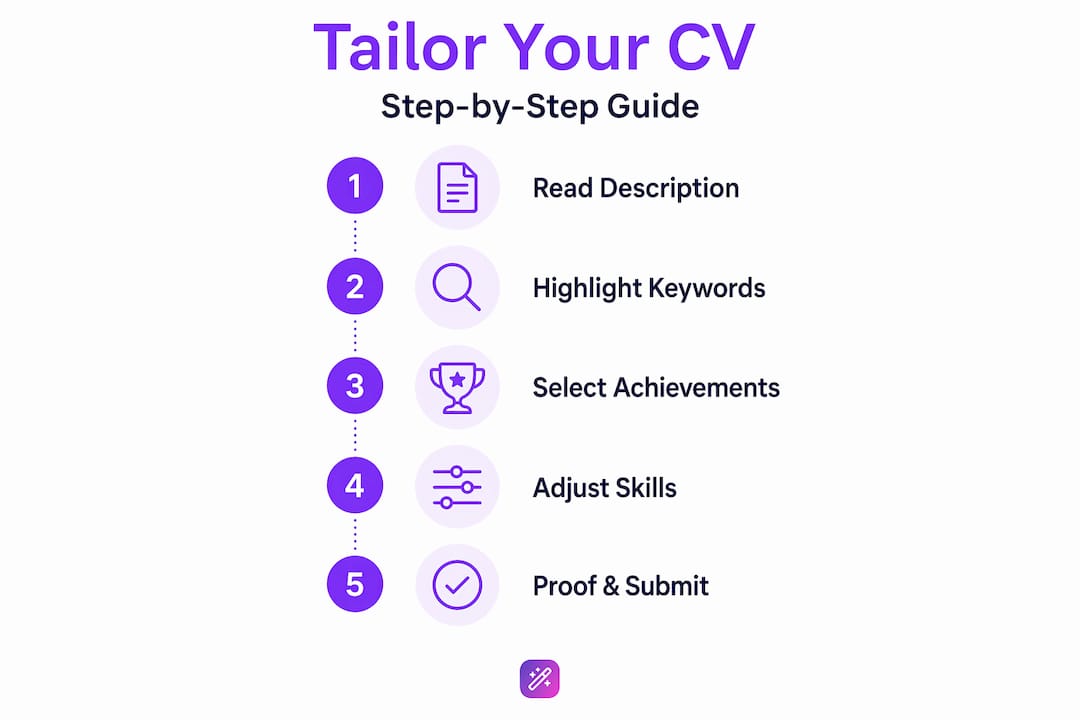
This is where the actual work happens. Follow this sequence for every application and you will produce a CV that genuinely reflects what the employer is asking for.
-
Rewrite your professional summary first. The summary sits at the top of the page and sets the tone. Pull in the job title exactly as written in the posting, and match the top two or three priorities the description emphasizes. If the role calls for “cross-functional project management,” those words belong in your summary.
-
Update your skills section. Compare your master resume’s skills list against the job description. Add any keywords you are legitimately qualified to claim. Remove skills that are irrelevant to this specific role. A targeted skills section scores better with ATS systems than a padded one.
-
Reorder your experience bullets. For each job in your history, move the bullets that are most relevant to this posting to the top. Recruiters spend seconds on initial scans. The most relevant content needs to appear first.
-
Use the employer’s exact terminology. ATS matching is literal. Using precise terms like “Amazon Web Services (AWS)” instead of just “AWS” improves your match rate. Do not substitute synonyms when the posting uses a specific phrase.
-
Tie accomplishments to the job’s stated goals. If the job description stresses customer retention, your bullets should surface evidence of work you did that improved retention. Quantifiable achievements aligned with the job’s priorities consistently outperform generic responsibility lists.
-
Address qualification gaps head-on. If the posting asks for five years of experience and you have three, do not hide from it. Highlight the depth and quality of your three years, and add adjacent skills that demonstrate you can perform at that level.
-
Run a keyword check before you finalize. Tools like Jobscan or Resume Worded can compare your draft against the job description and flag missing terms.
| Approach | ATS outcome | Recruiter impression |
|---|---|---|
| Generic, untailored CV | Low match score, likely filtered out | Feels impersonal and vague |
| Keyword stuffed CV | May pass ATS, but unreadable | Immediately off-putting to humans |
| Tailored with natural language | High match score, passes filters | Reads as genuinely qualified |
Pro Tip: An efficient tailoring workflow, once you have your master resume ready, takes about 10 minutes per application. Speed comes from having your master document organized, not from cutting corners on customization.
Common mistakes that hurt your CV match rate
Even job seekers who understand the importance of tailoring often undermine their own applications. Here are the pitfalls worth watching for:
- Keyword stuffing. Pasting a list of keywords into white text or jamming terms into sentences where they do not fit naturally will get your CV rejected by humans even if it clears ATS filters.
- Copying the job description verbatim. Recruiters notice immediately when you echo their own language back at them word for word. Authenticity and natural language resonate far better than a parroted description.
- Using vague or inconsistent terms. Calling yourself a “marketing specialist” in one section and a “digital marketing coordinator” in another creates confusion for both ATS systems and human readers.
- Ignoring company culture signals. A CV that is technically accurate but tonally mismatched reads as a poor fit. If the company emphasizes innovation and autonomy, your language should reflect that kind of initiative.
- Skipping proofreading after edits. Tailoring introduces errors. Every time you revise, read the whole document again from top to bottom.
- Applying despite a significant qualification gap without adjusting your pitch. A tailored CV frames your strongest fit. An untailored one just lists credentials without context.
“Using the same vocabulary as hiring managers shows you understand the role requirements — not that you are gaming the system.”
Verifying your CV before you submit
Tailoring a CV is only half the job. Confirming it works is the other half.
| Verification method | What it checks | Best used for |
|---|---|---|
| ATS keyword score tool | Keyword match percentage against job description | Catching missing terms before submission |
| Peer or mentor review | Readability, tone, and logical flow | Identifying awkward phrasing or gaps |
| Self-review after 24 hours | Fresh eyes on errors and consistency | Final proofreading pass |
| Plain text test | Formatting compatibility without styling | Confirming ATS can parse your layout |
A keyword match score above 70% is the threshold most ATS platforms use before routing a resume to a human reviewer. Below that, your application is at real risk of being filtered out automatically, regardless of how qualified you actually are.
Tools like Jobscan or Resume Worded give you a score and tell you exactly which keywords you are missing. Use the feedback to make specific edits, not wholesale rewrites.
Pro Tip: Paste your tailored CV into a plain text editor like Notepad before submitting. If the formatting falls apart, an ATS may struggle to parse it. Fix spacing, remove tables or graphics that do not translate to plain text, and recheck the flow.
Once you have passed the ATS check and gotten a second set of eyes on readability, you are ready to submit with confidence. Understanding how to improve your CV for job boards through this kind of structured review makes every application stronger.
My honest take on CV tailoring
I have watched a lot of job seekers tie themselves in knots over CV tailoring. They treat it like a puzzle to solve or a system to trick. That mindset leads to keyword-dense, hollow documents that impress no algorithm and convince no recruiter.
Here is what I have learned: the best tailored CVs do not sound tailored at all. They sound like someone who genuinely read the posting, understood the role, and then described their own experience in a way that made the fit obvious. That is not manipulation. That is clear communication.
The people I have seen get the best results are not the ones spending two hours overhauling their CV for every application. They are the ones who built a strong master document, developed a sharp eye for reading job descriptions, and then made precise, targeted edits. Twenty minutes of focused work beats two hours of anxious rewriting every time.
My other honest observation: most job seekers overcomplicate the ATS side. A keyword match showing alignment with the employer matters, but a human being still has to want to interview you. Write for that person first. The keywords are the floor, not the ceiling.
If your tailored CV sounds robotic, it will still fail. If it reads naturally and clearly demonstrates your fit, it will work, whether a machine reads it first or not.
— Andras
Let Easy-CV do the heavy lifting
Tailoring a CV for every application is the right strategy. But doing it manually for every role is exhausting, and most people eventually stop doing it well.
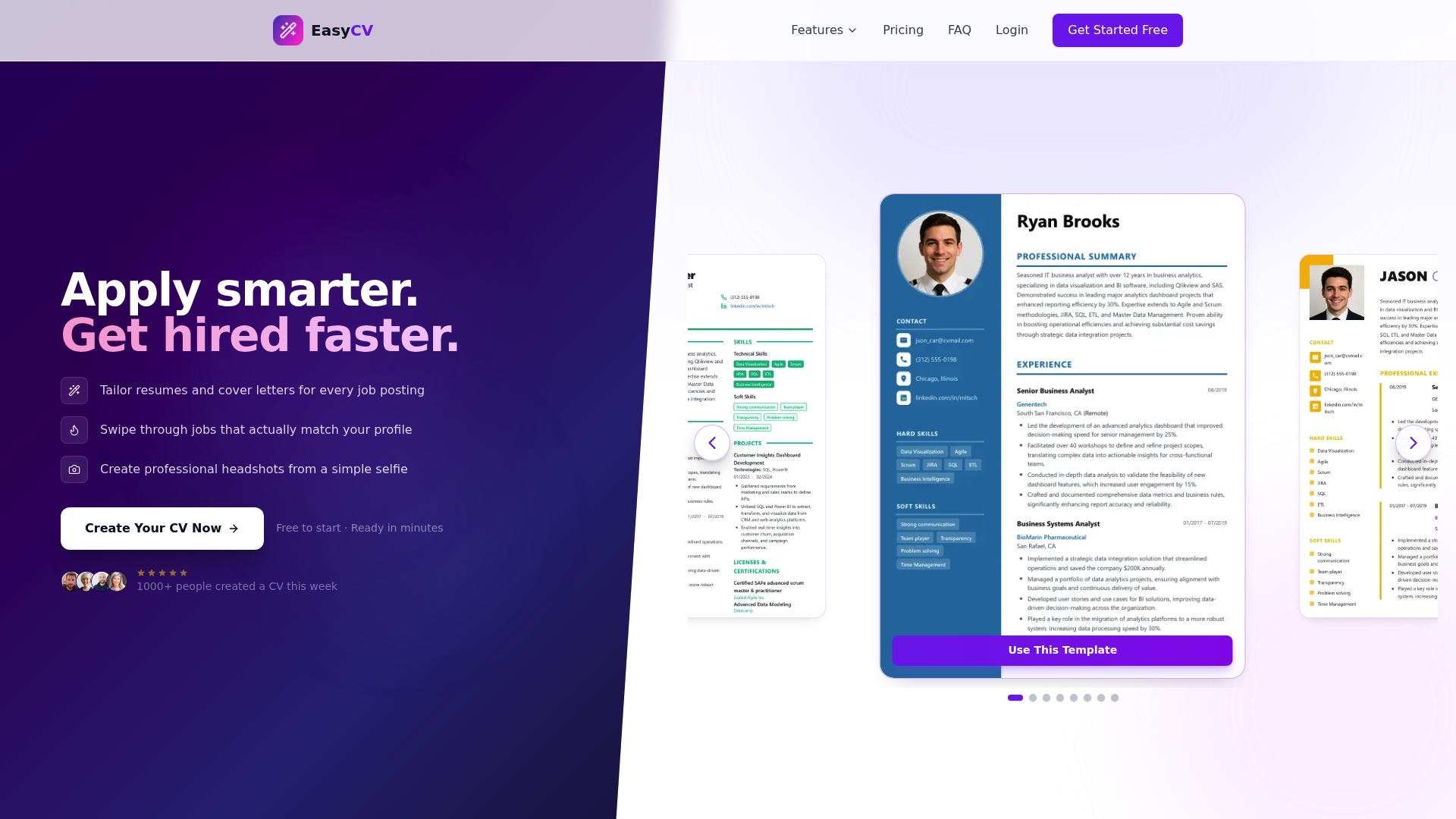
Easy-CV was built specifically for this problem. The platform pulls job listings from major boards and uses AI to tailor your CV and cover letter to each role automatically, matching the language, priorities, and requirements from the job description. You get a CV that reads like you spent an hour on it, generated in minutes. The built-in ATS optimization means your keyword match score is handled before you even think to check it. With ATS-friendly templates and an AI writing assistant that refines your content to professional quality, every application you send looks like your best work. Try the Easy-CV AI builder and see how much faster a smart, organized job search actually feels.
FAQ
What does it mean to tailor your CV to a job description?
Tailoring your CV means adjusting your professional summary, skills, and experience bullets to reflect the specific keywords, priorities, and requirements listed in a job posting. The goal is to make your qualifications immediately obvious to both ATS systems and human recruiters.
How long does it take to tailor a CV for each application?
With a well-organized master resume, an effective tailoring workflow takes approximately 10 minutes per application. Most of that time goes toward keyword alignment and reordering your experience bullets to match the role’s stated priorities.
What keyword match score should I aim for on my CV?
Aim for a keyword match score of 70% or higher when comparing your tailored CV against a job description. Scores below that threshold risk automatic filtering by ATS systems before a recruiter ever sees your application.
Is it wrong to use the same keywords the job description uses?
No. Using the employer’s exact language demonstrates that you understand the role. The mistake is copying phrases verbatim in a way that reads unnaturally. Integrate keywords into genuine descriptions of your experience and accomplishments.
Should I create a different CV for every single job?
Yes, at least in terms of targeted edits. You do not need to rewrite your entire CV from scratch for every role. Maintain a master resume and make specific, focused changes to your summary, skills section, and top experience bullets for each application.