What is a CV? Essential guide for job seekers

Most job seekers use “CV” and “resume” as if they mean exactly the same thing. They don’t. Swapping one for the other when an employer specifically requests one format can quietly kill an application before anyone even reads your qualifications. Understanding what a CV truly is, how it differs from a resume, what belongs inside it, and how to tailor it for each opportunity you pursue gives you a concrete edge over applicants who are still guessing. This guide walks through every piece of that puzzle, from basic definitions to AI-powered tailoring strategies.
Table of Contents
- Understanding the basics: What is a CV?
- Key differences: CV vs. resume
- What to include in a CV: Essential sections and extras
- How to tailor your CV for different job applications
- Why mastering the CV makes you future-proof
- Build and optimize your CV easily with AI
- Frequently asked questions
Key Takeaways
| Point | Details |
|---|---|
| CV vs. resume | A CV is a detailed career document, while a resume is concise and targeted. |
| CV structure | A strong CV includes education, experience, skills, and achievements, plus extras relevant to your field. |
| Tailoring matters | Customize your CV for each job application to showcase the most relevant skills and experiences. |
| Leverage AI tools | AI-powered CV builders can help you optimize content and layout for better job search results. |
Understanding the basics: What is a CV?
A CV, short for curriculum vitae, is a Latin phrase that translates to “course of life.” That name tells you a lot. A CV is not a snapshot of your most recent work history. It is a running, detailed record of your entire professional and academic journey.
A CV is preferred in academia and research (and sometimes medicine) because it supports longer, more comprehensive career documentation, including publications, academic achievements, grants, fellowships, and conference presentations. A resume simply does not have room for all of that, nor is it designed to.
Here is what typically lives inside a CV:
- Full academic history, including every degree, institution, graduation date, and any honors or distinctions
- Research and teaching experience, described in detail rather than summarized
- Publications, often formatted in a recognized citation style like APA or MLA
- Grants and fellowships received, with funding amounts where relevant
- Conference presentations and invited talks
- Professional memberships and affiliations
- Awards and honors at any stage of your career
- References, often listed directly rather than available upon request
“A CV is not a marketing document the way a resume is. It is a record. Its job is to be complete and accurate, not punchy and brief.”
The length of a CV reflects that completeness. A recent graduate’s CV might run two to three pages. A senior professor or research scientist could have a CV stretching fifteen pages or more. That is not padding. That is an honest account of a career built over decades.
Understanding the core differences between a resume and CV before you apply to any position is one of the most practical steps you can take as a job seeker. Submitting the wrong document creates friction from the very first moment.

Key differences: CV vs. resume
Once you understand what a CV is, it’s crucial to see how it stacks up against a resume. The differences go beyond length. They touch on purpose, audience, and structure.
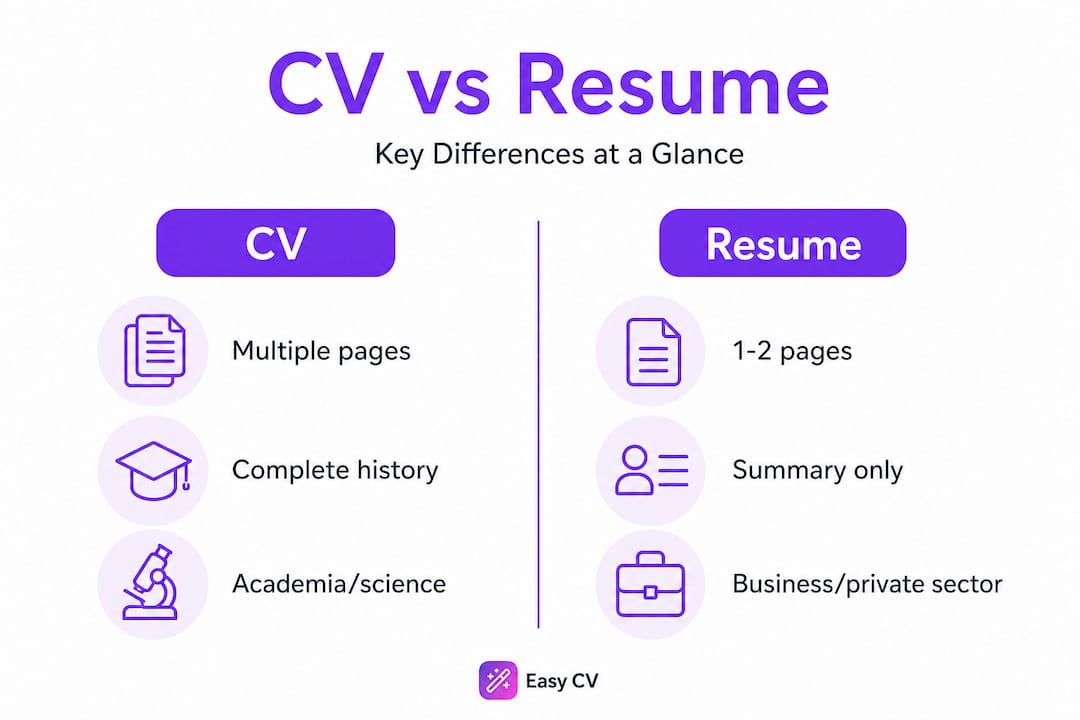
You would use a CV for jobs in fields such as academia or science because it allows for greater length and can include expanded professional information like publications. A resume, by contrast, is built for speed. A hiring manager in a corporate setting may spend fewer than ten seconds scanning it, so brevity and targeted language matter most.
| Feature | CV | Resume |
|---|---|---|
| Length | Multiple pages, no strict limit | 1 to 2 pages maximum |
| Purpose | Complete career record | Targeted job application |
| Content | Publications, research, grants, talks | Work history, skills, key achievements |
| Update style | Continuously updated | Customized per application |
| Common fields | Academia, research, medicine | Business, tech, marketing, most industries |
| Format flexibility | Structured but comprehensive | Concise and highly tailored |
Mistaking these two formats is more common than you might think, and the consequences are real. Sending a three-page CV to a startup recruiter signals that you do not understand the role or the hiring culture. Sending a one-page resume to a university department chair applying for a faculty position tells them you are not serious, or simply uninformed.
Pro Tip: Always check the job posting carefully. If it says “CV required” and you work in a non-academic field, search for industry norms in that specific sector before assuming. In countries like the UK and Australia, “CV” is often used as a synonym for resume, so context and location both matter.
Some fields sit in a gray area. Clinical medicine, for example, sometimes uses CVs in the United States because physicians need to document board certifications, hospital privileges, research output, and continuing education credits. A standard resume could never hold all of that information without becoming misleading through omission.
Reviewing a solid resume vs. CV comparison guide before applying helps you make a confident, informed decision every time.
What to include in a CV: Essential sections and extras
Knowing the difference is one thing. Building a strong CV is another. A CV can be several pages long and typically includes an exhaustive list of educational, academic, institutional, and professional accomplishments. But “exhaustive” does not mean disorganized. Structure matters enormously.
Here are the essential sections every CV should include:
- Contact information: Full name, professional email, phone number, location (city and country are enough), and a link to your professional profile or academic website if you have one
- Professional or research summary: Two to four sentences positioning your expertise and career focus, written specifically for the role you are targeting
- Education: Listed in reverse chronological order, including degree type, major, institution, graduation year, and any thesis titles or dissertation topics
- Work and research experience: Again, reverse chronological, with detailed descriptions of responsibilities, methodologies used, and measurable outcomes where possible
- Publications: Use a consistent citation format; separate peer-reviewed journals from books, book chapters, and conference proceedings
- Skills: Technical tools, laboratory methods, programming languages, or software relevant to your field
- Awards and honors: Include the name of the award, the granting body, and the year received
Beyond those essentials, there are optional but powerful sections that can differentiate your application:
- Grants and funding: Especially important in research-heavy fields; list the grant name, funding body, amount, and your role (principal investigator vs. co-investigator)
- Conference presentations: Note whether you gave an oral presentation or a poster session, and include location and year
- Teaching experience: Courses taught, institutions, and student levels (undergraduate, graduate)
- Mentorship and supervision: If you have supervised graduate students, postdocs, or research assistants
- Certifications and licenses: Especially relevant in medicine, nursing, and clinical psychology
- Professional affiliations: Membership in relevant societies or boards
Pro Tip: Build a “master CV” that includes every single achievement, role, and publication you have ever had. Then create a targeted version for each application by selecting the most relevant sections. This keeps you organized and prevents you from accidentally omitting something important.
The way you organize these sections sends signals to the reader. Education usually leads for early-career applicants. Publications or research experience often lead for mid-career and senior candidates because those are the credentials that carry the most weight.
Exploring professional CV templates can also help you visualize how to structure these sections cleanly. Good formatting is not decoration. It makes content easier to scan and prevents reviewers from missing your strongest qualifications. Understanding why template structure matters for readability is especially useful when you are entering a new field or targeting a different type of role than your current one.
How to tailor your CV for different job applications
With your content ready, the next step is tailoring it for each application and leveraging technology for an edge. A generic CV sent to dozens of employers rarely performs well. Even in academia, where CVs follow a more standardized format than resumes, the emphasis you place on different sections should shift depending on the position.
Here is how tailoring looks across three common CV fields:
| Field | What to emphasize | What to minimize |
|---|---|---|
| Academia | Publications, grants, teaching philosophy, research agenda | Short-term industry roles, unrelated work experience |
| Healthcare/Medicine | Clinical experience, board certifications, continuing education, hospital affiliations | Non-clinical research that lacks direct patient care relevance |
| Research/Science industry | Technical skills, lab methodologies, patents, industry collaborations | Teaching experience (unless the role involves it) |
A thorough CV supports comprehensive documentation of your accomplishments, which is exactly what makes this level of tailoring possible. Because your master CV contains everything, you always have material to draw from. You are not starting from scratch each time.
Here is a simple tailoring process you can follow for each application:
- Read the full job description twice: Once for the big picture, once to note specific keywords and required qualifications
- Identify what the hiring committee values most: Is it research output? Clinical volume? Grant funding? Leadership experience?
- Reorder your sections to put the most relevant material toward the top
- Adjust your professional summary to reflect the specific role and department language
- Mirror key terms from the job posting in your descriptions (without stuffing or forcing them unnaturally)
- Remove or condense sections that are not relevant to this particular position
AI tools have made this process significantly faster. Platforms that analyze job descriptions and suggest CV edits can identify keyword gaps in seconds, a task that used to take manual review and comparison. Learning to use AI for CV optimization is now a genuine competitive advantage, not just a convenience.
Strong job application strategy extends beyond the CV itself. But getting the CV right is the foundation. Everything else, the cover letter, the portfolio, the interview, follows from it.
Pro Tip: After tailoring a CV, paste both the job description and your CV into an AI writing assistant and ask: “What skills or qualifications from the job description are not addressed in this CV?” The answer will often surprise you, and give you something concrete to fix before you submit.
Why mastering the CV makes you future-proof
Here is a perspective that most career guides skip: the CV is not just a job application tool. It is an investment in your own professional clarity.
When you maintain a well-organized, consistently updated CV, you force yourself to reflect on what you have actually accomplished, not just what your title was. That reflection is valuable regardless of whether you are currently job searching. Researchers and academics who keep strong CVs tend to know their own career trajectory more clearly. They can articulate their value quickly and confidently in any setting, from a grant interview to a dinner conversation with a potential collaborator.
There is also a resilience argument. How job boards and application systems work changes constantly. New platforms emerge. ATS (applicant tracking system) requirements shift. What stays constant is the human need to tell a coherent, compelling story about who you are and what you have done. A well-maintained CV gives you the raw material to tell that story in any format, on any platform, in any year.
AI tools will keep improving at formatting and keyword matching. They already do both of those things quite well. What AI cannot replicate is the texture of your actual experience: the research question that kept you working at 2 a.m., the teaching moment that changed how you explain a concept, the setback that redirected your career in a more interesting direction. Those details, woven authentically into a CV, are what make a candidate memorable rather than just qualified.
Mastering the CV is not about optimizing a document. It is about knowing yourself well enough to represent your career honestly and strategically. That skill does not expire.
Build and optimize your CV easily with AI
If you are ready to put these strategies into practice, EasyCV.ai makes the process faster and smarter. The platform uses AI to help you build customized, modern CVs that align with specific job descriptions, whether you are targeting an academic department, a research institution, or a healthcare organization.
With the EasyCV.ai builder, you can create multiple CV versions from a single master document, receive keyword suggestions based on real job postings, and export your finished CV in multiple formats. The platform also supports cover letter generation, AI headshots, and job matching across more than 10 million positions. Explore the full range of advanced CV features to see how each tool supports a faster, more organized job search. Whether you are applying for your first academic position or pivoting to a new field entirely, the right tool removes friction from the process.
Frequently asked questions
When should I use a CV instead of a resume?
Use a CV when applying for academic, research, or some healthcare positions because it supports longer, more comprehensive career documentation. For most industry roles, a targeted resume is the better choice.
How long should a CV be?
A CV can be several pages long since it covers your complete professional and academic history, including publications, grants, and presentations. There is no upper page limit as long as the content is relevant and accurate.
Can I use the same CV for every job application?
It is best to tailor your CV for each role by emphasizing the qualifications and accomplishments most relevant to that specific position. A master CV helps you pull the right content without starting from scratch each time.
Are CVs only for academic jobs?
While CVs are most common in academia, some medical and research positions also require them. In many countries outside the United States, the term “CV” is also used broadly to refer to what Americans would call a resume.