Resume and Cover Letter Guide for Job Seekers in 2026

A resume presents your professional achievements in a concise, scannable format, while a cover letter narrates your motivation and fit for a specific role. Together, these two documents form the foundation of every competitive job application. Most candidates treat them as separate tasks. The strongest applicants treat them as a coordinated system. This guide covers the key differences, proven structures, and advanced strategies you need to craft a resume and cover letter that get you to the interview stage in 2026.
What is the difference between a resume and a cover letter?
A resume is a focused marketing document designed to give a hiring manager a strong reason to say “yes” within a five-minute scan. Every line should demonstrate a relevant skill or a noteworthy achievement. It is not a biography. It is a curated argument for why you are the right person for the job.
A cover letter, by contrast, explains the human story behind the resume. It provides context, elaborates on your most relevant highlights, and communicates your motivation for the specific role. Where the resume lists, the cover letter explains. Where the resume quantifies, the cover letter connects.

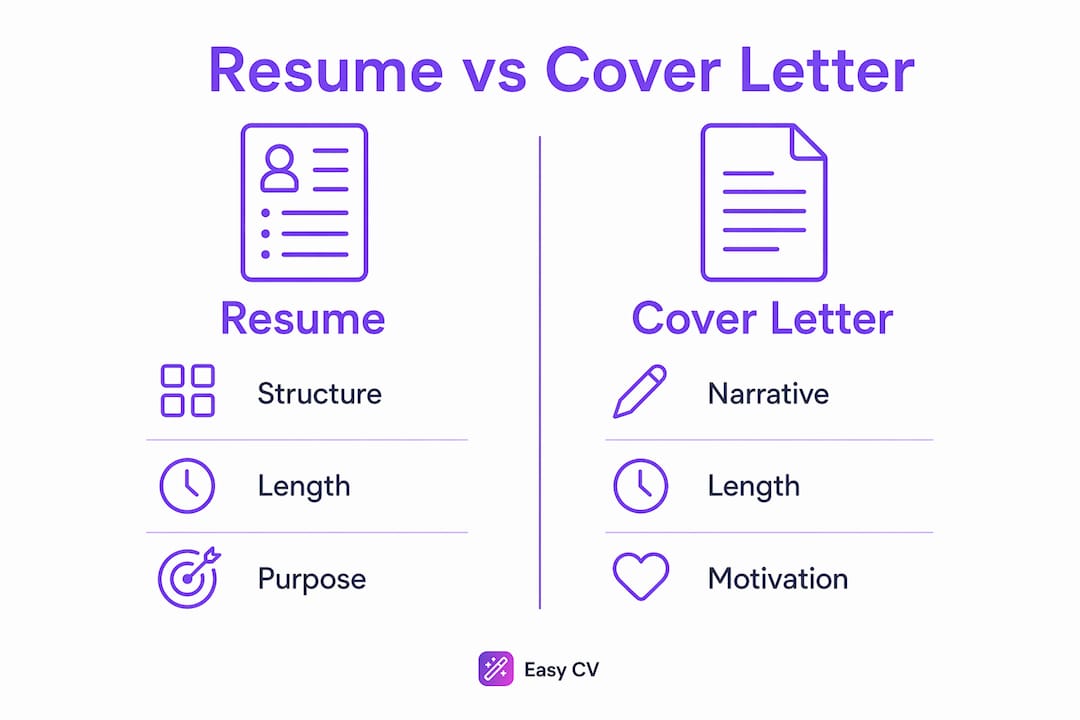
The table below captures the core distinctions at a glance:
| Feature | Resume | Cover letter |
|---|---|---|
| Format | Structured sections, bullet points | Narrative paragraphs, block style |
| Length | 1 to 2 pages | 1 page maximum |
| Primary purpose | Prove skills and achievements | Explain motivation and fit |
| ATS role | Primary keyword matching document | Supports human storytelling with natural keywords |
| Tone | Factual, achievement-focused | Confident, personable, persuasive |
Understanding this distinction changes how you write both documents. Candidates who repeat resume bullet points in their cover letter waste the recruiter’s time and miss the opportunity to add real depth to their application.
Key differences in practice:
- Resumes use ATS-compatible layouts with standard section headings, clean formatting, and real job titles so the system can parse and score them correctly.
- Cover letters use natural language to weave in keywords, since ATS prioritizes resume scanning and the cover letter is primarily read by a human recruiter.
- Resumes are largely consistent across applications with targeted tweaks. Cover letters should be substantially rewritten for each role.
How to structure and format a resume and cover letter in 2026
Structure is not a stylistic preference. It is a functional requirement. A poorly formatted resume fails ATS parsing before a human ever reads it. A cover letter without a clear opening hook gets skimmed and discarded.
Resume structure
A strong resume follows this sequence: header with contact information, a two to three sentence professional summary, work experience in reverse chronological order, education, and a skills section. Each experience entry should lead with a strong action verb and close with a measurable result. For resume formatting ideas that align with current ATS and recruiter preferences, the principles have not changed much: clean fonts like Calibri or Arial at 10 to 12 points, consistent spacing, and no graphics or tables that confuse parsing software.
Standard resume length is a maximum of two pages. One page is appropriate for candidates with fewer than five years of experience. Going beyond two pages signals poor editing judgment, not impressive depth.
Cover letter structure
Effective cover letters follow a four-part structure: a four to six line header matching your resume header, a two to three sentence opening hook, one to two body paragraphs that highlight achievements using job-specific keywords, and a two to three sentence closing with a direct call to action. The cover letter must stay to one page, formatted in block style with single spacing and a space between paragraphs.
The formatting rules for both documents, side by side:
| Element | Resume | Cover letter |
|---|---|---|
| Length | Max 2 pages | Max 1 page |
| Font | Calibri, Arial, 10-12pt | Match resume font |
| Format style | Reverse chronological or hybrid | Block style, single spaced |
| Sections | Header, summary, experience, education, skills | Header, hook, body paragraphs, closing |
| File format | PDF unless otherwise specified | PDF unless otherwise specified |
Pro Tip: Name your files professionally. Use “FirstName_LastName_Resume_CompanyName.pdf” rather than “resume_final_v3.pdf.” Recruiters download dozens of files per day, and a clearly named document signals attention to detail before they open it.
Proofreading is non-negotiable. Run both documents through Grammarly or ProWritingAid before submitting. A single typo in a cover letter can eliminate an otherwise strong candidate, particularly in roles where written communication is part of the job.
What strategies make your resume and cover letter stand out?
Getting past ATS is the first filter. Impressing the recruiter is the second. You need a strategy that handles both without sacrificing authenticity.
The master resume strategy is the most efficient approach for active job seekers. You build one comprehensive document containing every role, achievement, and skill you have. For each application, you pull the most relevant content and tailor it to match the job description. AI tools like Easy-cv can identify keyword gaps and generate tailored versions quickly, but always edit the output yourself. Generic AI language is easy for recruiters to spot.
Quantification is the single most powerful differentiator on a resume. 98.7% of HR professionals value numerical indicators of impact. That means replacing “managed a team” with “managed a team of 8 engineers, reducing deployment time by 30%.” The number does not need to be dramatic. It needs to be real and specific.
For your cover letter, the opening line is where most candidates fail. Open with a specific result or achievement, not a statement about how excited you are to apply. “In my last role at Deloitte, I led a client retention initiative that recovered $2.4M in at-risk contracts” is a hook. “I am writing to express my interest in the Senior Account Manager position” is not.
Additional strategies that separate strong applications from average ones:
- Avoid vague bullet points like “responsible for” or “assisted with.” Replace every one with a measurable achievement or a specific skill demonstrated.
- Do not stuff keywords. Tailored applications that mirror job description language naturally outperform those that repeat keywords mechanically.
- Use confident, positive language throughout both documents. Hedging phrases like “I believe I could potentially contribute” undermine your credibility.
- Keep your professional cover letter focused on two or three achievements that directly address the role’s core requirements. More is not better.
Pro Tip: Build your master resume in a tool that supports version control. Easy-cv lets you maintain a base document and generate tailored versions per application without starting from scratch each time.
How to customize your application for each employer
Customization is where most job seekers cut corners, and recruiters notice immediately. Researching company culture and mirroring the language of the job description significantly improves your chances. This is not about flattery. It is about demonstrating that you understand the role and the organization.
Here is a practical process for customizing each application:
- Read the job description three times. On the third pass, highlight every skill, value, and outcome the employer mentions more than once. These are the keywords and themes your documents must address.
- Research the company. Check their LinkedIn page, recent press releases, and the “About” section of their website. Look for language about their mission, values, and current priorities.
- Rewrite your cover letter opening and closing paragraphs for each application. The body paragraphs can stay largely consistent if the role is similar, but the opening hook and the closing call to action should reference the specific company and role.
- Address the hiring manager by name wherever possible. “Dear Ms. Chen” is more effective than “Dear Hiring Manager.” LinkedIn makes this research straightforward in most cases.
- Link your achievements directly to the role’s stated needs. If the job description emphasizes cross-functional collaboration, your cover letter body paragraph should include a specific example of cross-functional work with a measurable outcome.
The closing paragraph of your cover letter should reference the company by name and include a clear call to action. Something like “I would welcome the opportunity to discuss how my experience in supply chain optimization aligns with Acme Corp’s expansion into Southeast Asia” is specific, confident, and memorable.
One warning: do not copy-paste the job description back at the employer or overload your documents with jargon. Recruiters read hundreds of applications. Authentic, specific language stands out far more than polished corporate speak.
Key takeaways
A tailored resume and cover letter, each structured correctly and customized per application, are the two most controllable factors in your job search success.
| Point | Details |
|---|---|
| Resume vs. cover letter roles | The resume proves your skills; the cover letter explains your motivation and fit. |
| Length and format rules | Resumes max at 2 pages; cover letters stay to 1 page in block style. |
| ATS optimization | Use standard headings, clean layouts, and natural keyword placement to pass automated screening. |
| Quantify achievements | Replace vague bullet points with specific numbers and measurable outcomes. |
| Customize every application | Mirror job description language and reference the company directly in your cover letter. |
What I’ve learned after reviewing hundreds of job applications
Most candidates spend 80% of their effort on the resume and treat the cover letter as an afterthought. That is exactly backwards for competitive roles. At the senior level, resumes within a shortlist look remarkably similar. The cover letter is where the decision often gets made.
The biggest mistake I see is candidates writing cover letters that summarize the resume. If your cover letter says “As you can see from my resume, I have five years of experience in marketing,” you have wasted a paragraph. The recruiter can read your resume. What they cannot get from your resume is why this role, at this company, at this point in your career. That is the only question your cover letter needs to answer.
I also think the obsession with ATS optimization has gone too far for many job seekers. Yes, your resume needs to pass the scan. But the candidates I have seen land the best roles are the ones who write like humans, not like keyword databases. Use the language from the job description, but use it in sentences that actually mean something.
One practical habit that makes a real difference: maintain a “wins log.” Every time you hit a target, complete a project, or receive positive feedback, write it down with the numbers attached. When you sit down to write or update your resume, you are not trying to remember what you accomplished two years ago. You are selecting from a documented record. This single habit transforms the quality of resume bullet points more than any formatting trick.
Finally, do not underestimate your LinkedIn profile as a complement to your application. Many recruiters check it before they even open your resume. Keep it consistent with your documents and use the summary section to tell the story your resume cannot.
— Andras
Build your resume and cover letter faster with Easy-cv
Putting this guide into practice takes time, especially when you are applying to multiple roles at once. Easy-cv brings the entire process into one place so you can move faster without sacrificing quality.
With Easy-cv’s AI-powered CV builder, you can create ATS-friendly resumes using modern, professionally designed templates and generate tailored cover letters for each application in minutes. The built-in AI writing assistant refines your content, identifies keyword gaps, and helps you match the language of each job description. The platform also aggregates over 10 million job listings per month, so you can find roles, tailor your documents, and track your applications without switching between tools. Whether you are a first-time applicant or a senior professional targeting a career change, Easy-cv’s full feature set is built to get you to the interview stage faster.
FAQ
What is the main purpose of a cover letter vs. a resume?
A resume lists your skills, experience, and achievements in a structured format. A cover letter explains your motivation for the specific role and provides context that the resume cannot, making both documents necessary for a complete application.
How long should a resume and cover letter be?
A resume should be no longer than two pages, and a cover letter must stay to one page. Exceeding these limits signals poor editing judgment to most recruiters.
How do I make my resume pass ATS screening?
Use standard section headings, clean layouts without graphics or tables, and real job titles. Place keywords from the job description naturally throughout your experience and skills sections rather than listing them in bulk.
Should I write a new cover letter for every job application?
Yes. The opening hook and closing paragraph should reference the specific company and role by name. Reusing a generic cover letter is one of the most common reasons strong candidates get passed over.
How do I write a strong cover letter opening line?
Open with a specific achievement or result rather than a statement of interest. A concrete example from your career immediately establishes your value and gives the recruiter a reason to keep reading.