What Is a Student Resume? Your 2026 Guide
A student resume is a strategic, one-page marketing document that presents your qualifications, skills, and experiences to a specific employer for a specific role. Unlike a diary of everything you have ever done, it is tailored to each position you apply for, selecting only the details most relevant to that job. Most students entering the job market for the first time treat their resume as a formality. The ones who get callbacks treat it as their strongest argument for why they deserve an interview. Tools like Grammarly, the Easy-cv builder, and university career centers at UNC and UMass all agree on one thing: relevance beats volume every time.
What is a student resume, and how does it differ from a CV?
A student resume and a curriculum vitae (CV) are not interchangeable, and using the wrong one can cost you an opportunity. Resumes are concise, tailored, and achievement-focused documents suited for most jobs and internships, while CVs are comprehensive records of your academic and professional history used primarily for research positions, graduate school applications, and academic roles. For the vast majority of students applying to part-time jobs, internships, or entry-level corporate roles, a resume is the correct document.
The practical difference comes down to length and purpose. A student resume is almost always one page. A CV can run three to ten pages and includes publications, conference presentations, teaching experience, and academic awards in full detail. A professional resume for someone with ten years of experience might stretch to two pages, but a student applying for their first internship has no business submitting anything longer than one.
| Document | Length | Best used for |
|---|---|---|
| Student resume | 1 page | Internships, part-time jobs, entry-level roles |
| Professional resume | 1 to 2 pages | Mid-career job applications |
| CV (curriculum vitae) | 3 or more pages | Academic, research, and graduate school applications |
Pro Tip: If you are applying to a graduate program or a research lab, ask explicitly whether they want a resume or a CV. Submitting a one-page resume to a PhD program signals that you do not understand academic hiring conventions.
For a deeper breakdown of when each document applies, the Easy-cv guide on resume vs. CV differences is worth reading before you apply anywhere.
What to include in a student resume
Every section of your resume must earn its place. The goal is not to fill a page. The goal is to give a recruiter exactly the information they need to decide you are worth interviewing.
Contact information sits at the top and includes your full name, phone number, a professional email address, and optionally your city and state. Skip your full street address. Never include a photo unless the employer explicitly requests one.
Education comes next for most students, since it is your strongest credential at this stage. List your school, degree, major, and expected graduation date. Including your GPA is optional and depends on employer preferences. A GPA above 3.5 is generally worth listing. Below 3.0, leave it out unless asked.
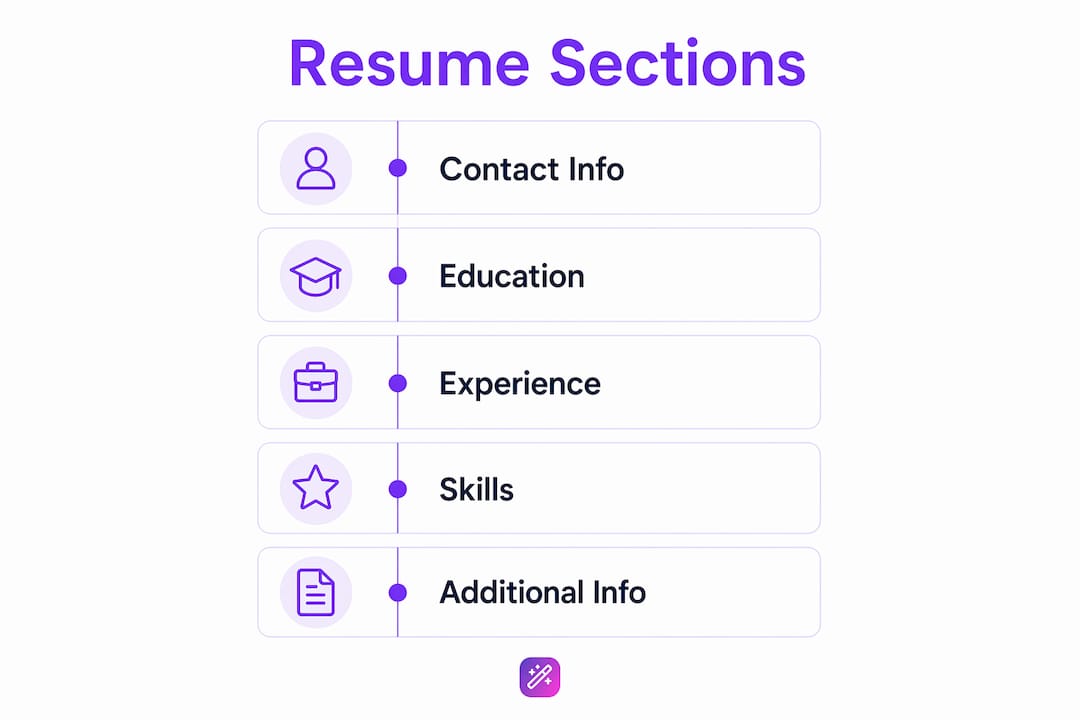
Relevant experience is the heart of the document. This section covers paid jobs, internships, volunteer work, and significant campus roles. Each entry should include the organization name, your title, dates, and two to four bullet points describing what you did and what resulted from it. Using action verbs and quantifiable achievements makes each bullet sharper. “Managed social media accounts” is weak. “Grew Instagram following by 40% over three months by scheduling daily posts and analyzing engagement data” is strong.
Skills and certifications round out the core sections. List technical skills like Python, Adobe Premiere, or Salesforce, along with any certifications from Google, HubSpot, Coursera, or similar platforms. Soft skills like communication and teamwork matter to employers, but demonstrate them through your experience bullets rather than just listing them as standalone words.
Optional sections worth including when relevant:
- Academic projects tied directly to the role you are applying for
- Leadership positions in clubs or student organizations
- Awards and honors with brief context
- Extracurricular activities that show character or commitment
Pro Tip: Cut any experience that does not connect to the role. A babysitting job from three years ago does not belong on a marketing internship resume unless you can frame it around responsibility, scheduling, or client communication.
How to format your student resume for 2026 applications
Resume formatting is not about making your document look pretty. It is about making sure both a human recruiter and an applicant tracking system (ATS) can read it without friction. ATS systems increasingly govern resume screening, and a resume with heavy graphics, text boxes, or unusual fonts may never reach a human reader at all.
Follow these formatting steps in order:
- Set your font. Use a clean, professional typeface like Calibri, Garamond, or Georgia at 10 to 12 points for body text and 14 to 16 points for your name at the top.
- Set your margins. Keep margins between 0.5 and 1 inch on all sides. Going narrower than 0.5 inches makes the page feel cramped.
- Choose a single-column layout. Two-column layouts look modern on screen but often confuse ATS parsers, which read left to right and top to bottom.
- Save as a PDF. Unless the job posting specifically requests a Word document, PDF preserves your formatting across every device and operating system.
- Name your file professionally. The standard format recommended by UNC and Oklahoma State University Career Services is Last_First_Resume.pdf. “Resume_Final_v3_REAL.pdf” signals disorganization before anyone reads a word.
- Tailor the content. Mirror keywords from the job description in your resume. If the posting mentions “data analysis” and you have done data analysis, use that exact phrase.
Using professional resume templates built for ATS compatibility removes most of the formatting risk from the equation. The structure is already correct. You fill in the content.
| Formatting element | Recommended standard |
|---|---|
| Font size | 10 to 12 pt for body, 14 to 16 pt for name |
| Margins | 0.5 to 1 inch |
| File format | PDF (unless otherwise specified) |
| File name | Last_First_Resume.pdf |
| Layout | Single column, no text boxes or graphics |
Understanding why resume formatting matters goes beyond aesthetics. A poorly formatted document can be rejected before a recruiter ever reads your name.
Practical tips and common mistakes students make
The single most damaging mistake students make is submitting the same generic resume to every job. A resume tailored to each application consistently outperforms a one-size-fits-all version because it speaks directly to what that specific employer needs. Spend fifteen minutes per application adjusting your summary, reordering your bullet points, and swapping in keywords from the job description.
The second most common mistake is confusing activity with achievement. Listing your duties tells a recruiter what you were supposed to do. Listing your results tells them what you actually delivered. Replace “Responsible for customer service” with “Resolved an average of 30 customer inquiries per shift with a 95% satisfaction rating.”
Here are the most important tips for writing a student resume that gets noticed:
- Tailor every version. Read the job description carefully and reflect its language back in your resume.
- Lead with your strongest material. Recruiters spend an average of six to seven seconds on an initial resume scan. Put your most relevant experience near the top.
- Cut ruthlessly. Recruiters prioritize relevant, concise resumes over long ones packed with unrelated experience. If a bullet point does not support your candidacy for this specific role, delete it.
- Use Grammarly or a similar tool to catch spelling errors, grammar issues, and passive voice before you submit. One typo can eliminate an otherwise strong application.
- Get a second opinion. Ask a professor, a career center advisor, or a peer in your field to read your resume. Fresh eyes catch what you miss.
- Update it regularly. Your resume is a living document that should reflect your current skills and experiences, not a snapshot from freshman year.
Pro Tip: Do not over-design your resume to stand out visually. Colorful headers, icons, and infographic-style layouts often fail ATS screening and distract from your actual qualifications. Clean and readable beats creative and unreadable every time.
For more ways to strengthen your overall application, the Easy-cv article on standing out in job applications covers the full picture beyond the resume itself.
Key takeaways
A student resume is a one-page, tailored document that works only when its content is relevant, its format is ATS-compatible, and it is updated for every application.
| Point | Details |
|---|---|
| Definition and purpose | A student resume is a targeted marketing document, not a complete work history. |
| Resume vs. CV | Use a resume for jobs and internships; use a CV only for academic or research roles. |
| Core sections | Include contact info, education, relevant experience, and skills. Cut everything else. |
| Formatting standards | Single-column PDF, 10 to 12 pt font, professional file name, no graphics. |
| Tailoring is non-negotiable | A resume matched to the job description outperforms a generic version every time. |
What most students get wrong about their first resume
Most students I have seen approach their first resume as a record-keeping exercise. They list everything they have done in chronological order and hope something sticks. That approach almost never works, and I think it comes from a fundamental misunderstanding of what a resume actually is.
A resume is not your story. It is your argument. Every line should answer one question: why should this employer pick you over the other 200 applicants? When you frame it that way, the editing process becomes much easier. Anything that does not answer that question gets cut.
The other thing I have noticed is that students underestimate how much their academic projects and campus involvement can substitute for formal work experience. A capstone project where you analyzed real market data for a local business is legitimate experience. A leadership role in a student organization where you managed a $5,000 budget is legitimate experience. The mistake is not having too little to say. The mistake is not knowing how to say it.
My strongest advice: treat your resume as a living document from day one of college, not something you scramble to build in senior year. Add to it every semester. By the time you are applying seriously, you will have more material than you need, and the editing will be the easy part.
— Andras
Build your student resume faster with Easy-cv
Starting a resume from scratch is one of the most time-consuming parts of a job search, especially when you are applying to multiple roles at once.
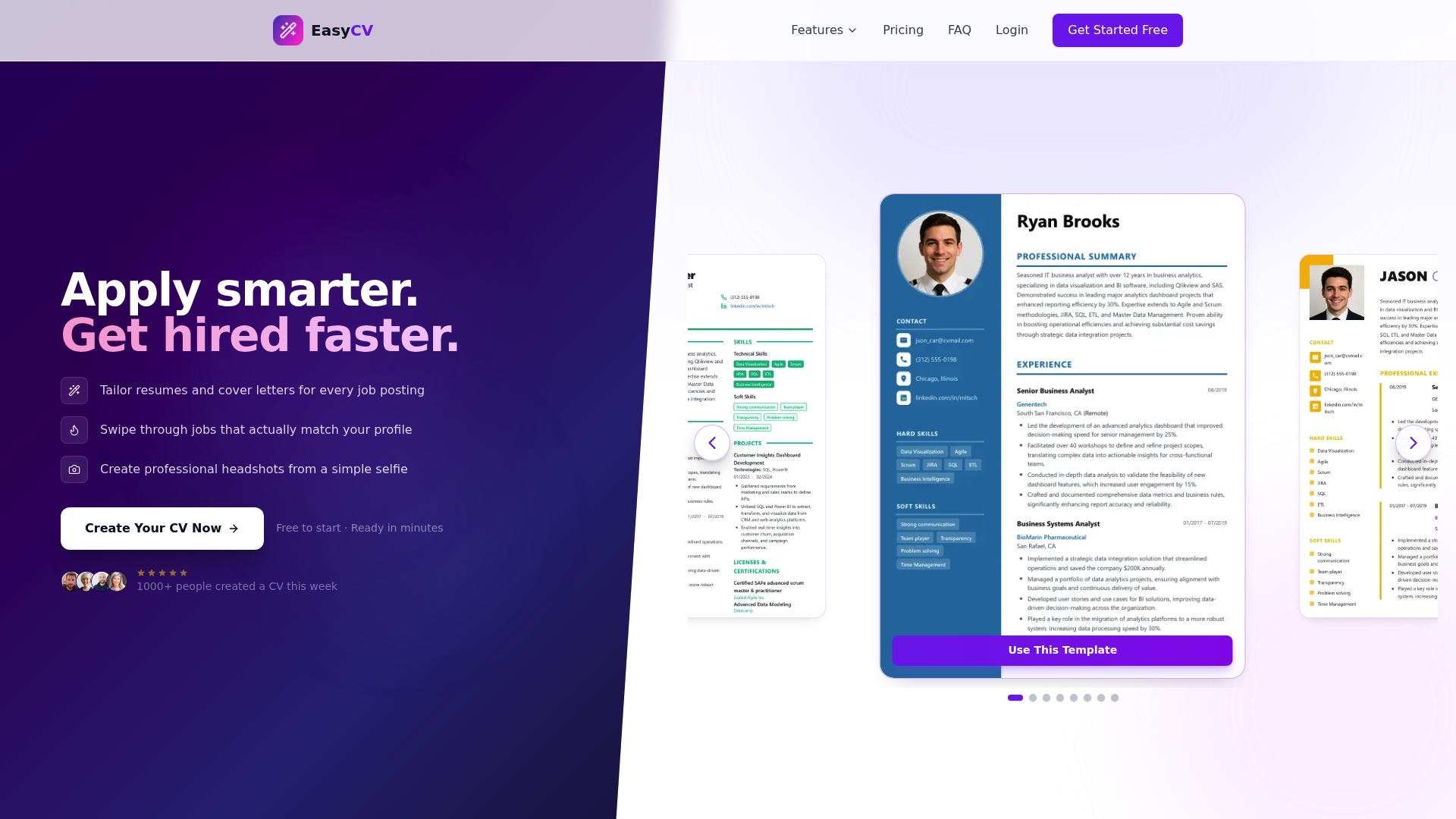
Easy-cv removes that friction. The platform’s AI-powered resume builder gives you access to modern, ATS-friendly templates designed specifically for students and entry-level applicants. You can generate and refine your resume content using the built-in AI writing assistant, then tailor it to each job description without rebuilding from scratch every time. Easy-cv also handles cover letters, job tracking, and even translates your application materials into 30+ languages for international opportunities. If you are ready to stop guessing and start applying with confidence, build your resume on Easy-cv today.
FAQ
What is a student resume used for?
A student resume is used to apply for internships, part-time jobs, and entry-level positions. It presents your education, relevant experience, and skills in a concise, one-page format tailored to a specific role.
How long should a student resume be?
Most student resumes should be one page. Two pages are acceptable only when you have extensive relevant experience, which is rare for students early in their academic careers.
What is the difference between a student resume and a CV?
A resume is a concise, tailored document for job and internship applications, while a CV is a comprehensive academic record used for research roles and graduate school. Students applying to most jobs need a resume, not a CV.
Should I include my GPA on my student resume?
Including your GPA is optional. List it if it is above 3.5 or if an employer specifically requests it. If your GPA is below 3.0, focus on your skills and experience instead.
How do I make my student resume stand out?
Tailor your resume to each job description, lead with your most relevant experience, use action verbs with measurable results, and keep the format clean and ATS-compatible. Tools like Grammarly help catch errors before submission.