Resume vs CV: Choose the Right Format for Your Job

Knowing whether to send a resume or a CV feels simple until you’re actually staring at a job posting and second-guessing yourself. The confusion is real, it’s common, and it can quietly cost you interviews. Even seasoned professionals mix up these two documents, especially when switching from industry jobs to academic roles or applying internationally. This article breaks down exactly what each document is, how they differ in structure and purpose, and gives you a clear framework for picking the right one every time. Whether you’re a recent graduate, a professional updating your documents, or someone re-entering the workforce, this guide has you covered.
Table of Contents
- What is a resume? Core features and use cases
- How is a CV different? Key distinctions and academic focus
- Resume vs CV: Direct comparison for US job seekers
- How to choose—and tailor—your document for every application
- Why resume vs CV is more about audience than format
- Build the perfect resume or CV with Easy CV
- Frequently asked questions
Key Takeaways
| Point | Details |
|---|---|
| Resume is best for US jobs | A resume is the standard for most US industry applications and should be kept concise and tailored. |
| CVs suit academic careers | Use a CV for US academic, research, or grad school opportunities, and let it grow with your achievements. |
| Match your document to the audience | Always check the job posting and region to ensure you’re submitting the correct format. |
| Customization matters | Resumes should be tailored for each job, while CVs showcase your full career over time. |
What is a resume? Core features and use cases
A resume is a concise, targeted snapshot of your skills, work history, education, and accomplishments. Its entire purpose is to show a hiring manager, in the shortest amount of time possible, that you are the right fit for one specific job. That last part matters. A resume is not a general life summary. It is a tailored pitch document built for a particular role.
The golden rule for resumes is brevity. Most resumes run one to two pages. For recent graduates or people with fewer than five years of experience, one page is ideal. Mid-career professionals can stretch to two pages, but rarely beyond that for industry positions. Every line on a resume should earn its place by proving relevance to the job at hand.
Top components of a strong resume:
- Contact information — Your name, phone number, professional email, LinkedIn profile, and city/state
- Professional summary or objective — A two to three sentence pitch at the top that frames your value
- Work history — Listed in reverse chronological order with bullet points highlighting achievements, not just duties
- Education — Degree, institution, graduation year; placement varies based on experience level
- Skills section — Hard skills like software proficiency and soft skills like communication or leadership
- Accomplishments and certifications — Anything quantifiable, such as “increased sales by 22%” or relevant licenses
Resumes dominate the US job market for virtually every non-academic sector: tech, finance, marketing, healthcare, retail, manufacturing, and more. If you’re applying to a corporate or business role, a resume is almost certainly what the employer expects.
“Lead with education if you have limited professional experience.” As Arizona State University notes, recent graduates should use resumes for most entry-level industry jobs and prioritize their education section when professional experience is thin.
Pro Tip: Every time you apply for a new position, revisit your resume and adjust the language in your work history and skills sections to mirror the keywords in that specific job posting. Applicant tracking systems (ATS) are software programs companies use to filter resumes before a human ever reads them. Matching the job description’s language dramatically increases your chances of getting through.
Using professional resume tips and AI-powered tools can save you hours of manual editing while ensuring each version of your resume is precisely aligned with the role you want.
How is a CV different? Key distinctions and academic focus
CV stands for curriculum vitae, a Latin phrase meaning “course of life.” That name tells you everything. Where a resume is a targeted highlight reel, a CV is a full, chronological record of your entire academic and professional life. Nothing gets cut for relevance. Everything gets documented.

CVs are primarily used in academic, research, and scientific settings. If you are applying to a graduate program, a faculty position, a postdoctoral fellowship, or a grant-funded research role, a CV is the expected format. The hiring committee in these environments wants to see the full breadth of your work, not a curated two-page pitch.
Main content sections of a CV:
- Contact information and academic profile
- Education (listed first and in detail, including thesis titles)
- Research experience and lab affiliations
- Publications (peer-reviewed articles, book chapters, conference papers)
- Presentations and conference talks
- Teaching experience
- Grants, fellowships, and awards
- Professional memberships and service
- References (often listed directly on the CV in academic contexts)
Unlike a resume, a CV grows over your career and is never “finished.” A junior researcher might have a three-page CV. A seasoned professor might have a twenty-page CV. That’s expected and appropriate. Length signals depth of contribution, not a failure to edit.
As Harvard’s career services team explains, CVs grow throughout your career without needing tailoring for each application, while resumes are customized per submission. Outside the US, this terminology flips, which causes real confusion.
That last point is critical. In the United Kingdom, Ireland, Australia, New Zealand, and much of Europe, the term “CV” is used for what Americans would call a resume. A UK job posting asking for a “CV” typically wants a concise, two-page document tailored to the role, not an academic life record. If you’re applying internationally, always research the local convention before submitting anything.
Professionals exploring academic career tools designed for these specific contexts will find it much easier to format and manage documents for research or academic roles without reinventing the wheel each time.
Resume vs CV: Direct comparison for US job seekers
Understanding each document separately is helpful, but seeing them side by side makes the differences impossible to ignore. Here is a clear comparison designed specifically for US job seekers navigating the domestic market.
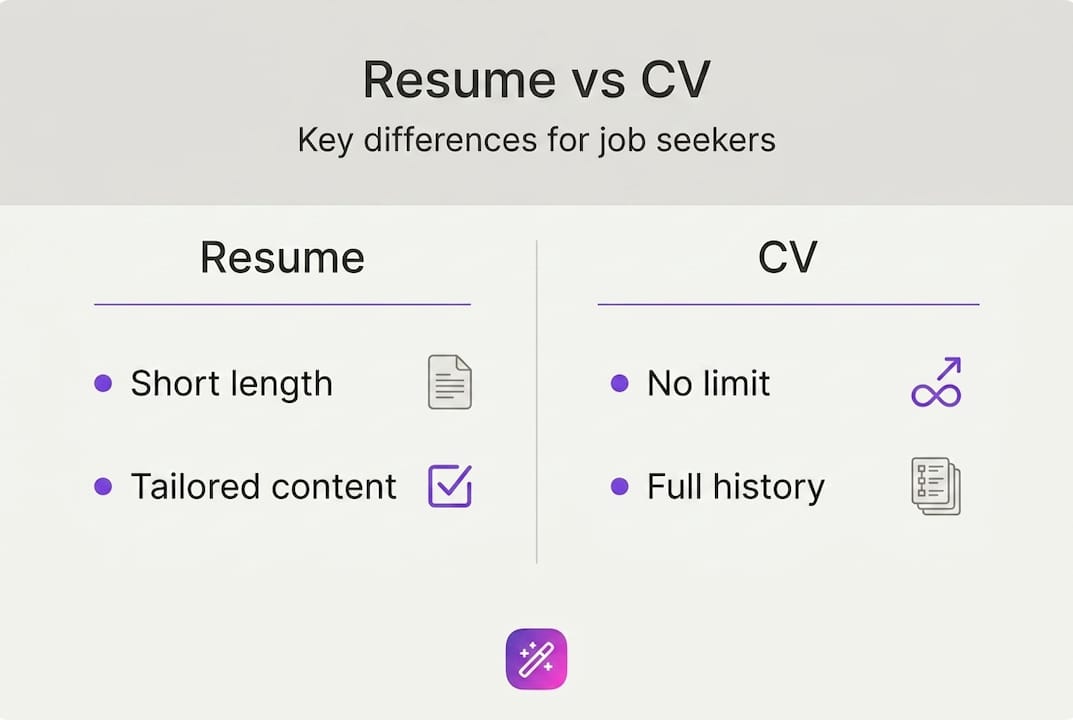
| Feature | Resume | CV |
|---|---|---|
| Length | 1 to 2 pages | No limit; grows with career |
| Tailoring | Customized for each role | Rarely tailored; comprehensive record |
| Primary audience | Industry hiring managers | Academic committees, grant reviewers |
| Tone | Achievement-focused, concise | Scholarly, comprehensive, detailed |
| Typical use | Corporate, business, nonprofit | Academia, research, graduate school |
| Publications section | Almost never included | Central component |
| References | Available upon request | Often listed directly |
| Format evolution | Updated and pruned regularly | Grows continuously |
The data is clear. Industry jobs default to resumes, and submitting a multi-page CV to a standard corporate role can signal that you don’t understand professional norms in that sector.
Pro Tip: Before submitting any application, read the job posting twice. Look for specific language like “please submit your CV” or “attach your resume.” If the posting is for a university faculty position, a research scientist role, or a fellowship program, a CV is almost certainly expected. If it’s a business, tech, or nonprofit role, default to a resume.
Common mistakes to avoid:
- Sending a CV to a business role — This can make you look out of touch with industry norms
- Sending a resume to a grad school committee — Academic reviewers want your full scholarly record, not a two-page pitch
- Assuming CV and resume are interchangeable worldwide — They are not, and regional differences are significant
- Neglecting to update your resume’s keywords — Each application should have a version customized to that specific posting
The stakes are higher than most people realize. A well-matched document format signals professional awareness before the hiring manager even reads a single bullet point.
How to choose—and tailor—your document for every application
Now that the distinction is clear, the practical question is: how do you make the right call every single time? The answer is a short checklist applied consistently before every application.
Key questions to ask yourself before applying:
- What country is the employer based in? US conventions differ from UK, European, and Australian norms.
- Does the job posting explicitly say “resume” or “CV”?
- Is the role in academia, research, or a grant-funded institution?
- Is this a graduate school application or an industry role?
- Does the organization have a careers page that specifies their preferred format?
If you answer yes to the third or fourth question, you almost certainly need a CV. For everything else in the US market, go with a resume.
Here is a practical customization strategy for both document types:
| Situation | Document type | Customization approach |
|---|---|---|
| Entry-level US industry job | Resume | Lead with education; tailor skills to job description |
| Mid-career US corporate role | Resume | Prioritize achievements with numbers; trim older roles |
| US graduate school application | CV | Full academic record; highlight research and publications |
| US academic faculty position | CV | Emphasize teaching, research agenda, and service |
| UK or Australian industry role | Resume (called CV locally) | Use local terminology; keep to two pages |
| International research fellowship | CV | Comprehensive scholarly record; follow institution guidelines |
When in doubt, universities emphasize audience-tailoring as the single most impactful decision a job seeker can make. If the posting still feels unclear after your checklist review, email the HR contact or career services team at the organization. Asking demonstrates initiative, not confusion.
Using customizing your application tools that allow you to build multiple versions of your document with AI-powered adjustments means you can move fast without sacrificing quality. The goal is always to make the reader feel like this document was written specifically for them, because it was.
Why resume vs CV is more about audience than format
Here’s what most articles about this topic miss entirely. Job seekers obsess over formatting rules, page counts, and section headings. Those things matter, but they’re not the real driver of application success.
The deeper question is: who is reading this document, and what do they need to see?
A hiring manager at a tech startup wants to instantly identify your relevant skills, see quantified results, and move on. They are scanning dozens of applications quickly. Your resume needs to deliver a clear answer to “can this person do the job?” in about six seconds.
An academic search committee is doing something completely different. They want to evaluate scholarly output, methodological depth, and intellectual trajectory. They will read carefully. They want your full record. A trimmed resume feels dismissive in that context.
The format follows the audience, not the other way around. Navigating resume choices becomes much easier once you stop thinking about these documents as fixed rules and start thinking about them as communication tools built for specific readers.
Even the best-formatted document fails if it doesn’t match what the reader expects. We’ve seen candidates with genuinely strong experience lose out simply because they sent the wrong document type. It signals a misread of the environment, which is exactly the kind of signal you don’t want to send at the start of a professional relationship.
Build the perfect resume or CV with Easy CV
You now know the difference, you have the checklist, and you understand what each audience wants. The next step is execution.
Easy CV platform gives you AI-powered tools to build both polished resumes and detailed CVs that meet global standards. Whether you’re a recent grad crafting your first one-page resume, a professional optimizing for ATS systems, or a researcher assembling a full academic CV, the platform has templates and customization features built for every stage. The CV and resume tools include keyword optimization, multiple document versions, cover letter generation, and export options in multiple formats. Explore Easy CV pricing to find the plan that fits your job search needs, from free access to premium features designed for serious applicants.
Frequently asked questions
When should I use a resume instead of a CV?
Use a resume for most US industry jobs, especially if the posting does not specify a CV. As career experts confirm, defaulting to a resume for US-based industry roles is the right call when the posting is unclear.
How long should my resume or CV be?
A resume is typically one to two pages, while a CV has no page limit and grows throughout your career. Harvard career services notes that CVs expand over time as your scholarly and professional record deepens.
What if the employer doesn’t specify which document to submit?
If applying to a US industry job and the posting is unclear, submit a resume by default. Career advisors consistently recommend that unspecified US job postings should be answered with a resume unless the role is academic or research-focused.
Is the term “CV” used differently outside the US?
Yes, outside the US, “CV” often refers to what Americans call a resume. Harvard career resources confirm that international terminology differs significantly, so always research country-specific conventions before applying abroad.