Benefits of Tailored Resumes: Your 2026 Job Search Edge
A tailored resume is a version of your CV customized for a specific job posting, built to match the employer’s exact language, priorities, and requirements. The benefits of tailored resumes are measurable: they double your interview rate compared to generic applications, with a 5.75% conversion rate versus 2.68% for one-size-fits-all resumes. That gap is not a minor edge. It is the difference between six callbacks per 100 applications and fewer than three. Whether you are switching industries, climbing a ladder, or re-entering the workforce, customized resume advantages compound with every application you send.
1. Benefits of tailored resumes for ATS scoring
Applicant Tracking Systems, known as ATS, filter most resumes before a human ever reads them. A tailored resume is built to pass that filter by matching the exact keywords and phrases a job description uses.
Applying a 5-minute tailoring method raises ATS scores by an average of 18.4 points over generic resumes. That benchmark comes from a sample of 4,180 job seekers tested in early 2026. An 18-point jump can move your resume from the rejection pile to the top of the shortlist.

The key is contextual matching, not keyword stuffing. Contextual matching means using the employer’s exact terminology in the right sections, so the ATS reads your resume as a strong fit. Pasting in a wall of keywords at the bottom of your document does the opposite. It flags your resume as manipulative and tanks your score.
Focus your keyword work on two sections: the professional summary and the skills list. These carry the most weight in most ATS algorithms. Getting those two sections right accounts for the majority of your score improvement.
Pro Tip: Before applying, paste the job description into a word frequency tool like WordCounter or TagCrowd. The words that appear most often are the ones your resume needs to include naturally in the summary and top bullet points.
2. Why tailored resumes increase recruiter interest
Passing the ATS is only half the battle. Once a recruiter opens your resume, you have very little time to make an impression. Hiring managers scan resumes in an average of 7.4 seconds. That is not a reading session. It is a pattern-recognition check.
A tailored resume wins that check because it puts the most relevant information first. Recruiters prefer resumes that quickly show industry literacy and role fit, reducing the time they spend screening. In specialized fields like technology and finance, this matters even more. A generic resume forces the recruiter to search for relevance. A tailored one delivers it immediately.
“Recruiters in specialized industries want resumes that do the filtering for them, highlighting relevant skills and achievements instantly.” — Robert Half
Reordering your experience bullets to lead with the most relevant achievements is one of the highest-return moves you can make. If you are applying for a project management role, your bullet about leading a cross-functional team should appear before your bullet about managing vendor contracts, even if the vendor work came first chronologically.
Pro Tip: Read the job posting and identify the top three responsibilities. Then check that your resume’s first visible section addresses all three within the first ten lines a recruiter sees.
3. Tailored resumes signal genuine interest to employers
Tailoring signals focused interest, and recruiters recognize it immediately. A resume that mirrors the language of a job posting tells the hiring manager that you read the description carefully, understood what they need, and took the time to show how you fit. That signal carries real weight in competitive hiring.
Generic resumes communicate the opposite. They suggest you are applying to dozens of roles with minimal thought. Even if your qualifications are strong, a generic presentation makes you look like a volume applicant rather than a focused candidate.
Candidates who tailor their resumes also tend to perform better in interviews. When your resume accurately reflects the role you are interviewing for, the conversation flows more naturally. You have already done the work of connecting your experience to the job, and that preparation shows.
The compounding effect is real. Better resumes attract better-fit interviews. Better-fit interviews lead to stronger offers. The tailored CV advantages extend well beyond the initial callback.
4. What to customize and how to do it efficiently
Tailoring a resume does not mean rewriting it from scratch for every application. The most effective approach targets three specific sections: the professional summary, the skills list, and the top two or three bullet points under each relevant role.
Here is a practical order of operations:
- Update your professional summary. Swap in the job title from the posting and reflect the top one or two priorities the employer lists. This takes two to three minutes.
- Reorder your skills section. Put the skills mentioned in the job description at the top of your list. Skills buried at the bottom rarely register in a 7-second scan.
- Adjust your top achievement bullets. Lead with the accomplishment most relevant to this specific role. You are not inventing new content. You are reordering what you already have.
- Check your language. If the job posting says “stakeholder management” and your resume says “client relations,” change it. ATS systems and recruiters both respond to exact matches.
- Save a master resume. Keep a comprehensive document with every role, skill, and achievement you have ever held. Pull from it each time you tailor. This prevents you from starting from zero.
Tailoring commonly takes 3–5 minutes per application when you work from a strong master resume. That time investment pays for itself many times over in interview conversion.
Pro Tip: Keep your master resume in a separate document and never send it directly. It is your source file, not your submission file. Treat every application as a targeted edit of that source.
5. The numbers: tailored vs. generic resumes
The data on personalized resume benefits is clear and consistent across multiple studies.
| Metric | Tailored resumes | Generic resumes |
|---|---|---|
| Interview conversion rate | 5.75% | 2.68% |
| Interviews per 100 applications | ~6 | ~3 |
| Applications needed for 6 interviews | ~104 | ~224 |
| Wasted applications saved | 120+ per hiring cycle | Baseline |
Sending 50 tailored applications equals the effectiveness of sending 107 generic ones. That means you can work at roughly half the volume and achieve the same number of interviews. For anyone managing a job search alongside a current job or other responsibilities, that efficiency is significant.
Customized applications also increase hireability by up to 8% when aligned with employer requirements. That figure comes from academic and industry research examining how ATS algorithms score resume-to-job-description alignment. Eight percent may sound modest, but in a competitive applicant pool of 200 candidates, it can mean the difference between making the shortlist and not.
The importance of customized resumes is not just about getting more interviews. It is about getting the right interviews, with employers who already see you as a strong fit before you walk in the door.
6. When to tailor fully and when a light edit is enough
Not every application deserves the same level of effort. Strategic tailoring means matching your investment to the opportunity.
Full tailoring is worth it when:
- The role is a strong match for your target career path
- The employer is a top-choice company for you
- The job is competitive and the posting is highly specific
- You are changing industries or roles and need to reframe your experience
A light edit is usually enough when:
- You are applying to multiple roles with nearly identical requirements
- The job is in the same industry with the same core skills as your last role
- The posting is vague and does not list specific tools or methodologies
The importance of tailored resumes is highest for roles you genuinely want. Attempting exhaustive rewrites for every job leads to burnout and lower overall quality. A well-tailored application to ten strong-fit roles will outperform a rushed application to fifty mediocre ones.
Tracking which roles you have tailored for, and what adjustments you made, also helps you learn over time. If you notice that certain keywords or framings consistently lead to callbacks, you can build those into your master resume as defaults. Tools that help you organize your job search make this pattern recognition much easier.
Key takeaways
Tailored resumes consistently outperform generic ones because they align your skills and language with what each employer is actively looking for, improving both ATS scores and recruiter response rates.
| Point | Details |
|---|---|
| ATS score improvement | A 5-minute tailoring method raises ATS scores by an average of 18.4 points. |
| Interview conversion | Tailored resumes convert at 5.75% vs. 2.68% for generic, doubling interview opportunities. |
| Efficiency gain | 50 tailored applications match the output of 107 generic ones, saving significant effort. |
| What to customize | Focus on the professional summary, skills order, and top achievement bullets per role. |
| When to go deep | Reserve full tailoring for high-fit, competitive roles where the investment pays off most. |
My honest take on resume tailoring
I was skeptical of resume tailoring for a long time. The advice always sounded like more work for marginal gain. Rewrite your resume for every job? That felt unsustainable.
What changed my thinking was tracking my own application data. Once I started logging which applications led to callbacks and which did not, the pattern was impossible to ignore. The callbacks almost always came from applications where I had spent even five minutes adjusting the summary and reordering the skills. The generic sends were mostly silence.
The shift that made tailoring sustainable was building a strong master resume first. Once that foundation existed, tailoring became a quick edit, not a full rewrite. I stopped thinking of it as creating a new document and started thinking of it as tuning an existing one.
The other thing I learned: you do not need to tailor everything. Selective tailoring for your top-choice roles, combined with a solid baseline resume for everything else, is a realistic and effective strategy. Trying to perfectly customize every single application is how people burn out and quit their job search entirely.
Start with your next three applications. Pick the roles you actually want. Spend five minutes on each one adjusting the summary and top bullets. Then track what happens. The data will convince you faster than any article will.
— Andras
How Easy-cv makes resume tailoring fast and effortless
Tailoring a resume manually takes discipline and time. Easy-cv removes most of that friction by bringing the entire process into one place.
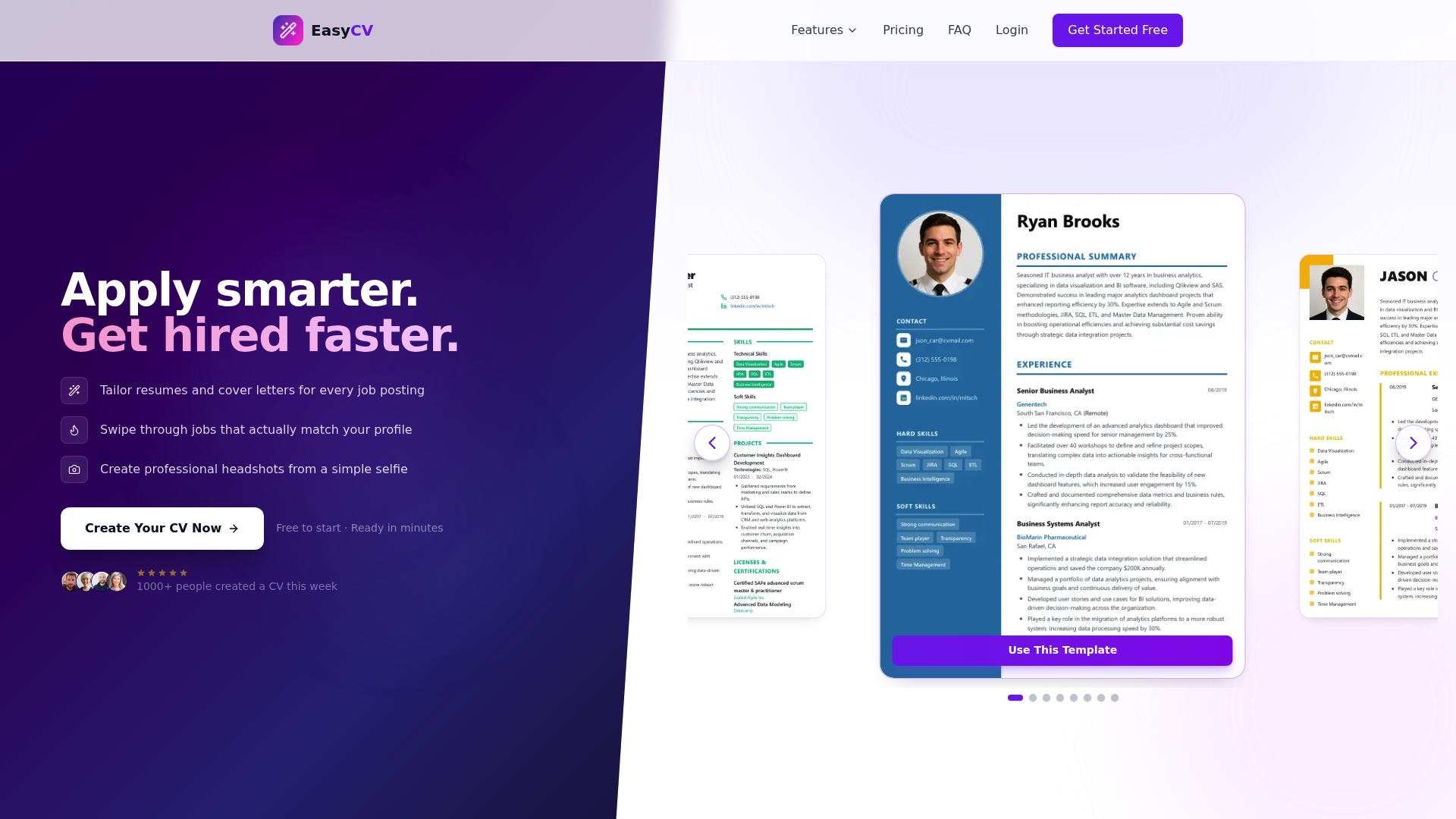
Easy-cv’s AI writing assistant reads a job description and automatically suggests adjustments to your summary, skills section, and bullet points, so you get the ATS keyword alignment without the manual scanning. The platform also includes a built-in job tracker, so you always know which version of your resume went to which employer. With access to 10 million+ job listings per month and ATS-friendly templates ready to go, Easy-cv turns a 30-minute tailoring session into a 5-minute one. If you want to build a tailored resume that actually gets callbacks, Easy-cv is where to start.
FAQ
What is a tailored resume?
A tailored resume is a version of your CV customized for a specific job posting, adjusted to match the employer’s language, required skills, and stated priorities. It differs from a generic resume in that it directly mirrors what the job description asks for.
How much does tailoring a resume improve interview rates?
Tailored resumes achieve a 5.75% interview conversion rate compared to 2.68% for generic resumes, effectively doubling your chances of getting a callback per application sent.
Do I need to rewrite my resume for every job?
No. Effective tailoring focuses on three sections: the professional summary, the skills list order, and the top achievement bullets. Working from a master resume, this process takes 3–5 minutes per application.
How do tailored resumes help with ATS filters?
Tailored resumes use the exact keywords and phrases from a job description in the right sections, which raises ATS match scores. A structured 5-minute tailoring method has been shown to improve ATS scores by an average of 18.4 points over generic submissions.
When is tailoring a resume most worth the effort?
Tailoring delivers the highest return on competitive, high-fit roles where the job description is specific and the employer is a strong match for your career goals. For similar roles in the same industry, a light edit to the summary and skills section is usually enough.