CV Optimization Tips That Get You Hired in 2026

CV optimization is the practice of tailoring your resume to pass Applicant Tracking System filters and earn recruiter attention through targeted keyword alignment, clean formatting, and measurable achievement highlights. 99% of Fortune 500 companies use ATS software, and 75% of applications are rejected before a human ever reads them. That means your CV’s structure and language determine whether you get a callback or disappear into a digital void. Tools like Easy-cv, Jobscan, and Grammarly each address a different layer of this problem. The tips below cover every layer, from formatting to keyword strategy to quantified results.
1. Format your CV for ATS parsing first
ATS-friendly formatting is the foundation of every effective resume optimization technique. Parsing failures caused by tables, columns, and nonstandard layouts cripple ATS reading, and removing these elements yields immediate score improvements. That single change costs you nothing and fixes the most common reason strong candidates get filtered out.
Use a single-column layout with no text boxes, no graphics, no headers or footers, and no decorative dividers. ATS parsers read left to right, top to bottom, and anything outside that flow gets scrambled or dropped entirely. Fonts like Calibri, Arial, or Georgia at 10 to 12 points read cleanly across all systems. Submit your file as a DOCX or a simple, non-scanned PDF unless the job posting specifies otherwise.

Standard section headings like “Work Experience,” “Education,” and “Skills” are non-negotiable. Creative labels like “My Journey” or “Where I’ve Been” confuse parsers and cause entire sections to be skipped. This is one of the most overlooked CV optimization tips because it feels like a minor stylistic choice when it is actually a structural requirement.
Pro Tip: Copy your CV text into a plain text editor like Notepad. If the content looks scrambled, out of order, or missing sections, your ATS formatting has problems that need fixing before you submit anywhere.
For a deeper look at structure, the ATS-friendly formatting guide from Easy-cv covers every layout decision with specific examples.
2. Build a targeted keyword strategy
Keyword optimization is where most job seekers either win or lose the ATS match game. Spending 15 to 20 minutes tailoring each CV to include 15 to 20 keywords pulled directly from the job description is the proven standard for 2026. Brief, two-minute edits are not enough to move the needle.
Here is how to build your keyword list effectively:
- Pull the job description into a document and highlight every skill, tool, qualification, and responsibility mentioned more than once.
- Cross-reference that list against two or three similar job postings to identify which terms appear consistently across the role.
- Separate the list into hard skills (Python, Salesforce, financial modeling) and soft skills (cross-functional collaboration, stakeholder communication).
- Mirror the exact phrasing used in the posting. If the employer writes “project management,” do not substitute “managing projects.”
- Integrate keywords into your professional summary, your Skills section, and the bullet points of your most recent roles.
Machine learning ATS platforms now score contextual relevance rather than raw keyword counts, so natural integration into achievement descriptions outperforms keyword lists every time. Aim for a 60 to 80% keyword match rate. Going above that threshold often signals stuffing, which modern ATS software detects and penalizes.
Pro Tip: A dedicated Skills section with comma-separated keywords carries more ATS weight than the same keywords buried inside paragraph descriptions. Keep it clean and scannable.
For a full breakdown of keyword research methods, Easy-cv’s guide on resume keyword strategy is worth reading before your next application.
3. Replace task descriptions with quantified achievements
ATS algorithms now prioritize impact metrics such as dollar amounts, percentages, and volume-based results over simple task descriptions. This shift means that “managed a team” scores lower than “managed a team of 8 engineers and reduced deployment time by 34%.” The number is not decoration. It is what the system is scanning for.
Every bullet point in your Work Experience section should answer one question: what changed because of what you did? Use this structure as your default:
- Action verb + task + measurable result. “Increased quarterly sales revenue by $420K by restructuring the outbound prospecting process.”
- Scope + outcome. “Oversaw a $1.2M product launch across three markets, hitting 112% of the first-year adoption target.”
- Problem + solution + metric. “Identified a recurring billing error affecting 300+ accounts and recovered $85K in outstanding payments within 60 days.”
If you are early in your career or transitioning fields, pull metrics from academic projects, internships, or volunteer roles. “Coordinated logistics for a 200-person fundraising event, raising 18% more than the prior year” is a legitimate achievement. Recruiters and ATS systems do not distinguish between paid and unpaid work when the numbers are real.
“Length matters less than impact density.” The most effective CVs for experienced professionals are not one page. They are dense with verified, measurable outcomes on every line.
4. Tailor your CV for every application
Tailored CVs receive up to 3 times more recruiter callbacks than generic ones, and the average unoptimized ATS score sits around 48 compared to 85 or higher for optimized versions. That gap is the difference between an interview and silence.
Efficient tailoring does not mean rewriting your entire CV for each role. It means making targeted edits in the right places:
- Rewrite your professional summary to reflect the specific role title and two or three priorities from the job description.
- Update the top three to four bullet points in your most recent position to include the job’s primary keywords.
- Adjust your Skills section to front-load the tools and competencies the employer listed first.
- Remove or de-emphasize experience that is irrelevant to this specific role.
Maintaining two or three base CV versions for different role types (for example, one for project management roles and one for operations roles) cuts your tailoring time significantly. You start from a closer baseline each time. Easy-cv’s article on managing multiple CV versions explains how to organize this without losing track of which version went where.
Pro Tip: After tailoring, run your CV through an ATS simulation tool to check your keyword match score before submitting. A score below 60% is a signal to revise, not submit.
5. Keep your career narrative consistent across platforms
Machine learning ATS platforms cross-reference data points like job title progression and LinkedIn profiles to detect inconsistencies. A CV that lists a different job title or employment date than your LinkedIn profile creates a flag that can remove you from consideration before a recruiter notices your qualifications. Consistency is not just good practice. It is a ranking factor.
Audit your LinkedIn profile, your CV, and any other professional profiles before you start applying. Job titles, company names, employment dates, and education credentials should match exactly. If you held an informal title internally but a different one officially, use the official title everywhere and clarify the scope in your bullet points. This is one of the resume optimization techniques that takes 20 minutes to fix and protects every application you send afterward.
6. Avoid the mistakes that trigger automatic rejection
The most common CV errors in 2026 are not typos. They are structural and strategic choices that look fine to a human but break ATS parsing or trigger penalty flags. Knowing what to avoid is as important as knowing what to include.
- Nonstandard section headings confuse parsers and cause entire blocks of content to be misread or dropped.
- White text keyword stuffing (hiding keywords in white font on a white background) is detected and penalized by modern ATS platforms. It results in immediate rejection.
- Tables and multi-column layouts break parsing logic. The ATS reads columns left to right across the full page width, which scrambles content.
- Generic descriptions like “responsible for managing projects” provide no signal to ATS or recruiters. Replace them with specific, metric-backed statements.
- Submitting the same CV everywhere without tailoring produces consistently low match scores. Even a 15-minute edit per application significantly improves interview rates compared to mass-applying with one static document.
For additional guidance on recruiter expectations and ATS filtering, the resume and interview prep resource from Cornerstone Search covers what professional recruiters actually look for once a CV clears the ATS stage.
7. Test your CV before every submission
Testing your CV by copying it into a plain text editor or running it through an ATS simulation tool reveals parsing issues that are completely invisible in formatted views. Most candidates submit without testing and never know why their applications go unanswered.
Paste your CV into Notepad or TextEdit and check whether the content reads in the correct order, whether section headings appear where expected, and whether any text has gone missing. If bullet points become garbled symbols or your Skills section appears in the middle of your Work Experience, your formatting is failing the parse. Fix the source document before submitting anywhere. This single step separates candidates who get interviews from those who wonder why they never hear back.
Key takeaways
Optimized CVs score 85 or higher on ATS systems compared to an average of 48 for unoptimized versions, and tailored applications receive up to three times more recruiter callbacks.
| Point | Details |
|---|---|
| ATS formatting is non-negotiable | Single-column layouts with standard headings prevent parsing failures that eliminate strong candidates. |
| Keywords must match job description language | Mirror exact phrasing from postings and aim for a 60 to 80% keyword match rate. |
| Metrics outperform task descriptions | ATS systems score bullet points with dollar values, percentages, and volume results higher than generic duties. |
| Tailoring takes 15 to 20 minutes per application | Editing your summary and top bullet points for each role produces measurably more callbacks than mass applying. |
| Test before you submit | Copying your CV into a plain text editor reveals ATS parsing failures invisible in formatted document views. |
What I’ve learned after watching hundreds of CVs succeed and fail
The single biggest shift I’ve seen in hiring over the past few years is that keyword stuffing stopped working and contextual relevance took its place. Candidates who used to load their Skills section with 40 buzzwords and call it optimized are now getting filtered out by the same ATS systems they thought they were gaming. Modern platforms read your CV the way a skeptical analyst would. They check whether your keywords appear in context, whether your job titles make sense in sequence, and whether your claimed achievements are plausible given your role level.
What actually works now is simpler and more honest than most people expect. Write clearly about what you did, attach a number to it wherever you can, and use the same language the employer used in their job posting. That combination passes ATS scoring and holds up under recruiter scrutiny. I’ve seen early-career candidates with modest experience outperform senior professionals simply because their CVs were specific, clean, and tailored.
The other thing I’d push back on is the one-page rule. For professionals with more than seven years of experience, a tightly written two-page CV packed with measurable outcomes will outperform a cramped one-pager every time. The goal is impact density, not brevity for its own sake. If you’re unsure whether your current CV is working, run it through an ATS tool before your next application. The score will tell you more than any subjective opinion can.
— Andras
How Easy-cv takes the guesswork out of CV optimization
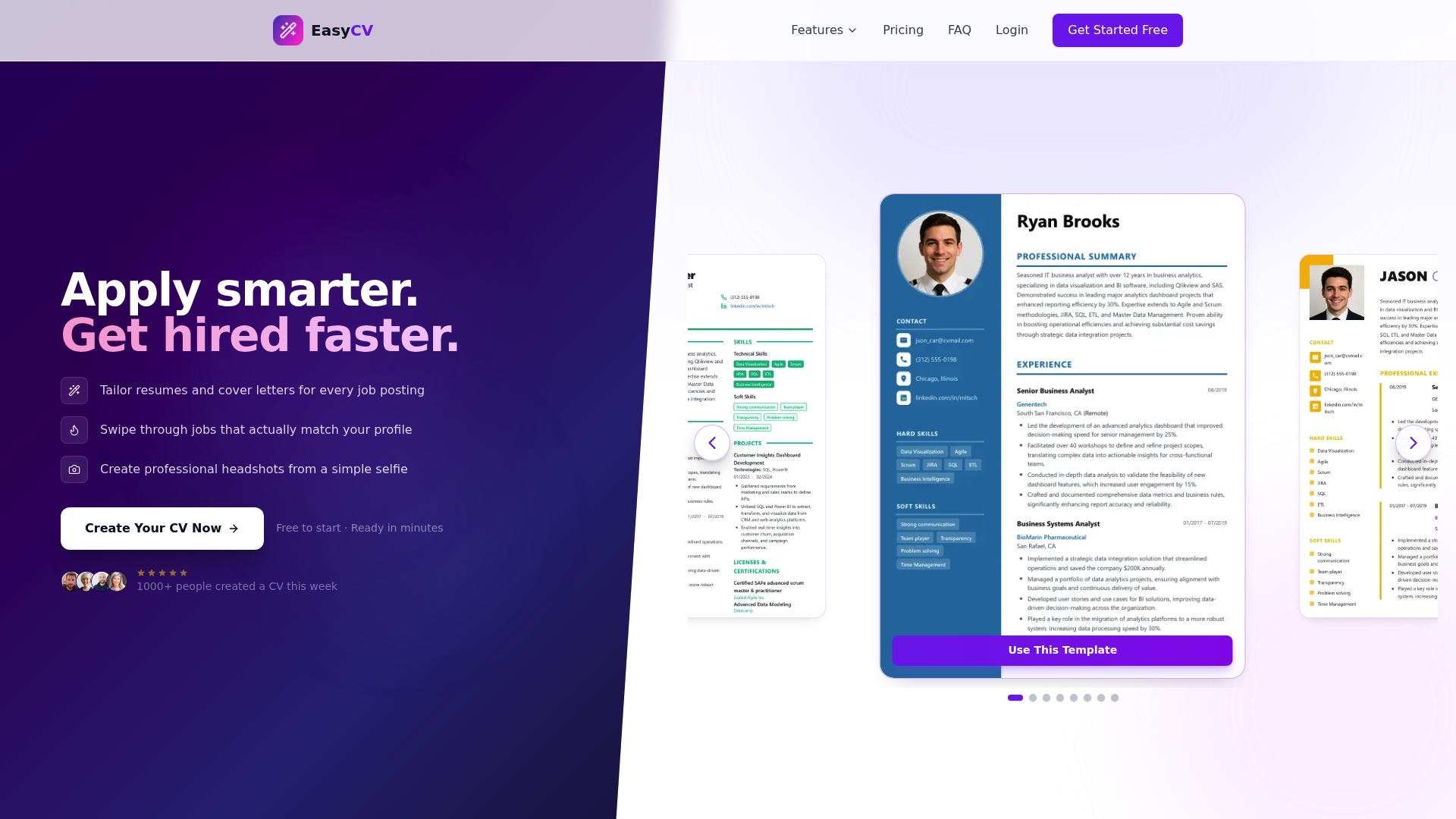
Easy-cv brings every part of the optimization process into one place. The AI writing assistant generates and refines bullet points with the kind of specific, metric-forward language that scores well with ATS systems. The platform’s ATS-friendly templates are built around single-column layouts with standard section headings, so formatting errors are eliminated before they start. You can tailor your CV and cover letter for each application in minutes, maintain multiple CV versions for different role types, and track every application from the same dashboard. For job seekers who want to apply smarter without spending hours on manual edits, Easy-cv’s AI CV builder is the most direct path from application to interview.
FAQ
What does CV optimization actually mean?
CV optimization means tailoring your resume’s formatting, keywords, and content to pass ATS filters and attract recruiter attention. It combines structural choices, keyword alignment, and measurable achievement highlights into a single document strategy.
How many keywords should I include in my CV?
Pull 15 to 20 relevant keywords from the job description and aim for a 60 to 80% match rate. Targeting above 80% risks keyword stuffing, which modern ATS platforms detect and penalize.
Does CV length affect ATS scoring?
Length matters less than impact density. Experienced professionals with more than seven years of experience often benefit from a two-page CV focused on dense, measurable achievements rather than forcing everything onto one page.
How do I know if my CV is ATS-compatible?
Copy your CV text into a plain text editor like Notepad. If the content appears scrambled, out of order, or missing sections, your formatting is causing ATS parsing failures that need to be corrected before submission.
How much time should I spend tailoring each application?
Spending 15 to 20 minutes per application to update your professional summary and top bullet points with job-specific keywords produces significantly better ATS match scores and more recruiter callbacks than submitting a single static CV everywhere.