Types of resumes: Choose the best format for your job search

Picking the wrong resume format costs you interviews before a human even reads your name. With applicant tracking systems (ATS) filtering out roughly 75% of resumes before they reach a recruiter, the structure you choose is just as important as the content inside it. Whether you’re a recent graduate with limited work history, a professional making a career pivot, or someone re-entering the workforce after a gap, each situation calls for a different approach. This article walks you through every major resume type, when to use each one, and how to match your background to the format that gives you the best shot at landing an interview.
Table of Contents
- Understand your job search criteria
- Chronological resumes: Showcase your career path
- Functional resumes: Highlight your skills and versatility
- Combination resumes: Get the best of both worlds
- Compare resume types: Which fits your situation?
- How to choose: Matching resume style to your career needs
- The overlooked resume strategy: Beyond the traditional formats
- Easily build your best resume with Easy CV
- Frequently asked questions
Key Takeaways
| Point | Details |
|---|---|
| Resume types matter | Choosing the right resume format directly affects your job hunt success. |
| Chronological for steady careers | Use a chronological resume if you have a strong, consistent work history. |
| Functional for gaps or changes | Functional resumes help if you have career gaps or want to emphasize skills. |
| Hybrid adapts to many paths | Combination resumes suit diverse experiences and evolving careers. |
| Customize for every application | Tailoring your resume and blending format elements maximizes results. |
Understand your job search criteria
Before you even open a resume template, you need to be clear on what you’re working with. Your employment history, the roles you’re targeting, and the industries you’re applying to all shape which format will serve you best.
Think about where you currently stand:
- Recent graduates often lack extensive work history but have internships, coursework, and projects that deserve prominence.
- Career changers need to reframe transferable skills without drawing attention to unrelated job titles.
- Professionals with steady experience benefit from showcasing clear progression and measurable impact.
- People re-entering the workforce after a gap need a format that frames skills and value without spotlighting the time off.
ATS software scans for keywords, section headers, and formatting consistency. A resume that looks beautiful as a PDF may completely fall apart when a system tries to parse it. Recruiters, on the other hand, typically spend fewer than ten seconds on an initial scan, so clarity and hierarchy matter enormously.
Tailoring your resume to each job posting is one of the most effective job application tips you can follow. Generic resumes sent to dozens of jobs almost always underperform compared to targeted ones.
Pro Tip: Before choosing a resume format, write down three things: your most relevant experience, your biggest skill gap for the target role, and any gaps or transitions in your history. That list will guide your format decision faster than anything else.
Chronological resumes: Showcase your career path
The chronological format is the most widely recognized structure in hiring. It lists your work experience in reverse order, starting with your most recent position and working backward. Each role typically includes your job title, company name, dates of employment, and bullet points describing your responsibilities and achievements.
The three primary resume types are chronological, functional, and combination (hybrid). Among them, the chronological format has long been the default choice for hiring professionals.
Here’s why this format works so well in most contexts:
- ATS compatibility is high. Chronological resumes follow a predictable structure that parsing software handles easily.
- Recruiters prefer it. The linear format lets them quickly assess your experience level, job tenure, and career trajectory.
- It shows progression. If you’ve moved up within a company or taken on increasing responsibilities, this format makes that obvious at a glance.
- It builds credibility. Each verified job title and employer signals reliability.
That said, the chronological format is not perfect for everyone. Chronological resumes work best for job seekers with steady career progression and relevant experience, but they can highlight problems for others. If your work history has a two-year gap, or if your last three jobs were in a completely different field, a chronological layout will surface those issues immediately.
Most hiring managers prefer chronological resumes for their clarity, consistency, and ease of evaluation.
Consider using a chronological resume if you have at least two to three years of consistent work experience in a relevant field, no major gaps, and a clear upward or lateral trajectory. You can explore resume vs CV comparison details to also confirm whether you need a resume or a full CV for your target market.

Pro Tip: Use strong, specific action verbs at the start of every bullet point. Instead of “Responsible for managing a team,” write “Led a seven-person team that reduced project delivery time by 22%.” Numbers and outcomes catch recruiters’ eyes quickly.
Using quality resume templates for 2026 can help you build a clean chronological layout that passes ATS filters while still looking professional to human readers. Understanding the resume builder advantages also helps you see how digital tools save time here.
Functional resumes: Highlight your skills and versatility
Not everyone has a straight-line career path, and the functional resume exists precisely for that reality. Instead of organizing your experience by employer and date, a functional resume groups your accomplishments and abilities under skill categories. A typical structure might have headings like “Project Management,” “Client Communication,” or “Technical Analysis,” each filled with bullet points that describe what you’ve done, regardless of when or where.
The functional resume format suits career changers, candidates with employment gaps, and anyone needing to highlight transferable skills rather than a specific job history.
Here’s a breakdown of the functional format’s strengths and weaknesses:
- Strength: It lets you lead with relevance. If you’re switching from teaching to corporate training, you can build a “Curriculum Development” section that pulls achievements from your classroom experience and applies them to a new context.
- Strength: It de-emphasizes dates, which reduces the visual impact of gaps or frequent job changes.
- Weakness: Many ATS systems struggle with non-standard section headers. A resume that groups skills without clear date-stamped job history may get flagged or misread.
- Weakness: Experienced recruiters recognize the functional format and sometimes view it as an attempt to hide something. This suspicion, fair or not, can work against you in competitive applicant pools.
Functional resumes are best used when you need to emphasize transferable abilities rather than a specific career timeline.
One way to reduce ATS risk is to still include a brief employment history section at the bottom, even if it’s not the focus. This satisfies parsing software while keeping your skills front and center.
Reviewing a thorough AI resume checklist can help you make sure a functional format still hits all the technical checkboxes that ATS software requires. If you’re submitting to major job boards, check out guidance on how to improve CV for job boards to optimize your visibility.
Pro Tip: Don’t just list skills in a functional resume. Anchor each skill heading with a quantifiable result. “Increased customer retention by 18% through restructured onboarding program” is far more convincing than “Strong communication skills.”
Combination resumes: Get the best of both worlds
If neither the chronological nor functional format feels like a perfect fit, the combination (also called hybrid) resume offers a middle path. As one of the three primary resume types, the combination format merges a skills summary section at the top with a reverse-chronological work history below it.
This structure works well because it addresses two audiences at once. Your skills section tells the reader immediately what you bring to the table. Your job history then backs it up with real context and dates.
Key strengths and challenges of the combination format:
- Strength: Works for a wide range of backgrounds, including career changers, people with gaps, and upward movers.
- Strength: Lets you tailor the skills section to each job posting while keeping the timeline intact.
- Strength: ATS compatibility is generally better than a purely functional resume because job history with dates is still present.
- Weakness: The hybrid format can become cluttered if you’re not disciplined about what you include. Trying to squeeze in every skill and every job detail results in a dense document that’s hard to scan quickly.
- Weakness: It requires more time and thought to organize well. Simply bolting a skills list onto the top of a chronological resume is not a true combination format.
The key to a strong hybrid resume is focus. Your skills section should only highlight abilities directly relevant to the specific role you’re applying for. Your job history should reinforce those skills, not repeat them.
Exploring AI resume automation options can make building a polished hybrid resume much faster, especially if you’re managing multiple applications. Reading through AI resume writing tips helps you use technology to refine your structure and language.
Pro Tip: Use bold section titles in your combination resume to create clear visual breaks. Labels like Core Competencies, Professional Experience, and Education help both recruiters and ATS software navigate the document without confusion.
Compare resume types: Which fits your situation?
Here’s a quick reference to see all three formats side by side. This table reflects the guidance from types of resumes research and practical hiring insights.
| Feature | Chronological | Functional | Combination |
|---|---|---|---|
| Best for | Steady career progression | Career changers, gaps | Flexible backgrounds |
| ATS compatibility | High | Low to moderate | Moderate to high |
| Recruiter preference | High | Lower | Moderate to high |
| Skills emphasis | Low | High | High |
| Timeline visibility | Full | Minimal | Full |
| Risk of confusion | Low | Moderate to high | Low to moderate |
Quick checklist to match yourself to a format:
- Do you have at least two years of consistent, relevant experience? Go chronological.
- Are you switching industries or have significant gaps? Consider functional or combination.
- Do you want to highlight skills while still showing job history? Use combination.
- Are you applying to a company with a known ATS screening process? Avoid pure functional.
Pairing this knowledge with a solid AI resume checklist before you submit will help you confirm that whichever format you choose is optimized for both people and systems.
How to choose: Matching resume style to your career needs
Now that you’ve seen each format in detail, here are practical recommendations for the most common job seeker situations:
- Recent graduates with limited experience: Use a chronological format but lead with education and any internship or project experience. Your limited history is expected at this stage, and the format still conveys structure and clarity.
- Career changers moving to a new industry: Use a combination resume. Build a targeted skills section using language from the job posting, then back it up with a job history that shows real-world evidence of those skills.
- Professionals with steady, relevant experience: Stick with chronological. It’s the format that most reliably passes ATS screening and reads clearly to recruiters. Strong chronological resumes remain the top choice for this group.
- Candidates with employment gaps: Use a combination resume. You can lead with your most relevant skills and accomplishments while still providing the job history that ATS systems expect. A purely functional resume can raise flags, but a hybrid approach handles gaps more gracefully.
- Freelancers or consultants with varied project work: Use a combination resume. Group your capabilities under skill themes, then list your project or client history chronologically below.
- Senior professionals with 15 or more years of experience: Use a chronological format but limit your history to the last 10 to 15 years. Older roles can be briefly noted or omitted entirely to keep the document focused.
Reviewing professional resume templates for each of these scenarios can make your final product cleaner and more effective.
Pro Tip: After you build your resume, paste the job description and your resume text into an ATS simulation tool. Look for keyword alignment and fix any gaps before you apply. This single step can meaningfully increase your response rate.
The overlooked resume strategy: Beyond the traditional formats
Here’s a perspective that most resume guides skip entirely. The question “which format should I use?” assumes there’s a single best answer, and there rarely is. The most effective resumes in competitive hiring processes often don’t fit neatly into any of the three categories.
Think about what a hiring manager actually wants. They want to understand, within seconds, whether you can solve a specific problem they have right now. That clarity matters far more than whether your resume follows a strict chronological or functional template.
The best strategy is to treat your resume as a custom argument for each application. Pull the structure that highlights your most relevant experience for that specific role. For one application, a hybrid approach might work best. For another, leading with a brief skills summary before a chronological history might be all you need. The format is a vehicle, not the message itself.
What’s also frequently underestimated is the power of formatting choices within a section. Bold text on key achievements, consistent date formatting, and clean margins all influence how quickly a reader grasps your story. Poorly formatted resumes create cognitive friction, and cognitive friction leads to rejection.
Staying current on AI resume automation insights is one way to keep your strategy adaptive. AI tools can now flag mismatches between your resume language and a job description in seconds, which used to take manual analysis.
A one-size-fits-all resume rarely wins interviews. Tailoring each document to the specific opportunity yields far better results every time.
The job seekers who get consistent callbacks are not necessarily the most qualified. They’re the ones who made it easy for the reader to say yes.
Easily build your best resume with Easy CV
Now that you know which resume type fits your situation, building and customizing that resume doesn’t have to be a manual, time-consuming process.
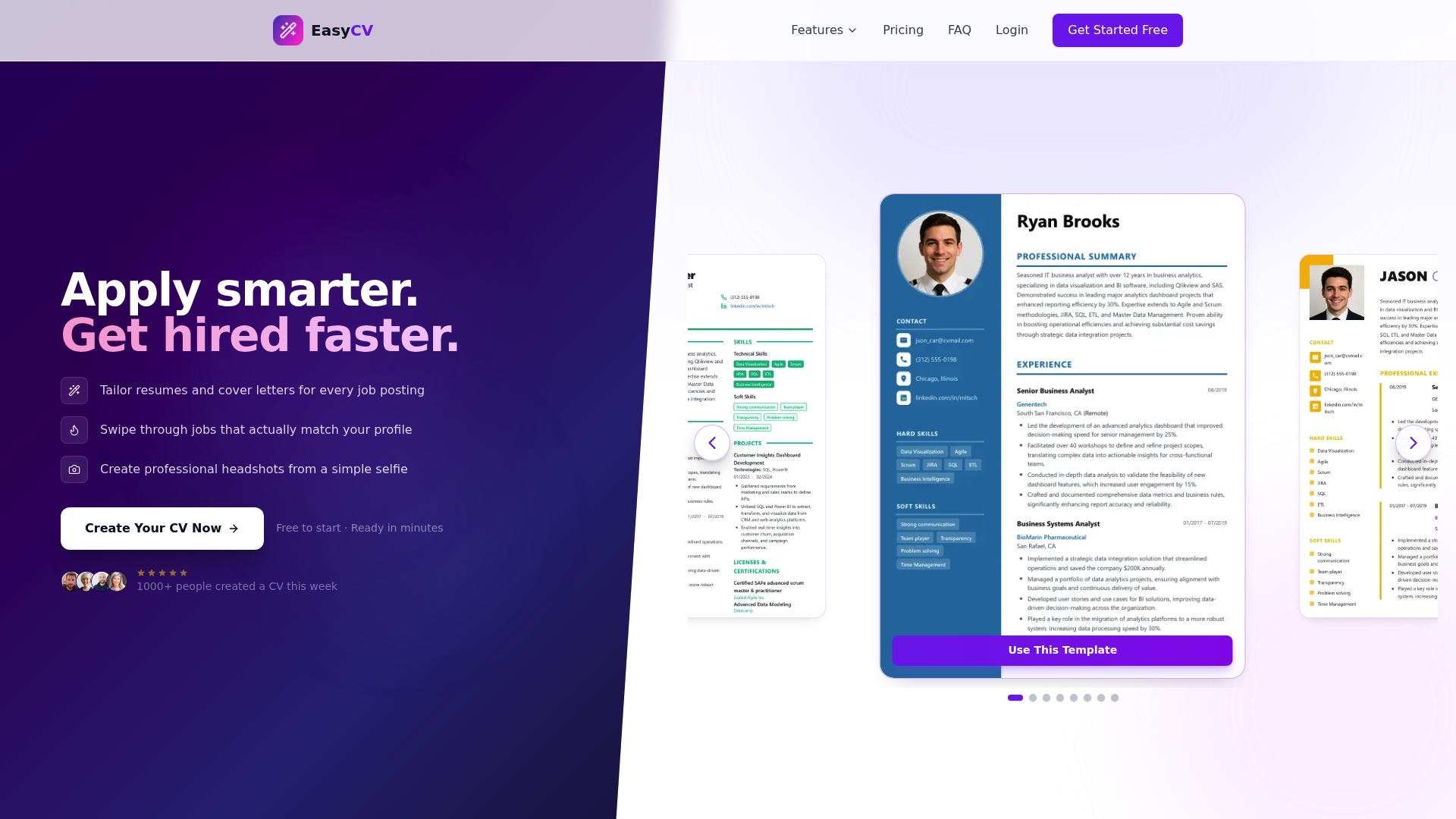
Easy CV gives you AI-powered tools designed to handle exactly this kind of tailoring at scale. Whether you need a clean chronological layout, a skills-forward combination resume, or a format optimized for a specific job board, the platform’s features support all three approaches with intelligent templates and real-time keyword matching. Every template is built with ATS compatibility in mind, so your carefully chosen format actually reaches a human reader. Head to Easy CV to create your first optimized resume in minutes and start matching to roles across millions of active job listings.
Frequently asked questions
What are the three main types of resumes?
The three main types are chronological, functional, and combination (hybrid), each suited to different career situations and goals.
Which type of resume is most ATS-friendly?
Chronological resumes are the most ATS-friendly format because their predictable structure is easiest for parsing software to read accurately.
Is a functional resume good for someone with career gaps?
Yes, functional resumes are designed for candidates with gaps or career changes, though they carry some ATS compatibility risks compared to other formats.
Can I mix resume types to better suit my needs?
Absolutely. A combination hybrid resume blends a skills summary with a chronological job history, giving you flexibility without sacrificing ATS readability.