4 Metric Driven Marketing Manager Resumes, Tailor in 20–40 Minutes
This article gives you four annotated marketing manager resume examples by career level, an ATS-safe template checklist, a metric-driven bullet formula, and a 20 to 40 minute tailoring workflow. The Bureau of Labor Statistics frames what hiring managers actually expect from the role, and an AI resume tool can speed up the tailoring once you have a draft. Start by picking the sample closest to your level, then quantify three bullets before you apply anywhere.
TL;DR:
- Successful resumes focus on specific, measurable results that demonstrate impact, with at least three quantifiable achievements tailored to the job posting.
- Using plain text, ATS-safe formatting, and including relevant keywords naturally within experience bullets increases the chances of passing applicant tracking systems.
- Incorporating strong action verbs and framing soft skills through real examples makes a resume stand out as evidence of leadership and influence.
- Tailoring the top bullet to match the employer’s priorities and avoiding generic duties significantly raises interview response rates.
- Building a master resume and using AI tools can speed up tailoring processes, while careful formatting ensures compatibility with ATS systems.
Table of Contents
- Marketing Manager Resume Examples by Career Level
- ATS-Friendly Resume Templates and Formatting to Avoid
- Writing Bullets That Prove Impact, Not Just Activity
- Skills and Keywords That Get Past the ATS
- Professional Summary Examples by Level and Specialty
- Education, Certifications, and Extras Worth Including
- Tailoring Your Resume to a Specific Job Posting
- Common Mistakes That Sink a Marketing Manager Resume
- Showing Leadership and Team Management Clearly
- Action Verbs and Power Words That Fit Marketing Roles
- Turning Campaign Results Into Resume Proof
- Weaving in Soft Skills Without Sounding Generic
- Cover Letters to Pair With Your Marketing Manager Resume
- What Hiring Managers Actually Notice First
- Build and Apply These Examples Faster With EasyCV
- Sources
Marketing Manager Resume Examples by Career Level
The gap between a resume that gets an interview and one that gets ignored almost always comes down to specificity. Vague duties read like a job description. Quantified results read like proof. Here are four examples, each built for a different stage of the marketing manager career path, with notes on why the structure works.
Entry-level marketing manager example
This works best for someone moving from a coordinator or specialist role into their first management title, or pairing a marketing degree with internship experience.
- Led a cross-channel product launch campaign for a mid-size DTC brand, coordinating three interns and one contractor to hit a hard launch date.
- Grew email list significantly in one quarter by testing multiple lead-magnet formats and rebuilding the welcome sequence in Klaviyo.
- Managed a quarterly paid social budget across Meta and TikTok, cutting cost-per-acquisition through audience refinement.
- Built a monthly reporting dashboard in Google Looker Studio that cut executive reporting time from four hours to 45 minutes.
- Coordinated with product and sales teams on two feature launches, contributing to a 15% increase in trial-to-paid conversion.
Why this works: every bullet ties an action to a number, even at entry level, where duties are often thinner. The intern/contractor mention signals early leadership before the “manager” title technically existed.
Skills snapshot: campaign coordination, Meta Ads Manager, Klaviyo, Google Analytics 4, cross-functional communication.
Mid-level marketing manager example
Built for someone with three to six years of experience who owns a channel mix and a small team.
- Managed a small team delivering numerous campaigns per year across email, paid social, and SEO.
- Increased organic traffic significantly year-over-year by rebuilding the content calendar around search intent and refreshing underperforming posts.
- Owned a substantial annual marketing budget, reallocating part of it from underperforming display ads into retargeting, which lifted ROAS notably.
- Launched a customer referral program that generated a large number of new leads in its first six months at a fraction of paid acquisition cost.
- Partnered with sales leadership to align lead scoring in HubSpot, shortening the average sales cycle by nine days.
Why this works: the bullets show ownership (team size, budget size) alongside outcomes. Mid-level reviewers want proof you can run a channel mix, not just execute one tactic.
Senior marketing manager example
Built for someone managing multiple teams or reporting lines and owning strategic outcomes tied to revenue.
- Directed a sizable marketing organization spanning brand, demand generation, and content across two product lines.
- Owned a multimillion-dollar annual budget, delivering a significant reduction in blended customer acquisition cost while increasing pipeline substantially.
- Rebuilt go-to-market strategy for a product relaunch, resulting in multimillion-dollar incremental revenue within the first two quarters.
- Mentored direct reports into management roles within a short timeframe, reducing team turnover considerably.
- Presented quarterly marketing performance to the executive team and board, tying campaign metrics directly to revenue targets.
Why this works: senior resumes need to read like a business case, not a task list. Budget size, revenue impact, and people development all signal readiness for the next level up.
Digital or product marketing manager example
Built for someone whose work centers on growth metrics, funnels, and technical marketing tools rather than brand or traditional campaigns.
- Owned the full-funnel growth strategy for a SaaS product, improving trial-to-paid conversion from 8% to 13% over 12 months.
- Ran over 60 A/B tests on onboarding flows using Optimizely, identifying three changes that reduced churn by 11%.
- Built lifecycle email and in-app messaging sequences in Braze, increasing 90-day retention by 22%.
- Managed SQL-based cohort analysis to identify the highest-LTV acquisition channels, reallocating 30% of paid spend accordingly.
- Collaborated with product and engineering on feature adoption campaigns, driving a 19% lift in weekly active users.
Why this works: this version leans harder on tools (Optimizely, Braze, SQL) and funnel-stage metrics because digital and product marketing roles get evaluated on technical fluency as much as strategy.
ATS-safe formatting note: every bullet above uses plain text, standard bullet characters, and no tables or text boxes. That is deliberate. Keep it that way when you copy the structure into your own document.
ATS-Friendly Resume Templates and Formatting to Avoid
Reverse-chronological format wins for most marketing manager applications because it maps directly to how Indeed’s marketing manager resume guidance recommends structuring experience: most recent role first, clear dates, consistent formatting. A hybrid format, which leads with a skills summary before the chronological history, only makes sense if you’re pivoting specialties (say, brand to product marketing) and need to reframe transferable skills before the job history does the framing for you.
Certain layout choices look sharp in a design tool and break completely once they hit an applicant tracking system. Avoid these:
- Headers and footers for contact information (many ATS platforms skip content in headers entirely).
- Multi-column layouts and text boxes, which can scramble the reading order.
- Tables for skills or experience, which often import as garbled text or get dropped.
- Icons or images standing in for section labels instead of plain text headings.
- Non-standard fonts that don’t render consistently across systems.
Stick to a single column, standard headings (“Experience,” “Skills,” “Education”), and a common font like Calibri, Arial, or Georgia at 10 to 12 points.
On file type: submit a PDF when the application allows it, since PDFs preserve formatting across devices. When a job posting specifically requests a .docx file, or when you’re unsure which ATS the employer uses, .docx is the safer default because some older ATS platforms parse Word files more reliably than PDFs. ResumeTemplates’ 2026 formatting guidance backs this same reverse-chronological, ATS-safe approach.
Pro Tip: Before you submit anywhere, paste your resume text into a plain text editor like Notepad. If the formatting collapses into an unreadable mess, an ATS will likely struggle with it too.
Writing Bullets That Prove Impact, Not Just Activity
Every strong marketing bullet follows the same skeleton: Situation, Action, Measurable Result. State the context briefly, name what you did, and close with a number that shows the outcome. Skip the formula and you get a resume full of duties. Follow it and you get a resume full of proof.
The single biggest gap between resumes that get interviews and resumes that get ignored is this: one describes a job, the other describes a result. Hiring managers skim for the second kind.
Here’s the formula applied across common marketing activities:
- Email marketing. Before: “Managed email marketing campaigns.” After: “Rebuilt a stagnant email program, growing open rates from 14% to 26% and generating $180,000 in attributed revenue over six months.”
- Paid social. Before: “Responsible for paid social advertising.” After: “Managed a $50,000 monthly Meta and TikTok budget, cutting cost-per-lead by 31% through creative testing and audience segmentation.”
- SEO. Before: “Worked on SEO strategy.” After: “Increased organic search traffic significantly in nine months by restructuring site architecture and targeting multiple high-intent keyword clusters.”
- Events. Before: “Planned company events.” After: “Organized a 400-person industry conference that generated 210 qualified leads and $410,000 in pipeline within 60 days.”
The hardest part is usually the number, especially if you left a role without access to final reports. When you can’t pull an exact figure, estimate conservatively using what you do know. If you ran a campaign that filled a 300-seat webinar and you know the sign-up-to-attendance rate industry-wide runs around 40 to 50%, you can reasonably state “drove 300+ webinar registrations.” If your CRM tracked lead source, even a rough percentage increase quarter over quarter is fair to cite, as long as you can explain it honestly in an interview. What you should never do is invent a number you can’t stand behind if asked to elaborate. Resume Worded’s analysis of top-performing examples consistently points to quantified, specific claims as the differentiator between resumes that get interviews and resumes that don’t.
Skills and Keywords That Get Past the ATS
A marketing manager resume needs both hard skills that prove technical fluency and soft skills that prove you can lead. The mistake most applicants make is listing skills in a block at the bottom without ever using those exact terms inside their experience bullets, which is exactly where ATS keyword matching weighs most heavily.
Hard skills carry more ATS weight than soft skills, so lead with tools and platforms by name: Google Analytics 4, Google Ads, HubSpot, Salesforce, Klaviyo, SEMrush, SQL, and Meta Business Suite are among the most commonly scanned terms across marketing manager postings. Soft skills like cross-functional leadership, stakeholder management, and budget ownership still matter, but they land better woven into a bullet (“led cross-functional launch team of eight”) than listed as a standalone adjective.
| Specialty | Core keywords to include |
|---|---|
| Digital marketing | GA4, Google Ads, SEO/SEM, conversion rate optimization, marketing automation, A/B testing |
| Brand marketing | Brand strategy, positioning, integrated campaigns, market research, creative direction |
| Product marketing | Go-to-market strategy, product launches, competitive analysis, sales enablement, funnel metrics |
To integrate keywords naturally, pull the exact phrasing from the job posting and match it to a bullet that’s already true about your experience. If the posting says “marketing automation,” and you used HubSpot workflows, write “built automated nurture workflows in HubSpot” rather than the vaguer “managed email automation.” The EasyCV guide to resume keywords walks through this matching process in more depth, and the skills section guide covers how to structure the standalone skills block so it doesn’t read like a keyword dump.
Professional Summary Examples by Level and Specialty
A resume summary earns its place only when it adds context a hiring manager wouldn’t get from the bullets alone, things like years of experience, industry focus, or a headline achievement. Skip it entirely if you’re entry-level with little to summarize; that space is better used for one more strong bullet. Keep any summary you do write between 20 and 40 words, and match its tone to the seniority you’re claiming.
- Entry-level: “Marketing coordinator with two years of campaign and social media experience, skilled in Klaviyo email builds and Meta Ads, seeking to grow into a management role.”
- Mid-level, digital focus: “Digital marketing manager with five years driving organic and paid growth for SaaS brands, known for turning underperforming channels into measurable revenue sources.”
- Mid-level, brand focus: “Brand marketing manager with six years leading integrated campaigns across retail and CPG, specializing in positioning strategy that grows category share.”
- Senior, digital focus: “Senior digital marketing leader with a decade of experience scaling acquisition programs from seed stage to Series C, managing budgets over $1 million.”
- Senior, brand focus: “Senior brand manager with 12 years directing multi-market campaigns, known for rebuilding brand equity in mature categories through data-informed creative strategy.”
- Product marketing: “Product marketing manager with seven years translating technical features into go-to-market strategy, driving adoption across enterprise and mid-market segments.”
If your resume summary and your LinkedIn headline tell two different stories, that’s a signal to a recruiter who checks both. Keep the core claim, the specialty and the standout metric, consistent across both. The EasyCV professional summary templates offer more variations if none of these fit your exact situation.
Education, Certifications, and Extras Worth Including
Certifications carry real weight for marketing managers because they prove current tool fluency in a field that changes fast. The ones worth listing: Google Ads and Google Analytics certifications, HubSpot’s marketing and inbound certifications, and any product-specific or analytics credential tied to a platform you’ll actually use in the role. List them in a dedicated “Certifications” section with the issuing body and year, not buried inside your skills list.
- Google Analytics (GA4) Certification, Google, 2025
- HubSpot Inbound Marketing Certification, HubSpot Academy, 2024
- Google Ads Search Certification, Google, 2025
If your degree isn’t directly related to marketing, a communications, psychology, or business degree still counts. List it briefly, without apology, and let your experience section carry the weight instead.
Portfolio links and campaign samples add credibility when they’re easy to verify. A single link to a portfolio site or a specific published campaign, placed near your contact information, works better than scattering multiple links through the document. Avoid linking to anything requiring a login or containing confidential client data.
Pro Tip: If a campaign you’re proud of isn’t public anymore, describe the result in your resume and keep a one-page case study ready to share in the interview instead of linking to a dead page.

Tailoring Your Resume to a Specific Job Posting
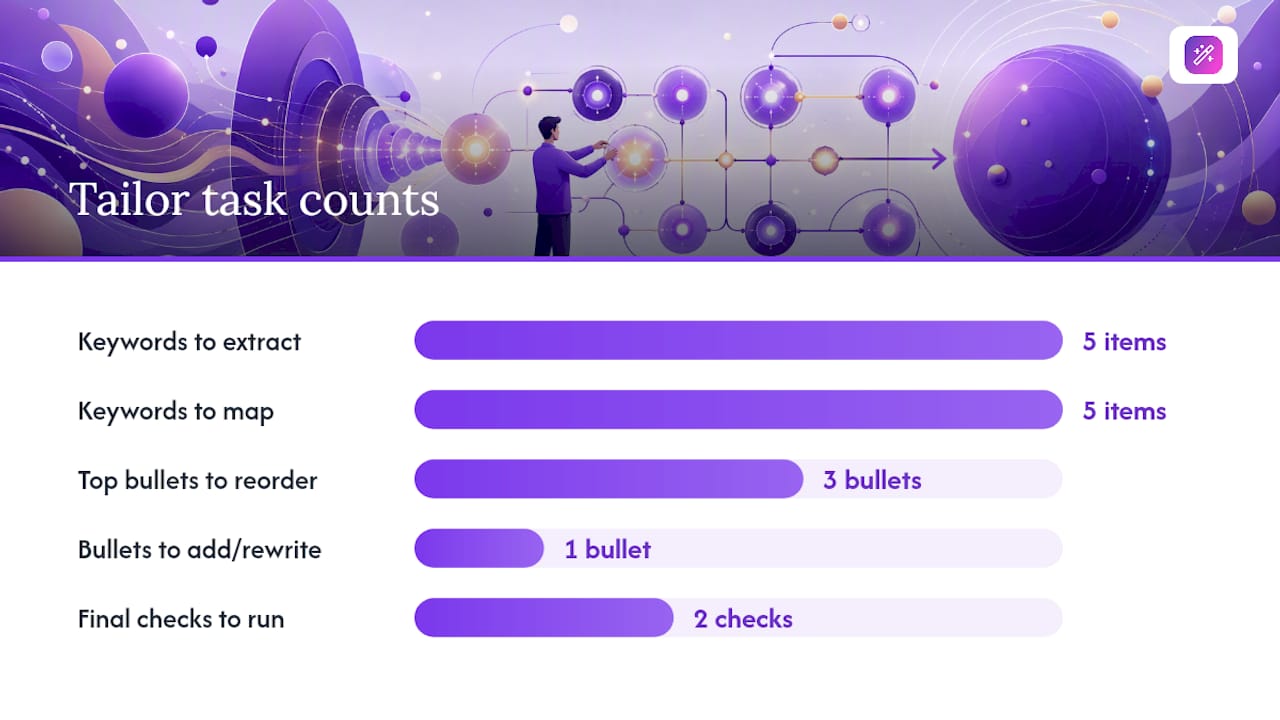
Generic resumes get generic results. A resume tailored to the actual posting, even loosely, consistently outperforms one sent identically to every application. Here’s a workflow that takes 20 to 40 minutes:
- Read the job posting and pull out the five keywords or phrases that repeat most or appear in the first two bullet points of the requirements.
- Map each keyword to a bullet already in your resume. If a keyword has no natural match, decide whether you genuinely have that experience and can add it honestly.
- Reorder your top three bullets in your most recent role so the strongest match to the posting’s stated priorities appears first, not buried fourth or fifth.
- Add or rewrite one bullet to include a metric-driven achievement that speaks directly to the posting’s stated goal, whether that’s growth, retention, or brand awareness.
The most common mistake in this process is keyword stuffing, jamming in every term from the posting regardless of whether you can speak to it in an interview. That backfires fast: if your resume claims “marketing automation strategy” and the interviewer asks a follow-up question you can’t answer, that mismatch costs more than the keyword gained you.
Before you submit, run two quick checks. Paste the resume into a free ATS simulator or plain text viewer to confirm nothing scrambles. Then export the final file exactly as the posting requests, whether that’s PDF or .docx, and open it on a different device to confirm formatting held.
Pro Tip: Keep one “master resume” with every bullet you’ve ever written, then build tailored versions from it. It’s faster than starting from scratch each time, and it keeps your strongest material from getting lost between applications.
Common Mistakes That Sink a Marketing Manager Resume
The most frequent error is listing responsibilities instead of results. “Managed social media accounts” tells a hiring manager nothing they can’t assume from the job title. Every duty-based bullet is a missed chance to prove impact with a number.
A close second: resumes that read identically for every application. Hiring managers, especially at mid-size and large companies, review dozens of resumes for a single role. A resume with zero connection to their specific posting reads as a mass-blast application, even when it isn’t.
Overloaded resumes are another common trap. Cramming 15 years of experience onto two pages with tiny fonts and no white space makes a hiring manager work harder to find what matters. Cut older or less relevant roles down to one or two lines, and let recent, relevant experience take the space.
Finally, watch for inconsistent verb tense (mixing “managed” and “manage” for past roles), unexplained gaps in employment, and job titles that don’t match what’s on LinkedIn. Small inconsistencies raise questions a strong resume shouldn’t invite.
Showing Leadership and Team Management Clearly
Leadership doesn’t show up automatically just because your title says “manager.” It shows up when you name the scope of what you led: team size, budget size, cross-functional reach, or the outcome of developing someone else’s career.
Specify numbers wherever you can: “led a team of six” carries more weight than “led a team.” Naming budget ownership (“managed a $500,000 paid media budget”) does double duty, proving both leadership and financial trust. If you mentored or promoted a direct report, say so explicitly; that single detail often stands out more than campaign metrics because it shows you can build a team, not just run one.
For applicants managing cross-functional projects without direct reports, leadership still counts. Coordinating a launch across design, sales, and product without formal authority over those teams is a real leadership skill, and it belongs in your bullets framed as “coordinated” or “aligned stakeholders across.”
Action Verbs and Power Words That Fit Marketing Roles
Generic verbs like “helped,” “worked on,” and “assisted with” undersell your actual role. Marketing-specific power verbs signal ownership: launched, scaled, optimized, negotiated, forecasted, repositioned, and cultivated all carry more precision than their generic counterparts.
Match the verb to what you actually did. “Launched” fits a new campaign or product; “optimized” fits improving something that already existed; “negotiated” fits vendor or media buy conversations; “forecasted” fits budget or pipeline planning work. Using “spearheaded” for a task you were assigned, rather than one you initiated, reads as inflated the moment an interviewer asks a follow-up question.
Vary your verbs across the resume. Opening every bullet with “managed” flattens your experience into one repetitive tone, even if the underlying work was genuinely varied.
Turning Campaign Results Into Resume Proof
A campaign success story only works as a resume line if it’s compressed into one measurable claim. Save the full narrative for the interview; the resume bullet just needs the headline number and enough context to make that number credible.
The strongest version usually includes three elements: the scale of the effort (budget, team, timeline), the specific action taken, and the outcome measured against a clear baseline (“increased from X to Y” beats “increased significantly”). A campaign that doubled email revenue reads stronger as “grew email-attributed revenue from $40,000 to $85,000 per quarter” than as “significantly grew email revenue.”
If a result took a team effort, it’s fair to claim your role in it honestly. Frame it as “contributed to” or “co-led” rather than implying sole credit for a result that had five people behind it. Hiring managers who dig into team dynamics during interviews notice inflated individual claims quickly, and it costs more trust than a modest, honest framing ever would.
Weaving in Soft Skills Without Sounding Generic
Soft skills like communication, adaptability, and collaboration matter for marketing managers, but listing them as bare adjectives (“strong communicator, team player”) adds almost nothing. The fix is to demonstrate the skill through a specific situation rather than naming it directly.
Instead of listing “stakeholder management” as a skill, show it: “presented quarterly campaign performance to the executive team, securing budget approval for a 20% spend increase.” That single bullet proves communication, data fluency, and influence without ever using the word “communication.”
Adaptability shows up well in bullets about pivoting strategy: “shifted paid media strategy mid-quarter after a platform policy change, recovering lead volume within three weeks.” Collaboration shows up in cross-functional project bullets. The rule holds across every soft skill: show the behavior in a real situation, and let the reader infer the trait.
Cover Letters to Pair With Your Marketing Manager Resume
A cover letter for a marketing manager role should do one thing your resume can’t: connect your specific experience to this specific company’s situation in a few sentences. Skip the summary of your resume; the reader already has that document.
A strong opening names the role and one specific reason you’re a fit tied to something in the posting or the company’s recent work: “I’m applying for the Marketing Manager role because your recent expansion into [category] mirrors the growth-stage work I led at [previous company], where I grew organic traffic 48% in nine months.” The body paragraph expands on one or two of your strongest, most relevant achievements, ideally ones that also appear on your resume but with slightly more narrative context. The closing paragraph states your interest plainly and invites a next step, without hedging language.
Keep it under 300 words. A cover letter that repeats the entire resume in paragraph form gets skimmed, not read. The EasyCV marketing cover letter templates walk through a few structures if you want a starting draft to adapt.
What Hiring Managers Actually Notice First
Resumes that succeed almost always share one habit: they get specific in the first three bullets. Resumes that fail tend to bury their strongest achievement on page two, after three paragraphs of generic responsibility statements. Hiring managers skim, and the first ten seconds decide whether the rest gets read closely.
The BLS occupational data on marketing managers confirms what most job postings already imply: the role spans budget management, campaign strategy, and cross-team coordination in almost every listing, regardless of industry. That consistency is useful. It means the four resume examples in this article translate across most marketing manager postings with only light tailoring.
One habit raises response rates more than any other single change: rewriting your top bullet in every application to speak directly to that employer’s stated priority. It takes five minutes and it’s the single highest-leverage edit available to you.
— Andras
Build and Apply These Examples Faster With EasyCV
Some platforms turn everything covered above into a faster, less manual process. Instead of rewriting bullets by hand for every application, you may be able to import your existing resume text, with AI writing assistants helping to rephrase duty-based lines into metric-driven, action-verb-led bullets like those described above.
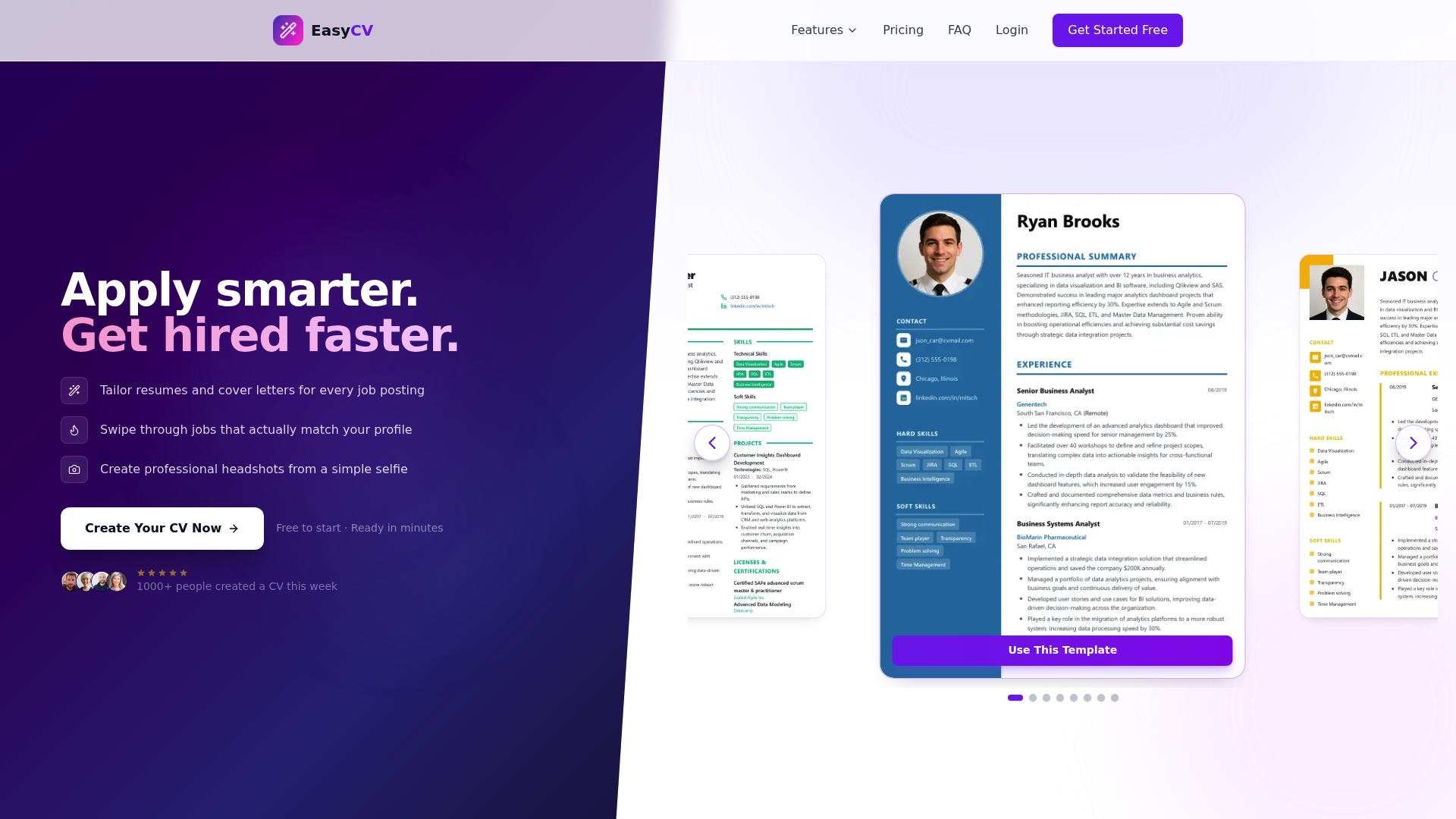
The platform’s ATS-friendly templates handle the formatting rules covered in the templates section automatically, so you’re not manually checking for headers, tables, or fonts that might confuse an applicant tracking system. Once your resume is tailored, the built-in job matcher swipes through aggregated listings and scores them against your profile, which shortcuts a lot of the manual searching that normally eats up a job hunt.
A practical way to start: pick the sample closest to your level from this article, drop your own experience into the EasyCV resume builder, and let the AI assistant tighten your bullets before you export an ATS-safe file for your next application.
Sources
- Advertising, promotions, and marketing managers: Occupational Outlook Handbook
- 4 Best Marketing Manager Resume Examples and Templates for 2026
- 25 Marketing Manager Resume Examples - Here’s What Works In 2026