Brand Manager Resume Examples and Templates for 2026
Hiring managers scanning a brand manager resume look for five things in the first ten seconds: the role title, years of experience, the size of the portfolio or P&L you touched, one quantified brand outcome, and three or four named tools or metrics that prove you can operate the job, not just describe it. Skip any of those and you get filed under “maybe,” which in a stack of 200 applications means never.
These elements matter because both humans and ATS filters are pattern-matching against the same job posting. A recruiter wants proof you have run something at scale; the software wants exact-match keywords from the listing. A resume that leads with vague duties (“responsible for brand strategy”) satisfies neither.
Put these at the top of your resume before anything else:
- Your target title, matched to the posting’s exact phrasing
- Years of experience and the industry (CPG, tech, pharma, retail)
- Portfolio size or P&L figure, in dollars, if you managed one
- One headline metric: market share gain, revenue lift, or launch result
- Three to four platform names (Nielsen, Kantar, GA4, Tableau) that match the job description
Pro Tip: A resume showing 4.2 percentage points of market share growth in the summary line does more work than three bullet points of duties below it. Lead with the number, not the narrative.
Key Takeaways
A brand manager resume earns a callback when it opens with commercial scope and closes each bullet on a measurable result, not a duty description.
| Point | Details |
|---|---|
| Lead with scope and outcome | Put portfolio size or P&L figure and one quantified brand result in your summary’s first two sentences. |
| Use the action-scale-result bullet formula | Every bullet needs a strong verb, the scale you operated at, and a number proving impact. |
| Name real tools, not generic skills | List Nielsen, Kantar, GA4, or Tableau only if you’ve genuinely used them for ATS and interview credibility. |
| Match formatting to ATS limits | Skip tables and images, use standard headers, and save as .docx unless a PDF is requested. |
| Build and tailor with Easy-cv | Use Easy-cv’s templates and AI rewrite tools to draft faster, then verify every metric before exporting. |
Table of Contents
- Brand Manager Resume Examples for Every Career Stage
- How Should You Format a Brand Manager Resume for ATS?
- How Do You Write Experience Bullets That Prove Brand Impact?
- What Skills Belong on a Brand Manager Resume?
- How Do You Write a Brand Manager Resume Headline?
- How Do You Write a Brand Manager Resume With No Experience?
- What Should You Check Before Submitting Your Resume?
- What Mistakes Hurt a Brand Manager Resume Most?
- How Can AI Tools Speed Up Resume Tailoring?
- Should You List Certifications and Education on This Resume?
- How Should Your Cover Letter Complement Your Resume?
- What Actually Gets Brand Manager Candidates Shortlisted?
- Build and Tailor Your Brand Manager Resume Faster
- Sources
Brand Manager Resume Examples for Every Career Stage
You don’t need to reinvent your resume from a blank page. Eight structures cover almost every brand management career path, and each one leans on the same core discipline: show insight, strategy, execution, and a number, in that order.
Senior CPG brand manager
Lead with total portfolio value and a P&L figure. A senior candidate managing three SKUs across two retail channels should open with something like “P&L-owning brand manager overseeing a $45M portfolio across grocery and club channels.” Anchor the top bullet with market share movement, since that’s the metric CPG hiring managers scan for first, and name the syndicated data platforms (Nielsen, Kantar, IRI/Circana) you used to get there.

Mid-level CPG brand manager
Same structure, smaller scope. If you owned a single sub-brand or a regional launch, quantify the launch itself: distribution points gained, velocity versus category average, or trial rate from a sampling campaign. Mid-level resumes get penalized most often for vague scope statements, so name the retailer relationships (Walmart, Kroger, Target) if you had them.
Tech or PLG brand manager
Tech hiring managers care less about P&L and more about growth-loop metrics: activation rate, NPS, MQL-to-SQL conversion, and brand lift studies tied to paid campaigns. Lead with a product launch or repositioning and the downstream metric, like “Repositioned core product messaging, lifting trial-to-paid conversion by 11%.” Name GA4, Amplitude, or Mixpanel if you touched them.
Digital brand manager
This template leans on channel-specific performance: paid social ROAS, organic engagement growth, or content-driven traffic lift. Lead with the channel mix you owned and one clear efficiency metric, such as cost-per-acquisition improvement across a quarter.
Global brand manager
Scope is the story here. Note the number of markets, languages, or regional teams you coordinated, and quantify one cross-market win, like a campaign template that scaled from one market to six with a measurable lift in each.
Assistant brand manager (ABM)
You’re not running the P&L yet, but you’re touching pieces of it. Frame your bullets around what you supported and the measurable slice you owned: a promotional calendar, a packaging refresh test, or a competitive tracking report that changed a pricing decision.
Entry-level or graduate brand candidate
Lean on internships, capstone projects, or case competitions. Quantify whatever you can, even at small scale: “Grew campus Instagram engagement 34% over one semester managing a $2,000 content budget.”
Product or activation-focused brand manager
This one centers on in-market execution: shopper marketing, retail activation, or experiential campaigns. Lead with the activation format and the resulting lift in trial, sales, or foot traffic, and name any measurement partner (Qualtrics, IRI) used to verify it.
Before-and-after bullet rewrites
Seeing the transformation in practice helps more than any template description. Here are three representative rewrites:
Before: “Responsible for brand positioning and marketing strategy for a portfolio of snack products.” After: “Repositioned a $30M snack portfolio, growing market share by 2.1 points over 18 months using Nielsen syndicated data to guide the shift.”
Before: “Worked with agencies to develop campaigns.” After: “Managed a $4M media agency relationship, launching a campaign that lifted brand awareness 8 points per Kantar tracking.”
Before: “Helped launch a new product line.” After: “Led go-to-market for a line extension across 1,200 retail doors, hitting 118% of first-year volume target.”
Every template above works best as a base you customize, not a script you copy verbatim. Swap in your real numbers, your real tools, and your real scope. The before-and-after pattern will hold up across almost any brand role you’re targeting.
How Should You Format a Brand Manager Resume for ATS?
Keep it to one page under ten years of experience, two pages beyond that, and never longer. ATS software and human reviewers both punish resumes that force scrolling to find the metric that matters.
Section order should run: header and contact info, a three-to-five sentence summary, a skills section, work experience (reverse chronological), education, certifications, and finally a portfolio or LinkedIn link if you have one. This order matches what most ATS-friendly templates expect and what recruiters scan for first.
A few formatting rules hold up across every version of this resume:
- Use a standard, sans-serif font (Calibri, Arial, or Helvetica) at 10 to 12 points
- Stick to standard section headers: “Experience,” “Skills,” “Education,” not creative labels like “My Journey”
- Avoid tables, text boxes, columns, and embedded images. Parsing software often drops or scrambles content inside them
- Save as a .docx unless the job posting specifically requests a PDF; some ATS platforms still misread PDFs
- Name your file clearly: FirstName_LastName_BrandManager.docx, not “Resume_Final_v3.docx”
- Include your LinkedIn URL and a portfolio link only if both are current and relevant
If you’re compressing a two-page resume down to fit ATS expectations, cut duty-based bullets first. A line describing a responsibility with no number attached is the easiest one to lose without losing substance. Formatting choices that hold up under ATS scanning tend to favor plain structure over visual flair, and that tradeoff almost always favors the plain version when a machine reads it first.
How Do You Write Experience Bullets That Prove Brand Impact?
Every strong bullet follows the same skeleton: action verb, what you did, the scale or context, and a measurable result. Two templates cover most brand manager bullets:
Template one: [Action verb] + [what you managed/launched] + [scale: budget, market, portfolio size] + [result with a number]. Template two: [Action verb] + [problem you solved] + [approach or tool used] + [measurable outcome].
Start with verbs that show ownership, not participation: Managed, Led, Launched, Grew, Directed, Negotiated. Avoid “assisted with” or “helped” unless the role genuinely was support-level, because recruiters read those bullets as duties, not case studies, and duties don’t get shortlisted.
The metrics you lead with should match what the role actually rewards:
- Market share and distribution points for CPG roles, since category managers and retail buyers think in those terms
- Revenue lift and ROAS for roles with direct P&L or media budget ownership
- NPS, activation rate, and MQL-to-SQL conversion for tech and SaaS brand roles
- Prescriptions written or market access wins for pharma brand roles, where regulatory context also matters
- SKU velocity and shelf turns for retail-facing product or activation roles
Here are five before-and-after rewrites you can adapt directly:
Before: “Managed social media presence for the brand.” After: “Grew Instagram engagement 42% and follower base by 18,000 over one year by shifting content mix toward user-generated video.”
Before: “Oversaw product launches across the category.” After: “Launched 4 SKUs in 9 months, generating $6.2M in incremental year-one revenue against a $4.8M target.”
Before: “Conducted market research to inform strategy.” After: “Ran quarterly Kantar brand health tracking, identifying a positioning gap that informed a repackaging decision lifting trial rate 14%.”
Before: “Collaborated with cross-functional teams on brand initiatives.” After: “Led a 12-person cross-functional team (sales, R&D, media) through a full rebrand, hitting launch date two weeks ahead of schedule.”
Before: “Managed marketing budget for the brand.”
Pro Tip: If you’re not sure which metric to lead with, check the job posting itself. If it mentions “P&L” or “trade marketing,” lead with dollars and share points. If it mentions “growth” or “activation,” lead with conversion and engagement numbers instead.
What Skills Belong on a Brand Manager Resume?
Hard skills prove you can run the mechanics of the job. Soft skills prove you can run the people. Both need to show up, but hard skills should dominate your skills section since that’s what ATS filters weight most heavily.
Hard skills worth listing, when they’re genuinely true:
- Brand strategy and positioning
- P&L ownership and budget management
- Product launch and go-to-market planning
- Market research and consumer insight analysis
- Trade marketing and retailer negotiation (CPG-specific)
- Competitive analysis and pricing strategy
Soft skills that actually get noticed, framed with context rather than as bare buzzwords:
- Cross-functional leadership across sales, R&D, and creative teams
- Stakeholder management with executive or C-suite reporting
- Agency and vendor management
- Negotiation with retail buyers or media partners
Tools and platforms worth naming, but only ones you’ve actually used: Nielsen, Kantar, IRI/Circana, Qualtrics, Google Analytics/GA4, Tableau, IQVIA (pharma-specific), HubSpot, and any A/B testing platform (Optimizely, VWO) relevant to your role.
Group these by target industry when you tailor a resume. A CPG-focused skills section should read: “Brand Strategy | P&L Management | Nielsen & Kantar Analytics | Trade Marketing | Retailer Negotiation.” A tech-focused version should read: “Product Marketing | Growth Strategy | GA4 & Amplitude | A/B Testing | Cross-Functional Leadership.” Matching the cluster to the industry-specific keyword set the job actually uses is what gets you past the first filter.

How Do You Write a Brand Manager Resume Headline?
Your summary should run three to five sentences and hit four things in order: role title, years of experience, one industry keyword or specialty, and a quantified achievement. That structure isn’t arbitrary. It mirrors what resume-parsing software and human reviewers both scan for in the first ten seconds.
Headline examples across seniority and focus:
- Senior: “Senior Brand Manager, CPG | 9 Years | P&L Owner, $60M+ Portfolio | Market Share Growth Specialist”
- Mid-level: “Brand Manager | 5 Years CPG Experience | Product Launch & Trade Marketing Lead”
- Tech-focused: “Product Marketing & Brand Manager | SaaS | Growth Loop and Activation Strategy”
- CPG-focused: “Brand Manager | Household Goods | Nielsen-Driven Insight to Shelf Execution”
- Entry-level: “Marketing Graduate | Brand Strategy Intern | Data-Driven Campaign Builder”
Three fill-in-the-blank summary templates you can adapt directly:
“[Role title] with [X] years managing [portfolio size or industry]. Delivered [quantified result] through [primary skill or tool]. Skilled in [two to three keywords matching the job posting].”
“[Role title] specializing in [specialty area]. Grew [metric] by [number] via [method]. Proficient in [tools/platforms].”
“[Years]-year brand marketing professional with a track record of [result type]. Most recently [specific achievement with a number]. Core strengths: [three skills].”
Keep the summary to three to five lines, no longer, and surface your two strongest keywords in the first sentence rather than burying them at the end.
How Do You Write a Brand Manager Resume With No Experience?
Lead with projects, not job titles you don’t have yet. A layout that puts a “Relevant Projects” or “Marketing Coursework” section above work history, right under your summary, lets you show brand thinking without pretending you’ve run a P&L.
Sample bullets that translate transferable work into brand-relevant impact:
- “Led a 5-person student team through a mock product launch, presenting a go-to-market plan that won first place in a regional case competition”
- “Managed content calendar and grew campus club Instagram following by 1,200 in one semester through consistent posting cadence”
- “Supported a local business’s product launch as a marketing intern, building a competitive analysis that informed pricing decisions”
- “Analyzed survey data from 200 respondents to identify a positioning gap for a class capstone project”
Two quick templates to build from:
Entry-level summary: “Marketing graduate with hands-on experience in [specific project type]. Delivered [result] through [method/tool]. Seeking to apply [skill] and [skill] to a brand management role.”
Project section header: “Relevant Projects” followed by project name, one line of context, and one bullet with a number, exactly like a work-experience entry.
What Should You Check Before Submitting Your Resume?
Run this five-minute pass before you hit submit on any brand manager application:
- Match the exact role title phrasing used in the job posting, not a close synonym
- Confirm P&L or budget figures appear somewhere in the top third of the resume
- Name the specific platforms and tools listed in the job description
- Use standard section headings only: Experience, Skills, Education, Certifications
- Save the file as .docx (or PDF only if explicitly requested) and name it clearly
- Paste your resume into a plain-text editor to check that formatting hasn’t scrambled the parsing order
Word-search your draft for the top five keywords in the job posting. If two or more are missing, revise before sending. Keeping a short keyword bank for each target role, updated per application, saves you from repeating this search from scratch every time.
What Mistakes Hurt a Brand Manager Resume Most?
The most common failure is a metric with no scale attached, like “grew sales” with no dollar figure, percentage, or timeframe. Fix it by adding the number and the period it happened over, even if it’s an estimate you can defend in an interview.
Overdesigned templates with columns, icons, or graphics often break ATS parsing entirely, dropping whole sections from what the software reads. Listing a tool by name without proficiency (“Tableau, Excel, SQL”) reads as filler unless a bullet nearby shows you actually used it. And stacking soft-skill buzzwords (“strategic thinker, team player, self-starter”) with no supporting evidence wastes space a metric could fill.
The rule of thumb: every design choice should make the content easier to scan, never harder. If a formatting decision doesn’t serve readability or ATS parsing, cut it.
How Can AI Tools Speed Up Resume Tailoring?
AI drafting tools are useful for structure and speed, not for inventing your accomplishments. A workflow that keeps you honest looks like this: generate a first draft from a template, swap in your real metrics and tool names, run the draft against the job posting’s top keywords, edit by hand for specificity, then export to an ATS-friendly file.
The editorial caveats matter more than the tool itself. Never let an AI draft insert a metric you can’t back up in an interview. Watch for generic phrasing AI tends to default to (“results-driven professional”) and replace it with your actual specialty. And verify any tool or platform name the AI suggests before it lands on your resume. Claiming Tableau proficiency you don’t have is the fastest way to fail a skills test after you’ve already gotten the interview.
Used this way, an AI resume builder speeds up the repetitive parts (formatting, keyword matching, first-draft structure) so you can spend your time on the part that actually differentiates you: the numbers.
Should You List Certifications and Education on This Resume?
List your degree, school, and graduation year in a compact education section near the bottom, above certifications only if you’re early career and the degree is your strongest credential. For anyone with five or more years of experience, certifications and recent work carry more weight than the degree itself.
Marketing certifications from recognized bodies act as quick credibility signals when they match the job requirements. AMA’s professional marketing certifications are worth listing if you hold one, particularly for roles emphasizing strategic marketing competency. Project management credentials like the PMP matter more for brand roles with heavy cross-functional coordination, since they signal you can run a launch timeline without hand-holding.
Platform-specific badges, such as those from Hootsuite Academy, or a Google Analytics certification, are worth a line if the job posting explicitly names that tool. Skip certifications that don’t map to anything in the posting. A resume cluttered with irrelevant credentials dilutes the ones that actually matter.
Put certifications in their own labeled section, not buried inside education, so a scanning recruiter or an ATS parser doesn’t miss them. If you’re pursuing a certification but haven’t finished it, list it as “in progress” with an expected completion date rather than omitting it entirely.
How Should Your Cover Letter Complement Your Resume?
Your cover letter’s job is to add context your resume can’t hold, not repeat it. Where your resume lists a metric, your cover letter should explain the decision behind it: why you chose a particular positioning shift, what tradeoff you navigated, or how a launch came together under a tight deadline.
Open with the same role title and one shared keyword from your resume summary, so the two documents read as one coherent application rather than two disconnected drafts. Then pick one or two resume bullets and expand them into short narratives. If your resume says you grew market share by 2 points, your cover letter can explain the insight that led there and the internal buy-in you had to win to execute it.
Keep it to three or four short paragraphs. Close with a direct statement of interest in the specific role and company, not a generic sign-off. A tailored cover letter built around your strongest resume metric gives the reader a reason to open your resume expecting proof, and then your resume delivers it.
Avoid restating your entire work history in the cover letter. If a hiring manager already has your resume, a cover letter that just repeats it in paragraph form adds nothing and signals you didn’t put in the extra effort.
What Actually Gets Brand Manager Candidates Shortlisted?
Three signals separate a shortlisted resume from the discard pile: a clear P&L or portfolio figure, at least one launch or campaign with a measurable result, and evidence of leading cross-functional work without formal authority over the people involved. Everything else on the page is supporting detail.
When you get to the interview, make sure your talking points map directly to your resume bullets. If a bullet claims a market share gain, be ready to walk through the decision that drove it, not just the outcome. Interviewers test whether the story behind the number holds up, and a resume bullet that can’t survive a follow-up question does more harm than good.
Build and Tailor Your Brand Manager Resume Faster
Rewriting the same resume for every brand management posting, swapping metrics and keywords by hand, eats hours you’d rather spend applying. Easy-cv handles the repetitive part of that workflow so you can focus on getting the numbers right.
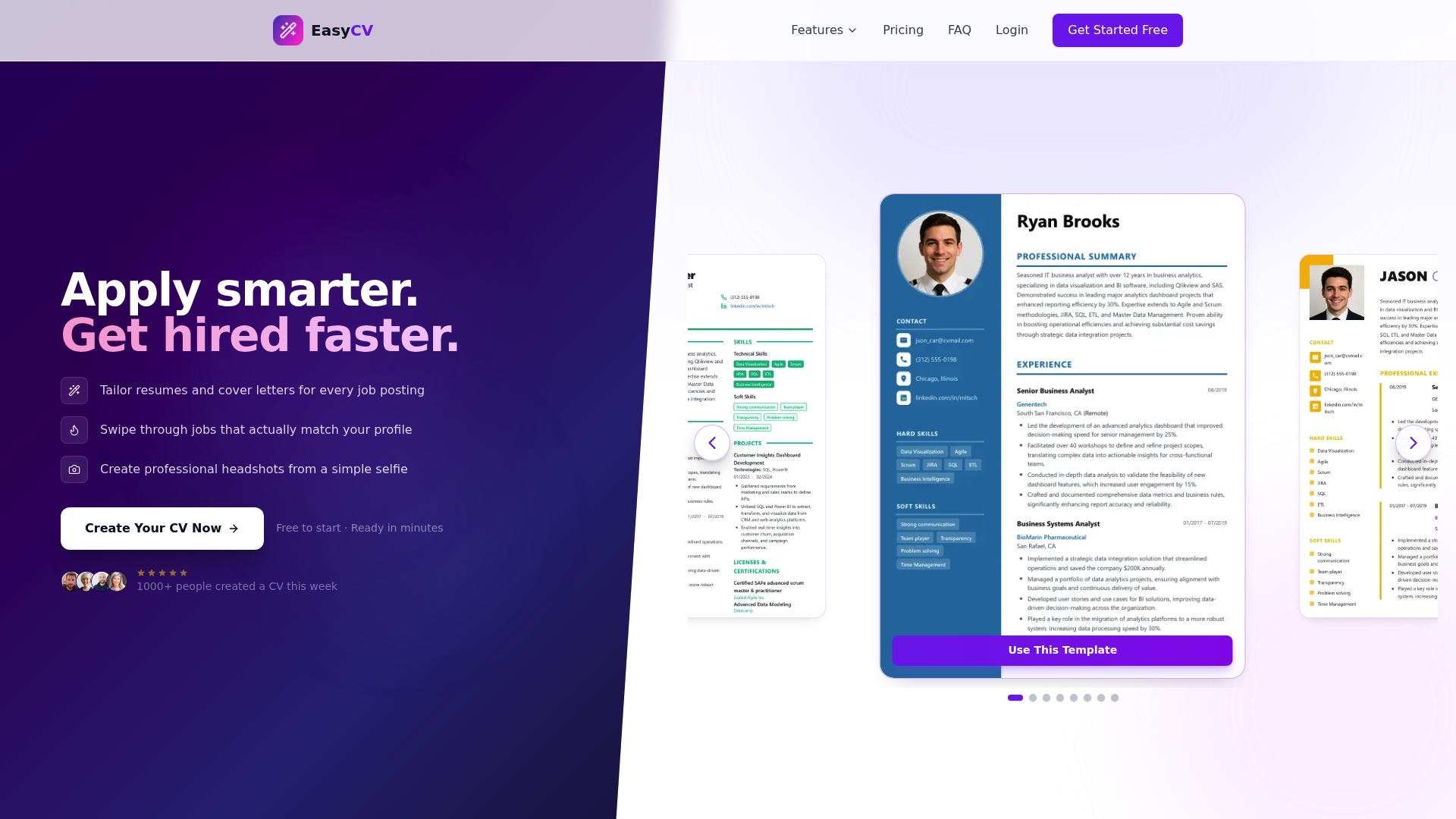
Start from a brand-management-ready template in the Easy CV builder, paste in your role bullets, and let the AI writing assistant suggest rewrites using the action-scale-result structure covered above. Verify every metric it surfaces against what you actually accomplished, then export to an ATS-friendly file format built to pass standard parsing checks. If you’re applying to global brand teams, the built-in CV translator lets you localize the same resume across 30-plus languages without rebuilding it from scratch. Pair that with the swipe-based job matcher to find brand roles that fit your background before you spend an evening tailoring a resume for a posting that was never a strong match.
Check the full feature set and build your next tailored resume there.