Resume Branding: What It Is and How to Do It
Resume branding is the practice of presenting your most employable qualities in a single, memorable statement that positions you as the right candidate before a recruiter reads a single bullet point. It is not a summary of your work history. It is a deliberate signal of your professional value. Personal branding differentiates you in a saturated market where hiring managers receive hundreds of applications for a single role. Understanding what is resume branding, and applying it correctly, is the difference between a resume that gets read and one that gets skipped.
What is resume branding, and why does it matter?
Resume branding is defined as the concise expression of your unique professional identity, placed at the top of your resume to create an immediate, lasting impression on recruiters. The industry term for the core element is a resume brand statement, and it typically runs fewer than 20 words to highlight the expertise that sets you apart. That brevity is intentional. Recruiters spend seconds, not minutes, scanning a resume at first glance.
The role of branding in resumes goes beyond aesthetics or word choice. It frames every other section that follows. When a recruiter reads your brand statement first, they interpret your experience through that lens. Without it, they build their own interpretation, which may not favor you.

Clear branding reduces perceived risk for recruiters by answering the question they always ask: “What does this person actually do, and why should I care?” A well-crafted brand statement answers both in one sentence. That clarity increases your chances of being shortlisted and invited to interview.
Resume personal branding also extends beyond the document itself. Your LinkedIn profile, cover letter, and portfolio should all reflect the same core message. Consistency across those touchpoints builds credibility and makes you easier to remember.
How does resume branding differ from a summary or objective?
Job seekers often confuse three distinct resume elements: the brand statement, the professional summary, and the objective. Each serves a different purpose, and using the wrong one in the wrong context weakens your application.
A professional summary is a two to three sentence overview of your background, skills, and career highlights. It is retrospective. It tells the recruiter what you have done. A career objective is forward-looking. It states what role you want and what you hope to achieve. A brand statement does neither of those things alone. Branding statements are shorter and more focused than summaries, designed to create instant impact by singling out your key employable quality.
The table below shows how these three elements compare across the dimensions that matter most to recruiters.
| Element | Length | Focus | Primary purpose |
|---|---|---|---|
| Brand statement | 1 sentence, under 20 words | Your unique professional identity | Instant differentiation |
| Professional summary | 2–3 sentences | Career highlights and skills | Context and credibility |
| Career objective | 1–2 sentences | Desired role and goals | Direction and intent |
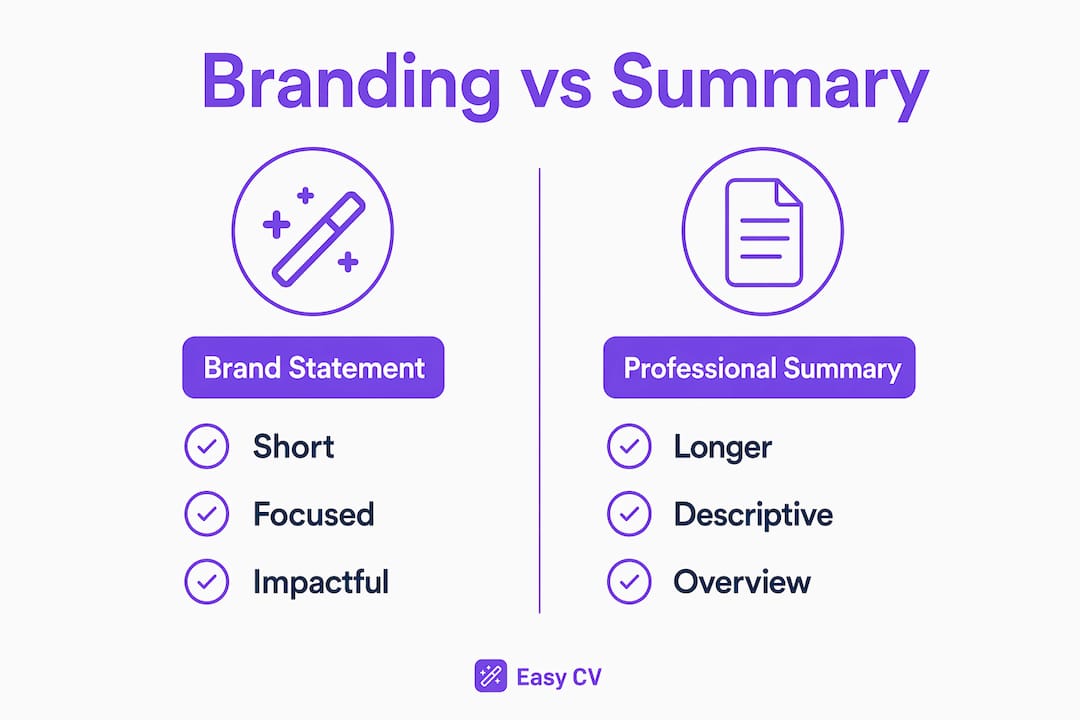
The practical implication is clear. A brand statement works best at the very top of your resume, before the summary. The summary then expands on the brand statement with evidence. The objective, if you use one at all, belongs only on entry-level resumes where you have limited experience to summarize.
Many professionals skip the brand statement entirely and lead with a summary. That approach buries the most important signal inside a paragraph. Recruiters who skim miss it completely.
What components make an effective resume branding statement?
A strong brand statement contains three elements: a specific professional identity, a measurable or concrete result, and a clear indication of the business problem you solve. Vague statements like “results-driven professional with strong communication skills” fail all three tests. They describe no one in particular and no problem specifically.
Specificity is the most important quality. Compare these two examples. “Marketing leader with 10 years of experience” tells a recruiter almost nothing. “B2B demand generation leader who has built pipeline programs from zero to $40M in annual recurring revenue” tells them exactly who you are and what you deliver. The second version is a brand statement. The first is a filler phrase.
Placement matters as much as content. Your brand statement belongs directly below your contact information, before any other section. That position makes it the first substantive thing a recruiter reads. Moving it lower on the page defeats its purpose entirely.
Pro Tip: Write your brand statement last. Draft the rest of your resume first, then distill your strongest proof points into one sentence. The statement should feel like the headline of the story your resume tells.
Common mistakes to avoid when writing a brand statement:
- Using generic adjectives like “dynamic,” “passionate,” or “motivated” without any supporting specifics
- Writing more than one sentence, which turns a brand statement into a summary
- Focusing on what you want rather than what you deliver
- Copying language directly from a job description without personalizing it
- Omitting measurable results when you have them available
Strong brand statements also reflect the language of your target industry. A resume headline that uses the exact terminology recruiters search for performs better in applicant tracking systems and in human review alike.
What are practical branding strategies for resumes across experience levels?
Branding strategies for resumes change significantly depending on where you are in your career. A one-size-fits-all approach produces generic results at every level.
Entry-level job seekers should anchor their brand statement in their field of study, a specific skill set, and any applied experience from internships, projects, or volunteer work. The goal is to signal potential and direction. An example: “Data science graduate with Python and SQL expertise, proven through three published Kaggle competition finishes in the top 10%.”
Mid-career professionals have more proof points to work with. Their brand statements should lead with a specific function, name the industries or company types they know best, and include a concrete result. Consistency across the resume matters here. The brand statement should connect directly to the skills section, the job titles, and the accomplishments listed under each role.
Executive job seekers face a different challenge. Leadership resumes function as positioning documents that emphasize the business problems a leader solves, not the titles they have held. A CFO whose brand statement reads “Chief Financial Officer with 20 years of experience” has wasted the most valuable real estate on their resume. A better version: “CFO who has led three successful IPOs and reduced operating costs by 30% across portfolio companies in the $500M to $2B range.”
Details beyond job titles build trust and reinforce what you are known for. Awards, board memberships, published thought leadership, and language skills all support and round out your personal brand on the page.
Follow these steps to build your branding strategy regardless of career stage:
- List your three strongest professional proof points, each tied to a measurable outcome.
- Identify the single business problem you solve better than most people in your field.
- Write a one-sentence brand statement combining your identity, your proof, and the problem you solve.
- Audit every section of your resume to confirm it supports the brand statement you wrote.
- Align your LinkedIn headline and summary with the same core message.
- Tailor the brand statement for each application by matching the language of the job description.
Pro Tip: Read your brand statement out loud. If it sounds like something anyone in your field could say, rewrite it. Your statement should be specific enough that a recruiter could not paste it onto a colleague’s resume without it being obviously wrong.
A tailored resume that aligns the brand statement with each specific role consistently outperforms a generic resume sent to multiple openings.
How to apply resume branding with digital tools and templates
The right tools make resume branding faster and more consistent across multiple applications. AI-powered resume builders help job seekers tailor brand statements to specific roles without starting from scratch each time. AI-powered tools like Easy-cv facilitate customization and ensure visual appeal alongside keyword optimization to pass applicant tracking system filters.
ATS optimization is not optional. Most large employers route applications through automated screening before a human ever sees them. A brand statement that uses the exact keywords from a job description passes those filters. One that uses synonyms or informal language may not.
Tips for using digital tools to support your resume branding:
- Choose ATS-friendly templates with clean layouts. Decorative fonts, graphics, and tables embedded in headers confuse parsing software.
- Use the AI writing assistant to generate a draft brand statement, then edit it to include your specific results and numbers.
- Run your resume through an ATS checker before submitting to confirm keyword alignment with the job description.
- Keep a master version of your resume with all proof points included, then create tailored versions for each application.
- Use an AI headshot generator to produce a professional photo that matches the tone of your brand, particularly for markets where photos are standard.
Visual consistency also reinforces branding. Font choice, spacing, and color all communicate something about your professional identity before a recruiter reads a word. A financial analyst and a creative director should not use the same resume template. The design should reflect the field and the role.
Key takeaways
Resume branding is the single most effective way to control how a recruiter interprets your application before they read your experience.
| Point | Details |
|---|---|
| Define your brand statement first | Write one sentence under 20 words that names your identity, your proof, and the problem you solve. |
| Place it at the top | Put your brand statement directly below contact information so it is the first thing recruiters read. |
| Adapt by career stage | Entry-level statements lead with skills and potential; executive statements lead with business impact and scale. |
| Align all touchpoints | Your LinkedIn headline, cover letter, and resume should all reflect the same core brand message. |
| Use AI tools to tailor | AI-powered builders help match brand statements to specific job descriptions and pass ATS filters. |
The shift I keep seeing job seekers miss
Most professionals treat their resume as a record of employment. They list where they worked, what their title was, and what they did day to day. That approach made sense when hiring was slower and recruiters had time to read carefully. It does not work now.
The job seekers I see succeed consistently are the ones who treat their resume as a positioning document. They ask a different question before they write a single word: “What do I want to be known for in this next role?” That question produces a brand statement. The old question, “What did I do at my last job?” produces a job description.
The other mistake I see constantly is treating the brand statement as a one-time exercise. Your brand should evolve as your career does. A statement that served you well as a mid-level manager needs a complete rewrite when you move into a director role. The proof points change. The scale of impact changes. The business problems you solve change.
The professionals who resist this work usually say the same thing: “I don’t want to oversell myself.” That is the wrong frame. A brand statement is not a boast. It is a service to the recruiter. It tells them quickly and clearly whether you are the right fit. Clarity is not arrogance. Vagueness is not humility. It is just noise.
— Andras
Build your branded resume with Easy-cv
Resume branding requires the right foundation, and that starts with a resume that looks professional and reads clearly on every screen and ATS filter.
Easy-cv gives you an AI writing assistant that drafts and refines your brand statement and resume content, a library of ATS-friendly templates, and a built-in job tracker to keep every tailored application organized. The platform aggregates over 10 million job opportunities per month, so you can match your brand to real roles immediately. Whether you are writing your first brand statement or refreshing an executive resume, Easy-cv’s AI resume builder handles the heavy lifting so you can focus on the application itself.
FAQ
What is a resume brand statement?
A resume brand statement is a single sentence of fewer than 20 words that describes your most employable qualities and positions you uniquely to recruiters. It appears at the top of your resume, directly below your contact information.
How does resume branding differ from a professional summary?
A brand statement is one focused sentence designed for instant impact, while a professional summary is two to three sentences that provide broader context about your background and skills.
Where should a brand statement appear on a resume?
Place your brand statement directly below your contact information. That position makes it the first substantive content a recruiter reads before moving into your experience or skills sections.
Do entry-level job seekers need a brand statement?
Yes. Entry-level job seekers should anchor their brand statement in a specific skill set and any applied experience from internships or academic projects to signal direction and potential to recruiters.
How do I tailor my resume brand for each application?
Match the language of your brand statement to the specific terminology in the job description. AI-powered tools like Easy-cv can generate tailored versions quickly while preserving your core professional identity.