Resume Headline Examples That Land More Interviews
Your resume has about six seconds to make an impression before a recruiter moves on. That’s not an estimate. That’s the reality of a hiring process where hundreds of applications compete for the same role. The resume headline sits at the very top of your document, right below your name, and it’s the first real sentence a recruiter reads. Get it right, and you pull them in. Get it wrong, and even a strong work history might not save you. This article gives you concrete resume headline examples for every career stage and industry, plus a clear framework for writing your own.
Table of Contents
- Key takeaways
- 1. What makes a resume headline actually work
- 2. Resume headline examples by career stage
- 3. Industry-specific resume headline examples
- 4. Effective vs. ineffective headlines: a side-by-side comparison
- My honest take on resume headlines
- How Easy-cv helps you write headlines that get results
- FAQ
Key takeaways
| Point | Details |
|---|---|
| Headlines work like ads | Treat your headline as a compact value statement that sells your biggest professional strength in one line. |
| Keep it tight and specific | The strongest headlines run 10 to 15 words and include a job title, experience level, and one measurable skill or achievement. |
| Keywords are non-negotiable | Recruiters and ATS systems both scan for relevant terms, so mirror the language in the job description. |
| Tailor by career stage | Entry-level, mid-career, and senior candidates each need a different emphasis to communicate the right kind of value. |
| Generic headlines cost interviews | Vague phrases like “Hard-working professional” add nothing. Specificity and metrics are what get you noticed. |
1. What makes a resume headline actually work
A resume headline is not a job title. It’s not a tagline. It’s a concise professional statement that tells a recruiter exactly who you are and what you bring, before they read another word. Effective resume headlines function like mini marketing statements that improve your visibility when recruiters search by keyword and increase the chance your resume gets read at all.
The formula that consistently produces strong results comes down to three parts:
- Job title or role: State what you are or what you’re targeting. “Data Analyst,” “Marketing Manager,” “Registered Nurse.”
- Experience or credential level: Signal your depth. “with 8 years of experience,” “Recent Graduate,” “Senior-Level.”
- Key skill or measurable achievement: Add the detail that separates you. “specializing in Python and machine learning,” “with a track record of 40% revenue growth.”
A headline combining job title with experience level and a key skill or achievement gives recruiters everything they need in one glance.
Here are the specific qualities that separate effective resume headlines from forgettable ones:
- Conciseness: 10 to 15 words is the sweet spot. Longer than that, and the headline starts to read like a summary. Shorter, and it lacks substance.
- Keyword alignment: Mirror the language in the job posting. If the listing says “cross-functional collaboration,” use that phrase, not “teamwork.”
- Quantifiable detail: Numbers do the heavy lifting. “Managed $2M budget” beats “experienced budget manager” every time.
- Strong verbs: Action verbs like “managed,” “developed,” and “achieved” communicate initiative and results far better than passive or generic language.
- No generic filler: Phrases like “results-driven professional” or “motivated team player” are so overused they carry zero meaning.
Pro Tip: Before you write your headline, read the job description and highlight every skill and qualification they mention. Your headline should reflect the two or three terms that appear most often. This is how you optimize for both ATS systems and human readers at the same time. For a deeper look at this process, the guide on resume keywords strategy walks you through exactly which terms to prioritize.
2. Resume headline examples by career stage
One of the most common mistakes job seekers make is using the same headline structure regardless of where they are in their career. A recent graduate and a VP of Engineering are selling completely different things. Here’s how to frame your headline depending on your career stage.
Entry-level candidates
At this stage, you haven’t built a long track record, so your headline should lead with education, transferable skills, and any hands-on experience you’ve gained through internships, academic projects, or part-time work. The goal is to communicate potential and readiness.
- “Enthusiastic business admin student seeking entry-level role”
- “Recent Marketing Graduate with Social Media and Campaign Analytics Experience”
- “Computer Science Graduate | Java, Python, and Agile Development Background”
- “Finance Intern with 2 Semesters of Hands-On Equity Research Experience”
- “Communications Major with Published Writing and PR Internship Background”
These headlines work because they’re honest about the candidate’s stage while immediately pointing to real, specific value.
Mid-career professionals
Here the emphasis shifts to proven results, leadership, and domain depth. Mid-career headlines highlight experience, accomplishments, and leadership qualities that separate you from entry-level candidates chasing the same roles.
- “Expert Software Engineer with Deep Agile and Cloud Computing Experience”
- “Seasoned Marketing Executive with 10+ Years Driving B2B Revenue Growth”
- “Operations Manager Who Reduced Costs by 22% Across 3 Regional Facilities”
- “Project Manager | PMP Certified | Led Cross-Functional Teams of 20+”
- “Sales Director with Consistent Record of Exceeding Quarterly Targets”
Notice how each one includes either a time frame, a certification, a metric, or a specific skill set. That specificity is what makes mid-career headlines land.
Senior-level and executive candidates
At this level, recruiters want to see strategic thinking, business impact, and leadership scale. Your headline should reflect the size of the problems you’ve solved, not just the tasks you’ve managed.
- “Chief Marketing Officer | Brand Transformation and 3x Revenue Growth Across Global Markets”
- “VP of Engineering with 15 Years Building and Scaling High-Performance Engineering Teams”
- “Senior HR Executive Specializing in Organizational Change and Talent Strategy”
- “CFO with Expertise in Series B Through IPO Financial Leadership”
- “CEO with Track Record of Turning Around Underperforming Business Units”
These are not modest. They’re not supposed to be. Senior candidates who write timid headlines signal a lack of confidence in their own record.
3. Industry-specific resume headline examples

Generic headlines lose their impact the moment they cross industry lines. A recruiter hiring for a hospital reads applications very differently from one hiring for a software startup. Tailoring headlines by industry keywords helps recruiters find you faster and signals that you understand their world.
Technology
Tech recruiters scan for specific tools, languages, and methodologies. Name them directly.
- “Full-Stack Developer with Expertise in Java, Python, and React”
- “DevOps Engineer | AWS Certified | CI/CD Pipeline Specialist”
- “UX Designer with 6 Years Building Mobile-First Products for SaaS Platforms”
- “Machine Learning Engineer Specializing in NLP and Large Language Models”
Education
Education headlines should emphasize student outcomes, pedagogical strengths, and any measurable engagement results.
- “Dedicated High School English Teacher with Proven Student Engagement Success”
- “Curriculum Developer with 8 Years Designing K-12 STEM Learning Programs”
- “Special Education Specialist | IEP Expert | Inclusive Classroom Advocate”
Healthcare
Healthcare recruiters look for licensure, specialization, and evidence of patient-centered care.
- “Experienced ICU Nurse Passionate About Patient Care and Critical Outcomes”
- “Licensed Physical Therapist Specializing in Sports Rehabilitation and Recovery”
- “Board-Certified Family Physician with 12 Years in Community Health Settings”
The difference between a generic headline and an industry-specific one isn’t creativity. It’s vocabulary. Use the words your industry actually uses, and you’ll connect with the right readers immediately.
4. Effective vs. ineffective headlines: a side-by-side comparison
Good resume headlines quantify impact and include keywords, while poor ones are generic and fail to communicate clear value. Seeing the contrast directly makes the lesson stick.
| Weak headline | Strong headline | What changed |
|---|---|---|
| “Hard-working professional looking for opportunities” | “Operations Manager with 7 Years Driving Efficiency Gains in Manufacturing” | Added title, years, industry, and measurable context |
| “Experienced sales person” | “B2B Sales Executive with $4M Annual Quota and 120% Attainment Record” | Added specific revenue figures and performance data |
| “Good communicator and team player” | "Corporate Communications Director | Internal Messaging and PR for 5,000+ Person Organizations" |
| “Recent graduate seeking full-time work” | "Marketing Graduate | Social Media Campaigns and Brand Growth Experience" |
| “IT professional with many years of experience” | “Senior Network Engineer with 10 Years Managing Enterprise Infrastructure” | Replaced “many years” with a number and named the specialty |
The pattern is consistent. Weak headlines describe personality or desire. Strong ones describe capability and proof. Every revision above adds at least one specific detail: a number, a title, a named skill, or an industry term. That’s the only edit you need to make your own headline stronger.
Pro Tip: Write your weak headline first on purpose. Most people already know their vague version. Then ask yourself: “What’s the most impressive specific thing I can say about this?” That answer becomes your strong headline.
My honest take on resume headlines
I’ve looked at a lot of resumes over the years, and the headline is almost always the first thing that tells me whether someone understands how hiring actually works. Most people treat it as an afterthought, something they fill in last after writing out every job description.
What I’ve learned is that the headline should come first in your thinking, even if it’s written last. It forces you to answer one question cleanly: what is the single most compelling thing a recruiter should know about me right now? If you can’t answer that clearly, your whole resume will probably be unfocused.
The other thing I’d push back on is the idea that headlines only matter for getting past ATS filters. That matters, yes. But the more important function is psychological. When a recruiter picks up your resume and the headline immediately confirms you’re the right type of candidate, they read the rest looking for reasons to call you. Without a clear headline, they read the rest looking for reasons to pass.
The candidates who get this right don’t write better resumes. They just understand that a resume is a marketing document, not a history report. Your headline is the subject line. Make it count. For a full walkthrough of how to write a professional resume that supports a strong headline with equally strong content, that resource is worth your time.
— Andras
How Easy-cv helps you write headlines that get results
Once you know what a strong headline looks like, building one from scratch for every application you send is still time-consuming. Easy-cv takes that work off your plate.
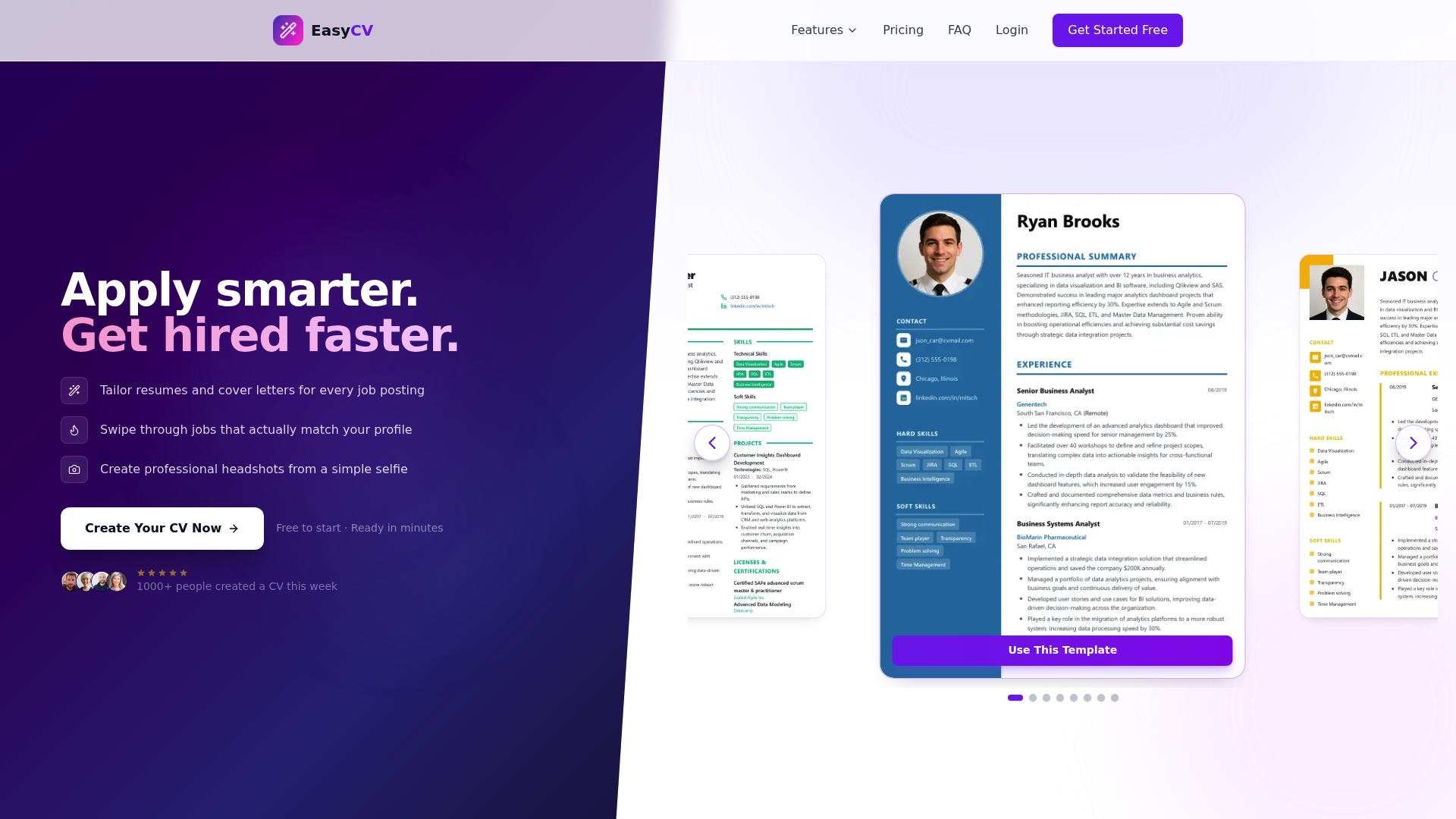
Easy-cv’s AI writing assistant generates and refines professional resume headlines tailored to each specific job you’re applying for. It pulls keywords directly from the job description, matches them to your experience, and suggests headlines you can use or adjust in seconds. Pair that with a library of modern, ATS-ready resume templates and built-in cover letter support, and you have everything you need in one place. Whether you’re applying to three roles or thirty, the Easy-cv AI builder keeps your applications sharp, consistent, and ready to move fast.
FAQ
What is a resume headline?
A resume headline is a short statement, typically 10 to 15 words, placed at the top of your resume that summarizes your professional identity, experience level, and strongest skill or achievement.
How long should a resume headline be?
The ideal length is between 10 and 15 words. Long enough to include a job title, experience context, and one specific qualifier, but short enough to be read in a single glance.
Should I change my headline for every job I apply to?
Yes. Tailoring your headline to match the keywords and priorities in each job description improves your chances with ATS systems and makes your resume feel directly relevant to the recruiter reading it.
What’s the difference between a resume headline and a resume summary?
A headline is one line at the top of your resume that captures your core value. A resume summary is a short paragraph (usually three to five sentences) that expands on your experience, skills, and goals in more detail.
Can entry-level candidates use resume headlines effectively?
Absolutely. Entry-level headlines work best when they lead with education, specific skills, or internship experience rather than trying to imitate the metrics-heavy format of senior candidates.