How to write a professional resume that gets noticed

Your resume has seconds to make an impression. Hiring managers may spend only moments scanning your application before moving on, and that’s assuming it even reaches a human. Many companies now use automated screening tools to filter applications before a recruiter ever sees them. Knowing how to write a professional resume that clears both of those hurdles is no longer optional. This guide walks you through everything: what to prepare beforehand, how to write and format strong content, how to use AI tools wisely, and how to keep your resume working for you over time.
Table of Contents
- Preparing your resume: what you need before writing
- Writing your resume: structure, bullets, and style
- Leveraging AI tools for smarter, faster resume creation
- Reviewing, updating, and tailoring your resume for best results
- Why typical resume advice falls short and how to truly stand out
- Simplify your resume writing with Easy CV’s AI-powered tools
- Frequently asked questions
Key Takeaways
| Point | Details |
|---|---|
| Resume brevity matters | Aim for a one-page resume unless applying to federal jobs requiring more detail. |
| Bullet impact | Use action verbs and include metrics to show clear, concise accomplishments. |
| Leverage AI wisely | Use AI for drafting but always personalize and align content to jobs. |
| Regular updates | Review and update your resume every six months to keep it relevant. |
| Tailor for each job | Customize your resume to match the keywords and requirements of every application. |
Preparing your resume: what you need before writing
Before you type a single bullet point, you need the right materials and a clear plan. Skipping this step is why so many resumes end up generic. Rushing into writing without preparation is like trying to cook a meal before you’ve checked the pantry.
Understanding the basics first
A resume is typically a one-page document summarizing your professional background, skills, and accomplishments. That one-page standard applies most strictly to early-career applicants and most private-sector roles. Federal positions and senior executive roles are the exceptions, often requiring longer documents with very specific formatting rules.
What to gather before you write
Use this checklist as your starting inventory:
- Full work history: job titles, employer names, locations, and exact dates
- Key accomplishments for each role (not just duties)
- Education credentials: degrees, institutions, graduation years, and relevant coursework
- Technical and soft skills relevant to your target field
- Certifications, licenses, and continuing education
- Volunteer work, freelance projects, and side work with measurable outcomes
- Contact information: professional email, phone number, LinkedIn profile, and portfolio link if applicable
An AI-optimized resume checklist can help you confirm you haven’t missed anything critical before you start building.
Reading job descriptions as research
This is where most job seekers leave points on the table. A job description tells you exactly what words, skills, and qualities the hiring team cares about. Pull out the repeated nouns and verbs, those are your keywords. If a posting mentions “cross-functional collaboration” three times, that phrase belongs in your resume if it accurately reflects your experience.
| Preparation task | Why it matters |
|---|---|
| Collect full work history with dates | Prevents gaps and inconsistencies |
| List accomplishments with numbers | Gives you raw material for strong bullets |
| Analyze job description keywords | Helps pass AI screening filters |
| Identify skills gaps | Lets you address them honestly or upskill |
| Build a master resume document | Makes tailoring faster and more accurate |
Pro Tip: Build a “master resume” document that contains everything, every job, every project, every skill. Never send this document to an employer. Use it as your personal source file to pull from when tailoring for specific roles.
Writing your resume: structure, bullets, and style
With your information organized, it’s time to write the content that actually gets you an interview. This section is where most resumes either shine or sink.

The structure that works
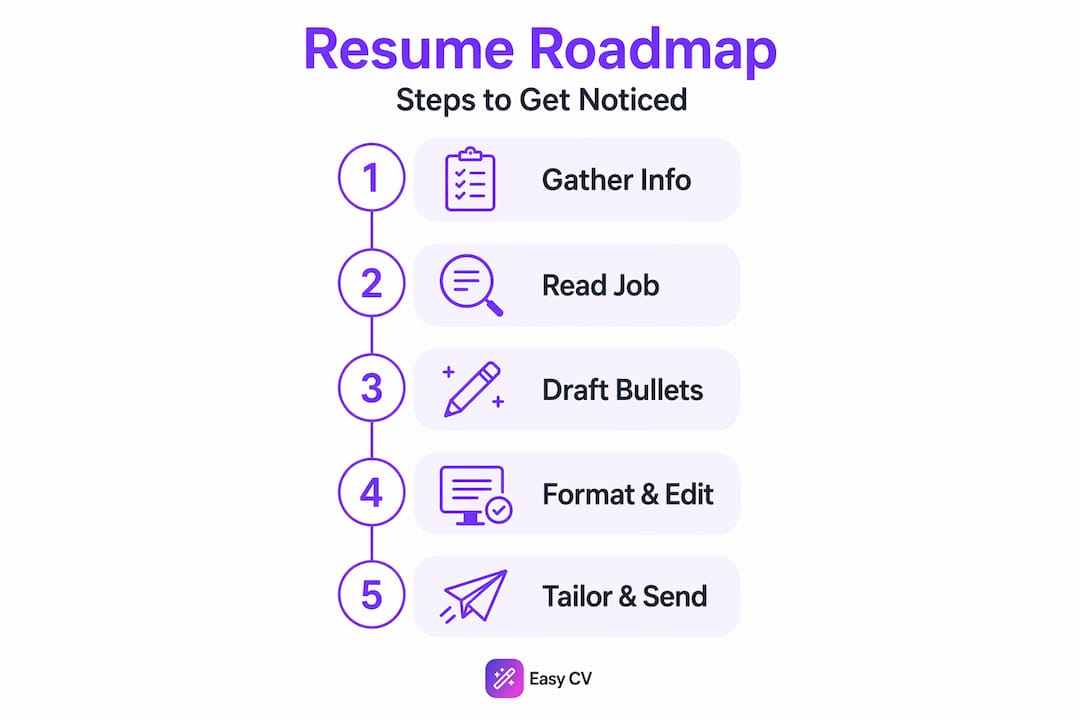
Stick to reverse chronological order for both your experience and education sections. That means your most recent job or degree comes first. List experiences in reverse chronological order and use consistent verb tense throughout. Past tense for previous roles, present tense for your current one. Mixing tenses is one of those small errors that signals carelessness to a detail-oriented recruiter.
The standard sections to include are:
- Contact information (name, phone, email, LinkedIn)
- Professional summary (2-3 sentences tailored to the specific role)
- Work experience (reverse chronological, with achievement-focused bullets)
- Education (degrees, institutions, graduation years)
- Skills (both technical and transferable)
- Optional additions (certifications, languages, volunteer work, publications)
Writing bullets that actually land
The difference between a weak bullet and a strong one is specificity. Strong bullet points start with an action verb, clearly explain what you did and how, and use numbers to show the impact. Compare these two:
- Weak: Responsible for managing social media accounts
- Strong: Grew Instagram following by 47% in six months by redesigning content calendar and shifting to short-form video
The second version tells a mini-story. It has a result, a method, and a timeframe. Every bullet on your resume should aim for that level of specificity.
Strong action verbs to lead with: led, built, reduced, increased, launched, negotiated, redesigned, trained, analyzed, secured.
Formatting for readability
| Formatting element | Best practice |
|---|---|
| Font | Calibri, Arial, or Georgia at 10-12pt |
| Margins | 0.75 to 1 inch on all sides |
| Section headings | Bold and slightly larger (12-14pt) |
| White space | Enough to breathe, not so much that it looks sparse |
| File format | PDF unless the employer specifies otherwise |
Using AI for resume writing can help you draft and reformat faster, but it works best when you’ve already prepared your raw content. Think of AI as an editor, not a ghostwriter.
Pro Tip: Avoid templates that lock your content into rigid text boxes. Many look polished in a design app but get scrambled when parsed by an applicant tracking system (ATS). A simple, clean Word or Google Docs layout often outperforms a heavily designed template for ATS compatibility. Check professional resume templates that are built with both design and ATS parsing in mind.
Leveraging AI tools for smarter, faster resume creation
Writing a tailored resume for every job application is time-consuming. That’s where AI tools earn their keep. But there’s a right way and a wrong way to use them.
What AI does well
AI-powered resume builders can take your raw work history and structure it into a clean, professional format in minutes. They can suggest action verbs, flag missing keywords from a job description, and help you rephrase vague duties into achievement-oriented bullets. That’s genuine value, especially when you’re applying to multiple positions simultaneously.
Here’s how to get the most out of AI tools:
- Draft fast, edit carefully. Paste in your work history and the job description. Let the AI generate a first draft, then go line by line and rewrite anything that doesn’t sound like you or doesn’t accurately reflect your experience.
- Run a keyword alignment pass. After drafting, compare your resume to the job description. Are the most important skills and phrases represented? AI tools can often do this comparison automatically.
- Use it for multiple versions. One of the biggest advantages is speed. What used to take hours per application can take 20 minutes when you have AI handling the structure and suggesting language.
- Check every claim. AI can draft and structure resumes, but it can also generate plausible-sounding content that’s slightly off. Dates, job titles, metrics: verify everything before submitting.
Knowing how resume builders power a smarter job search can help you decide which features are worth your time and which ones you can skip.
What AI cannot replace
AI doesn’t know your actual impact. It doesn’t know that the project you led quietly saved your company $200,000 or that you were the only person on your team who could handle a specific client. That kind of specificity only comes from you. Smarter job applications combine AI efficiency with human judgment. Always treat AI output as a starting point, not a finished product.
Pro Tip: When pasting a job description into an AI tool, explicitly ask it to flag skills or keywords mentioned in the description that are missing from your current resume draft. This turns the tool into an active gap analyzer rather than just a text formatter.
Reviewing, updating, and tailoring your resume for best results
A resume isn’t a document you write once and file away. Treating it that way is one of the most common mistakes professionals make.
How often to update
Review your resume at least every six months to add new skills, accomplishments, and experiences. The best time to add a win is right after it happens, while the details are fresh. Waiting until you need a job means trying to remember what you did two years ago and how to quantify it.
Here’s a simple update schedule to follow:
- Immediately: Add any new certification, major project, or promotion as soon as it occurs
- Every six months: Audit the full document for outdated skills, old job duties, and anything that no longer reflects your current direction
- Before each application: Tailor the summary and keyword-heavy bullets to match that specific job description
Tailoring: what it actually means
Tailoring is not swapping out the job title in your summary header. It means reading the job description carefully and ensuring your resume speaks directly to what that employer values. If the role emphasizes data analysis, your relevant data work should appear near the top of your experience bullets. If it prioritizes team leadership, lead with that.
Addressing employment gaps
Don’t try to hide gaps with formatting tricks. Recruiters notice. Instead, address them briefly in your resume or cover letter by noting what you did during that time: freelance work, caregiving, skill-building courses, volunteering. A brief explanation removes the uncertainty that makes a recruiter hesitate.
| Situation | How to handle it |
|---|---|
| Gap due to caregiving | Note it briefly: “Career pause for family caregiving” |
| Gap used for education | List relevant courses or certifications earned |
| Gap due to health | A general note like “personal leave” is sufficient |
| Freelance during gap | List as its own experience entry with clients and outcomes |
Federal resumes: a different game
If you’re applying to U.S. federal positions, the standard rules don’t apply. Federal resumes follow a two-page limit for most roles and require very precise formatting, including specific language from job announcements. Think of federal applications as compliance exercises. You’re matching language exactly and demonstrating that you meet every stated requirement. Resume automation with AI can help manage multiple versions and track which version you submitted to which position.
Pro Tip: Keep a running “accomplishments log” in a notes app or document. Every time you complete a project, hit a target, or receive recognition, jot it down with numbers. This becomes your source material for resume updates and makes quantifying achievements effortless.
Why typical resume advice falls short and how to truly stand out
Most resume advice circles around the same familiar points: use bullet points, quantify your achievements, keep it to one page. That advice isn’t wrong. But it’s also not enough.
Here’s what’s usually missing. The real problem with most resumes isn’t that they’re too long or use the wrong font. It’s that they read like job descriptions rather than personal records of impact. Resumes that list duties without outcomes are easy to ignore because they don’t tell you what changed because this person showed up. Every recruiter has seen a hundred resumes from people who “managed social media” or “supported the sales team.” None of those phrases create a picture.
The fix isn’t just adding metrics, although that helps enormously. It’s shifting your mental frame from “What was I responsible for?” to “What was different because I was there?” Those are not the same question. The first one produces a duty list. The second one produces a story.
Tailoring also goes deeper than most guides suggest. Real tailoring means understanding the company’s current priorities, not just the job description’s keywords. If a company recently announced a push into a new market, and your experience is directly relevant, name it. That kind of targeted framing signals genuine interest and research, two qualities that are surprisingly rare in applications.
The other underappreciated factor is timing. Most professionals only update their resume when they need a job. That’s reactive and it shows. A proactively maintained resume reflects someone who knows their own value clearly and can articulate it quickly. The advantages of resume builders include making that ongoing maintenance fast enough that you actually do it.
AI tools don’t replace strategic thinking. But they do remove the friction that causes most people to procrastinate on resume maintenance. Use them to handle structure and formatting so your mental energy goes to the parts that actually require judgment: what to include, how to frame it, and why this specific employer should care.
Simplify your resume writing with Easy CV’s AI-powered tools
Creating a resume that passes AI screening and impresses real people is a lot to manage alone. That’s exactly the problem Easy CV was built to solve.
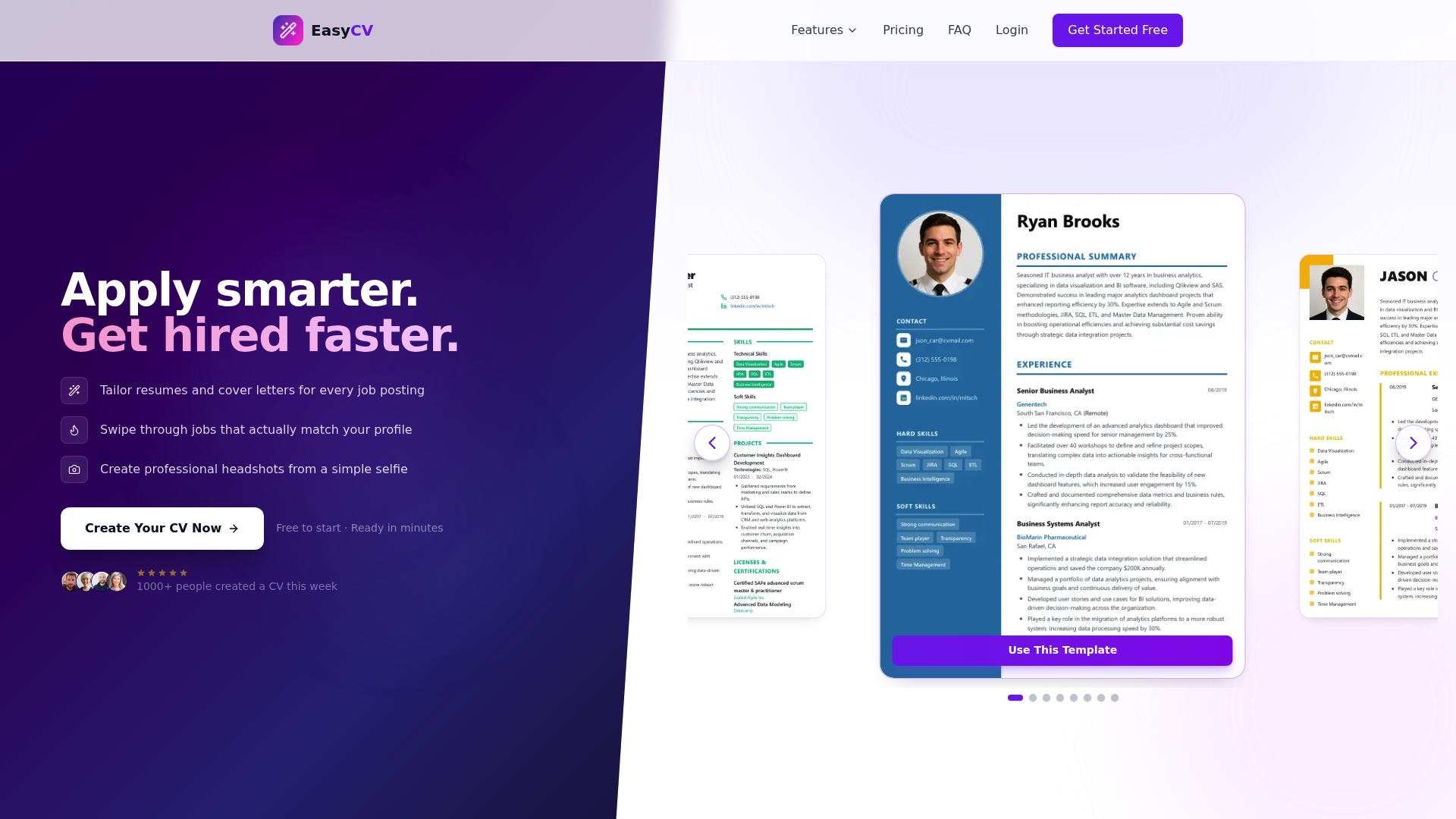
With Easy CV’s AI resume builder, you can generate a tailored, formatted resume in minutes rather than hours. The platform aligns your content with job description keywords, checks your formatting for ATS compatibility, and helps you maintain multiple resume versions for different roles. You don’t have to start from a blank page every time, and you don’t have to guess whether your resume will clear an automated filter. Explore Easy CV’s full features to see how AI-powered drafting, cover letter generation, and job matching can take the friction out of your job search and put the focus back where it belongs: on landing interviews.
Frequently asked questions
How long should a professional resume be for most job applications?
For early-career and most professional roles, a one-page resume is recommended. Federal resumes now follow a two-page limit for most applications, with additional requirements based on the specific position.
What is the best way to write bullet points on a resume?
Start each bullet with a strong action verb and describe what you did, how you did it, and the result. Strong bullets include metrics to show measurable impact whenever possible.
Can AI writing tools create a complete professional resume without edits?
No. AI can draft and structure content quickly, but you must review every line to confirm accuracy, relevance, and that it genuinely sounds like you.
How often should I update my resume?
Update your resume every six months at minimum, and add new achievements, skills, or certifications as soon as they happen rather than waiting until you’re actively job hunting.