How resume builders give you a smarter job search

Most job seekers assume AI resume builders do all the heavy lifting. You paste in your work history, hit a button, and out comes a perfect resume ready to land interviews. That assumption is costing people real opportunities. The truth is that resume builders are powerful tools, but they work best when you stay in the driver’s seat. This article breaks down exactly how to use these tools at every career stage, what mistakes to avoid, and how combining AI speed with your own strategic input creates applications that actually get noticed.
Table of Contents
- What makes resume builders valuable for job seekers
- How AI resume builders adapt to experience levels
- Common mistakes and how to maximize success with resume builders
- Turning resume builder outputs into winning applications
- Our take: Why resume builders are only the start
- Ready to build a better resume?
- Frequently asked questions
Key Takeaways
| Point | Details |
|---|---|
| AI speeds resume tailoring | Resume builders help job seekers quickly adapt resumes for different applications. |
| Human review is essential | Editing AI resumes adds impact and prevents errors. |
| Different benefits by experience | Entry-level and senior candidates use AI tools differently for maximum results. |
| ATS optimization with builders | Resume builder formatting improves chances with applicant tracking systems. |
| Personalization drives success | Resumes must be tailored and authentic to stand out to employers. |
What makes resume builders valuable for job seekers
After setting the stage, let’s clarify why resume builders are so popular and how they differ from manual resume creation.
Building a resume from scratch is time-consuming, stressful, and easy to get wrong. Most people spend hours wrestling with formatting, second-guessing their word choices, and wondering whether they’ve included the right keywords. Resume builders solve all three of those problems at once.
The biggest practical advantage is speed. When you’re applying to multiple jobs, each application ideally needs a tailored resume that reflects the specific role. Resume builders can materially speed iterative tailoring across multiple applications, making it realistic to customize your resume for every position rather than sending the same generic document everywhere.
Formatting is another area where builders shine. Applicant Tracking Systems, commonly called ATS, are software programs that companies use to filter resumes before a human ever reads them. Poorly formatted resumes get rejected automatically. Resume builders are designed with ATS compatibility in mind, using clean layouts, standard fonts, and structured sections that these systems can read without errors. Learning more about using AI for resume writing can help you understand exactly how these formatting decisions affect your chances.
For beginners, the value is even more immediate. Starting with a blank page is intimidating. Builders provide structure, suggest sections you might not think to include, and offer language prompts that help you articulate your experience clearly. The benefits of pre-made templates go beyond aesthetics. They give you a proven framework so you’re not reinventing the wheel every time you apply.
Here’s what resume builders consistently do well:
- Generate ATS-friendly formatting automatically
- Suggest relevant keywords based on job descriptions
- Eliminate common formatting errors like inconsistent fonts or misaligned bullet points
- Provide starting points for people who don’t know where to begin
- Allow fast duplication and editing across multiple versions
That said, one critical warning applies across all of these advantages:
“AI-generated content should be treated as a draft, not a finished product. Submitting a resume without personalizing it first is one of the most common mistakes job seekers make.” — Career development experts consistently echo this point.
Exploring professional resume templates gives you a clearer picture of what strong formatting looks like before you start building your own.
How AI resume builders adapt to experience levels
Now that the overall advantages are clear, we’ll explore how resume builders should be used based on your career stage.
Not every job seeker needs the same thing from a resume builder. A recent graduate and a senior marketing director are solving completely different problems, and the best builders recognize that. Job seekers should use resume builders differently depending on experience level, and understanding this distinction will help you get far more out of the tool.
For entry-level candidates and career changers, the primary challenge is structure. You may not have a long list of impressive job titles, but you do have transferable skills, volunteer work, coursework, and projects. AI builders help you organize these elements in a way that looks professional and complete. Resources on getting a job with no experience confirm that presenting your skills strategically matters far more than the number of years you’ve worked.
For experienced professionals, the challenge shifts. You have plenty of content, but the question is how to position it for a specific role. AI builders help you identify which keywords from a job description are missing from your resume, restructure your experience to match what the employer prioritizes, and trim older or less relevant content to keep the document focused.

Here’s a comparison of how each group benefits most:
| Career stage | Primary challenge | How AI builders help | What you must still do |
|---|---|---|---|
| Entry-level | Lack of structure | Provides sections and prompts | Add real examples and skills |
| Career changer | Framing transferable skills | Suggests relevant language | Rewrite to reflect your story |
| Mid-level | Keyword gaps | Flags missing terms | Verify accuracy and context |
| Senior/executive | Conciseness and impact | Trims and reorganizes | Add measurable outcomes |
For senior roles especially, measurable outcomes are non-negotiable. Hiring managers at this level expect to see numbers. “Led a team” is weak. “Led a team of 12 that reduced customer churn by 18% in six months” is the kind of detail that gets interviews. AI builders can prompt you to include metrics, but only you know the actual numbers.
Practical job application tips reinforce that tailoring is the single biggest factor separating successful applications from ignored ones. Builders make tailoring faster, but you still have to direct the process.
The best way to improve your CV with AI is to treat the tool as a skilled assistant, not an autonomous writer. Give it clear input, review everything it produces, and rewrite anything that doesn’t sound like you.
Pro Tip: Every time an AI builder suggests a phrase or bullet point, ask yourself: “Would I say this in an interview?” If the answer is no, rewrite it in your own voice before submitting.
Common mistakes and how to maximize success with resume builders
With tailored approaches in mind, let’s address the real-world pitfalls and how to get the most from these tools.
The single most damaging mistake job seekers make is submitting AI-generated resumes without editing them. It’s tempting when you’re under pressure and applying to dozens of jobs. But best results come from human review of AI-written resumes rather than submitting AI-written text verbatim. Recruiters read hundreds of resumes and can spot generic, builder-default language immediately.
The second most common mistake is ignoring measurable outcomes. AI builders generate descriptions of job duties, not achievements. “Responsible for managing social media accounts” tells an employer nothing meaningful. “Grew Instagram following from 4,000 to 22,000 in eight months through targeted content strategy” tells a story worth hiring for.
Here are four steps to optimize your resume builder process:
- Input specific, detailed information. The quality of the output depends entirely on what you put in. Vague job titles and generic descriptions produce generic resumes. Give the builder your actual responsibilities, accomplishments, and the specific job description you’re targeting.
- Review every section critically. Read each bullet point out loud. If it sounds robotic, flat, or interchangeable with anyone else’s resume, rewrite it. Your voice and your specific experience should come through clearly.
- Add quantified achievements manually. AI builders rarely have access to your real numbers. Go through each role and add at least one or two specific metrics that demonstrate your impact.
- Run an ATS check before submitting. Even after editing, verify that your formatting hasn’t broken ATS compatibility. Some edits, especially in formatting, can accidentally introduce elements that scanning software misreads.
Understanding resume automation strategies helps you see where automation genuinely saves time and where it needs human oversight. A good AI-optimized resume checklist can also serve as your final quality gate before you hit send.
Statistic to keep in mind: Studies consistently show that resumes tailored to specific job descriptions perform significantly better in ATS screening than generic ones. Some estimates suggest tailored resumes are up to 40% more likely to pass initial screening filters. That gap is too large to ignore.
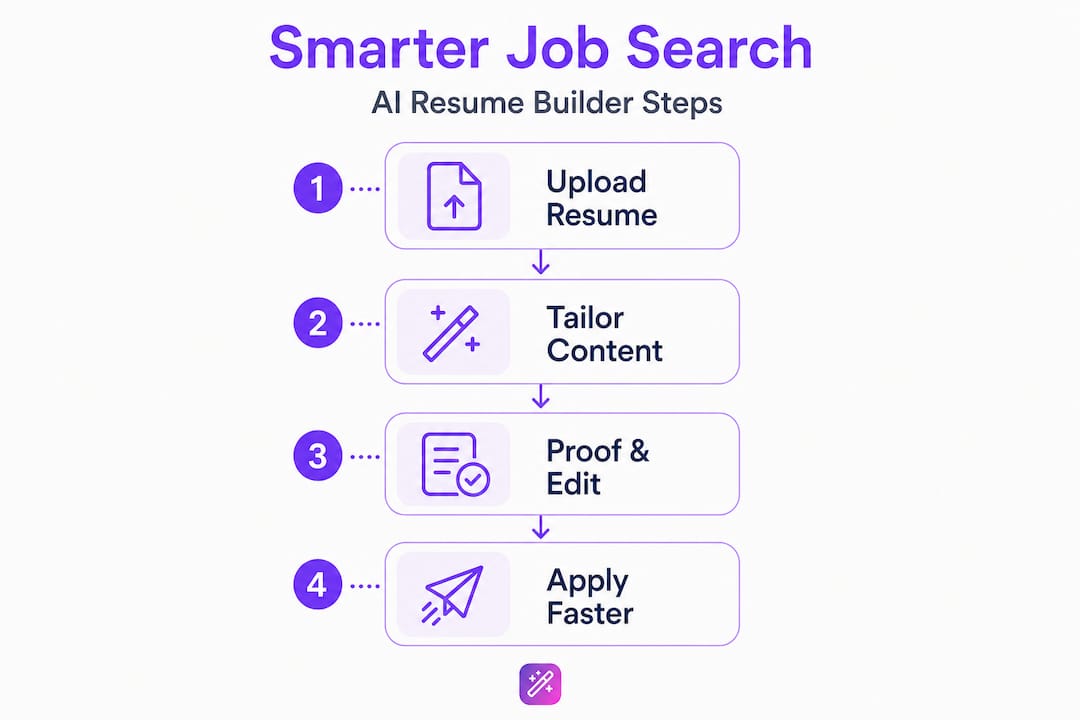
Pro Tip: Use the resume builder to generate your first draft in under 20 minutes, then spend at least 30 minutes editing, personalizing, and adding your real achievements before submitting.
Turning resume builder outputs into winning applications
Having learned how to avoid mistakes, let’s focus on transforming builder-ready resumes into winning job applications.
A resume builder gives you a strong starting point. What you do next determines whether that resume gets results. The editing phase is where good applications become great ones.
Start with a thorough proofread. AI tools reduce spelling and grammar errors significantly, but they don’t catch everything. Context-specific errors, awkward phrasing, and factual mistakes still slip through. Read your resume slowly, word by word. Then read it again from the bottom up, which forces your brain to evaluate each sentence individually rather than skimming.
Next, integrate your evidence-based achievements. For every role you’ve listed, identify at least one specific result you delivered. Use the formula: action verb plus specific task plus measurable outcome. This structure is clear, credible, and compelling. It also AI can help condense and eliminate errors, but should not replace the human applicant’s authentic story and specific accomplishments.
Preserve your ATS formatting through the editing process. This is a common trap. You make edits in a word processor, add a table or text box for visual interest, and suddenly your resume is unreadable to ATS software. Stick to simple formatting. Use standard section headings like “Work Experience,” “Education,” and “Skills.” Avoid headers and footers for critical information, since ATS systems often skip those sections entirely. Reviewing what to include on a resume ensures you’re not accidentally leaving out sections that matter.
Here are the key steps for turning AI-generated output into a final, submission-ready resume:
- Proofread for grammar, spelling, and factual accuracy
- Replace generic descriptions with specific, achievement-focused language
- Add quantified results to every role where possible
- Confirm the job title and company names are accurate and consistently formatted
- Check that your contact information is current and professional
- Verify that the resume reads naturally and sounds like you
The resume template impact on your overall application is significant. A clean, professional layout signals attention to detail before a recruiter reads a single word.
Here’s how editing affects resume outcomes in practice:
| Resume type | ATS pass rate | Recruiter callback rate | Time to first interview |
|---|---|---|---|
| Unedited AI output | Moderate | Low | Longer |
| Lightly edited AI output | Good | Moderate | Average |
| Fully personalized with metrics | High | High | Shorter |
| Tailored per job description | Highest | Highest | Shortest |
The pattern is clear. Every layer of personalization you add improves your results. The builder gets you started. Your edits get you hired.
Our take: Why resume builders are only the start
We’ve covered practical steps. Here’s a perspective you won’t find in most guides.
Resume builders are genuinely powerful tools. We’ve seen job seekers cut their application time in half, pass ATS filters they previously failed, and get callbacks from roles they thought were out of reach. But there’s a dangerous narrative spreading through the job search community that AI tools have made human effort optional. That narrative is wrong, and it’s hurting people.
The resumes that actually get people hired share one quality that no AI can manufacture: a clear, authentic story about who you are and what you bring to a specific role. That story requires judgment, self-awareness, and strategic thinking. A builder can suggest bullet points. It cannot decide which three accomplishments from your last job best position you for this particular opportunity. Only you can make that call.
We’ve also noticed that job seekers who rely entirely on AI output tend to produce resumes that look polished on the surface but feel hollow when read carefully. Recruiters notice. Hiring managers notice. The language is technically correct but somehow impersonal, like a form letter dressed up as a conversation.
The most effective approach we’ve seen consistently is treating the builder as a first draft engine. Use it to generate structure, check your formatting, and identify keyword gaps. Then take ownership of the content. Rewrite the bullet points that don’t sound like you. Add the specific numbers that only you know. Cut the sections that don’t serve this particular application.
Exploring AI resume writing strategies in depth reveals that the professionals getting the best results aren’t the ones using AI the most. They’re the ones using it the most strategically.
The job market rewards authenticity, specificity, and relevance. AI gives you the scaffolding. You provide the substance that makes it real.
Ready to build a better resume?
If you’re ready to put these insights into action, here’s how EasyCV.ai can help you start strong.
EasyCV.ai is built for exactly the kind of strategic, human-guided resume building this article describes. Whether you’re applying for your first job or your fifteenth senior role, the platform gives you ATS-friendly templates, AI-powered keyword optimization, and tools that make tailoring fast without removing you from the process.
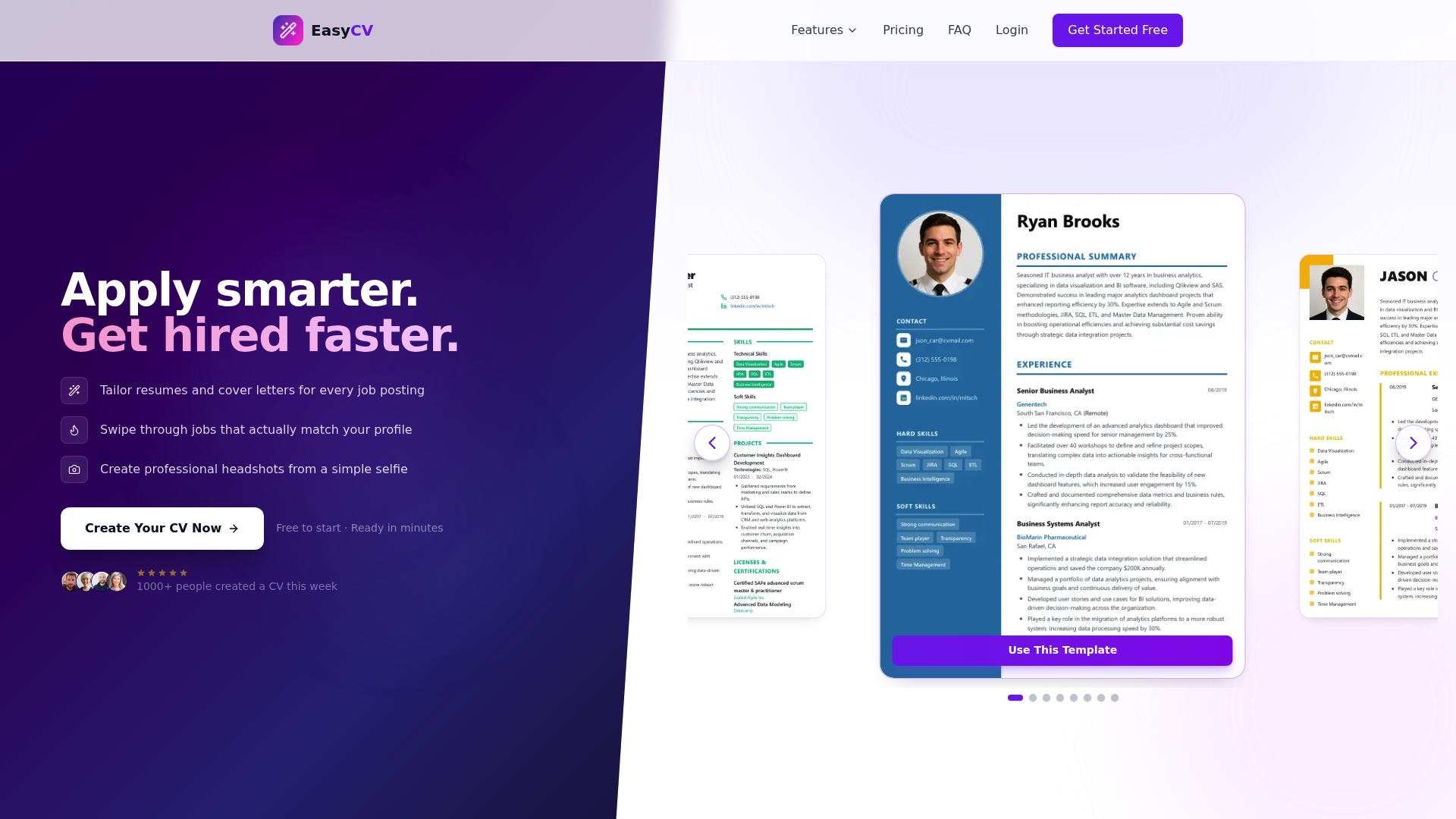
Explore the full range of Easy CV features to see how cover letter generation, job matching, and resume translation work together to support your entire job search. When you’re ready to create your first tailored resume, the Easy CV builder walks you through every step with AI assistance that keeps you in control. Your next interview starts with a resume that actually represents you.
Frequently asked questions
Is it safe to use an AI resume builder for job applications?
Yes, as long as you review and personalize AI-generated resumes before submitting. Best results come from human review of AI-written resumes rather than submitting AI-written text verbatim.
How do resume builders help experienced professionals?
Resume builders streamline ATS formatting and keyword targeting, letting experienced candidates focus on metrics and impact. Job seekers should use resume builders differently depending on experience level to get the most relevant results.
Can resume builders improve chances of getting hired?
Yes, when used to tailor resumes for each application and optimize for ATS requirements. Resume builders can materially speed iterative tailoring across multiple applications, which directly improves your odds.
Should I use AI resume templates for entry-level jobs?
AI templates make it easier for beginners to structure resumes effectively and present transferable skills professionally. AI assistance tends to be most helpful when you need structure and starting points, which is exactly the entry-level challenge.
Do I need to manually edit AI-generated resume content?
Yes, manual editing ensures your resume stands out and avoids generic language that recruiters recognize immediately. Best results come from human review of AI-written resumes, making your personal edits the most important step in the process.