What Is Resume Benchmarking? A 2026 Job Seeker Guide

Resume benchmarking is the process of systematically comparing your resume against job descriptions and peer standards to measure its effectiveness in both ATS systems and recruiter reviews. Think of it as a performance audit for your application. Instead of guessing why you’re not getting callbacks, you gather data, identify gaps, and fix them. Tools like Jobscan, Workday’s ATS, and AI platforms like Consiliari.ai have made this process accessible to any job seeker willing to treat their resume as something to be tested, not just written.
The core insight is this: resume benchmarking transforms subjective gut feelings into objective, measurable feedback. Most candidates submit dozens of applications with no idea where their resume falls short. Benchmarking tells you exactly what’s missing and gives you a repeatable method to improve.
What is resume benchmarking and why does it matter?
Resume benchmarking is defined as a structured evaluation method that scores your resume against specific job descriptions, peer resumes, and industry standards across three dimensions: keyword alignment, formatting compatibility, and readability. The industry also refers to this practice as resume assessment or resume performance measurement.

The importance of resume benchmarking comes down to one hard truth: most resumes never reach a human. Applicant Tracking Systems filter candidates before any recruiter sees their file. Benchmarking your resume against a job description gives you a baseline score, such as 35% or 85%, and shows you exactly which keywords, skills, and format elements are missing. That baseline is your starting point for improvement.
Without this process, you’re applying blind. With it, you have a feedback loop that turns each application into a learning opportunity.
How does the resume benchmarking process work?
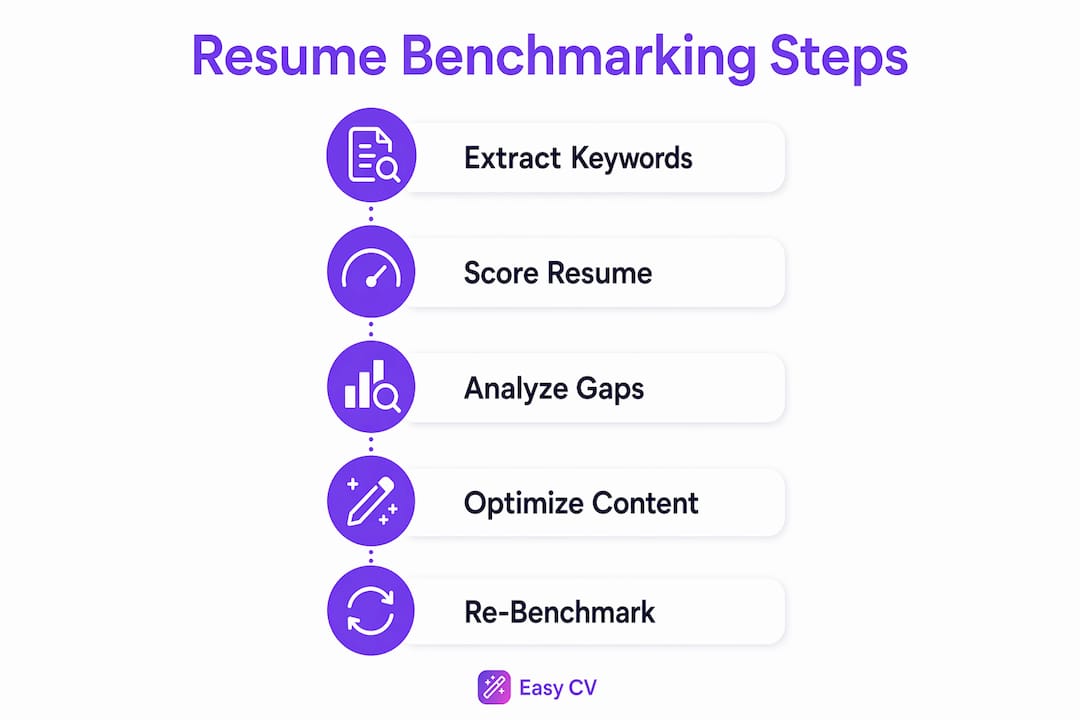
The resume benchmarking process follows a clear, repeatable workflow. Each step builds on the last, and skipping any one of them reduces the accuracy of your results.
-
Collect reference material. Gather 3–5 job postings for the role you’re targeting. Pull peer resumes from LinkedIn or professional communities when possible. These become your comparison baseline.
-
Extract keywords and competencies. Identify the hard skills, soft skills, job titles, certifications, and tools listed across your collected postings. Note which terms appear most frequently. Frequency signals priority.
-
Run a side-by-side comparison. Place your resume next to the job description. Use an ATS scoring tool or a structured checklist to flag missing keywords, weak formatting, and misaligned section headers. ATS benchmarking workflows typically include this mapping step as the core diagnostic phase.
-
Rewrite and retest. Revise your resume to address the gaps identified. Then rescore it. The goal is measurable improvement, not perfection on the first pass.
-
Repeat for each application. A resume optimized for a Product Manager role at a fintech company will not perform equally well for the same title at a healthcare startup. Tailoring is not optional.
Pro Tip: When extracting keywords, separate “required” from “preferred” qualifications in the job posting. Required terms carry more weight in ATS parsing and should appear in your resume with higher priority.
How do ATS scores and human readability affect your resume?
ATS scores and human readability are the two forces your resume must satisfy simultaneously. Optimizing for one while ignoring the other is a common and costly mistake.
Understanding ATS score benchmarks
ATS scores are proxy measures, not absolute verdicts. They approximate how well your resume matches a job description based on keyword presence, placement, and formatting. ATS scores depend on keyword type, section placement, and weighted scoring logic. Presence alone is not enough. A keyword buried in a skills list carries less weight than one in a job title or summary.
The numbers matter here. The median ATS score among submitted applications sits around 48 out of 100. Improving from 65 to 85 roughly doubles callback rates. Scores above 90, however, can actually hurt your chances because they often signal keyword stuffing, which recruiters recognize and penalize.
| ATS Score Range | Likely Outcome |
|---|---|
| Below 40 | Auto-filtered in most systems |
| 40–64 | Low callback probability |
| 65–85 | Strong callback range |
| Above 90 | Risk of appearing keyword-stuffed |
The human readability factor
A resume that passes ATS still needs to survive a recruiter’s first glance. Recruiters spend about 7.4 seconds scanning a resume before deciding whether to read further. That means your formatting, bullet clarity, and visual hierarchy do as much work as your keywords.
Flesch Reading Ease scores between 50–65 represent the optimal range for professional resume writing. This range signals clear, direct language without being overly simplified. You can check your score using tools like Hemingway Editor or the readability checker in Microsoft Word.
Key human readability factors to benchmark:
- Bullet point clarity: Each bullet should lead with a strong action verb and include a quantified result.
- Section header consistency: Use standard labels like “Experience,” “Education,” and “Skills” so both ATS and recruiters navigate your resume without friction.
- White space and font size: Dense text blocks reduce scan-ability. Aim for 10.5–12pt font and consistent margins.
- Sentence length: Short sentences score better on readability tools and are faster to process under time pressure.
Pro Tip: Run your resume through the Hemingway Editor before submitting. Aim for a Grade 8–10 reading level. Recruiters read fast, and clear writing signals clear thinking.
What resume comparison techniques go beyond keyword matching?
Surface-level keyword matching is the entry point for resume comparison, not the finish line. Effective resume comparison requires mapping both explicit requirements and the implied competencies that experienced hiring managers expect but rarely write down.
Here is what a deeper comparison looks like in practice:
-
Explicit vs. implied requirements. A job posting for a Senior Data Analyst might list Python and SQL as required skills. The implied expectation is that you can communicate findings to non-technical stakeholders. If your resume shows no evidence of cross-functional collaboration or presentation experience, you have a gap even if your technical keywords are perfect.
-
Proficiency and recency assessment. Listing a skill is not the same as demonstrating current competency. Manual self-assessments lose reliability quickly as criteria multiply. A structured approach asks: How recently did I use this skill? At what level? Does my resume reflect that honestly?
-
Peer resume benchmarking. Comparing your resume to those of professionals who hold the role you’re targeting reveals formatting norms, title conventions, and skill sets you may have overlooked. LinkedIn profiles of people in your target role serve as free benchmarking references.
-
AI-assisted gap analysis. AI tools can scan your resume and a job description simultaneously, flagging missing terms and suggesting rewrites. This is faster than manual comparison and catches patterns a human reviewer might miss on a first pass. For professionals in technical fields, resources like SaaS industry recruitment guides outline the specific competencies hiring managers prioritize in those sectors.
The risk of over-optimizing for ATS alone is real. Quantified achievements and clear formatting improve human reviewer perception even when ATS proxy scores are already adequate. A resume that reads like a keyword list will pass the algorithm and fail the recruiter.
How can you apply resume benchmarking to win more interviews?
Applying resume benchmarking to your job search is a four-step cycle you repeat for every significant role you target. The goal is not a perfect universal resume. The goal is a well-scored, well-read resume for each specific application.
-
Establish your baseline. Submit your current resume to an ATS scoring tool against a target job description. Record your score. This number tells you where you stand before any optimization. Without a baseline, applicants often submit resumes scoring under 40%, triggering automatic filtering with no understanding of why.
-
Identify and prioritize gaps. List every missing keyword, weak section, and readability issue the tool flags. Sort them by impact. Missing job-title keywords and required certifications rank higher than optional soft skills.
-
Rewrite with precision. Add missing keywords in context, not as a list. Rewrite bullet points to lead with action verbs and end with measurable results. Review resume keyword strategies to understand how placement affects ATS parsing. Apply CV formatting best practices to fix any layout issues that reduce scan-ability.
-
Rescore and validate. Run the revised resume through the same ATS tool. Confirm your score improved. Then read the resume aloud to check for natural language flow. If it sounds like a keyword dump, rewrite it.
Pro Tip: Create a master resume with all your experience, skills, and accomplishments. For each application, copy it and trim or tailor it to match that specific job description. This saves time and keeps your benchmarking process consistent.
Continuous benchmarking also builds a personal database of what works. Over time, you will notice which keywords appear across multiple roles, which formats score consistently well, and which industries require different language conventions. That pattern recognition is a real competitive advantage.
Key takeaways
Resume benchmarking works because it replaces guesswork with a measurable, repeatable process that improves both ATS scores and recruiter readability simultaneously.
| Point | Details |
|---|---|
| Define your baseline first | Score your current resume against a target job description before making any changes. |
| Target the 65–85 ATS score range | Scores in this range roughly double callback rates without triggering keyword-stuffing penalties. |
| Match explicit and implied skills | Map both listed requirements and the unstated competencies experienced recruiters expect. |
| Balance ATS and human factors | Recruiters spend about 7.4 seconds scanning a resume, so formatting and bullet clarity matter as much as keywords. |
| Benchmark every application | A tailored, rescored resume for each role consistently outperforms a single generic version. |
The uncomfortable truth about resume optimization in 2026
Most job seekers treat their resume as a document they write once and update occasionally. Benchmarking exposes how wrong that approach is, and I say that from watching hundreds of professionals go through this process.
The candidates who struggle most are not the ones with weak experience. They are the ones with strong experience and poor signal. Their resumes describe what they did without proving what they delivered. Benchmarking forces you to confront that gap directly, because the score does not lie.
What I have found genuinely useful is treating the ATS score as a floor, not a ceiling. Getting to 70 or 75 is necessary. Stopping there is not enough. The second layer of work, fixing readability, sharpening bullet points, and removing jargon, is where interviews actually come from. A recruiter who picks up your resume after it clears the ATS still needs a reason to call you. That reason lives in the quality of your writing, not your keyword count.
The other pitfall I see constantly is benchmarking once and calling it done. Job descriptions shift. Hiring priorities change. A resume that scored well six months ago may underperform today against the same role title at a different company. Treat benchmarking as a habit, not a one-time fix. The professionals who optimize their CV continuously are the ones who stay competitive across market cycles, not just during active job searches.
— Andras
How Easy-cv makes resume benchmarking faster and smarter
Resume benchmarking works best when the tools do the heavy lifting so you can focus on the writing.
Easy-cv builds the benchmarking workflow directly into its AI-powered resume builder. The platform analyzes your resume against job descriptions, flags missing keywords, and suggests rewrites that improve both ATS compatibility and readability. You get ATS-friendly templates, an AI writing assistant that generates strong bullet points, and a job tracker that keeps every tailored application organized. With access to over 10 million job listings per month and AI-tailored CVs for each role, Easy-cv removes the manual work from the benchmarking cycle. Explore the full feature set at Easy-cv features to see how it fits your job search.
FAQ
What is resume benchmarking in simple terms?
Resume benchmarking is the process of comparing your resume against a job description and peer standards to measure how well it performs with ATS systems and recruiters. It gives you a score-based starting point and a clear list of improvements to make.
What is a good ATS score for a resume?
A score between 65 and 85 is the target range. Scores in this band roughly double callback rates compared to the median of 48, while staying below the over-optimization threshold that can flag keyword stuffing.
How often should i benchmark my resume?
Benchmark your resume for every significant application, especially when targeting a new role, industry, or company type. A resume optimized for one job description will not perform equally well across different postings for the same title.
Do ATS scores guarantee interview callbacks?
No. ATS scores are proxy measures that approximate parsing compatibility. A high score gets your resume past the filter, but human readability, quantified achievements, and clear formatting determine whether a recruiter moves you forward.
What tools can i use to benchmark my resume?
Jobscan, Resume Optimizer Pro, and CVHive offer ATS scoring and keyword gap analysis. For readability, Hemingway Editor and the readability checker in Microsoft Word provide Flesch Reading Ease scores. Easy-cv combines AI-driven benchmarking with resume building in one platform.