Resume Mistakes to Avoid for Every Job Seeker
A resume mistake is any error that causes your application to be rejected before a recruiter reads it. Applicant Tracking Systems, known as ATS, now screen most corporate job applications automatically. Over 75% of resumes never reach a human reviewer because of formatting and keyword errors. That statistic means the majority of job seekers lose before the game even starts. The resume mistakes to avoid in 2026 fall into three clear categories: technical formatting failures, missing keyword tailoring, and weak content. Fix all three, and your chances of landing an interview rise sharply.
1. What are the top resume mistakes to avoid with ATS formatting?
ATS software reads your resume like a plain text document. Anything that disrupts that reading order causes parsing errors, and parsing errors cause automatic rejection.
Multi-column layouts, graphics, and tables scramble the reading order that ATS software follows. The system reads left to right, top to bottom, so a two-column layout often merges unrelated text into nonsense. Icons and decorative elements introduce unreadable characters that corrupt the parsed output entirely.

The numbers are stark. 78% of creative templates with graphics fail ATS parsing. A clean, single-column format maintains a 95% success rate. That gap is too large to ignore, especially when a simple formatting choice determines whether anyone reads your resume at all.
Common ATS formatting errors include:
- Multi-column layouts: Text merges incorrectly and loses context.
- Headers and footers: ATS often skips content placed in these zones entirely.
- Non-standard fonts: Stick to Arial, Calibri, or Georgia for reliable parsing.
- Tables within tables: Nested tables break parsing logic in most ATS platforms.
- Graphics and icons: These introduce unreadable characters that corrupt parsed text.
- Text boxes: Content inside text boxes is frequently invisible to ATS scanners.
Pro Tip: Use ATS-friendly formatting with standard section headers like “Work Experience,” “Education,” and “Skills.” Avoid creative labels like “My Story” or “Where I’ve Been,” which ATS software cannot categorize.
2. Why keyword tailoring is a non-negotiable resume strategy
A generic resume sent to 50 jobs is less effective than one tailored resume sent to five. ATS systems score resumes by matching your text against the job description. If your resume lacks the exact phrases the employer used, your score drops below the threshold and the application is filtered out.
Exact keyword matching from the job description is necessary to pass ATS scans. This means copying the precise job title, skill names, and tool names the employer listed. If the job description says “project management” and your resume says “project coordination,” the ATS may not count them as a match.
The most effective place to find keywords is the “Requirements” and “Responsibilities” sections of the job posting. Pull the exact phrases from those sections and mirror them in your resume where they honestly apply. Do not stuff keywords into sections where they do not fit. ATS systems are sophisticated enough to flag keyword density anomalies, and recruiters will notice the mismatch when they read your resume.
Key keyword tailoring tactics:
- Mirror job titles exactly: If the posting says “Senior Data Analyst,” use that phrase, not “Data Analytics Specialist.”
- List tools by name: Specific software like Salesforce, Tableau, or Python should appear verbatim.
- Include both acronyms and full terms: Write “Search Engine Optimization (SEO)” to cover both variations.
- Update your skills section per application: A static skills list rarely matches every job description perfectly.
Pro Tip: Paste the job description into a word frequency tool to identify the most repeated terms. Those are the keywords the employer values most. Learn more about resume keyword strategy to apply this method systematically.
3. How to write content that shows results, not just responsibilities
Recruiters spend an average of seconds, not minutes, scanning a resume. Bullet points that describe duties tell them what you were supposed to do. Bullet points that show results tell them what you actually delivered. The second type wins every time.
Vague job duty descriptions reduce recruiter interest. Replace phrases like “responsible for managing a team” with “managed a team of eight engineers and delivered three product releases on schedule.” The second version gives the recruiter a concrete picture of your impact.
Buzzwords are another content trap. Words like “results-oriented,” “team player,” and “dynamic professional” appear on so many resumes that recruiters filter them out mentally. Every adjective on your resume should point to a specific fact. If you cannot back it up with a number or an outcome, cut it.
Grammar and verb tense consistency matter more than most job seekers realize. Typos and inconsistent verb tenses immediately reduce your credibility with recruiters. Use past tense for every previous role and present tense for your current position. Mixing tenses signals carelessness, which is the last impression you want to leave.
- Before: “Responsible for social media accounts.”
- After: “Grew Instagram following from 4,000 to 22,000 in 12 months through weekly content planning.”
Pro Tip: Read each bullet point and ask: “So what?” If you cannot answer that question with a number or a business outcome, rewrite the bullet. For niche fields like marketing, social media manager resume examples show how to frame digital results effectively.
4. Resume length and format: what actually works
Resume length is one of the most debated topics in job searching, and the answer is simpler than most guides suggest. Recruiting standards recommend one page for candidates with zero to five years of experience and two pages for those with five to ten or more years. The read-through rate drops by 30% for every additional page beyond those recommendations. That drop is significant enough to cost you interviews.
| Experience level | Recommended length |
|---|---|
| 0–5 years | One page |
| 5–10+ years | Two pages |
| Executive or academic | Two to three pages |
Formatting choices beyond length also affect how long a recruiter stays on your resume. White space is not wasted space. Margins between 0.5 and 1 inch, consistent font sizes between 10 and 12 points, and clear section dividers all reduce visual fatigue. A resume that is easy to scan gets read longer than one that looks dense.
Pro Tip: Save your resume as a PDF unless the job posting specifically requests a Word document. PDFs preserve your formatting across all devices and operating systems, so what you see is what the recruiter sees.
5. Other common resume errors that quietly kill applications
Some resume blunders have nothing to do with formatting or keywords. They are small details that signal unprofessionalism or create unnecessary friction for the recruiter.
Including references, photos, and personal information like salary requirements can disqualify applicants before a conversation starts. References belong on a separate document, shared only when requested. Photos introduce unconscious bias and are not standard practice in American hiring. Salary requirements shared too early can eliminate you from consideration before you have had a chance to negotiate.
Your email address carries more weight than you might expect. An address like “partyguy1998@gmail.com” signals immaturity. Create a professional address using your first and last name. Check that your phone number and LinkedIn URL are current and correct. A recruiter who cannot reach you because of a typo in your contact information will not try twice.
Inconsistency between your resume and LinkedIn profile is a growing red flag among recruiters at major tech firms. If your resume says you were a “Marketing Director” from 2020 to 2023 but your LinkedIn says “Marketing Manager,” a recruiter will notice. Align your dates, titles, and achievements across both platforms before you apply.
Additional errors to eliminate:
- Objective statements: Replace with a two-to-three sentence professional summary focused on what you offer.
- Outdated skills: Remove software or tools you no longer use and would not want to be tested on.
- Irrelevant work history: Trim jobs from more than 15 years ago unless they are directly relevant.
- Unprofessional formatting choices: Avoid colored paper backgrounds, decorative borders, or novelty fonts.
Key Takeaways
Avoiding the most damaging resume errors requires fixing ATS formatting first, then tailoring keywords, then sharpening content quality.
| Point | Details |
|---|---|
| ATS formatting is the first filter | Use a single-column layout and standard section headers to pass automated screening. |
| Keyword tailoring determines ATS score | Mirror exact phrases from the job description’s Requirements and Responsibilities sections. |
| Results beat responsibilities | Replace duty-based bullet points with measurable achievements and specific outcomes. |
| Length affects read-through rates | One page for under five years of experience; two pages for more, per recruiting standards. |
| Small details signal professionalism | Keep contact info current, remove photos and references, and align your LinkedIn profile. |
The resume advice nobody talks about enough
After reviewing hundreds of resumes across different industries and experience levels, I keep seeing the same pattern. Job seekers spend hours perfecting the design of their resume and almost no time on the substance. A beautifully formatted resume with weak bullet points will still lose to a plain resume with strong, specific achievements.
The second thing I see constantly is the “spray and pray” approach. Sending the same resume to 40 jobs feels productive. It rarely is. Tailoring each resume to the specific job description takes more time upfront, but it dramatically improves your response rate. One tailored application beats ten generic ones.
ATS optimization is not optional anymore. It is the baseline. If your resume cannot pass an automated scan, no amount of experience or skill will save it. Start there, fix the formatting, add the right keywords, then focus on making the content genuinely compelling. That sequence matters. Most job seekers do it in reverse, and they wonder why they are not getting callbacks.
The most underrated resume tip I can give you is this: read your resume out loud. If a sentence sounds awkward when spoken, it reads awkwardly too. Your resume should sound like a confident professional describing their work, not a legal document listing obligations.
— Andras
Your next step toward a stronger resume
Fixing every resume error manually takes time most job seekers do not have. Easy-cv brings the entire process into one place, from ATS-friendly templates to an AI writing assistant that generates strong, specific bullet points based on your experience.
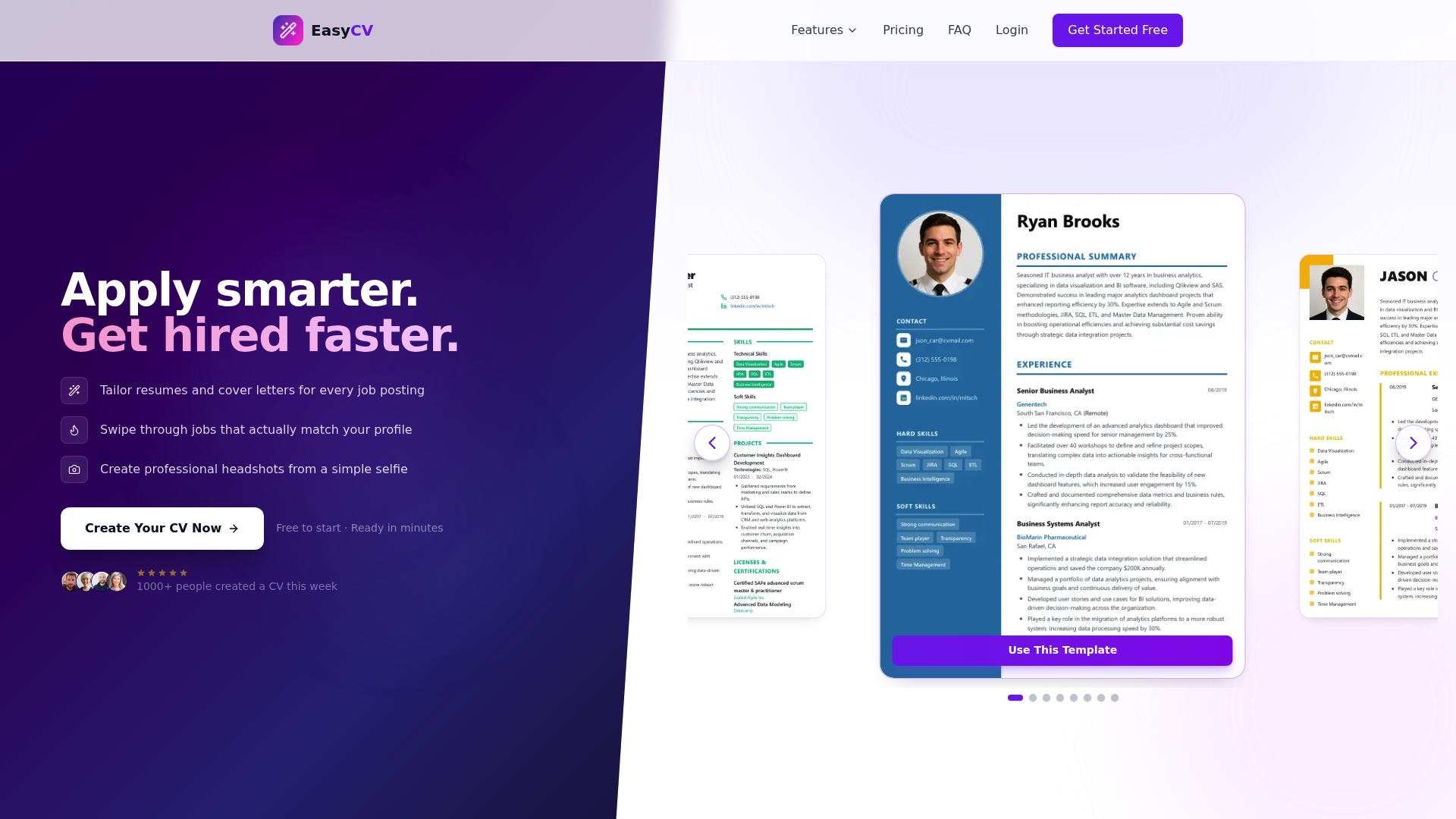
Easy-cv’s AI resume builder checks your formatting for ATS compatibility, suggests keywords pulled from real job descriptions, and helps you tailor each application without starting from scratch. The platform also includes a built-in job tracker and access to over 10 million job listings per month. Whether you are a recent graduate writing your first resume or a career changer repositioning your experience, Easy-cv gives you the tools to apply with confidence. Explore the full feature set to see what fits your job search.
FAQ
What is the number one resume mistake job seekers make?
Failing to optimize for ATS is the most damaging error, causing over 75% of resumes to never reach a human reviewer. A clean, single-column format with standard section headers fixes this immediately.
How long should a resume be in 2026?
One page for candidates with zero to five years of experience and two pages for those with five or more years. Read-through rates drop by 30% for every page beyond the recommended length.
Should I include a photo on my resume?
No. Photos are not standard practice in American hiring and can introduce unconscious bias into the screening process. Leave the photo off and use that space for a strong professional summary instead.
How do I tailor my resume to a job description?
Copy the exact job title, skill names, and tool names from the posting’s Requirements and Responsibilities sections and mirror them in your resume where they honestly apply. This exact phrase matching is what ATS systems score against.
Does my LinkedIn profile need to match my resume?
Yes. Inconsistencies between your resume and LinkedIn profile, such as different job titles or dates, are immediate red flags for recruiters. Align both before you start applying.