Why Custom CV Versions Matter for Job Seekers
Custom CV versions are defined as role-specific resumes that highlight the qualifications most relevant to each individual job application. A single generic resume fails most job seekers because applicant tracking systems (ATS) filter out resumes that don’t closely match job descriptions. Tailored resumes improve ATS scores by 15–25 percentage points compared to lightly tailored ones, lifting scores from as low as 45% to over 80%. That gap is the difference between getting an interview and never hearing back. Understanding why custom CV versions matter is the first step toward building a job search that actually works.
Why custom CV versions matter for ATS and recruiters
Targeted resume versions achieve 3.4x higher ATS match scores than generic resumes submitted to the same positions. That number reflects a fundamental truth: ATS software scores your resume against the exact language in the job posting, and generic resumes rarely mirror that language closely enough to rank well.
Recruiters compound the problem. Recruiters scan resumes for only 6–7 seconds before deciding whether to read further. A resume that buries the most relevant experience halfway down the page loses that window immediately. A tailored version puts the right qualifications front and center, matching both the ATS algorithm and the recruiter’s eye.

The difference between light tailoring and full tailoring is measurable. Light tailoring of key sections takes about 5 minutes and improves ATS scores by 15–25 percentage points. Full tailoring, which aligns every section to the job description, takes 20–30 minutes but significantly boosts recruiter attention and interview rates. The right level depends on how competitive the role is and how different it is from your baseline version.
The benefits of tailored resumes go beyond keyword matching. Tailoring reduces recruiter cognitive load by presenting a clear, role-specific narrative instead of a sprawling career history. Recruiters recognize this as a professionalism marker, not a trick.
Key reasons tailored versions outperform generic ones:
- ATS systems score keyword density and section alignment against the job description
- Recruiters respond faster to resumes where relevant experience appears immediately
- Role-specific summaries signal genuine interest and preparation
- Reordered achievements show the employer exactly what they need to see first
How many CV versions should you maintain?
Experts recommend maintaining 3–5 core resume variants aligned to specific roles or industries. This range balances effectiveness with manageability. Fewer than three versions forces you to submit resumes that don’t fit well. More than five creates a maintenance burden that leads to outdated or inconsistent content.
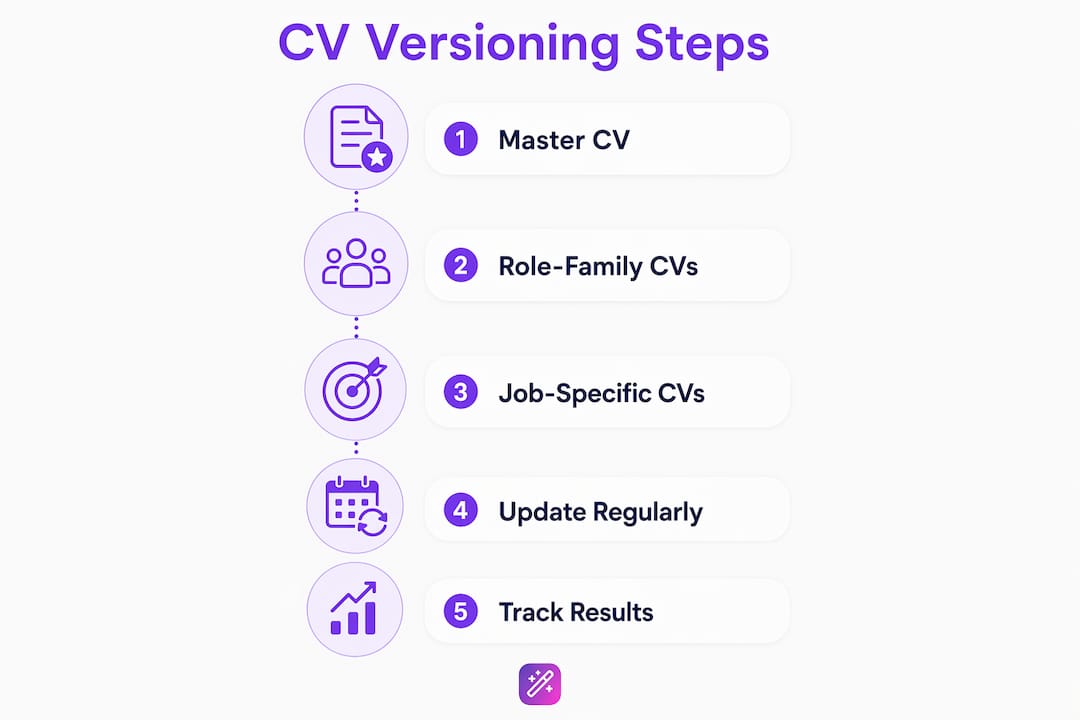
The distinction between role-family versions and job-specific tailoring matters here. A role-family version is built for a broad category, such as marketing manager roles, product roles, or operations roles. A job-specific version is a final customization of that role-family version for one particular application. You need both layers.
Here is the recommended version structure:
- Master CV. A comprehensive 4–6 page document containing every achievement, role, skill, and credential you have. This is your source of truth, never submitted directly.
- Role-family CVs. Two-page versions drawn from the Master CV, each aligned to a specific role category. Maintain 3–5 of these.
- Job CVs. Final versions customized from a role-family CV for a specific application. These include company-specific language and reordered bullets.
Maintaining three pre-built role-family variants reduces friction during applications and increases callback rates by 41% relative to using a single resume. Pre-built variants minimize the tailoring needed per application, which means you apply faster and more consistently.
The trap most job seekers fall into is maintaining either one master resume they submit everywhere or dozens of slightly different files with no clear system. Both approaches fail. One version can’t fit every role well. Too many versions without a clear hierarchy creates confusion and errors.
Best practices for managing multiple CV versions
The most reliable system separates your CV work into three distinct layers: the Master CV, role-family CVs, and job-specific CVs. A resume stack strategy prevents inconsistent data drift by letting you update facts once in the Master CV and generate tailored exports from there. This means a promotion, a new certification, or a corrected date only needs to be entered once.
File naming conventions that prevent errors
A clear naming convention is non-negotiable when managing multiple versions. A file naming format like lastname-firstname-role-company-v3.pdf prevents accidental submissions and aids ATS indexing. Avoid dates in filenames. Dates create confusion when you update a version and don’t signal anything useful to a recruiter or ATS system.
Tracking changes across versions
Proactively tracking changes to each CV variant reveals which versions convert better to interviews. A simple private log, even a spreadsheet with columns for version name, date updated, changes made, and application outcomes, gives you data to improve over time. Most job seekers never do this, which means they repeat mistakes across dozens of applications.
Pro Tip: Set aside 15 minutes every week to review your active role-family CVs. Update any section that no longer reflects your most recent work, and check that your skills sections still match the language appearing in current job postings for your target roles.
What to track in your version log
| Column | Purpose |
|---|---|
| Version name | Identifies which role-family or job CV this row covers |
| Last updated | Flags versions that may be stale |
| Key changes | Notes what was added, removed, or reordered |
| Applications sent | Counts how many times this version was submitted |
| Interview rate | Tracks conversion to measure version effectiveness |
Experienced professionals should build their Master CV as a comprehensive source of truth, typically 4–6 pages, and draw two-page role-specific versions from it. This prevents content loss and keeps all variants consistent.
Common mistakes when tailoring CV content
Tailoring does not mean rewriting your entire CV for every application. Tailoring means modifying your summary, reordering achievements, and refining skills sections to align your vocabulary with the job description. The goal is to speak the employer’s language, not to fabricate a different career history.
The most common mistakes job seekers make when tailoring:
- Including every achievement in every version. Score your bullet points for relevance: High, Medium, or Low. Include only High and Medium items in each role-specific version.
- Keyword stuffing. Packing a resume with keywords from the job description without integrating them naturally reads as spam to both ATS systems and recruiters.
- Rewriting from scratch each time. This wastes time and introduces inconsistencies. Draw from your Master CV instead.
- Ignoring the job summary section. The summary is the first thing a recruiter reads. A generic summary kills relevance before the recruiter reaches your experience.
- Forgetting to update the skills section. Skills sections are heavily weighted by ATS. Match the exact terminology used in the job posting.
Pro Tip: Use the AccomplishMint features to surface your most relevant achievements for each posting. Structured achievement tracking makes it far faster to identify which bullet points belong in each role-specific version.
Tailoring is about framing, not fabricating. Every claim in your tailored CV must be true. What changes is which true things you emphasize and in what order. A marketing manager applying for a brand strategy role leads with brand work. The same person applying for a demand generation role leads with pipeline and campaign data. Same career, different frame.
The importance of custom CVs also shows up in cover letters. A tailored CV paired with a generic cover letter sends a mixed signal. Both documents should reflect the same role-specific framing.
Key Takeaways
Tailored CV versions consistently outperform generic resumes because they match ATS keyword requirements and present the most relevant experience immediately to recruiters.
| Point | Details |
|---|---|
| ATS match scores | Tailored resumes score 3.4x higher in ATS matching than generic versions submitted to the same roles. |
| Recruiter scan window | Recruiters decide in 6–7 seconds, so relevant experience must appear at the top of every version. |
| Optimal version count | Maintain 3–5 role-family CV variants as your core set, plus job-specific versions for each application. |
| Master CV as source of truth | Build a comprehensive 4–6 page Master CV and draw all tailored versions from it to prevent inconsistencies. |
| Version tracking pays off | Logging changes and interview rates per version reveals which approaches convert best over time. |
What I’ve learned from watching job seekers ignore this
Most job seekers I’ve observed treat CV tailoring as optional, something to do when they have extra time. That mindset costs them interviews they would otherwise get. The data is not ambiguous: a 3.4x improvement in ATS match scores is not a marginal gain. It’s the difference between being seen and being filtered out before a human ever reads your name.
What surprises me most is how little time proper tailoring actually takes once you have a system. Job seekers who build a solid Master CV and two or three role-family versions can tailor a final job CV in under 10 minutes. The upfront investment is a few hours. The return is a dramatically higher response rate across every application they send after that.
The shift from one-size-fits-all to a multi-version CV approach is not a trend. It’s a response to how hiring actually works in 2026. ATS systems are more sophisticated, recruiter time is more constrained, and competition for good roles is higher. A generic resume is not a neutral choice. It’s a disadvantage.
The job seekers who get this right treat their CV library the way a good writer treats a draft folder: organized, current, and built for a specific purpose. Discipline in version management is what separates people who apply constantly with no results from people who apply selectively and hear back consistently.
— Andras
Easy-cv makes CV versioning fast and practical
Building and managing multiple CV versions used to mean hours of manual work. Easy-cv changes that by bringing the entire process into one place, from creating your Master CV to generating tailored versions for specific roles.
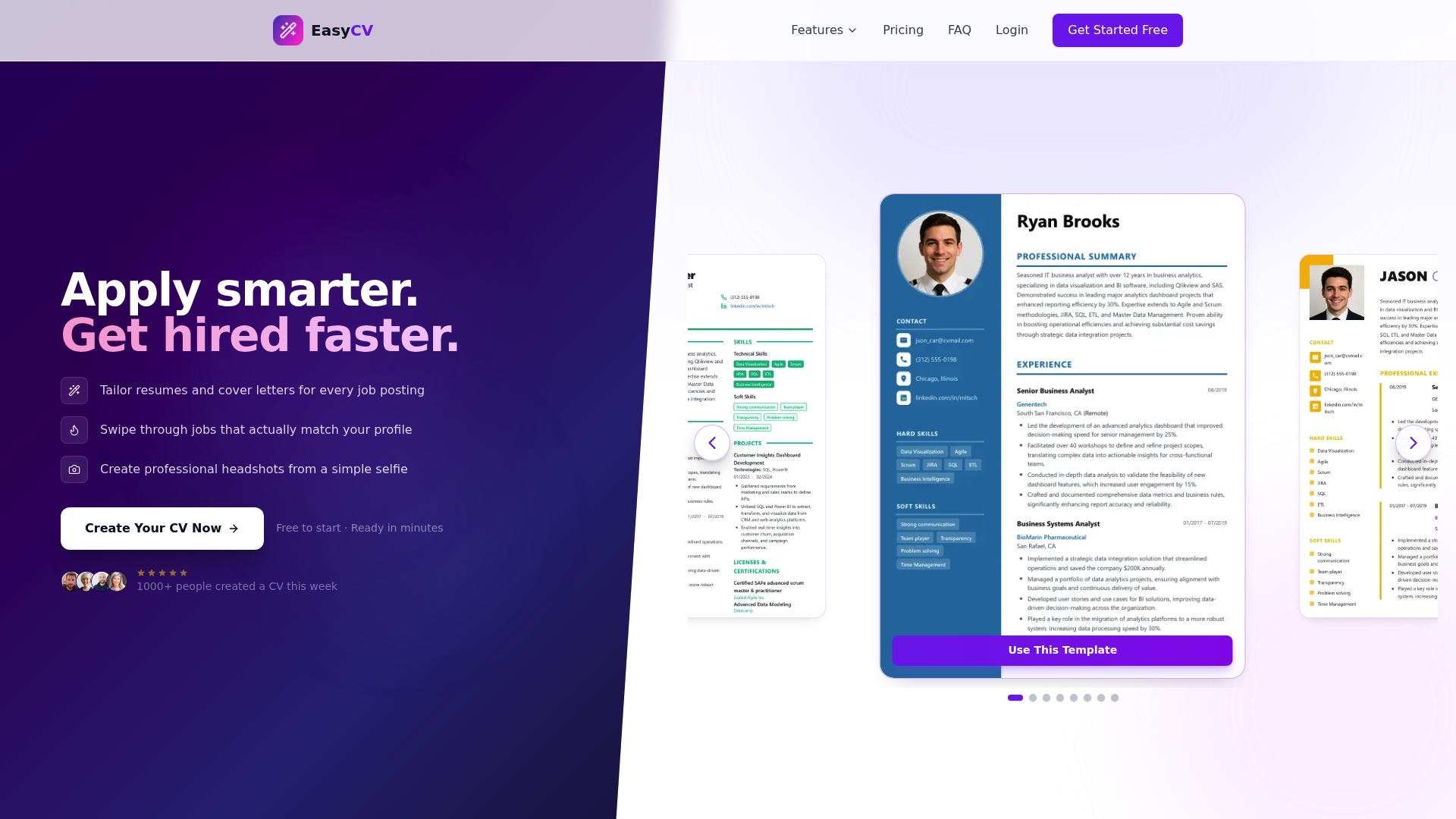
Easy-cv’s AI CV builder generates and refines professional CV content, matches your application to job descriptions, and produces ATS-friendly versions across 30+ languages. The built-in job tracker keeps every version linked to the right application so nothing gets mixed up. Whether you’re a student building your first CV or a professional managing five role-family variants, Easy-cv’s free and premium plans give you the tools to apply with confidence. Start with Easy-cv’s full feature set and see how fast a disciplined CV system comes together.
FAQ
What is CV versioning?
CV versioning is the practice of maintaining multiple tailored versions of your resume, each aligned to a specific role family or job application. The standard system includes a Master CV, role-family CVs, and job-specific CVs.
How many CV versions should I have?
Experts recommend 3–5 core role-family versions as your baseline. You then create job-specific versions from those for individual applications, keeping your total active files manageable.
Does tailoring a CV really improve interview rates?
Tailored resumes achieve 3.4x higher ATS match scores than generic versions, and maintaining three pre-built role-family variants increases callback rates by 41% compared to using a single resume.
How long does it take to tailor a CV for each job?
Light tailoring of key sections takes about 5 minutes. Full tailoring, which aligns every section to the job description, takes 20–30 minutes. Having a strong role-family version as your starting point keeps this time closer to 5–10 minutes per application.
What is the difference between a Master CV and a role-family CV?
A Master CV is a comprehensive 4–6 page document containing your complete career history and every achievement. A role-family CV is a two-page version drawn from the Master CV, filtered and framed for a specific category of roles.