What Is CV Customization and Why It Matters

Most job seekers send the same CV to every application and wonder why they never hear back. CV customization is the practice of deliberately reframing your professional experience to align with a specific job description, its language, its priorities, and its keywords. It is not fabrication. It is strategic emphasis. And it matters more than most people realize because ATS software filters 70 to 80% of applications before a human ever reads them. This guide breaks down exactly what CV customization involves, where people go wrong, and how to do it right.
Table of Contents
- Key Takeaways
- What CV customization actually means
- Misconceptions and pitfalls to avoid
- How to customize your CV step by step
- CV format and its impact on customization
- Multiple CV versions and cover letters
- My honest take on CV customization
- Make CV customization faster with Easy-cv
- FAQ
Key Takeaways
| Point | Details |
|---|---|
| CV customization is reframing, not fabrication | You are strategically emphasizing real experience using the employer’s own language. |
| ATS filters most applications first | Matching job description keywords exactly is what gets your CV in front of a human recruiter. |
| Subtraction matters as much as addition | Removing irrelevant experience is just as important as adding the right keywords. |
| Build a master CV first | A comprehensive master document makes tailoring each application faster and more consistent. |
| Cover letters must match your CV | A tailored CV paired with a generic cover letter signals disconnected, low-effort applications. |
What CV customization actually means
CV customization means deliberately reframing your professional experience to fit specific job descriptions for both ATS and recruiter appeal. That word “reframing” is doing a lot of work here, and it deserves unpacking.

Think about a project manager applying to two different companies. One job posting emphasizes “cross-functional team leadership.” The other focuses on “stakeholder communication and risk mitigation.” The candidate’s actual experience is identical for both applications. What changes is which parts of that experience get spotlighted, how they are described, and which keywords appear in the text. That is CV customization in practice.
The core components worth understanding include:
- Reordering bullet points so the most relevant responsibilities appear first within each role, not the oldest or most impressive in a generic sense
- Using industry-specific synonyms that mirror the job description’s exact language, since an ATS treating “people management” and “team leadership” as separate terms will miss one of them
- Quantifying achievements with concrete metrics to demonstrate actual impact, not just activity
- Adding or removing optional sections based on what each role values, such as a certifications section for technical roles or a publications section for academic positions
- Matching ATS keywords exactly, including abbreviations and acronyms as they appear in the posting
Pro Tip: Copy the job description into a free word cloud tool. The largest words are almost always the must-have keywords. Cross-reference them against your current CV before you apply.
Worth noting is what CV customization is not. It is not the same as writing a completely new CV from scratch for every job. And it is not the same as lying. Tailoring your CV is an exercise in reframing, not fabrication. You are selecting from your real experience and presenting it in the language the employer already uses.
Misconceptions and pitfalls to avoid
CV customization sounds straightforward until you see how many ways candidates get it wrong. Here are the most damaging mistakes, ranked roughly by how often they appear.
- Thinking customization means exaggerating. Adding responsibilities you did not have or inflating your seniority is not customization. It is misrepresentation, and it falls apart in interviews. Customization means presenting what is true more persuasively.
- Keyword stuffing. Packing a CV with job description phrases until it reads like a word salad hurts you in two ways. Human readers recognize it immediately, and modern ATS tools are increasingly capable of detecting hollow keyword usage that lacks supporting context.
- Only adding, never subtracting. Reducing less relevant early career details prioritizes space for recent, role-related achievements. Most candidates add keywords and stop there. The editing pass, where you cut roles, bullet points, and whole sections that do not support this specific application, is equally critical.
- Writing the personal statement first. Many candidates write their summary at the top before they have customized the body. The result is a generic paragraph that conflicts with the tailored content below it.
- Leaving a misaligned personal statement. A personal statement that describes you as a “sales-focused business development professional” when you are applying for a client success role creates cognitive dissonance for the recruiter. It signals a copy-paste application.
“Most candidates add keywords to customize CVs, but subtracting irrelevant information is equally vital for clarity and impact.” This idea consistently separates the candidates who get callbacks from those who do not.
A poorly matched generic CV does not just fail to impress. It actively signals low effort to a recruiter who reviews hundreds of applications per week. The opportunity cost is real.
How to customize your CV step by step
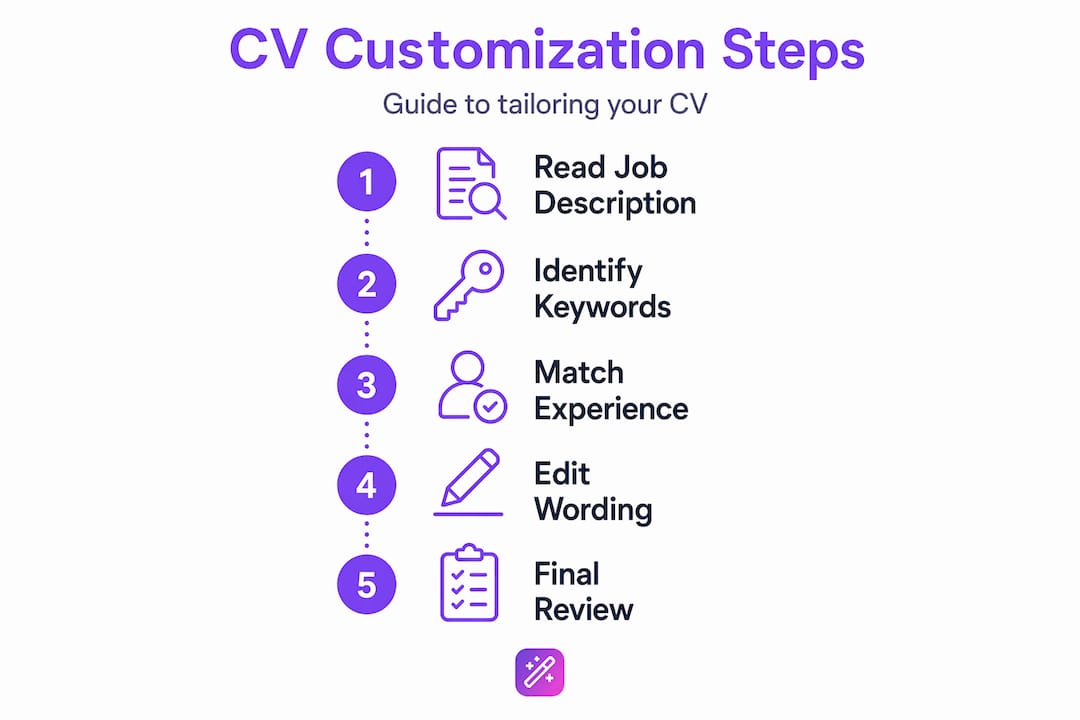
This is where theory becomes practice. Follow these steps in order for each application.
-
Decode the job description. Read it twice. On the first pass, highlight every specific skill, tool, and qualification listed. On the second pass, note the language patterns: does the company say “clients” or “customers”? “Revenue targets” or “sales goals”? These distinctions matter for ATS matching.
-
Pull from your master CV. Before you tailor anything, you need a master document that contains every role, every bullet point, every skill, and every achievement you have ever documented. Think of it as a personal catalog you never send to anyone. Each customized application draws selectively from this master file.
-
Rewrite your bullets with structure. Tailored CV bullets are structured as action verb plus context plus measurable result. “Led” is not enough. “Led a 6-person product team through a platform migration that reduced customer churn by 18% in Q3” gives the recruiter an action, a scope, and a result they can picture. Generic role descriptions get skipped.
-
Trim what does not belong. Once you have added the relevant material, go back through every bullet point and ask: does this support my case for this specific role? If the answer is no, cut it or condense it. This discipline is what keeps your CV focused and readable.
-
Customize the skills section. Match skills to the posting’s language. If the job asks for “Google Analytics” and your master CV says “web analytics tools,” update it. Exact matches matter for ATS compatibility.
-
Write the personal statement last. Writing your personal statement last yields a more precise and tailored summary that reflects your full CV content. Aim for 3 to 5 sentences that connect your identity directly to this role’s core requirements. Keep it between 50 and 150 words.
Pro Tip: After completing a customized version, paste the job description and your CV into a CV-to-job matching tool and check your keyword match score before submitting.
AI tools can handle mechanical tasks like keyword matching and initial bullet rewriting, but strategic judgment is essential for tone, inclusion decisions, and ensuring the final document still sounds like you. Automate what you can. Think critically about the rest.
CV format and its impact on customization
How you structure your CV affects how well your customization actually comes through. Three formats dominate the market.
| Format | Best for | ATS compatibility | Key limitation |
|---|---|---|---|
| Chronological | Consistent career progression | High | Highlights gaps or frequent changes |
| Functional | Skills-first presentation | Low to medium | ATS often misreads skill-focused layouts |
| Hybrid | Career changers, gap management, early career | High | Requires more planning to balance sections |
The hybrid CV format combines a skills section upfront with a reverse-chronological work history, which helps when you are emphasizing transferable skills from a different industry. It also gives ATS systems the chronological structure they expect while letting you lead with relevance.
A clean, single-column layout with standard fonts and no graphics will outperform a visually elaborate design every time for ATS parsing. Content drives callbacks, not design flourishes. If you are applying to a creative role and want to show design sensibility, keep a separate portfolio link and keep the CV itself clean. You can find modern ATS-friendly templates that accomplish both goals without sacrificing parseability.
Multiple CV versions and cover letters
One tailored CV is better than a generic one. But the real advantage comes from maintaining a small library of targeted versions aimed at different roles or industries you are actively pursuing.
Here is what a well-organized approach looks like:
- A core version for your primary target role with full customization for that job family
- A secondary version for adjacent roles that draws on transferable experience
- A cover letter written specifically for each application that explains why you want this role, not just that you are qualified
That last point is critical. A tailored CV paired with a generic cover letter is a missed opportunity. The cover letter’s job is to explain your motivation and context. The CV’s job is to prove your qualifications. Both documents should tell a consistent story. When they do not, recruiters notice the mismatch.
Maintaining multiple tailored CV versions takes more upfront effort but pays off in dramatically higher response rates over the course of a search.
My honest take on CV customization
I have worked with hundreds of job seekers over the years, and the pattern is always the same. People dramatically underestimate the effort that real customization requires, and then dramatically underestimate the return.
Most candidates spend an hour writing a CV and then fire it at 50 jobs. I have seen candidates spend three hours customizing two applications and land interviews from both. The math is not hard.
What I have learned, though, is that customization changes more than your callback rate. It changes your mindset. When you sit down and actually decode a job description, match your language to theirs, and cut the parts that do not belong, you move from passive applicant to someone who genuinely understands what the employer wants. That clarity shows in interviews, too.
The part most advice glosses over is the honesty piece. I have seen candidates try to game ATS systems with invisible keywords, white font tricks, and skill padding. It occasionally gets past the filter. Then it falls apart the moment a recruiter asks a follow-up question. The best version of CV customization is using employer language to tell your own real story more clearly. That approach holds up under scrutiny because it is true.
Managing industry transitions requires even more deliberate work. When I have helped professionals move from, say, operations management into consulting, the key is leading each bullet with transferable skills rather than leading with the industry context. The reader needs to see the skill before they get skeptical about the sector.
— Andras
Make CV customization faster with Easy-cv
Customizing every application manually is time-consuming work. Easy-cv exists to cut that time without cutting corners. The platform’s AI writing assistant analyzes job descriptions and helps you rewrite and align your CV content to match what each employer is actually looking for. You keep full editorial control. The AI handles the mechanical heavy lifting.
Every template in the Easy-cv builder is designed for ATS compatibility, so your carefully customized content actually gets read. You can manage multiple CV versions, generate matched cover letters, and track all your applications in one place. Whether you are targeting one industry or actively exploring a few directions at once, Easy-cv keeps your search organized and your applications sharp. Explore Easy-cv’s full features and see how much time you can reclaim per application.
FAQ
What is CV customization?
CV customization is the process of deliberately adjusting your CV’s language, structure, and content to align with a specific job description. It increases ATS compatibility and recruiter relevance by mirroring exact job posting language without fabricating experience.
How is customization different from lying on your CV?
Customization means reframing real experience using the employer’s language and emphasizing the most relevant accomplishments. It does not involve adding responsibilities you did not have or overstating your seniority.
How many versions of my CV should I maintain?
Most active job seekers benefit from two to three targeted versions covering their primary and adjacent target roles, plus individual cover letters for each application to maintain consistency across their materials.
Does CV format affect how well customization works?
Yes. A clean, ATS-friendly format like chronological or hybrid ensures your customized keywords are parsed correctly. Overly designed CVs with graphics or tables often confuse ATS systems and lose the keyword matches you worked to include.
Should the personal statement be customized too?
Absolutely. A concise personal statement of 50 to 150 words that directly connects your profile to the target role improves both recruiter engagement and ATS keyword matching. Write it last, after the body of your CV is fully tailored.