How to Tailor Your Resume to a Job Description
Resume tailoring is the practice of customizing your resume to directly match the language, skills, and priorities of a specific job description. Generic resumes score below 60% on Applicant Tracking Systems (ATS), while tailored ones consistently hit 80% or higher. That gap is the difference between getting screened out before a human ever reads your application and landing an interview. Tools like Easy-cv and ATSAlign now make this process faster than ever, but the strategy behind it still requires your judgment.
What does a job description actually tell you?
A job description is a ranked list of what the employer values most. The skills and requirements that appear first, or repeat multiple times, are the non-negotiables. Everything else is a preference.

Start by reading the entire posting twice. On the first pass, absorb the overall role. On the second, mark every repeated word, required tool, and specific qualification. Pay close attention to the job title itself. If the posting says “Senior Data Analyst” and your resume says “Data Specialist,” an ATS may not connect the two.
Here is what to extract from any job description:
- Required skills and tools: Software names, programming languages, platforms (e.g., Salesforce, Python, Google Analytics)
- Repeated keywords: Any term that appears more than once is a signal of priority
- Qualifications: Degree requirements, certifications, years of experience
- Soft skills with specific language: “Cross-functional collaboration” is not the same as “teamwork” in an ATS
- Company values and culture language: Phrases like “data-driven culture” or “fast-paced environment” tell you how to frame your experience
Exact wording from job descriptions should be mirrored in your resume. ATS systems do not reward synonyms. If the job says “project management” and you write “project coordination,” you may lose the match entirely.
Pro Tip: Copy the job description into a free word cloud tool. The largest words are your highest-priority keywords. Build your tailoring list from those.
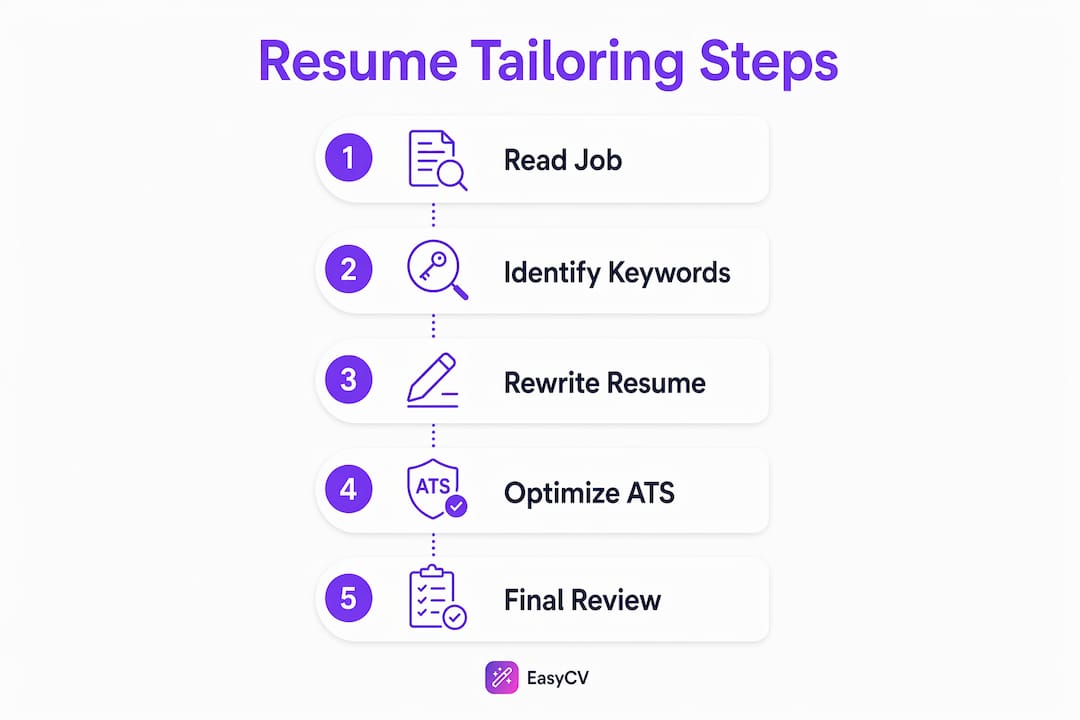
One mistake to avoid: do not copy phrases verbatim in large blocks. Pasting entire sentences from the job description reads as lazy to any recruiter who sees your resume after the ATS passes it. Use the employer’s vocabulary, but write your own sentences.
Company culture language is worth a separate look. If a company’s job posting uses phrases like “ownership mentality” or “customer-first thinking,” those are not accidents. Incorporating company values into your wording signals cultural fit beyond just technical qualifications.
How to rewrite your summary, skills, and experience sections
Tailoring a resume means updating three specific sections: your summary, your skills list, and your experience bullets. Each one plays a different role in passing ATS filters and convincing a recruiter.
-
Rewrite your summary first. Your summary is the first thing a recruiter reads during their 30-second scan of your resume. It should mirror the job title and reflect the top two or three priorities from the posting. If the role emphasizes “B2B sales leadership” and “revenue growth,” those exact phrases belong in your summary. Keep it to three or four sentences.
-
Rebuild your skills section with the employer’s terms. List skills in the order the job description prioritizes them, not the order you find most impressive. If the posting lists “SQL” before “Tableau,” put SQL first. This is not about misrepresenting yourself. It is about speaking the employer’s language.
-
Update your experience bullets with keyword-rich, truthful examples. Each bullet should describe a real accomplishment and include at least one keyword from the job description. “Managed a team” becomes “Led a cross-functional team of eight to deliver a $1.2M product launch on schedule.” The keyword “cross-functional” comes from the job description. The rest is your real experience.
-
Apply keyword depth across sections. Keywords must appear in at least two resume sections for ATS “depth.” A keyword only in your skills list carries less weight than one that also appears in your summary and an experience bullet.
-
Quantify wherever possible. Numbers make accomplishments concrete and credible. Percentages, dollar amounts, team sizes, and timeframes all add weight. “Increased email open rates by 34% over six months” is far stronger than “improved email marketing performance.”
The optimal keyword count for a 500-word resume is 8–15 keywords, each appearing 2–4 times. That range gives ATS systems enough signal without triggering spam filters.
Pro Tip: After rewriting, read your resume out loud. If a sentence sounds robotic or forced, rewrite it. ATS systems pass it forward, but a recruiter still has to want to call you.
What tools and strategies make resume tailoring faster?
Tailoring every application from scratch is not realistic. The goal is a repeatable system that produces strong results in 15–20 minutes per application.
AI tools identify keyword gaps efficiently, flagging terms in the job description that are missing from your resume. That is their best use. They are not a replacement for your judgment about which experiences to highlight or how to frame your accomplishments honestly.
Here is a comparison of tailoring approaches based on how much the role matters to you:
| Application type | Time investment | What to update |
|---|---|---|
| Dream job | 45–60 minutes | Full rewrite: summary, skills, all experience bullets |
| Strong match | 20–30 minutes | Summary, skills, top 3–4 experience bullets |
| Exploratory | 5–10 minutes | Summary and skills only |
Tailoring depth should match job priority. A five-minute adjustment to your summary and skills section still produces a meaningful ATS score improvement for exploratory applications. You do not need a full rewrite every time.
A practical workflow looks like this:
- Paste the job description into Easy-cv or a similar AI tool to surface missing keywords
- Add confirmed gaps to your skills section and one or two experience bullets
- Rewrite your summary to reflect the job title and top priorities
- Run a final ATS check before submitting
For a deeper look at how AI fits into this process, the AI resume writing workflow guide from Easy-cv walks through each step in detail. You can also explore optimized job search workflows to see how tailoring fits into a broader application strategy.
Common mistakes that hurt tailored resumes
The most damaging mistake in resume tailoring is keyword stuffing. ATS systems penalize keyword stuffing by flagging resumes as manipulative, and recruiters spot it immediately when they read the document. Only include a keyword if you can back it up with a real, specific example you could describe in a two-minute conversation.
A few other errors that undercut otherwise strong applications:
- Overclaiming skills: Listing “expert-level Python” when you have used it in two projects is a liability, not an asset. Interviewers test what you claim.
- Generic summaries: A summary that could apply to any candidate in your field adds no value. Every sentence should be specific to this role.
- Irrelevant experience: Tailoring also means removing or deprioritizing experience that does not connect to the target role. A cluttered resume dilutes your strongest points.
- Skipping proofreading: Tailored resumes often have inconsistencies from multiple edits. Read the final version carefully for tense shifts, repeated phrases, and formatting breaks.
“A tailored resume makes the hiring manager’s job easier by surfacing relevant evidence immediately.” — Robert Half
That quote captures the real goal. You are not writing for an algorithm. You are writing for a person who has 200 resumes to review and limited time. A resume that clearly answers “why this candidate for this role” wins the callback.
For more on keeping your resume competitive beyond tailoring, the CV optimization tips guide covers ATS compatibility and formatting strategies worth reviewing.
Key takeaways
Tailoring your resume to each job description is the single most reliable way to improve your ATS score and get in front of a recruiter.
| Point | Details |
|---|---|
| ATS score gap | Generic resumes score below 60%; tailored ones score 80% or higher on ATS systems. |
| Keyword matching | Use exact wording from the job description, not synonyms, to pass ATS filters. |
| Keyword depth | Place each target keyword in at least two resume sections for maximum ATS weight. |
| Time investment | Match tailoring depth to job priority: 5 minutes for exploratory, 45+ for dream roles. |
| Avoid stuffing | Only include keywords tied to real, verifiable experience you can discuss in an interview. |
The part most job seekers skip
I have reviewed hundreds of resumes over the years, and the pattern is consistent. Most people spend 90% of their effort on the resume itself and almost none on studying the job description. They treat tailoring as a find-and-replace exercise: swap in a keyword here, adjust the title there. That approach produces a resume that passes a basic ATS check but reads as hollow to any experienced recruiter.
The candidates who actually get called back do something different. They read the job description the way a journalist reads a source document. They look for what is emphasized, what is repeated, and what is conspicuously absent. A job posting that lists five responsibilities but only one required qualification is telling you something about what the team actually needs right now.
AI tools like Easy-cv are genuinely useful for this process, but not in the way most people use them. The best use is gap analysis: paste your current resume and the job description, and let the tool surface what is missing. Then you decide what to add, based on your real experience. The writing still has to be yours. An AI-generated bullet that sounds polished but describes nothing specific will not survive a 30-second recruiter scan.
My honest advice: treat every tailored application as a short research project. Spend five minutes on the company’s website before you touch your resume. Read their “About” page, their recent news, and any language about their team or culture. That context shapes how you frame your experience, and it shows up in ways that keyword matching alone never captures.
— Andras
Build your next tailored resume with Easy-cv
Tailoring every application manually takes time you may not have. Easy-cv brings the entire process into one place, from finding the right roles to submitting a resume that is already matched to the job description.
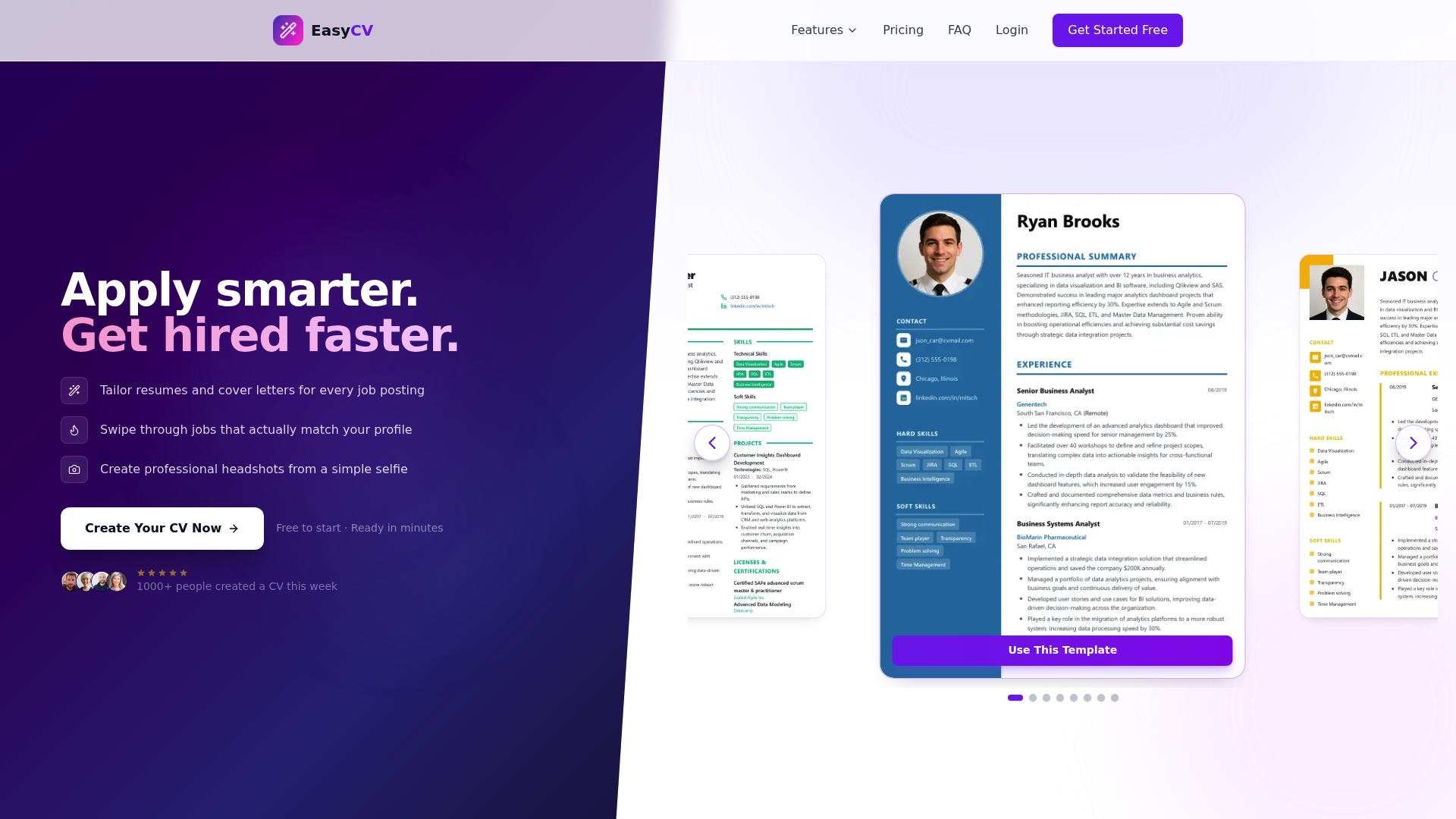
Easy-cv’s AI writing assistant analyzes each job posting and surfaces the keywords your resume is missing, then helps you rewrite your summary, skills, and experience bullets in minutes. The platform’s ATS-friendly templates give your content the right structure from the start. With 10 million+ job listings added each month and a built-in job tracker, you can manage your full search without switching between tools. Start tailoring smarter with the Easy-cv AI builder and see the difference a precisely matched resume makes.
FAQ
What is resume tailoring?
Resume tailoring is the process of customizing your resume to match the specific language, skills, and requirements of a single job description. The goal is to increase ATS compatibility and make your fit immediately clear to a recruiter.
How long does it take to tailor a resume?
Tailoring with AI assistance takes roughly 15–20 minutes per application and produces meaningfully higher callback rates. Exploratory applications can be adjusted in as little as five minutes with summary and skills updates only.
Should I use synonyms for keywords in my resume?
No. ATS systems match exact terms, not synonyms. If the job description says “stakeholder management,” use that exact phrase rather than “stakeholder relations” or “client management.”
How many keywords should a tailored resume include?
A 500-word resume should include 8–15 target keywords, each appearing 2–4 times across different sections. Staying within that range signals relevance without triggering ATS spam filters.
Is it dishonest to tailor your resume for every job?
Tailoring is not dishonest. It means presenting your real experience using the employer’s language and priorities. You should never claim skills you do not have, but framing your genuine accomplishments to match what a specific role requires is both ethical and expected.