Marketing Cover Letter Templates That Get Interviews
A strong marketing cover letter opens with a metric-driven hook, connects your results to the role’s priorities, and closes with a clear call to action. That’s the whole job. If yours does those three things in under 350 words, you’re already ahead of most applicants.
Here’s a fill-in-the-blank frame you can use right now:
“At [Company], I [grew/reduced/launched] [metric] by [X%] in [timeframe] using [tool/channel]. I’d bring that same approach to your [role title] to [company goal from JD].”
Two things worth knowing before you write a single word: 83% of hiring managers say cover letters influence their interview decisions, and roughly 45% of applicants skip the cover letter entirely. That gap is your advantage.

Table of Contents
- What does a ready-to-use marketing cover letter look like?
- What should every paragraph in your cover letter do?
- How do you write and tailor a cover letter step by step?
- What do strong marketing cover letters look like in practice?
- What mistakes kill a marketing cover letter?
- How should you use AI tools responsibly for cover letters?
- Key Takeaways
- The part most cover letter guides get wrong
- Easy-cv makes tailored cover letters faster
- Useful sources and further reading
What does a ready-to-use marketing cover letter look like?
Three templates below, one for each career stage. Swap the bracketed fields for your actual numbers and tools. Keep each letter to three short paragraphs.
Template 1: Marketing intern or entry-level
Dear [Hiring Manager’s Name],
During my [coursework/internship] at [University/Company], I [built/managed/launched] a [campaign/project] that [achieved a concrete result, e.g., grew the email list by 400 subscribers in eight weeks]. I used [HubSpot/Canva/Google Analytics] to [specific action], which taught me how to [relevant skill].
Your [role title] caught my attention because [specific company initiative or product]. My background in [relevant coursework or project] maps directly to your need for [JD priority phrase].
I’d welcome the chance to discuss how I can contribute to [team/goal]. I’m available for a call any time this week.
Customization note: Replace the result with a real number, even a small one. “Grew our club newsletter list from 120 to 340 subscribers” beats “helped grow our audience” every time.
Template 2: Mid-level specialist or coordinator
Dear [Hiring Manager’s Name],
As a [current title] at [Company], I [managed/led/optimized] [channel or campaign type] that delivered [metric, e.g., a 28% lift in qualified leads over two quarters]. I work primarily in [tools: e.g., Salesforce, Marketo, GA4] and have owned [budget or scope detail].
[Company]'s focus on [specific initiative from careers page or JD] is exactly the kind of challenge I’m looking for next. My experience [brief relevant achievement] aligns with your goal to [JD priority].
I’d love to connect and show you the campaign breakdown. Please feel free to reach out at [email/phone].
Customization note: One metric per paragraph is enough. Two metrics in the same sentence compete for attention and dilute both.
Template 3: Senior or strategic (manager or director)
Dear [Hiring Manager’s Name],
In my [X] years leading [function] at [Company], I built and scaled a [team size]-person team that [business outcome, e.g., reduced customer acquisition cost by 34% while growing revenue 2x year-over-year]. I’ve owned budgets up to [$X] and led cross-functional work with [Sales/Product/Engineering].
[Company]'s [strategic initiative or market position] is where I want to apply that experience next. I’ve studied your [recent campaign/product launch/market move] and see a clear opportunity to [specific strategic contribution].
I’d appreciate 20 minutes to walk through my approach. I’ll follow up on [specific date] if I don’t hear back first.
Customization note: Senior letters should name a business outcome, not just a marketing metric. Revenue, retention, and market share land harder than impressions or click-through rates at this level.
What should every paragraph in your cover letter do?
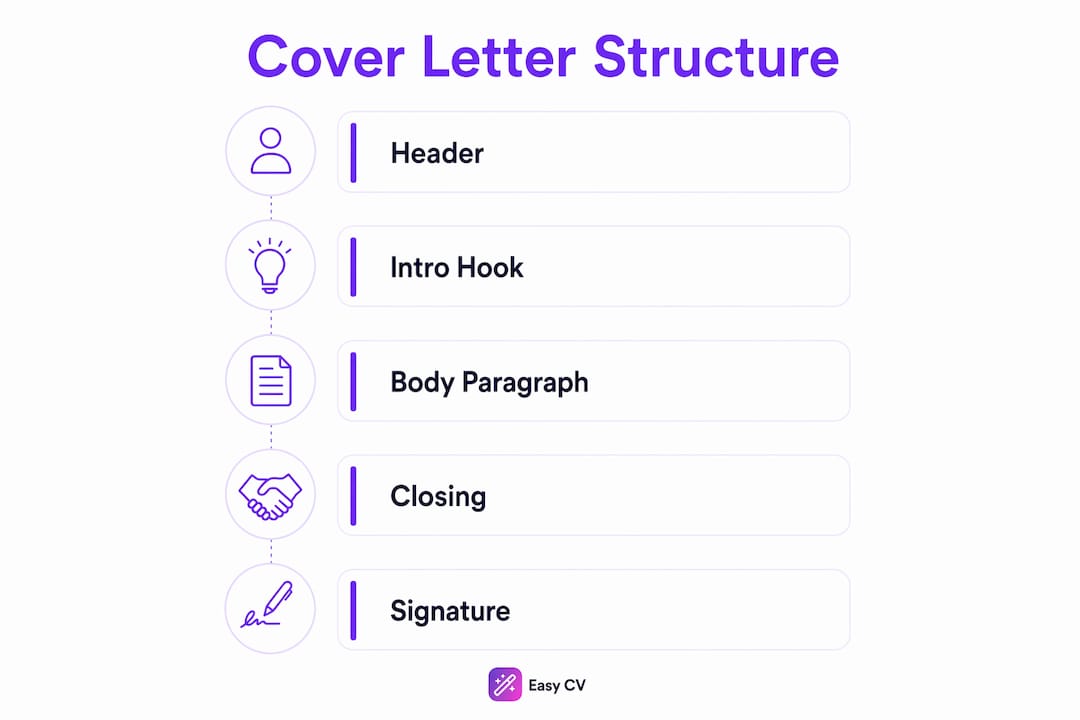
The structure isn’t complicated, but each paragraph has a specific job. Drift from it and the letter loses focus fast.
| Paragraph | Word target | Primary goal |
|---|---|---|
| Header / contact line | 20–40 | Name, email, LinkedIn, date, company address |
| Opening hook | 40–70 | Lead with one metric or result; state the role |
| Proof body | 80–120 | Two achievements mapped to JD priorities; tools named |
| Cultural fit / why this company | 40–60 | One specific reason tied to company goals or culture |
| Closing CTA | 30–50 | Request next step; offer follow-up date |
Total target: 250–350 words. Hiring panels react first to a concise metric-driven hook and evidence of role fit. Everything else gets scanned for alignment.
Formatting that helps, not hurts
Use 1-inch margins, a readable font like Calibri or Georgia at 11–12pt, and save as a PDF unless the application system requires .docx. One page, always. For email applications, your subject line should read: “[Role Title] — [Your Name] — [One differentiator, e.g., 5 years B2B SaaS marketing].”
When you don’t know the hiring manager’s name
Check LinkedIn, the company website, and the job posting itself. If you still can’t find a name, “Dear Hiring Manager” is fine. “To Whom It May Concern” reads as dated. Never guess a name and get it wrong.
Dos and don’ts
- Do open with a result, not “I am writing to apply for…”
- Do name the tools you used (measurable accomplishments and specific tools are what hiring managers look for)
- Don’t copy your resume bullet points verbatim into the letter
- Don’t use the same letter for every role without swapping the company name and JD phrases
- Don’t exceed one page, regardless of experience level
How do you write and tailor a cover letter step by step?
Follow this process once and it becomes fast. The first time takes 45 minutes; subsequent tailored versions take 15.
- Read the job description for priorities. Highlight the top three skills or outcomes the employer mentions first or most often. Those are your targets.
- Extract three priority phrases. Pull the exact language from the JD (“demand generation,” “cross-channel attribution,” “content strategy”). You’ll use these verbatim in your letter.
- Write a metrics-first hook. Draft your opening sentence around your strongest relevant result. If you don’t have a number, use scope: “Led a three-person content team” or “Managed a $150K paid media budget.”
- Map two or three achievements to the JD priorities. Each achievement should connect to one of the three phrases you extracted. Aligning your accomplishments to company goals creates both strategic and emotional resonance with the reader.
- Personalize the final paragraph. Name something specific about the company: a recent campaign, a product launch, a public goal. One sentence of genuine research signals more than three paragraphs of generic enthusiasm.
- Proofread and format. Read it aloud. Check that your name, email, and LinkedIn are correct. Confirm the company name is spelled right. Save as “[FirstName-LastName-MarketingCoverLetter-CompanyName.pdf].”
ATS keyword placement
For ATS and human readers alike, place one or two of your highest-priority JD terms in the opening sentence and repeat them once in your skills or tools sentence. That’s it. Stuffing the same phrase four times doesn’t help your ranking and reads awkwardly to the human reviewer who sees it next.
Quick proofreading checklist
- Spelling and grammar (read backward, sentence by sentence, to catch errors your brain skips)
- Consistent date format throughout
- Resume and cover letter metrics match exactly
- File named correctly before upload
- Subject line or email header matches the role title on the posting
What do strong marketing cover letters look like in practice?
Here are five annotated examples, one per common marketing role. Each annotation explains what the sentence does and what to swap for your background.
Example 1: Digital marketer
“At Acme Corp, I reduced cost-per-click 22% over six months by restructuring Google Ads campaigns around high-intent keywords identified in GA4.”
Why it works: Specific tool, specific metric, specific timeframe. The hiring manager knows exactly what you did and how. Swap: Replace the metric and tool with your own. If you don’t have a CPC reduction, use CTR lift, ROAS improvement, or lead volume growth.
Example 2: Content marketer
“I grew organic blog traffic 38% in one year by shifting our editorial calendar toward bottom-of-funnel topics, which lifted demo requests 14% quarter-over-quarter.”
Why it works: Two metrics connected by a cause-and-effect chain. It shows strategic thinking, not just execution. Swap: Use your own traffic or engagement metric. If you lack traffic data, use content output volume or social engagement rate.
Example 3: Marketing coordinator
“I coordinated a 12-asset product launch across four teams, delivering all materials five days ahead of schedule and reducing revision cycles by consolidating feedback into a single Asana workflow.”
Why it works: Coordinators often struggle to quantify impact. Scope (12 assets, four teams) and process improvement (revision cycles) are legitimate proof points. Swap: Use your own project scope and any process you improved.
Example 4: Marketing manager
“As marketing manager at [Company], I led a team of six to reposition our flagship product, resulting in a 19% increase in qualified pipeline within two quarters of launch.”
Why it works: Quantified outcomes and team leadership in one sentence. It answers the two questions every hiring manager has for a manager candidate: can you lead people, and can you drive results? Swap: Replace pipeline with revenue, retention, or NPS depending on your role’s actual KPIs.
Example 5: Marketing intern
“During my internship at [Agency], I built and scheduled 30 days of social content for three client accounts, growing average engagement rate from 1.8% to 3.4% in six weeks.”
Why it works: Even intern-level work can be quantified. Volume (30 days of content) plus outcome (engagement rate) makes this concrete. Swap: Use any project with a before/after comparison, even from a class assignment or volunteer role.
Pro Tip: To convert a resume bullet into a cover-letter proof line, connect the tactic to the business outcome. “Increased organic traffic 42% in six months” becomes “I grew organic traffic 42% in six months by refocusing our editorial calendar on high-intent keywords, which lifted conversions 18% — tracked in Ahrefs and GA4.” That single sentence shows strategy, execution, and measurement.
What mistakes kill a marketing cover letter?
The most common errors aren’t typos. They’re structural problems that make a letter invisible before anyone reads it carefully.
Top mistakes to avoid:
- Opening with “I am writing to apply for…” (wastes the most-read sentence)
- Repeating resume bullets word-for-word instead of adding context
- No metrics anywhere in the letter
- Generic company praise (“I’ve always admired your innovative culture”)
- Weak or missing CTA in the closing
- Tone mismatch: too formal for a startup, too casual for a financial services firm
- Failing to use any JD language, which flags as ATS-unfriendly
- Oversharing: career gaps, salary expectations, or personal details the letter doesn’t need
- Wrong file name or wrong company name (happens more than you’d think)
- Skipping personalization entirely and sending one letter to 40 jobs
10-point checklist before you submit
- Opening sentence contains a metric or concrete scope
- At least two JD priority phrases appear naturally in the letter
- Two achievements are named with numbers or scope
- Company name is spelled correctly and appears at least once
- Hiring manager’s name is used, or “Dear Hiring Manager” if unknown
- Letter is 250–350 words and fits one page
- Font is readable (Calibri, Georgia, or Arial, 11–12pt)
- File is saved as a PDF with a professional file name
- Resume metrics and cover letter metrics match exactly
- Closing includes a specific next step or follow-up offer
On career gaps and transitions: One sentence is enough. “After a career break to [reason], I’ve [what you did to stay current, e.g., completed a Google Analytics certification and freelanced on two campaigns].” Don’t over-explain. Hiring managers respect brevity.
When to skip the cover letter: Only when the job posting explicitly says not to include one. Otherwise, write it. With roughly 45% of applicants skipping the letter, submitting one is a low-effort competitive edge.
How should you use AI tools responsibly for cover letters?
AI can draft a cover letter in 30 seconds. That’s both the opportunity and the risk. A generic AI output reads like one, and hiring managers notice.
The principles that keep AI useful without making your letter sound like everyone else’s:
- Seed with your real metrics. Paste your actual results into the prompt. An AI that starts with “grew organic traffic 38%” will produce a far more specific draft than one starting from scratch.
- Edit voice and tone manually. AI defaults to a neutral, slightly formal register. Your letter should sound like you, not a press release.
- Verify every factual claim. If the AI invents a metric or tool you didn’t use, cut it. Fabricated specifics collapse in an interview.
- Anonymize proprietary data. Before pasting campaign results or client names into any AI tool, replace identifiable details with placeholders (“a B2B SaaS client” instead of the client’s name).
Using a tool like Easy-cv to pre-fill job-description-specific phrases speeds personalization, but manual verification of metrics and voice is what separates a letter that sounds human from one that sounds generated.
Where Easy-cv fits in the workflow
Easy-cv’s cover-letter generator is built to produce tailored drafts from the job description, not generic templates. Here’s a practical workflow:
- Paste the job description into Easy-cv’s job matcher to surface the role’s priority skills and confirm fit.
- Use the cover-letter generator to produce a first draft with JD-specific language already embedded.
- Replace any AI-generated metric placeholders with your exact numbers and one specific anecdote.
- Run a final proofread, check formatting, and export as a PDF using Easy-cv’s ATS-friendly templates.
Easy-cv also supports cover letters in 30+ languages, which matters if you’re applying to roles that require bilingual assets or targeting companies with international offices.
Key Takeaways
A strong marketing cover letter opens with a metric-driven hook, maps two achievements to the job description’s priorities, and closes with a specific call to action — all in 250–350 words.
| Point | Details |
|---|---|
| Lead with a metric | Open with a concrete result (number, scope, or timeframe) in the first sentence. |
| Match JD language | Extract two to three priority phrases from the posting and use them verbatim for ATS alignment. |
| Keep it short | Target 250–350 words across five short paragraphs; one page maximum. |
| Quantify every claim | Replace vague statements with numbers, tools, and outcomes before submitting. |
| Use Easy-cv to speed tailoring | Easy-cv’s cover-letter generator and job matcher produce JD-specific drafts you edit and export as ATS-ready PDFs. |
The part most cover letter guides get wrong
Most advice focuses on what to include. The harder problem is what to cut.
Hiring managers skim. The first two sentences of a cover letter get read carefully; the rest gets scanned for signals of fit. That means your opening hook isn’t just important — it’s almost the whole letter. If it’s generic, the rest doesn’t matter.
The edit that moves candidates forward most consistently is deceptively small: replacing a passive claim with a metric-driven outcome in the first sentence. “I have experience in digital marketing” becomes “I reduced cost-per-lead 31% in four months by restructuring our paid search campaigns.” Same candidate, completely different first impression.
There’s also a tone problem that’s specific to marketing roles. Marketing hiring managers are professional communicators. They notice when a cover letter is stiff, over-formal, or stuffed with buzzwords. A letter that reads like a human wrote it — direct, specific, a little confident — stands out precisely because most letters don’t read that way. Passion for marketing doesn’t come from saying you’re passionate. It comes from showing you understand the craft: that you know what a good CAC looks like, that you’ve thought about attribution, that you have opinions about channel mix. That specificity is what signals genuine interest.
One more thing: the closing CTA is almost always an afterthought. “I look forward to hearing from you” is not a call to action. “I’d welcome a 20-minute call to walk through the campaign breakdown — I’m available Tuesday or Wednesday afternoon” is. The difference in response rate is real.
Easy-cv makes tailored cover letters faster
Writing a tailored marketing cover letter for every application is the right move. It’s also time-consuming when you’re applying to 20 roles. Easy-cv cuts that time without cutting the quality.
Here’s what you get with Easy-cv’s cover-letter workflow:
- Job matcher: Swipe through pre-scored roles matched to your CV, so you’re writing letters for jobs where you already fit.
- AI cover-letter generator: Produces a JD-specific draft in minutes, with the role’s priority language already embedded.
- ATS-friendly templates: Clean, exportable formats that parse correctly through applicant tracking systems.
- 30+ language support: Translate your cover letter without reformatting from scratch.
- Free and premium plans: The free plan covers core features; premium unlocks unlimited exports, advanced AI rewriting, and the AI headshot generator.
Start with the Easy-cv cover-letter generator to produce your first tailored draft, then use the checklist in this guide to refine it before you submit. The full platform, including the job matcher and CV builder, is at easy-cv.ai.
Useful sources and further reading
The templates and advice in this guide draw on the following primary sources. Use them to go deeper on specific areas or to validate recommendations for your own situation.
- Sample Cover Letter – Marketing — Emory University’s Career and Professional Development office provides an annotated marketing cover letter sample that informed the paragraph structure and tone guidance here.
- Marketing Cover Letter Example and Template — Indeed’s marketing-specific guidance on measurable accomplishments, skills, and reasons for applying; informed the template content and annotation notes.
- Marketing Manager Cover Letter Example and Template — Indeed’s formatting and structural steps (header, greeting, body, conclusion) that informed the paragraph word-range table.
- How to Write a Sales Cover Letter — Close.com’s guide, which supplied the hiring-manager preference data and the applicant-skip-rate figure cited in the opening.
- Top Sales Cover Letter Tips, Examples and Templates — Pipedrive’s personalization and goal-alignment recommendations, cited in the step-by-step tailoring process.
- Sales Cover Letter Example and Template — Indeed’s guidance on quantified outcomes and CTA closings, used in the role-specific examples section.
A note on how to use these sources: The Emory and Indeed pages informed template structure and formatting. The Close.com and Pipedrive pages supplied the research-backed hiring statistics and personalization tactics. For any specific role you’re applying to, treat the company’s own job description and careers page as the final authority when tailoring your letter.