Cover Letter Personalization Process: Your 2026 Guide
What the cover letter personalization process actually is
The cover letter personalization process is not about rewriting your entire letter for every job. It is about targeting the three sections that do the heavy lifting, and leaving the rest on a solid template. Research shows that most of your impact comes from just three zones: the opening hook, the company-specific challenge paragraph, and a brief “why you, why now” closing. Everything else — your greeting format, sign-off, contact block — can stay fixed.
This approach is sometimes called the modular method. You build one strong base letter, then swap in tailored content for those three zones per application. The result reads as custom-written without the two-hour time sink.
- Opening hook: One to two sentences referencing a specific company development and the hiring manager’s name
- Company-specific paragraph: Address one challenge from the job posting and connect it to your experience
- Why-you-now close: Two to three sentences explaining why this company, at this moment in your career
- Base template: Header, greeting format, skill paragraphs, sign-off — these stay consistent
ATS alignment runs through all three zones. Mirroring the exact language from the job description, terms like “cross-functional stakeholder management” or “pipeline forecasting,” helps your letter pass automated screening before a human ever reads it.
Pro Tip: Build a library of 5–8 modular skill paragraphs, each focused on a single competency with one quantifiable result. When you sit down to apply, you scan, select, and paste in under 60 seconds. The system only works if retrieval is that fast.

Table of Contents
- Why a personalized letter gets you more interviews
- Step-by-step: how to personalize your cover letter efficiently
- Tips that actually improve your personalized cover letter
- How Easy-cv accelerates the personalization workflow
- What personalized cover letters look like across different roles
- Common mistakes that undercut cover letter personalization
- How to keep your personalized letter professional
- Easy-cv puts the whole process in one place
- Key Takeaways
Why a personalized letter gets you more interviews
Generic letters get rejected fast. A large portion of hiring managers say they reject generic submissions on sight, while many applicants send the same letter to every opening. That gap is your opportunity.
Personalization signals genuine interest. A hiring manager reading a letter that references their company’s recent product launch or a specific challenge from the job posting knows immediately that you did not mass-apply. That impression matters before they have read a single qualification.

The engagement difference is measurable. Recruiters spend notably more time reviewing personalized letters compared to generic ones. More time spent means more chances for your qualifications to land.
There is also an ATS dimension. Mirroring 3–4 key skills or phrases directly from the job posting improves your passage rate through automated screening. Job postings often repeat their most important requirements, so reflecting those exact terms back is both an ATS strategy and a signal to human readers that you understand the role.
Specific benefits of personalizing your cover letter:
- Higher callback rates from hiring managers who recognize company-specific research
- Longer recruiter review time, increasing the chance your qualifications register
- Better ATS passage through keyword mirroring
- A stronger first impression that separates you from the 45% sending identical letters
- Clearer demonstration of professional diligence and genuine interest in the role
Step-by-step: how to personalize your cover letter efficiently
This workflow gets you from blank page to polished, tailored letter in 15–20 minutes once your base template and paragraph library exist.
-
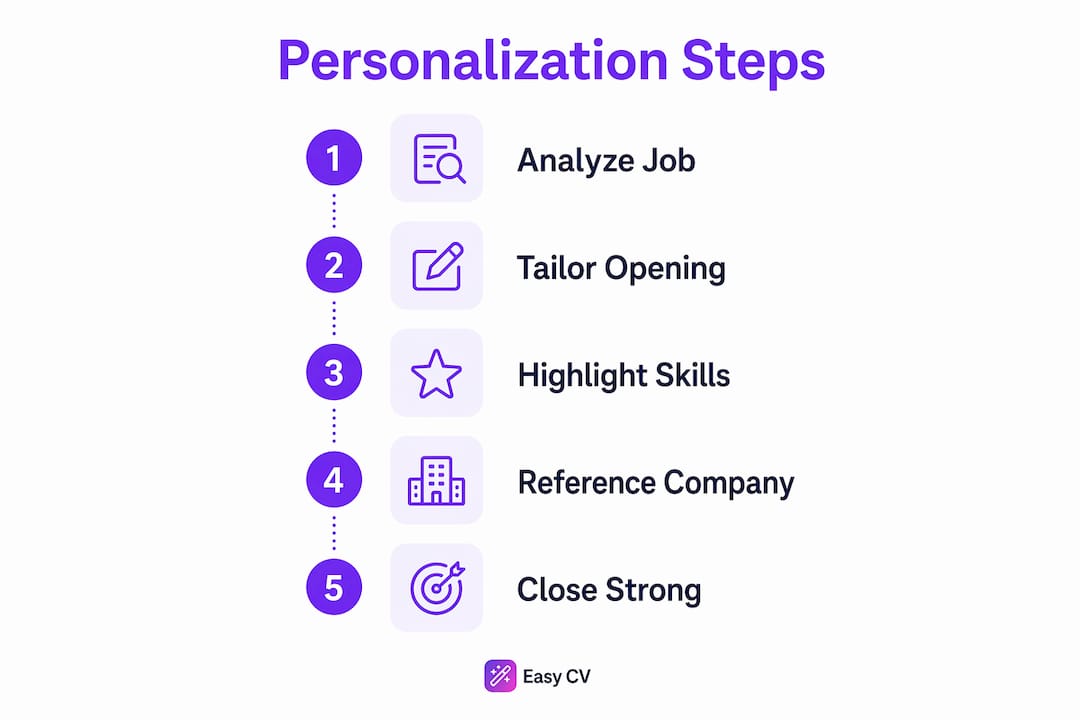
Read the job description and highlight the top 3–4 required skills (2 minutes). These are the competencies mentioned first or most often. They tell you which modular paragraphs to pull and which keywords to mirror.
-
Research the company (5 minutes). Skim the company homepage, one recent news item, and their LinkedIn page. You are looking for one specific recent development — a product launch, a funding round, a new initiative — and one challenge mentioned in the posting. Write down three to five bullet points. That is enough.
-
Find the hiring manager’s name (2 minutes). A LinkedIn search for the company plus the relevant department usually surfaces a name. MIT’s career advisors recommend addressing the letter directly to the hiring manager whenever possible. If you cannot find a name, “Dear Hiring Manager” is acceptable.
-
Write your opening hook (3 minutes). Reference the hiring manager by name, name the role, and drop in the specific company development you found. One to two sentences. The goal is to show you read their content, not just their job posting.
-
Select 2–3 modular skill paragraphs from your library (2 minutes). Match them to the top requirements you highlighted. Lead with the competency the posting mentions first. If the posting uses specific phrases, mirror those exact terms in your paragraphs — ATS systems match on precise language.
-
Mirror 3–4 keywords from the posting into your existing paragraphs (3 minutes). You are not rewriting paragraphs; you are swapping in the employer’s vocabulary where it fits naturally. “Managed cross-functional teams” becomes “led cross-functional stakeholder management” if that is what the posting says.
-
Write your why-you-now closing (2 minutes). Two to three sentences explaining why this company specifically, at this point in your career. Reference a specific initiative or value they have stated. Avoid “I look forward to hearing from you” as a standalone close — it reads as filler.
-
Leave the rest of the template untouched (1–2 minutes). Your header, standard greeting format, and sign-off do not need to change. Consistency here is not laziness; it is efficiency.
Tips that actually improve your personalized cover letter
The mechanics above get you a tailored letter. These practices make it a good one.
Mirror language, but stay in your own voice. Using the employer’s exact terminology for key skills is smart ATS strategy. Copying their entire tone or sentence structure reads as hollow. The connecting tissue — transitions, your opening line, your closing hook — should sound like you wrote it, because you did.
Drop the apology for missing experience. Career experts at The Muse are direct on this: apologizing for a gap draws the recruiter’s attention straight to the weakness instead of your strengths. Pivot immediately to transferable skills and frame them with confidence.
- Use specific company details, not generic praise. “I admire your company’s culture” tells a hiring manager nothing. “Your recent expansion into enterprise SaaS, announced in February, aligns directly with the client-facing work I have done for the past three years” tells them you paid attention.
- Keep paragraphs tight. Three to five sentences per paragraph. Your total letter should land in the 300–400 word range. Seventy percent of hiring managers favor letters that are half a page or shorter.
- Address the recipient by name when possible. “Dear Ms. Rivera” beats “Dear Hiring Manager” every time you can manage it.
- Avoid excessive enthusiasm. Professional, researched interest outweighs emotive language. One exclamation point in a cover letter is one too many.
- Personalize selectively, not exhaustively. Three to four tailored sections is the target. Personalizing every sentence comes across as over-eager and makes the letter harder to read.
Pro Tip: Read your finished letter aloud before sending. If a sentence sounds like it came from a template, it probably did. Rewrite it the way you would say it in a first-round interview.
MIT’s career development guidance adds one more layer: explicitly connect known business challenges with your specific skills. Generic statements about your qualifications are easy to ignore. A sentence that names the company’s challenge and maps it to your experience is not.
How Easy-cv accelerates the personalization workflow
The modular approach described above works well manually. Easy-cv’s AI tools compress the timeline further.
Easy-cv’s cover letter generator takes a job description and your personal motivations as inputs and produces a tailored draft. AI-generated drafts combined with manual editing cut cover letter writing time to under 10 minutes per application. You still do the editing — the opening line, the closing hook, the voice — but you are not starting from a blank page.
The real advantage of a modular paragraph library is not speed alone. It is consistency. Each paragraph follows the same internal pattern: name the skill, describe a specific situation, include one quantifiable result. When you pull from a well-built library, every application maintains the same quality floor regardless of how many you send that week.
The platform stores your modular skill paragraphs and lets you swap them in as needed. Storing 5–8 modular skill paragraphs aligned with common competencies keeps messaging consistent and quality high across a high-volume search.
Easy-cv features that directly support the personalization process:
| Feature | What it does for personalization |
|---|---|
| AI cover letter generator | Produces a tailored draft from job description input in under 10 minutes |
| Modular paragraph storage | Saves skill paragraphs for fast retrieval and swapping per application |
| Job matcher | Pre-scores job listings against your profile so you target roles worth personalizing for |
| Keyword integration | Surfaces job description keywords to mirror in your letter and resume |
| 30+ language support | Generates and translates cover letters for international applications |
| ATS-friendly templates | Formats output to pass automated screening before human review |
The practical workflow with Easy-cv: paste the job description, review the AI draft, swap in your strongest modular paragraphs, write your opening hook and closing in your own voice, and submit. For most roles, that runs 8–12 minutes total.
What personalized cover letters look like across different roles
Personalization looks different depending on the industry and seniority level. The structure stays the same; what changes is the specificity and the type of evidence you lead with.
Tech and engineering roles
The opening hook should reference a specific technical challenge or product direction from the posting. If the company just shipped a new API or announced a platform migration, name it. Body paragraphs lead with quantifiable outcomes: systems you built, latency you reduced, teams you unblocked. The why-you-now close often connects to the company’s technical stack or engineering philosophy.
Marketing and communications roles
Hiring managers in these fields read cover letters as writing samples. Every sentence is being evaluated for clarity and voice, not just content. Reference a specific campaign, piece of content, or brand decision the company made recently. Lead your skill paragraphs with results: conversion rates improved, audiences grown, campaigns that hit specific targets.
Entry-level and internship applications
MIT’s career advisors are explicit here: when you lack direct experience, focus on transferable skills — leadership, communication, problem-solving, project management. The opening hook still references a specific company detail. The body paragraphs pull from academic projects, volunteer work, or part-time roles. The why-you-now close explains how this role fits your career direction, which signals to the employer that you are thinking beyond just getting a job.
Senior and leadership roles
Personalization expectations are higher. Hiring managers at this level expect you to have done real research. Reference the company’s strategic direction, a recent acquisition, or a market challenge they are navigating. Your skill paragraphs should connect directly to business outcomes, not just tasks. The closing hook often names a specific initiative you would contribute to within the first 90 days.
Common mistakes that undercut cover letter personalization
Most personalization errors fall into one of two categories: not doing enough, or doing it wrong.
Swapping the company name and nothing else. Changing “Dear Hiring Manager at Acme” to “Dear Hiring Manager at Beta Corp” is not personalization. Hiring managers recognize this immediately. The opening hook, the company-specific paragraph, and the closing all need to reflect actual research.
Lying about or inflating your research. If you claim to know something about the company that you do not, a prepared interviewer will surface it in the first five minutes. Only reference details you can discuss confidently.
Personalizing every single sentence. Three to four tailored sections is the target. Over-personalizing makes the letter feel performative and harder to read. It also takes far longer than the results justify.
Changing your core story for each company. Your experience and strengths do not change. What changes is how you frame them for each employer’s context. Candidates who rewrite their professional narrative from scratch for every application often end up with letters that feel inconsistent or unconvincing.
Using “To Whom It May Concern.” This salutation signals immediately that you did not try to find the hiring manager’s name. Spend two minutes on LinkedIn. If you genuinely cannot find a name, “Dear Hiring Manager” is the correct fallback.
Ignoring ATS requirements. A beautifully personalized letter that uses different terminology than the job posting may not survive automated screening. Mirror the exact phrases the posting uses for key skills, not synonyms you prefer.
Closing with a throwaway line. “I look forward to hearing from you” as a standalone final sentence wastes the last impression. Close by naming a specific company initiative and what you would contribute to it.
How to keep your personalized letter professional
Personalization and professionalism are not in tension, but they require different things from you at different points in the letter.
The opening hook is where you take the most creative risk. Referencing a specific company development, naming the hiring manager, showing you read their content — this is where personality and research intersect. It should feel like a person wrote it, not a template generator.
The body paragraphs are where professionalism takes over. Skill paragraphs follow a consistent structure: name the competency, describe the situation, state the result. Concrete and specific beats enthusiastic and vague every time. A sentence like “I reduced customer resolution time from 48 hours to 18 hours by redesigning the ticketing workflow” carries more weight than “I am passionate about customer success.”
Tone calibration matters throughout. The Harvard Business Review frames it as writing a letter that sounds like you while still getting noticed. That means avoiding both extremes: the stiff, formal letter that reads like a legal brief, and the casual letter that reads like a text message. Read it aloud. If you would not say it in a first-round interview, rewrite it.
One practical check: ask whether every personalized detail you included is something you could discuss for five minutes in an interview. If you referenced a company initiative you only half-understand, either research it properly or cut the reference. Personalization that falls apart under questioning does more damage than no personalization at all.
Easy-cv puts the whole process in one place
Most job seekers manage their search across a half-dozen tabs: job boards, a word processor, a keyword list, a tracking spreadsheet. Easy-cv collapses all of that into a single workflow.
You find the role through Easy-cv’s job matcher, which pre-scores listings against your profile so you spend personalization time on applications worth the effort. The AI cover letter generator produces a tailored draft from the job description in under 10 minutes. Your modular paragraph library lives in the platform, ready to swap in. The built-in job tracker keeps every application organized without a separate spreadsheet.
For job seekers applying to 20 or 30 roles in a month, that compression matters. The Easy-cv platform handles the structural and keyword work so your editing time goes toward the three zones that actually drive results: the opening hook, the company-specific paragraph, and the closing. Start your first tailored letter on Easy-cv today and see how fast the process moves when the scaffolding is already built.
Key Takeaways
The most effective cover letter personalization process targets three specific zones — opening hook, company-specific paragraph, and why-you-now close — while keeping the rest of the letter on a consistent base template.
| Point | Details |
|---|---|
| Focus on three zones | Opening hook, company challenge paragraph, and why-you-now close drive 80% of impact (with 40% from the opening hook, 40% from the company-specific connection, and 20% from the why-you-now section). |
| Use a modular library | Store 5–8 skill paragraphs to swap per role, cutting writing time to around 15–20 minutes per application. |
| Mirror job description language | Reflecting exact phrases from the posting improves ATS passage and recruiter recognition. |
| Avoid common errors | Never swap only the company name, apologize for gaps, or close with a throwaway line. |
| Easy-cv speeds the process | Easy-cv’s AI generator and job matcher handle structure and keyword work so you focus on personalization. |