Step by Step Cover Letter Process: 2026 Guide
The step by step cover letter process is a structured method for writing personalized, results-focused letters that connect your experience directly to what employers need. Generic letters get ignored. Tailored ones get callbacks. Research from Indeed confirms that specific, metrics-backed hooks with 2–3 matched job requirements outperform generic openings every time. Tools like Grammarly, LinkedIn, and Easy-cv make this process faster and more precise. This guide walks you through every phase, from research to final submission, so you can write a cover letter that actually works.
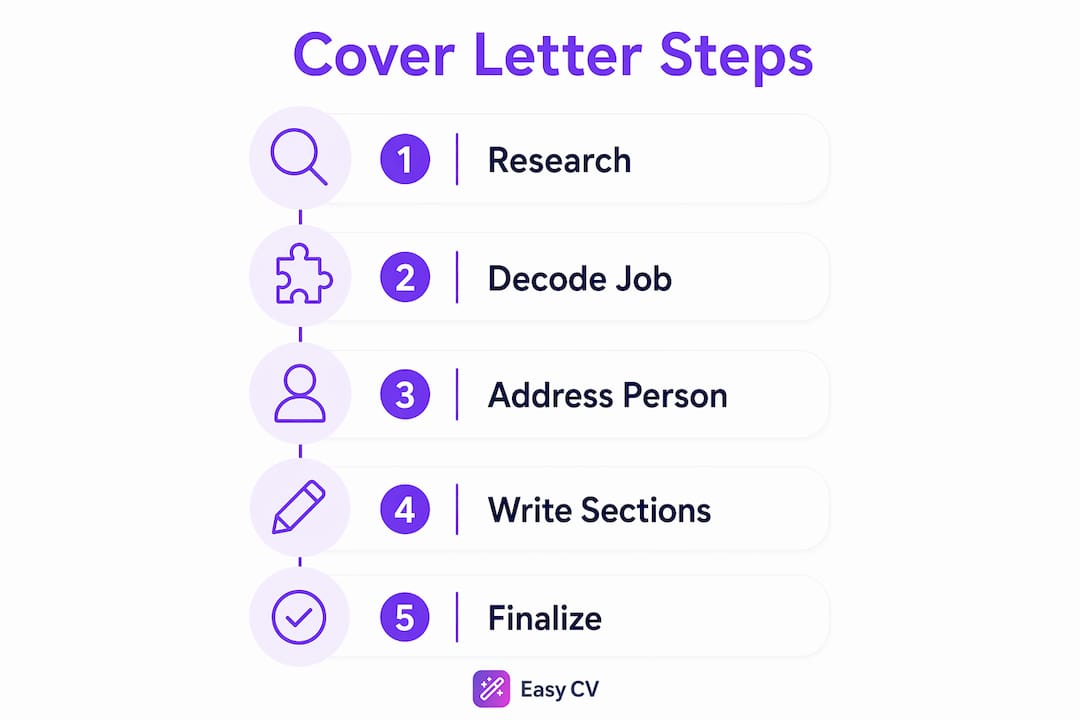
What preparation and research are needed before writing?
Preparation is the most skipped step in the cover letter writing guide, and it’s the one that matters most. Before you write a single sentence, you need to understand the company, the role, and the person reading your letter.
Research the company first
Tailoring your narrative to the organization’s mission, culture, and goals is what separates a letter that feels genuine from one that feels copied and pasted. Visit the company’s website, read their “About” page, and look at recent news or LinkedIn posts. This gives you specific language to mirror and real details to reference.

Decode the job description
Read the job posting line by line. Highlight every required skill, qualification, and responsibility. Then list 3–4 experiences from your own background that match those requirements directly. This is your raw material.
Gather concrete numbers wherever possible. Measurable achievements like reducing employee turnover by 50% or managing a team of 540 people make your letter credible and specific. Recruiters can detect recycled generic letters immediately, and numbers are the fastest way to prove you are not sending a form letter.
Find the right person to address
Address your letter to a specific person by name whenever possible. LinkedIn is the most reliable tool for finding hiring manager names. Search the company name plus the department or job title to identify the right contact. If you cannot find a name, use a role-based greeting like “Dear Hiring Manager” instead.
Pro Tip: Never open with “To Whom It May Concern.” It signals a lack of research and immediately reduces your letter’s impact with most recruiters.
- Check LinkedIn for the hiring manager’s name and title
- Review the company’s mission statement and recent announcements
- List 3–4 specific achievements that match the job’s top requirements
- Note exact keywords from the job posting to use naturally in your letter
How to structure and write each section effectively
The cover letter format follows a clear structure. Every section has a specific job to do, and understanding that job makes writing much easier.
Header and opening
Your header should match your resume exactly. Use the same font, name formatting, and contact details. This creates a cohesive application package that looks professional before anyone reads a word.
Your opening paragraph does three things: names the position you are applying for, states how you found it, and delivers a hook that references something specific about the company. Do not open with “I am writing to apply for.” Open with the reason you are the right fit, tied directly to something the company cares about.
Body paragraphs
Focus your body on 2–3 relevant experiences, not your entire career history. Candidates who focus on a few key experiences aligned with job requirements outperform those who list everything. Each experience should connect a specific achievement to a specific job requirement.
Use a short bulleted list inside the body to highlight your top qualifications. Bulleted lists make skills scannable for both human recruiters and applicant tracking systems. Limit this to 2–4 high-impact points.
Here is the sequence to follow for each body paragraph:
- State the relevant skill or experience directly
- Provide a specific example with a measurable result
- Connect that result to what the employer needs in this role
- Keep the paragraph to 3–4 sentences maximum
Closing paragraph
A strong closing expresses enthusiasm for next steps and projects a vision of mutual success, not just a summary of what you already said. Tell the hiring manager what you would bring to the team in the first 90 days. Then invite them to continue the conversation.
Pro Tip: Read your closing paragraph out loud. If it sounds like a form letter, rewrite it. If it sounds like you, send it.
What common mistakes should you avoid?
Most cover letter mistakes fall into one of three categories: being too generic, being too long, or being too formal. All three reduce your chances of getting a callback.
“Recruiters can detect recycled generic letters leading to rejections.” — Missouri University Career Center
The biggest mistake is treating your cover letter as a resume summary. Your resume already lists your experience. The cover letter’s job is to link your achievements to the specific challenges of this role. If your letter could apply to any company in any industry, it is not doing its job.
Here are the most common errors and how to fix them:
- Generic openings: Replace “I am excited to apply” with a specific claim tied to the company’s goals
- Resume repetition: Reference your resume’s highlights, but explain their relevance rather than restating them
- Outdated salutations: Drop “To Whom It May Concern” in favor of a named or role-based greeting
- Complex formatting: Avoid tables, text boxes, or graphics that confuse applicant tracking systems
- Skipping proofreading: Reading aloud catches awkward phrasing and tone issues that silent reading misses
Pro Tip: After your own review, send your letter to one trusted person for feedback. A second set of eyes catches errors you have become blind to after multiple reads. Grammarly is also useful for catching grammar and clarity issues before that human review.
How to finalize and tailor your cover letter for ATS and humans
The final step in the cover letter process explained is making sure your letter works for both the software screening it and the person reading it.
ATS compatibility
ATS-compatible letters use clean formatting with no tables, text boxes, or images. Stick to standard fonts like Arial, Calibri, or Georgia. Use keywords from the job description naturally throughout the letter, not crammed into a list at the bottom.
Tailoring for human readers
Every application deserves its own version of your cover letter. Swapping out the company name is not tailoring. Real tailoring means referencing a specific project the company launched, a challenge their industry faces, or a value their leadership has publicly stated.
| Tailoring Element | Generic Approach | Targeted Approach |
|---|---|---|
| Company reference | “I admire your company’s work” | “Your Q1 2026 expansion into healthcare AI aligns with my background in…” |
| Achievement framing | “I have management experience” | “I managed 540 employees across three departments, reducing turnover by 50%” |
| Closing tone | “I look forward to hearing from you” | “I would welcome the chance to discuss how I can contribute to your 2026 hiring goals” |
| Keywords | Vague skill labels | Exact phrases from the job posting |
Pro Tip: Include your LinkedIn URL in both your header and your closing. Hiring managers who want to learn more should not have to search for you.
Timing matters too. Submit your application within 48–72 hours of a job posting going live. Early applicants receive more attention before hiring managers are overwhelmed with submissions.
What tools and resources support the cover letter process?
The right tools reduce the time you spend on formatting and grammar, so you can focus on the content that actually gets you hired.
Easy-cv is built specifically for this workflow. Its AI writing assistant matches your experience to the job description and generates cover letter content tailored to each role. You can create and translate cover letters in 30+ languages, which matters if you are applying across borders. The platform also keeps your resume and cover letter aligned in format and tone, which creates a stronger overall application.
Grammarly handles grammar, clarity, and tone checks. It catches passive voice, wordy phrases, and punctuation errors before a recruiter sees them. Use it as a final polish layer, not a replacement for thoughtful writing.
LinkedIn serves two purposes in the cover letter process. First, it helps you find hiring manager names and research company culture. Second, a strong LinkedIn profile reinforces everything your cover letter claims. A professional LinkedIn photo alone increases profile views significantly, which matters when hiring managers look you up after reading your letter.
Cover letter templates give you a structural starting point. Easy-cv’s template library includes ATS-friendly designs you can customize without losing your personal voice.
Pro Tip: Use templates for structure, not for content. Copy the format, then replace every sentence with something specific to you and the role. A template that sounds like a template defeats its own purpose.
Key takeaways
A targeted, research-backed cover letter built on specific achievements and clean formatting consistently outperforms generic submissions at every stage of the hiring process.
| Point | Details |
|---|---|
| Research before writing | Study the company’s mission and decode the job description before drafting a single sentence. |
| Lead with metrics | Include measurable achievements like team size or percentage improvements to make your letter credible. |
| Structure every section | Use a clear header, specific opening, achievement-focused body, and forward-looking closing. |
| Avoid ATS blockers | Skip tables, images, and complex formatting to pass automated screening without issues. |
| Tailor every application | Reference company-specific details in each letter so it never reads as a recycled template. |
What i have learned after reviewing hundreds of cover letters
Most job seekers treat the cover letter as a formality. That is the single biggest mistake I see, and it costs people interviews they were otherwise qualified for.
The letters that actually work share one quality: specificity. Not just “I have leadership experience,” but “I led a team of 18 engineers through a product launch that shipped three weeks ahead of schedule.” That level of detail tells a hiring manager something your resume cannot. It shows how you think and how you communicate under pressure.
The other pattern I notice is that candidates who research the company deeply write better letters, even when their experience is thinner. A junior candidate who references a company’s recent strategic move in their opening paragraph will outperform a senior candidate who sends a polished but generic letter. Hiring managers notice when someone has done their homework. It signals genuine interest, which is rarer than most people think.
For job seekers applying to multiple roles at once, the challenge is balancing customization with volume. My advice: build a strong master letter with your top 3–4 achievements, then swap out the company-specific sections for each application. This cuts your drafting time significantly without sacrificing the personalization that matters. Easy-cv’s AI tools make this even faster by generating tailored drafts you can refine rather than starting from scratch every time.
Cover letters are not a formality. They are your first real conversation with a hiring manager. Treat them that way.
— Andras
Write better cover letters faster with Easy-cv
Crafting a tailored cover letter for every application takes time. Easy-cv cuts that time dramatically without cutting quality. Its AI-powered platform generates cover letters matched to each job description, keeps your resume and letter aligned in format and tone, and supports applications in 30+ languages for a global job search.
Easy-cv also aggregates over 10 million job opportunities per month from major job boards, so you can find roles and apply to them in one place. The built-in job tracker keeps your search organized so nothing falls through the cracks. Whether you are applying to your first job or your fifteenth, Easy-cv gives you the tools to apply with confidence at every stage.
FAQ
What is the step by step cover letter process?
The step by step cover letter process is a structured method that guides you through research, drafting, and finalizing a tailored cover letter for each job application. It starts with company research and ends with ATS-compatible formatting and proofreading.
How long should a cover letter be?
A cover letter should fit on one page, typically 3–4 paragraphs totaling 250–400 words. Recruiters spend limited time on each application, so concise and specific letters perform better than lengthy ones.
Should i address my cover letter to a specific person?
Yes. Addressing your letter to a named individual is more effective than using generic salutations. Use LinkedIn to find the hiring manager’s name, and fall back on “Dear Hiring Manager” only when a name is unavailable.
How do i make my cover letter ats-friendly?
Use clean formatting with no tables, images, or text boxes. Mirror keywords from the job description naturally throughout the letter, and save the file as a PDF or Word document unless the employer specifies otherwise.
What is the most common cover letter mistake?
The most common mistake is treating the letter as a resume summary rather than a targeted argument for why you fit this specific role. Every sentence should connect your experience to the employer’s needs, not just restate what your resume already says.