Examples of Professional Summaries: Templates That Work

A professional summary is a 2–4 sentence elevator pitch at the top of your resume that tells hiring managers and Applicant Tracking Systems (ATS) exactly why you’re the right fit before they read a single bullet point. It sits directly under your name and contact information, above your work history.
Copyable model template:
- [Job Title] with [X years] of experience in [industry/function]
- Delivered [quantified achievement] by [method or skill]
- Skilled in [2–3 keywords from the job posting]
- Seeking to bring [core value] to [target role/company type]
Swap in your own numbers and keywords, and you have a working first draft. Ideal length: 2–4 sentences or 2–5 tight bullet phrases. Keep it under 80 words.
Table of Contents
- What is a professional summary and where does it go on your resume?
- Should you write a summary or a resume objective?
- How to write a professional summary step by step
- Resume summary best practices and mistakes to avoid
- Resume summary examples by experience level and role
- How to tailor your summary to a specific job posting
- Before-and-after rewrites that show the real editing moves
- Key Takeaways
- The part most job seekers skip
- Easy-cv writes and tests your summary for you
- Useful sources and further reading
What is a professional summary and where does it go on your resume?
A professional summary is a concise 2–4 sentence introduction at the top of a resume that highlights relevant experience, key skills, and primary achievements to help hiring managers quickly assess fit. It is not a list of job duties. It is a curated argument for why you belong in the role.

Placement matters. The summary appears directly below your name, phone, and email, and above your work history section. Recruiters scan resumes for 6–7 seconds on average, so the summary is often the only section they read in full on a first pass.
The label you use is flexible. “Professional Summary,” “Summary of Qualifications,” and “Career Profile” all work. Pick one and keep it professional. One thing to avoid: treating your resume summary like a LinkedIn summary. On LinkedIn, you have room to be conversational and broad. On a resume, every word must earn its place and connect directly to the role you’re targeting.
Should you write a summary or a resume objective?
The choice comes down to one question: do you have relevant, demonstrable experience to show?
Use a professional summary when:
- You have at least one year of relevant work experience in the field.
- You’re a career changer with transferable achievements you can quantify (managed a $200K budget, led a team of 8, reduced costs by 18%).
- You’re applying for a mid-level or senior role where hiring managers expect evidence of impact.
- You want to reframe your background for a new industry using your strongest accomplishments.
Use a resume objective when:
- You’re a recent graduate with limited or no professional experience.
- You’re entering the workforce for the first time and your goal is to explain your direction.
- Your experience is so unrelated to the target role that leading with it would hurt, not help.
Career services recommend choosing a summary for candidates with meaningful work experience and an objective for those with very limited experience. If you’re unsure which fits your situation, the career objective guide on Easy-cv’s blog walks through both in detail.
How to write a professional summary step by step
Most job seekers write the summary first. That’s the wrong order. Write the resume body first, then come back and synthesize your strongest bullets into a tight summary. You’ll avoid overstating responsibilities and you’ll have real evidence to pull from.
Fill-in-the-blank template:
[Job Title] with [X years] of experience in [industry/specialty]. Proven track record of [quantified achievement]. Skilled in [2–3 role-specific keywords]. Seeking to [value you bring] at [type of company/role].
Step-by-step drafting process:
- List every achievement from your work history section, one per line.
- Circle the two or three that are most relevant to the target role and most quantifiable.
- Convert qualitative improvements into numbers wherever possible: percentage gains, dollars saved, team sizes, project counts.
- Pull 2–3 exact keywords from the job posting and insert them naturally.
- Write 2–4 sentences or 2–5 bullet phrases. Cut anything that doesn’t directly support your candidacy.
- Read it aloud. If it sounds like a job description, rewrite it to sound like a person.
Pro Tip: Draft your summary last. Once your bullet points are polished and your achievements are quantified, the summary almost writes itself. Pulling directly from the body also keeps you honest — you won’t claim a skill you haven’t demonstrated.
Strong summaries synthesize a candidate’s detailed bullet points into a short narrative that connects past accomplishments to future value. That’s the standard to aim for.
Resume summary best practices and mistakes to avoid
What to do
- Lead with your job title and years of experience.
- Quantify at least one achievement (revenue, percentage, team size, project count).
- Mirror exact keywords from the job posting for ATS matching.
- Use active verbs: led, delivered, reduced, grew, managed, built.
- Keep it to 2–4 sentences or under 80 words.
What to avoid
- Vague openers like “results-driven professional” or “dynamic team player” — these say nothing.
- Personal information (age, marital status, photo references in the text).
- First-person pronouns (“I am a skilled…”).
- Tense inconsistency — pick past tense for past roles, present for current.
- Copying the same summary to every application without tailoring.
ATS checklist
- Use exact keywords and acronyms from the job posting (e.g., “PMP” and “Project Management Professional” if both appear).
- Avoid tables, text boxes, or unusual characters in the header area — ATS parsers often skip them.
- Spell out acronyms at least once alongside the abbreviation.
- Use a standard section label the parser recognizes (“Professional Summary,” not “Who I Am”).
Summary format comparison
| Format | Best for | Tradeoff |
|---|---|---|
| Short paragraph (2–4 sentences) | Experienced professionals, narrative-heavy roles | Harder to skim quickly |
| Bulleted phrases (2–5 lines) | Technical roles, career changers with multiple skills | Can feel fragmented if not tight |
| Direct-address opening (“You need a PM who…”) | Creative fields, startups, personal brand roles | Risky in conservative industries |
For most job seekers, the short paragraph format is the safest and most widely accepted choice. Bulleted phrases work well when you have three or four distinct skill areas that don’t flow naturally into a sentence.
Resume summary examples by experience level and role
Experienced professionals
1. Project Manager Project Manager with experience leading cross-functional teams in the tech sector. Delivered a strong on-time and on-budget record across numerous projects using Agile and Waterfall methodologies. Known for reducing delivery delays significantly through process redesign. Why it works: Opens with role and years, uses two sourced metrics, names methodology keywords recruiters search for.

2. Marketing Manager Marketing Manager with experience in B2B SaaS. Grew organic traffic substantially through SEO-led content strategy and marketing automation. Skilled in HubSpot, Google Analytics, and cross-channel campaign management. Why it works: Specific metric, named tools, clear industry focus.
3. Finance Professional CPA with experience in corporate financial planning and analysis. Reduced annual reporting cycle substantially by implementing Power BI dashboards. Experienced in GAAP compliance, variance analysis, and board-level presentations. Why it works: Credential up front, concrete time-saving metric, technical keywords.
4. Sales Representative Enterprise Sales Rep with experience in SaaS. Consistently exceeded quotas and closed major deals recently. Proficient in Salesforce CRM and consultative selling for mid-market accounts. Why it works: Quota performance and a named deal size signal real commercial impact.
Career changers
5. Teacher transitioning to corporate training Educator with 7 years of classroom experience transitioning to corporate L&D. Designed curriculum for 200+ students and improved standardized test scores by 22%. Skilled in instructional design, LMS platforms, and adult learning principles. Why it works: Frames teaching as transferable, quantifies impact, uses target-industry vocabulary.
6. Military to operations management Former U.S. Army logistics officer with 9 years of experience managing supply chains for 500+ personnel. Seeking an operations management role where expertise in process efficiency and team leadership translates directly to civilian logistics. Why it works: Translates military experience into civilian terms, states the target role clearly.
Entry-level and recent graduates
7. Recent marketing graduate Trend-savvy Information Science graduate with 2 years of retail experience and a consistent record of advancement to leadership roles. Passionate about creating social media content that drives customer engagement and website traffic. Data-driven with hands-on experience adapting to digital business environments. Why it works: Adapted from a University of Arizona career resource, it leads with a personality signal, uses concrete experience, and closes with a relevant skill.
8. Entry-level software developer Computer Science graduate with internship experience in full-stack development using React and Node.js. Built a task management app with 500+ active users as a capstone project. Eager to contribute to a collaborative engineering team focused on scalable web applications. Why it works: Capstone project acts as a proxy for work experience; named technologies match ATS keywords.
Role-specific examples
9. Nurse Registered Nurse with 5 years of ICU experience at a Level I trauma center. Maintained a patient satisfaction score in the top 10% of the unit for three consecutive years. Certified in ACLS and PALS; experienced in Epic EHR documentation. Why it works: Certification and EHR keywords are standard ATS filters for nursing roles.
10. Administrative Professional Administrative Coordinator with 6 years supporting C-suite executives at Fortune 500 companies. Managed calendars for 4 VPs, coordinated 50+ annual events, and reduced scheduling conflicts by 35% through a new booking system. Why it works: Scale (Fortune 500, 4 VPs) and a concrete efficiency metric make this stand out.
11. Designer UX Designer with 4 years of experience in e-commerce and fintech. Redesigned a checkout flow that increased conversion rates by 18%. Proficient in Figma, Adobe XD, and user research methodologies. Why it works: Conversion metric is the language product teams care about most.
12. Customer Service Customer Service Manager with 7 years of experience in high-volume retail and e-commerce. Reduced average handle time by 25% and maintained a 4.8/5 CSAT score across a team of 15 agents. Skilled in Zendesk and conflict resolution. Why it works: Two metrics plus a named tool cover both performance and technical fit.
13. HR Professional HR Business Partner with 8 years of experience in tech and manufacturing. Reduced time-to-hire by 40% by redesigning the interview process and partnering with hiring managers on structured assessments. Skilled in Workday, HRIS management, and DEI program development. Why it works: Time-to-hire is the metric HR leaders care about; named system signals technical fluency.
For deeper guidance on resume branding and how to differentiate yourself beyond the summary, Easy-cv’s blog covers personal brand strategy in detail.
How to tailor your summary to a specific job posting
Generic summaries get ignored. A summary tailored to the job posting improves both ATS scoring and recruiter attention. Here’s the process:
Three-step tailoring checklist:
- Extract keywords. Read the job posting and highlight the top 4–6 requirements, skills, and tools mentioned most often or listed first.
- Match your achievements. Pick two accomplishments from your work history that directly address those requirements. If you can quantify them, do.
- Rewrite using the job’s language. Use the exact phrases from the posting where they fit naturally. One quantified result is enough.
Mini-template for tailored summaries:
[Job Title from posting] with [X years] of experience in [their industry/function]. [Achievement 1 using their keyword]. [Achievement 2 or skill set using their language]. Seeking to [their stated goal or team need].
Live transformation example:
Generic: “Experienced project manager with strong communication skills and a track record of success.”
Tailored (for a job posting emphasizing Agile delivery and stakeholder management): “Project Manager with 6 years of Agile delivery experience in financial services. Reduced sprint cycle time by 20% and managed stakeholder reporting for a $4M product roadmap. PMP-certified with a record of aligning cross-functional teams to on-time releases.”
The tailored version uses the job’s exact language, adds two metrics, and names the certification the posting likely filters for. Resume keywords are the fastest lever you have for improving ATS match rates without rewriting your entire resume.
Understanding what employers are actually filtering for also helps. Staffing professionals at firms like NIRYU note that keyword alignment between a candidate’s materials and the job description is one of the first signals recruiters use to advance or pass on an application.
Before-and-after rewrites that show the real editing moves
The difference between a weak summary and a strong one usually comes down to three things: specificity, metrics, and role clarity. Here are four rewrites with commentary.
Rewrite 1: Vague opener
Before: “Hardworking professional with experience in various industries looking for a challenging opportunity.”
After: “Operations Manager with 7 years of experience in manufacturing and logistics. Cut overhead costs by $180K annually by consolidating vendor contracts and automating inventory tracking. Skilled in ERP systems and cross-functional team leadership.”
What changed: Removed the cliché opener. Added role, years, a dollar-value metric, and two skill keywords. The “challenging opportunity” line told the employer nothing about the candidate.
Rewrite 2: Duties-focused
Before: “Responsible for managing social media accounts and creating content for multiple platforms.”
After: “Social Media Manager with 4 years of experience in consumer brands. Grew Instagram following from 12K to 85K in 14 months through data-driven content strategy. Proficient in Meta Business Suite, Hootsuite, and A/B testing.”
What changed: Shifted from job duty to result. The follower growth number is the kind of metric that stops a recruiter mid-scroll.
Rewrite 3: Career changer with no pivot framing
Before: “Educator with years of experience seeking a new role in project management.”
After: “Educator transitioning to project management with 8 years of experience coordinating curriculum for 300+ students across 5 departments. Managed a $75K departmental budget and led a cross-functional team of 12 teachers to implement a district-wide digital learning initiative. PMP candidate; proficient in Asana and Microsoft Project.”
What changed: Reframed teaching experience using PM vocabulary, added budget and team-size metrics, and signaled the certification in progress.
Rewrite 4: Senior role, too modest
Before: “Experienced software engineer with skills in Python and Java.”
After: “Senior Software Engineer with 10 years of experience building distributed systems at scale. Architected a microservices migration that reduced API latency by 40% and supported 3x traffic growth. Expert in Python, Java, and Kubernetes; experienced leading teams of 6–10 engineers.”
What changed: Added seniority signal, a concrete architectural achievement, a scale metric, and leadership scope.
The editing rule that applies to all four: Lead with role + years, add one quantified achievement, name 2–3 keywords the ATS will scan for, and cut everything that describes a duty rather than a result. Strong summaries connect past accomplishments to future value — that’s the frame every rewrite above follows.
Sample metrics from published examples:
| Metric type | Example phrasing |
|---|---|
| Delivery performance | 96% on-time and on-budget track record |
| Delay reduction | 30% reduction in delivery delays |
| Cost savings | $180K annual overhead reduction |
| Traffic growth | 140% increase in organic traffic |
| Conversion improvement | 18% increase in checkout conversion |
Key Takeaways
A strong professional summary leads with your role and a quantified achievement, mirrors the job posting’s keywords, and stays under 80 words.
| Point | Details |
|---|---|
| Write the summary last | Draft your resume body first so the summary reflects your strongest, verified achievements. |
| Lead with role and years | Open with your job title and experience level so recruiters and ATS identify your fit immediately. |
| Quantify at least one result | Convert qualitative wins into numbers: percentages, dollars, team sizes, or project counts. |
| Mirror job posting keywords | Use exact phrases from the posting to improve ATS scoring without bloating the summary. |
| Easy-cv AI rewrite tool | Easy-cv’s AI writing assistant generates and refines your summary against the job description in seconds. |
The part most job seekers skip
Here’s what I see most often: job seekers spend an hour on their bullet points and five minutes on the summary. Then they wonder why they’re not getting callbacks. The summary is the only part of your resume that every recruiter reads. Everything else is optional.
The advice that actually moves the needle is simple: write the summary last, test two versions, and pick the one that uses the job posting’s language more precisely. Not more creatively. More precisely. Hiring managers are not looking for a clever hook. They’re scanning for evidence that you’ve done the job before and can do it again.
The other thing worth saying: don’t treat your summary as permanent. It should change with every application. A summary that worked for a startup role will likely underperform for a corporate one, even if the job title is identical. The vocabulary, the metrics that matter, and the implied culture are all different.
If you want to test how well your summary matches a specific posting before you apply, Easy-cv’s job matcher scores your resume against live job descriptions so you can see the gap before a recruiter does.
Easy-cv writes and tests your summary for you
Writing a strong summary from scratch takes time most job seekers don’t have. Easy-cv cuts that time significantly. The AI writing assistant generates a tailored professional summary based on your experience and the specific job description, then rewrites it until the keywords and tone align.
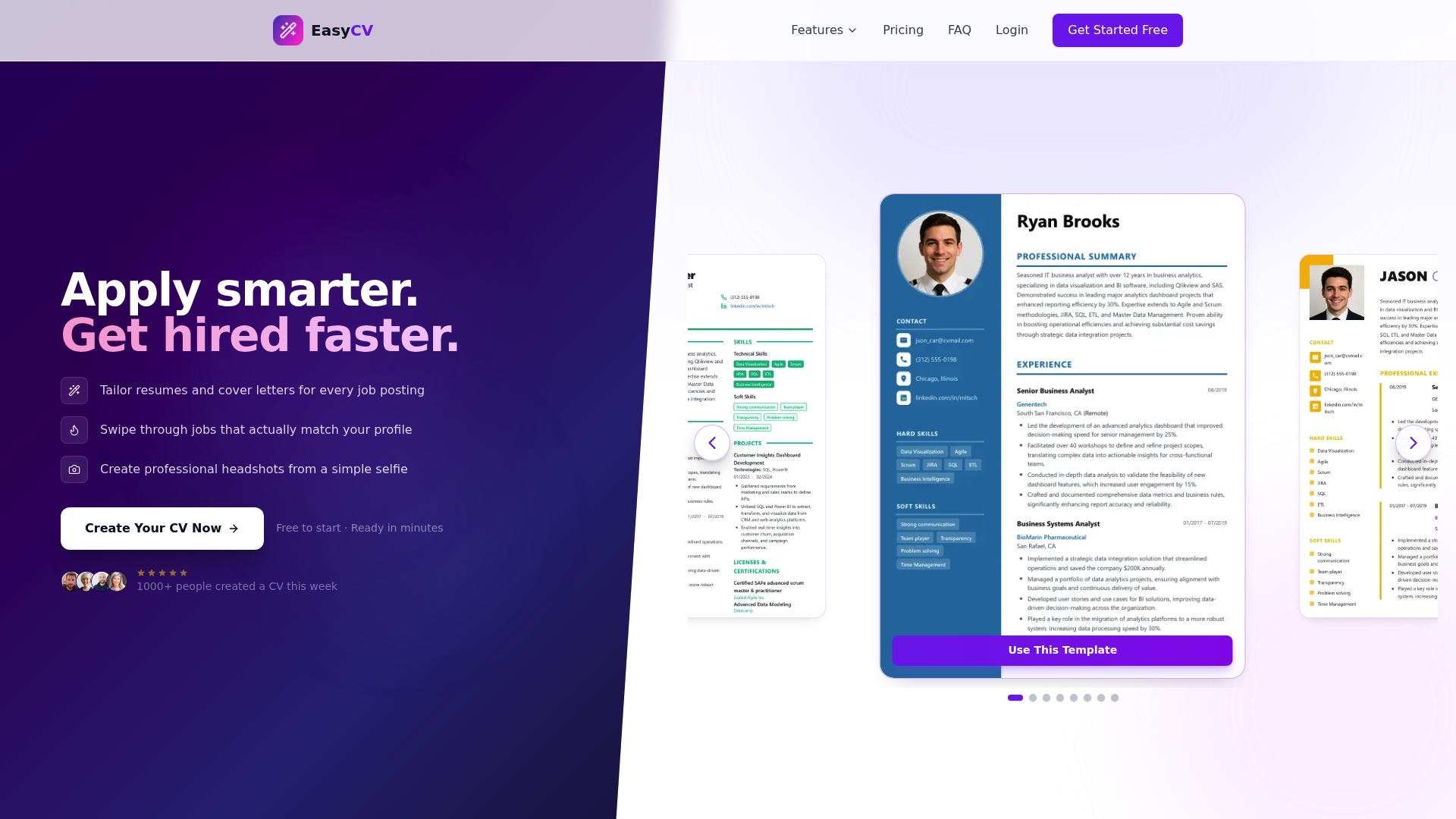
Beyond the summary, Easy-cv’s ATS-friendly templates place your summary exactly where recruiters expect it, and the built-in job matcher lets you swipe through pre-scored roles to see how your current summary performs against real postings. For job seekers applying across multiple markets, the CV translator handles 30+ languages without breaking your formatting.
The free plan covers the core builder. Premium unlocks the AI rewrite, job matching, and headshot generation. Start building your resume and let the AI handle the first draft of your summary.
Useful sources and further reading
- Indeed: How To Write an Effective Resume Summary — Covers length, placement, and the write-last method; includes role-specific examples with metrics.
- Columbia Career Education: Resume Profile or Summary Statement — Explains labeling options, format choices (paragraph vs. bullets), and the 6–7 second recruiter scan reality.
- Coursera: Resume Summary + Examples — Strong on the narrative approach and connecting past accomplishments to future value.
- NIU Career Services: Professional Summary Tips & Examples — Role-specific samples across sales, marketing, engineering, and nonprofit; useful for entry-level and career-changer templates.
- University of Arizona Center for Career Readiness — Practical summary statement examples for students and early-career professionals, including IT, healthcare, and marketing profiles.
- University of Iowa HR: Examples of Effective Professional Summaries — Real-world examples from project coordinators and grant managers with specific dollar and timeline metrics.
Once you’ve studied the examples, use Easy-cv’s AI tools to test your own version against a live job posting before you submit.