What Is a Career Objective? Your 2026 Resume Guide
A career objective is defined as a concise 1–3 sentence statement placed at the top of your resume that summarizes your immediate professional goals and the value you bring to a specific role. Think of it as your written elevator pitch to a hiring manager. It answers one question before they even read your experience: “Why should I keep reading?” Understanding what a career objective is, how it differs from a resume summary, and how to write one well gives you a real edge in a competitive job market.
What is a career objective on a resume?
A career objective is an optional statement, typically 2–3 sentences long, that sits at the very top of your resume. It tells the hiring manager who you are professionally, what role you are targeting, and what you bring to the table. The statement is forward-looking by design. It focuses on what you plan to contribute, not on a full history of where you have been.
Recruiters scan resumes in seconds from top to bottom, which makes the career objective a critical filter. A well-written one signals relevance immediately. A vague or generic one signals the opposite. The professional objective is your first and sometimes only chance to make a strong impression before a recruiter moves on.

How does a career objective differ from a resume summary?
The distinction matters because using the wrong one can undercut your application. A career objective is forward-looking. A resume summary is backward-looking. Both appear at the top of a resume, but they serve different audiences and different career stages.
Career objectives suit candidates who are entering a new field, changing careers, or re-entering the workforce after a gap. Resume summaries suit experienced professionals with substantial, relevant work history to highlight. Choosing the right one depends on where you are in your career, not on personal preference.
Here is how the two compare in practice:
- Career objective: “Recent marketing graduate seeking a junior content role at a B2B SaaS company, where strong writing skills and data analysis coursework can support lead generation goals.”
- Resume summary: “Content marketing manager with 8 years of experience driving 40% year-over-year traffic growth for B2B SaaS brands through SEO-led editorial programs.”
- Career objective (career changer): “Former high school teacher transitioning into corporate training, bringing 6 years of curriculum design and public speaking experience to support employee development programs.”
- Resume summary (senior professional): “Operations director with 12 years of supply chain leadership, specializing in cost reduction and cross-functional team management across global manufacturing environments.”
The rule is simple. If your work history directly matches the role, use a summary. If you are pivoting, starting out, or returning, use a career objective.
What are the key components of an effective career objective?
An effective career objective contains four elements working together. Miss one and the statement loses impact.
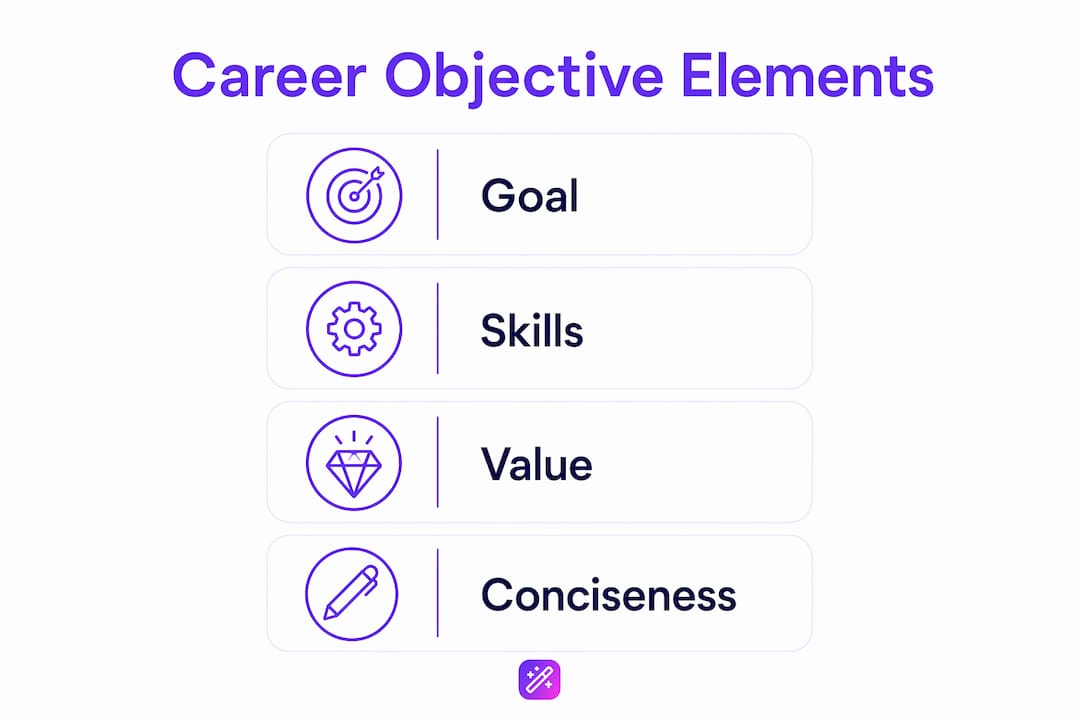
1. A clear statement of your immediate goal. Name the role and the type of company or industry you are targeting. Vague goals produce vague results. “Seeking a position in marketing” tells a recruiter nothing. “Seeking a digital marketing coordinator role at a growth-stage e-commerce company” tells them exactly where you fit.
2. Two or three relevant skills or achievements. Pull the skills that match the job posting directly. If the posting asks for project management and stakeholder communication, those exact phrases belong in your objective. Keyword alignment increases your resume’s visibility with applicant tracking systems (ATS) and with human reviewers alike.
3. A value proposition for the employer. The objective should answer “What will this person do for us?” not just “What do they want?” Shift the framing from your needs to their gains. “To grow my career in finance” is self-serving. “To apply financial modeling skills that reduce reporting time for a mid-size investment firm” is employer-focused.
4. Concise length. Modern resume objectives balance your contributions with your aspirations. They include core competencies, a target role, and a value proposition, all within 2–3 sentences. Two lines of text is the ceiling. Anything longer starts reading like a cover letter.
Pro Tip: Read the job description three times before writing your objective. Underline every skill and qualification listed. Then build your objective around those exact terms. A tailored objective outperforms a generic one every time.
What mistakes should you avoid in a career objective?
Most weak career objectives share the same problems. Knowing them upfront saves you from submitting a statement that works against you.
Generic language kills relevance. Phrases like “seeking a challenging position” or “looking to grow in a dynamic environment” appear on thousands of resumes. They say nothing specific and signal low effort. Every word in a career objective should earn its place.
Filler words dilute impact. Recruiters scan quickly. Removing words like “the,” “such as,” and “in order to” makes your objective tighter and more compelling. A statement that reads cleanly in one pass is a statement that gets read.
Treating it like a biography is a common error. The career objective is not a summary of your life story. It is a forward-looking pitch that bridges your past experience with the value you plan to deliver. Keep the focus on the role, not on your personal history.
Exceeding the recommended length loses readers. Two to three sentences is the standard. Going beyond that pushes your actual experience further down the page, which is where recruiters want to look next.
Pro Tip: After writing your objective, read it aloud. If it sounds like something anyone could have written, rewrite it. Your name and the target company’s name should feel like natural fits in every sentence.
How to write a career objective: a step-by-step guide
Writing a strong professional objective takes about 20 minutes when you follow a clear process. Here is how to do it.
-
Identify your immediate career goal. Write one sentence stating the exact role and industry you are targeting. Be specific about the level (entry-level, mid-level, senior) and the type of organization.
-
Select 2–3 key skills relevant to the role. Go back to the job posting. Pull the top skills listed and match them to your actual experience or education. Use the same language the employer uses.
-
Add your value proposition. Write one phrase that explains what the employer gains by hiring you. Frame it around their needs, not your ambitions.
-
Incorporate keywords from the job description. ATS software filters resumes before a human sees them. Tailoring your objective with the employer’s own language improves your chances of passing that filter.
-
Write 2–3 sentences and stop. Combine your goal, skills, and value proposition into a tight statement. Cut anything that does not add meaning.
-
Review for clarity and specificity. Replace every vague word with a concrete one. Read it from the recruiter’s perspective. Ask: does this tell me exactly who this person is and what they offer?
The table below shows how the same framework produces different results for different career stages.
| Career stage | Example career objective |
|---|---|
| Entry-level graduate | “Recent computer science graduate seeking a junior software developer role at a fintech startup, bringing Python proficiency and a capstone project in payment API integration.” |
| Career changer | “Former retail manager transitioning into HR, offering 7 years of team leadership, conflict resolution, and onboarding experience to support people operations at a mid-size company.” |
| Workforce re-entrant | “Returning professional with a background in financial analysis seeking a part-time analyst role, bringing updated Excel and Power BI skills from recent certification coursework.” |
| Experienced professional (new market) | “Senior UX designer with 10 years in consumer apps targeting a first role in healthcare technology, where patient-centered design principles can improve clinical software usability.” |
For job seekers navigating a career pivot, remote career transitions require the same targeted approach: lead with transferable skills and anchor every statement to the employer’s specific needs.
Pro Tip: Save a master version of your career objective, then create a new tailored version for each application. Never submit the same generic objective twice.
Key Takeaways
A career objective is the most underused tool on a resume. When written with specificity and employer focus, it filters you in rather than out.
| Point | Details |
|---|---|
| Career objective definition | A 1–3 sentence forward-looking statement at the top of your resume summarizing your goal and value. |
| Objective vs. summary | Use an objective when changing careers or starting out; use a summary when you have direct, relevant experience. |
| Four core components | Include a clear goal, 2–3 relevant skills, a value proposition, and ATS-aligned keywords. |
| Biggest mistake to avoid | Generic language and filler words make objectives invisible to recruiters. |
| Customization is non-negotiable | A tailored objective outperforms a generic one because it speaks directly to the employer’s stated needs. |
Career objectives still matter more than most job seekers think
Most job seekers treat the career objective as optional filler. That is a mistake. Recruiters assess candidate fit in seconds during initial resume screening. The career objective is the first text they read. A weak one sets a negative tone for everything that follows. A strong one makes the recruiter want to read more.
What I have seen consistently is that job seekers spend 90% of their resume effort on work history and almost none on the objective. That ratio is backwards for anyone who is changing fields or entering a new market. The objective is where you control the narrative before the recruiter forms an impression from your job titles alone.
The S.M.A.R.T. framework (Specific, Measurable, Achievable, Realistic, Time-bound) is worth applying here. Most people think of S.M.A.R.T. as a goal-setting tool for annual reviews. It works just as well for writing career objectives. A Specific target role, a Measurable skill set, an Achievable value proposition, a Realistic career stage, and a Time-bound sense of readiness. That structure produces objectives that read with authority.
The 2026 job market rewards clarity. Hiring managers receive more applications than ever. An objective that speaks directly to their needs, in their language, with zero filler, is not just a nice touch. It is a competitive advantage. Pair your objective with a strong resume headline and you give recruiters two reasons to keep reading before they reach your experience section.
— Andras
Build your career objective with Easy-cv
Writing a tailored career objective for every application takes time. Easy-cv cuts that time significantly. The platform’s AI writing assistant generates and refines professional CV content, including career objectives, based on the specific job posting you are targeting.
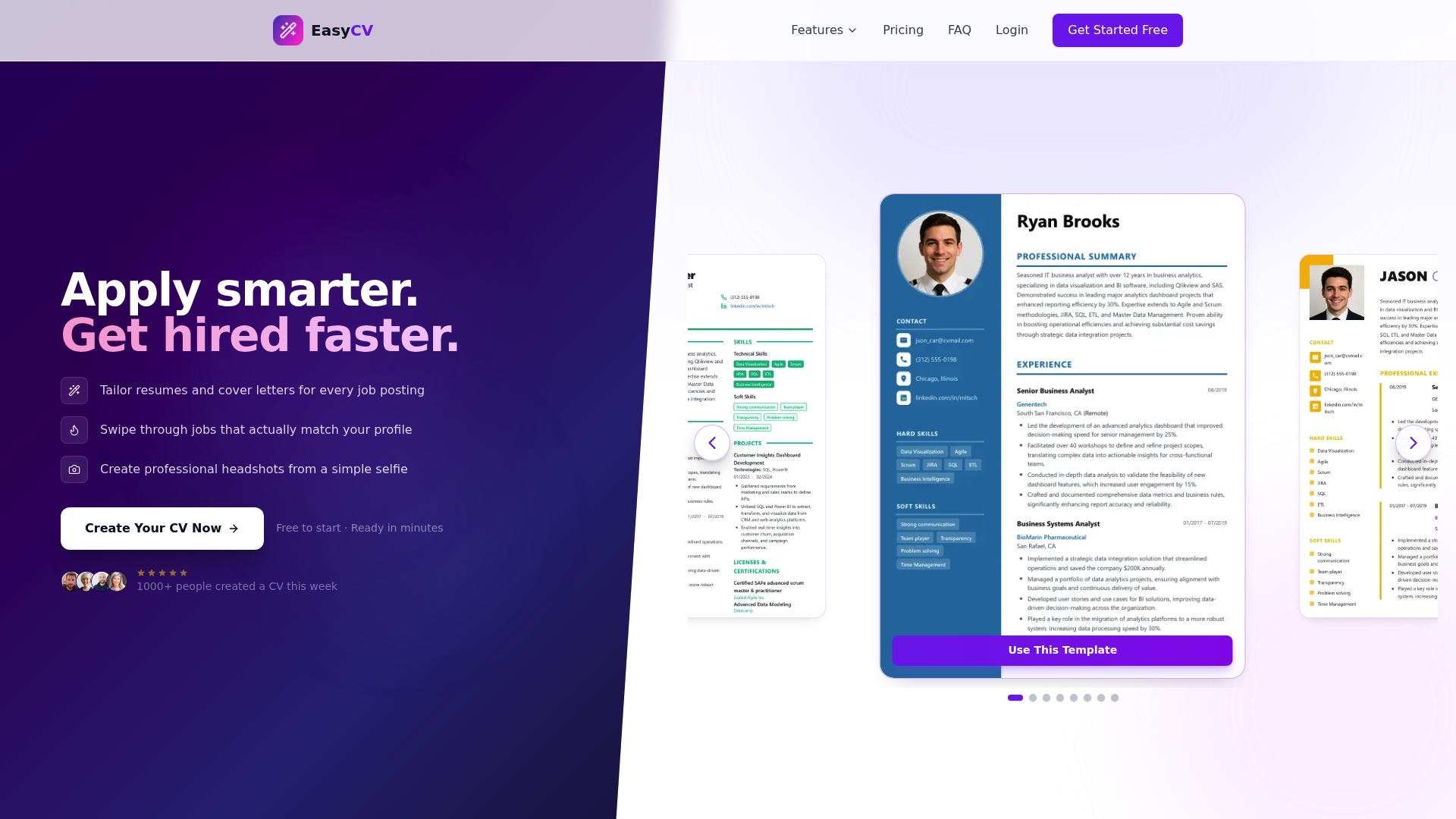
Easy-cv pulls from over 10 million job listings per month, so you can find a role, tailor your objective to it, and build a complete ATS-ready resume without switching between tools. The AI CV builder handles the formatting, keyword alignment, and language so you can focus on applying. Free and premium plans are available, making it accessible whether you are casually exploring or actively applying. Check out the full feature set to see what fits your search.
FAQ
What is a career objective in simple terms?
A career objective is a 1–3 sentence statement at the top of your resume that tells a hiring manager your immediate professional goal and the value you bring to the role.
When should I use a career objective instead of a resume summary?
Use a career objective when you are entering a new field, changing careers, or returning to work after a gap. Use a resume summary when you have direct, relevant experience that matches the role.
How long should a career objective be?
A career objective should be 2–3 sentences, roughly two lines of text. Anything longer risks losing the recruiter’s attention before they reach your work history.
Do career objectives need to be customized for each job?
Yes. A career objective customized to each application using the employer’s own keywords and focusing on their specific needs performs significantly better than a generic statement.
What is the difference between career goals and career objectives?
Career goals are broad, long-term aspirations such as reaching a leadership position or switching industries. Career objectives are short-term, specific statements written for a single job application that reflect where you are headed right now.