English Proficiency on Your Resume: A 2026 US Guide

How does the role of English proficiency in resumes actually work?
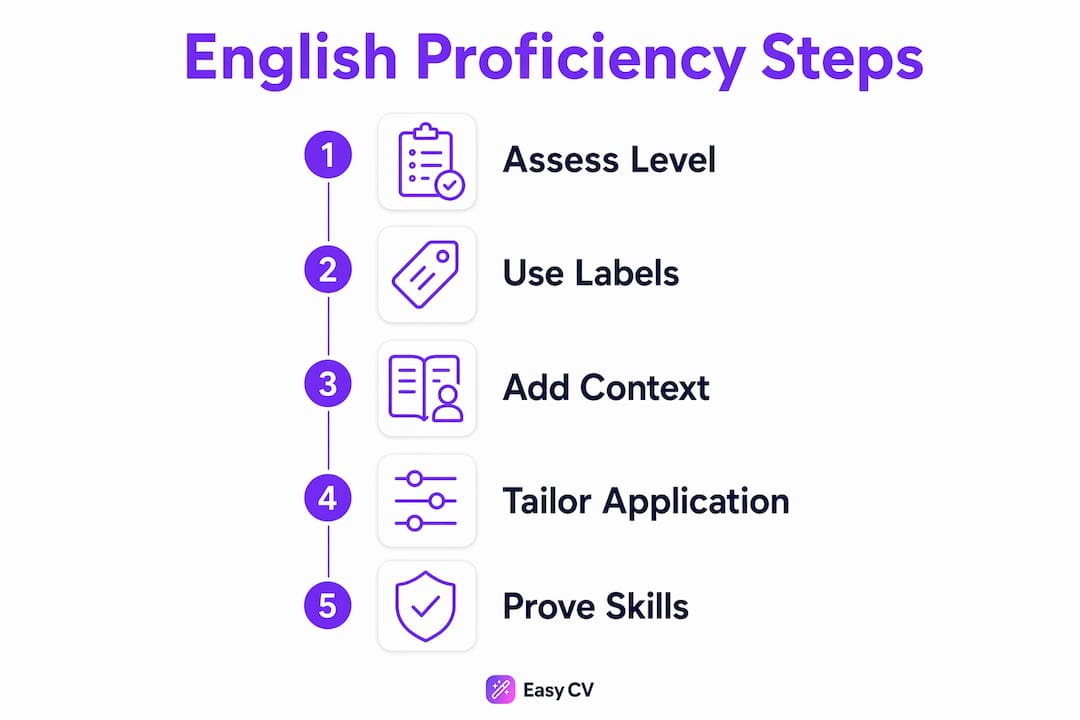
Your English proficiency on a resume tells a recruiter one thing fast: can you do this job in English? For US-based roles and multinational companies, that answer needs to be clear, specific, and honest. Vague labels like “fluent” or “conversational” without context reduce recruiter trust and can hurt your ATS keyword matching. Here is exactly how to get it right.
- Include English proficiency when it matters. List it explicitly if the job requires it, if the company is multinational, or if you are a non-native speaker applying in an English-speaking market. Native speakers applying locally typically skip it.
- Use a recognized framework. Labels like “Native/Bilingual,” “Full Professional,” “Professional Working,” “Conversational,” and “Elementary” are understood by recruiters across industries. The CEFR (Common European Framework of Reference) and ILR (Interagency Language Roundtable) scales back these terms with clear, testable criteria.
- Place it strategically. A dedicated “Languages” section near the top signals that English is central to the role. Buried in a general Skills section near the bottom, it reads as a bonus.
- Pair the level with proof. A TOEFL or IELTS score next to “Professional Working Proficiency” is far more credible than a self-assessment alone.
- Submit your resume in English when the job posting is in English or the employer is a multinational company, since the resume language itself demonstrates your written proficiency.
What do proficiency levels actually mean for your resume?
Recruiters scan fast. They need a label that tells them, in two words, whether you can write a client email, run a meeting, or read a legal brief in English. Standardized proficiency frameworks give them exactly that.
The two most referenced scales in US hiring are the CEFR (used widely in international contexts) and the ILR (developed by the US government for federal and professional use). Both map onto a set of common resume labels that recruiters recognize on sight.
| Resume Label | ILR Level | CEFR Level | What You Can Do |
|---|---|---|---|
| Native / Bilingual | — | C2 | Full fluency; speech accepted by native speakers; write official documents |
| Fluent / Full Professional | — | C1–C2 | Handle complex topics, legal writing, nuanced conversation |
| Professional Working | — | B2 | Satisfy demanding professional tasks; read and write without supervision |
| Conversational / Intermediate | — | B1–B2 | Manage concrete work topics; may struggle with abstract or technical content |
| Elementary / Basic | 1 | A1–A2 | Simple phrases and short texts; limited workplace use |
A few things worth knowing about these levels:
- “Fluent” has a high bar. According to Yale University’s Office of Career Strategy, you should be able to do all four language tasks (reading, writing, speaking, and listening) at an advanced level before claiming fluency. For every other level, three out of four is generally acceptable.
- Spoken and written skills often differ. Someone who grew up speaking a language at home may have strong conversational ability but weaker writing. List them separately if the gap is meaningful: “Spoken: Fluent, Written: Professional Working.”
- Employers reject star ratings and pie charts. Standardized labels are what ATS systems and human reviewers both understand. Graphics get filtered out.
How do you honestly assess your own English level?
Self-assessment is where most job seekers either oversell or undersell themselves. The practical test is simple: think about what you actually do in English at work, not what you studied.
Ask yourself these questions before picking a label:
- Can you run a 30-minute business meeting in English without a translator? If not, “Professional Working” is likely too high.
- Can you write a client-facing email without asking a colleague to review it?
- Do you understand fast-paced phone calls, including regional accents?
- Can you read and summarize a technical report or contract?
Differentiate spoken from written ability. Many professionals read and write English well but struggle in fast verbal exchanges, or vice versa. Your resume can reflect that distinction honestly. If your written English is strong but your spoken English is intermediate, say so. Recruiters appreciate the specificity.
Use test scores when you have them. TOEFL iBT, IELTS Academic, and Cambridge C1 Advanced (CAE) are the most recognized certifications in the US job market. A TOEFL score of 100+ or an IELTS band of 7.0+ generally supports a “Professional Working” or “Fluent” claim. Include the score and the year: “IELTS 7.— (2024).”

Overstating your level is a real risk. Phone screens and video interviews often include an impromptu English conversation, and a mismatch between your resume and your spoken ability can end the process immediately.
How to list English proficiency clearly on your resume
Formatting matters as much as the label itself. A clean, scannable entry takes seconds to read and leaves no room for doubt.
Basic structure for a Languages section:
- Languages: English (Native), Spanish (Professional Working)
- Languages: Proficient in English, Conversational in Mandarin
Where to put it:
- Near the top, below your summary, if English proficiency is a core job requirement
- In a Skills section near the bottom if it is a supporting credential
What to include on each line:
- Language name
- Proficiency level using a recognized label
- Certification or test score if available (e.g., “TOEFL iBT 104, 2023”)
What to avoid:
- Percentage bars, star ratings, or color-coded graphics (ATS cannot read them)
- Vague terms like “good English” or “working knowledge” with no framework label
- Listing English at all if you are a native speaker applying for a domestic US role, unless the job description specifically asks for it
Pro Tip: If English is your second language and you have used it in a professional context, add a brief note in your work experience section. Something like “Drafted client proposals and led weekly status calls in English” tells a recruiter far more than a label alone.
For a broader look at CV formatting best practices in 2026, the structure principles apply directly to how you present language skills.
What do career experts say about English skills on US resumes?
The US resume convention favors direct, results-oriented language. That applies to how you describe English proficiency too. Career advisors consistently point to a few practices that separate strong applications from weak ones.
Be specific about what you do in English, not just how well you speak it. Highlighting practical usage — negotiating contracts, writing technical documentation, presenting to executive teams — gives recruiters concrete evidence. A label tells them the level; an example tells them the application.
Align with US resume norms. International applicants sometimes translate their CVs literally, which can produce awkward phrasing or unfamiliar structures. American resumes favor short, active sentences and quantified achievements. If your English CV reads like a direct translation, it may undercut the very proficiency you are claiming.
Honesty is a screening filter, not just an ethical choice. Recruiters at large US companies often conduct initial phone screens specifically to verify language claims. A mismatch at that stage typically ends the candidacy, regardless of other qualifications.
Pro Tip: Pair your language level claim with a specific achievement from your work history. “Proficient in English — led cross-functional project calls with US and UK stakeholders” is a line that holds up under scrutiny.
How should you tailor proficiency descriptions for each application?
Not every job needs the same English proficiency framing. A software engineer applying to a US startup and a customer service rep applying to a bilingual call center are both listing English, but the emphasis should look different.

Read the job description carefully. If it mentions “strong written communication,” weight your written English skills and back them with an example. If it calls for “client-facing communication,” your spoken proficiency and any relevant experience should lead. Adapting your CV for the specific role and market is one of the most direct ways to improve your shortlist rate.
For roles where English is the primary working language, move the Languages section higher and add context in your experience bullets. For roles where English is secondary, a single clean line in the Skills section is enough.
How does English proficiency affect hiring decisions in the US?
English is increasingly treated as a core employability skill in the US job market, not just a nice credential. For roles involving client contact, cross-border teams, or written deliverables, it functions as a baseline requirement rather than a differentiator.
Hiring managers at multinational firms often screen for English proficiency before evaluating technical skills. A resume that clearly signals strong English ability moves faster through the initial review. One that leaves the question open, or worse, demonstrates weak written English through its own prose, tends to stall.
What do employers expect by industry?
Expectations vary sharply depending on the field.
Finance and law require near-native written English. Contracts, filings, and client communications leave no room for ambiguity. “Full Professional” or “Native/Bilingual” is the expected floor.
Technology is more flexible for spoken English but demands precise written communication for documentation, code comments, and async team collaboration. “Professional Working” is generally sufficient for most engineering roles.
Healthcare requires clear spoken and written English for patient safety reasons. Many clinical roles in the US require English proficiency verification as part of credentialing.
Customer service and sales weight spoken fluency heavily. A “Conversational” label will not clear the bar for a role that involves daily calls with English-speaking clients.
How can you prove English proficiency beyond a label?
Certifications and test scores are the most direct evidence. TOEFL iBT, IELTS Academic, Cambridge C1 Advanced, and the Duolingo English Test are all recognized by US employers, with TOEFL and IELTS carrying the most weight in corporate hiring.
Beyond tests, you can demonstrate proficiency through:
- Published writing — articles, reports, or documentation you authored in English
- Presentations — conference talks, webinars, or training sessions delivered in English
- Education — a degree completed entirely in English, especially from a US or UK institution
- Work experience — roles where English was the primary working language, stated explicitly in your experience bullets
How can you improve your English to strengthen your resume?
If your current level does not match the roles you are targeting, the gap is closable with focused practice.
The most effective methods for professional English improvement are consistent with what career coaches recommend: immersive reading in your field (industry publications, annual reports, technical documentation), writing practice with feedback (business writing courses on Coursera or LinkedIn Learning), and regular spoken practice through conversation groups or language exchange platforms like Tandem.
Formal certification is worth pursuing if you are targeting roles where English is a stated requirement. Preparing for and passing the IELTS or TOEFL also forces the kind of structured practice that produces measurable gains. Keeping your resume updated as your proficiency improves means you are always presenting your current best.
Key Takeaways
Presenting English proficiency clearly on your resume requires accurate self-assessment, standardized labels, and concrete evidence that backs your claimed level.
| Point | Details |
|---|---|
| Use recognized level labels | Terms like “Professional Working” or “Native/Bilingual” are understood by ATS systems and recruiters alike. |
| Match placement to importance | Put the Languages section near the top when English is a core job requirement; move it to Skills when it is secondary. |
| Back claims with evidence | Test scores (TOEFL, IELTS) and specific work achievements make proficiency claims credible and verifiable. |
| Never overstate your level | Phone screens and video interviews verify language claims directly; a mismatch ends most candidacies. |
| Tailor descriptions per role | Emphasize written or spoken skills depending on what the job description actually requires. |
Build your resume with Easy-cv
Listing English proficiency correctly is one piece of a resume that needs to work as a whole. Easy-cv gives you an AI-powered builder with ATS-friendly templates, a writing assistant that generates professional content in 30+ languages, and a job matcher that scores openings against your actual skills. Whether you are presenting English as your primary language or a professional credential, Easy-cv helps you frame it the way recruiters want to see it.