Why Adapt Your CV for Different Countries
CV adaptation is the practice of restructuring your resume’s format, content, and tone to match the hiring norms of a specific country. This matters more than most job seekers realize. A CV that wins interviews in Germany will likely fail in the United States, and one built for the UAE may get rejected before a human ever reads it. Understanding why you need to adapt your CV for different countries is the first step toward actually landing interviews abroad.
The core reason is cultural translation. Adapting your CV is not about running text through a language tool. It means reshaping your professional story to match what local recruiters expect to see. Terminology, length, personal details, and even paper size all vary by market. Get any of these wrong, and your application signals a lack of preparation before a recruiter reads a single bullet point.
Why adapt your CV for different countries: the core case
Recruiters assess both qualifications and cultural fit simultaneously. A CV that ignores local conventions signals poor adaptability, which is itself a disqualifying trait for international roles. Unfamiliar formats increase cognitive load for recruiters, and that friction gets interpreted as a lack of readiness. The fix is not cosmetic. It requires understanding what each market actually expects.

The terminology problem alone causes real rejections. In the United States, “resume” is the standard term for corporate job applications, while “CV” is reserved for academic and research positions. Submitting a document labeled “CV” to a US tech company signals that you do not understand the market. The reverse applies in the UK and most of Europe, where “CV” is the universal term regardless of industry. Getting the label right is the cheapest CV tailoring tip you will ever use.
What are the key country-specific differences in CV formats?
Format differences across major markets are concrete and well-documented. The table below captures the most critical variables.
| Country / Region | Document name | Typical length | Photo expected | Personal info |
|---|---|---|---|---|
| United States | Resume | 1 page (entry), 2 pages (senior) | No | No |
| United Kingdom | CV | 2 pages | No | No |
| Germany | Lebenslauf / CV | 2–3 pages | Yes | Yes |
| UAE / MENA | CV | 2–3 pages | Yes | Yes (visa status) |
| Japan | Rirekisho / CV | Standardized form | Yes | Yes |
Length is one of the most misunderstood international CV differences. US resumes stay short while German CVs favor detailed three-page documents for senior roles. Submitting a three-page document to a US employer signals poor editing skills. Submitting a one-page resume to a German company signals that you lack depth.
Personal information rules split sharply along legal lines. The US, UK, Canada, and Australia exclude personal details to comply with anti-discrimination laws. Including a photo on a US resume can trigger automatic rejection by ATS systems, because it creates legal liability for the employer. In Germany, the UAE, and Japan, omitting a photo reads as incomplete or evasive.
Paper size is a detail that most job seekers overlook entirely. US and Canada use Letter size (8.5 x 11 inches), while Europe, the UK, and the UAE use A4. Sending a Letter-formatted PDF to a European employer causes margin cutoffs that make the document look unprofessional. Formatting to the target country’s paper size takes two minutes and removes a silent rejection trigger.
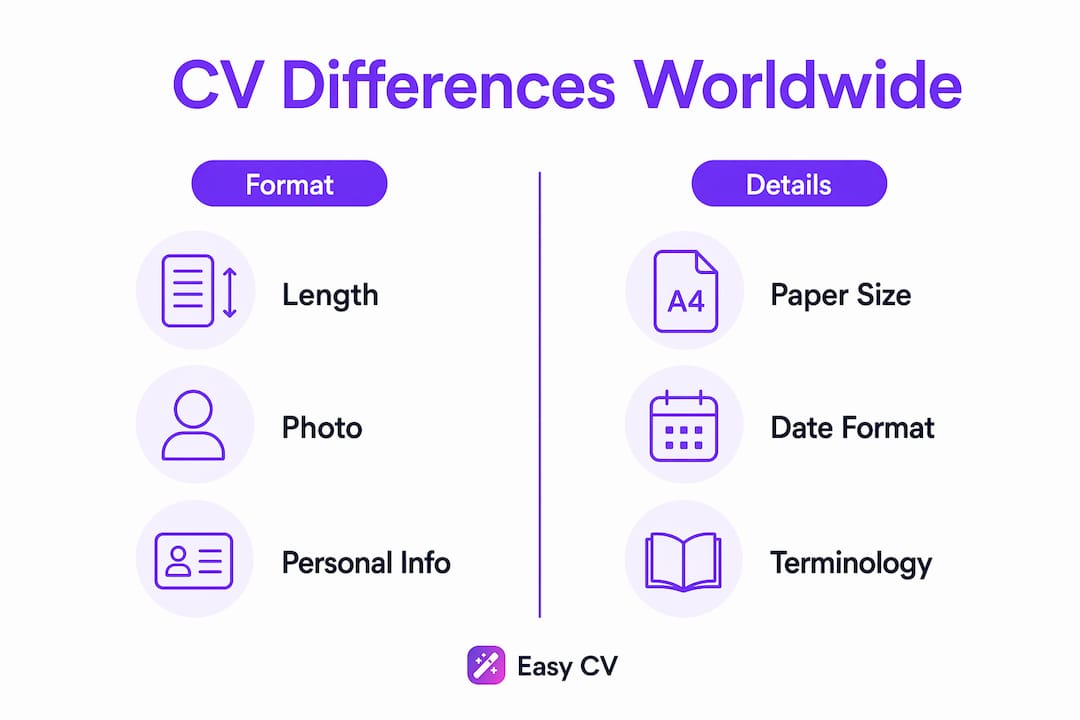
Date formatting carries the same risk. Writing “03/04/2024” means March 4 in the US and April 3 in the UK. Using unambiguous formats like “March 2024 – Present” removes all confusion and signals attention to detail.
How do ATS systems influence CV adaptation internationally?
Applicant Tracking Systems are the first filter your CV faces in most corporate hiring pipelines worldwide. ATS platforms globally require simple one-column layouts, standard fonts, and plain text headings. Graphics, tables, and photos break parsing algorithms and cause your CV to appear blank or garbled in the recruiter’s dashboard.
The practical implications are significant. A beautifully designed CV with a sidebar layout, icons, and a headshot may look impressive as a PDF. Inside an ATS, it often parses as a jumbled block of text or fails entirely. This is why best practices for CV formatting consistently recommend clean, single-column structures for any market where ATS screening is standard.
Local ATS nuances do exist. In the UAE, including your visa and work permit status prominently speeds up employer screening because eligibility is the first filter. In India, ATS portals often require specific field inputs that differ from Western resume conventions. In Japan, many companies still use standardized paper forms alongside digital submissions.
The most efficient approach is to build one ATS-compliant master document and customize content from there. Here is how to structure that process:
- Build the base. Create a clean, single-column CV with standard section headings: Work Experience, Education, Skills, and Certifications.
- Strip all graphics. Remove photos, icons, colored headers, and tables from the master version.
- Write in plain text. Use standard fonts like Arial or Calibri at 10–12pt. Avoid text boxes.
- Add a country-specific layer. Swap in the local terminology, adjust length, add or remove personal details, and reformat dates.
- Export in the right format. Most ATS systems prefer .docx or plain PDF. Check the job posting for instructions.
Pro Tip: Save your master CV as a .docx file, not just a PDF. Many ATS systems parse Word documents more accurately than PDFs, and having an editable base makes country-specific updates faster.
What are best practices for tailoring CV content to cultural expectations?
Content adaptation goes deeper than format. The dual-standard conflict between the concise Anglo-American resume and the detailed European or Asian CV requires cultural translation, not literal translation. An American resume leads with quantified achievements and power verbs. A German CV presents facts chronologically without self-promotional language. Submitting an achievement-heavy American resume to a German company reads as boastful. Submitting a dry chronological list to a US startup reads as passive.
Here is what to adjust by region:
- United States and Canada: Lead with a strong summary statement. Use active verbs (“led,” “built,” “grew”). Quantify every achievement you can. Keep the tone confident and direct.
- United Kingdom: Slightly more formal than US style. Achievements still matter, but the tone is less aggressive. Include a personal statement at the top.
- Germany and Austria: Chronological order is mandatory. Include a professional photo, your date of birth, and nationality. Avoid superlatives. Let facts speak.
- UAE and MENA: Include visa status prominently. A professional photo is expected. Formal tone with clear role titles and employer names.
- Japan: Follow the Rirekisho format if applying to Japanese companies. Handwritten versions are still used in some industries. Modesty in tone is valued over self-promotion.
Translating qualifications for local understanding is another layer most job seekers miss. A degree from a university that is well-known in your home country may be unfamiliar to a recruiter abroad. Adding a brief parenthetical note, such as “BSc Computer Science (top-ranked national university, equivalent to a US R1 institution),” removes ambiguity. The same logic applies to certifications, job titles, and industry-specific terminology.
Pro Tip: When applying to non-English-speaking markets, consider creating a localized CV version in the local language, even if the role is advertised in English. It signals genuine commitment to the market.
Visa status is a content element that belongs in the CV for certain markets and nowhere near it for others. In the UAE, stating “UAE residence visa holder” or “eligible for employment visa” at the top of the document is standard practice and accelerates screening. In the US or UK, visa status is never included on the resume itself.
How can job seekers manage multiple country-specific CV versions?
Managing several CV versions sounds complicated, but the process becomes straightforward with the right structure. Using a master document with region-specific content tweaks reduces errors and ensures every version passes automated screening filters. The key is treating your master CV as a modular system, not a static file.
The benefits of multiple tailored CVs are concrete: each version speaks directly to local recruiter expectations, passes country-specific ATS filters, and signals that you understand the market you are entering. A single generic CV sent to five countries will underperform a targeted version sent to one.
Tracking your versions is as important as creating them. A simple spreadsheet works well. Log each country version, the date last updated, the paper size used, and whether a photo is included. When a role’s requirements change or you update your experience, you update the master first, then propagate changes to each country version.
AI-powered CV builders have made this process significantly faster. Easy-cv supports CV creation and translation in over 30 languages, with ATS-friendly templates built for global markets. You can customize CV versions for different regions without rebuilding from scratch each time, which cuts the time cost of international applications considerably.
Key Takeaways
Adapting your CV for different countries is the single most effective way to avoid automatic rejection and signal genuine readiness for each market you target.
| Point | Details |
|---|---|
| Terminology matters immediately | Use “resume” for US corporate roles and “CV” for UK, European, and academic applications. |
| Format and length vary by country | US resumes run 1–2 pages; German CVs run 2–3 pages with a photo and personal details. |
| ATS requires a clean base | Single-column layouts with standard fonts pass ATS parsing in every major market. |
| Content needs cultural translation | Quantified achievements work in the US; factual chronological lists work better in Germany. |
| One master CV saves time | Build one ATS-compliant base and apply country-specific tweaks rather than rebuilding each time. |
What I have learned from watching international applications fail
Most international candidates treat CV adaptation as a formatting exercise. They change the paper size, maybe add a photo, and call it done. That approach misses the deeper problem. A German recruiter reading an achievement-heavy American resume does not just find it unfamiliar. They find it untrustworthy, because the self-promotional tone conflicts with the professional culture they operate in.
The candidates I have seen succeed internationally do something different. They research the hiring culture of the target country the same way they research the company. They read job postings in that market to absorb the language and tone. They look at what local professionals in their field actually include on their CVs. That research takes a few hours and changes everything about how the document reads.
The detail that surprises most people is how much paper size and date formatting matter. These feel trivial. But a recruiter who opens a PDF with clipped margins or reads “04/05/2024” and has to stop to figure out what it means has already formed a negative impression. These are not small errors. They are signals that you did not do the work.
My honest advice: treat every country as a distinct market with its own hiring language. The CV is your first communication in that language. If you send a document that sounds foreign to the reader, you have already lost the conversation before it started.
— Andras
Easy-cv makes international CV adaptation practical
Building country-specific CV versions used to mean hours of reformatting, translating, and second-guessing local norms. Easy-cv changes that equation.
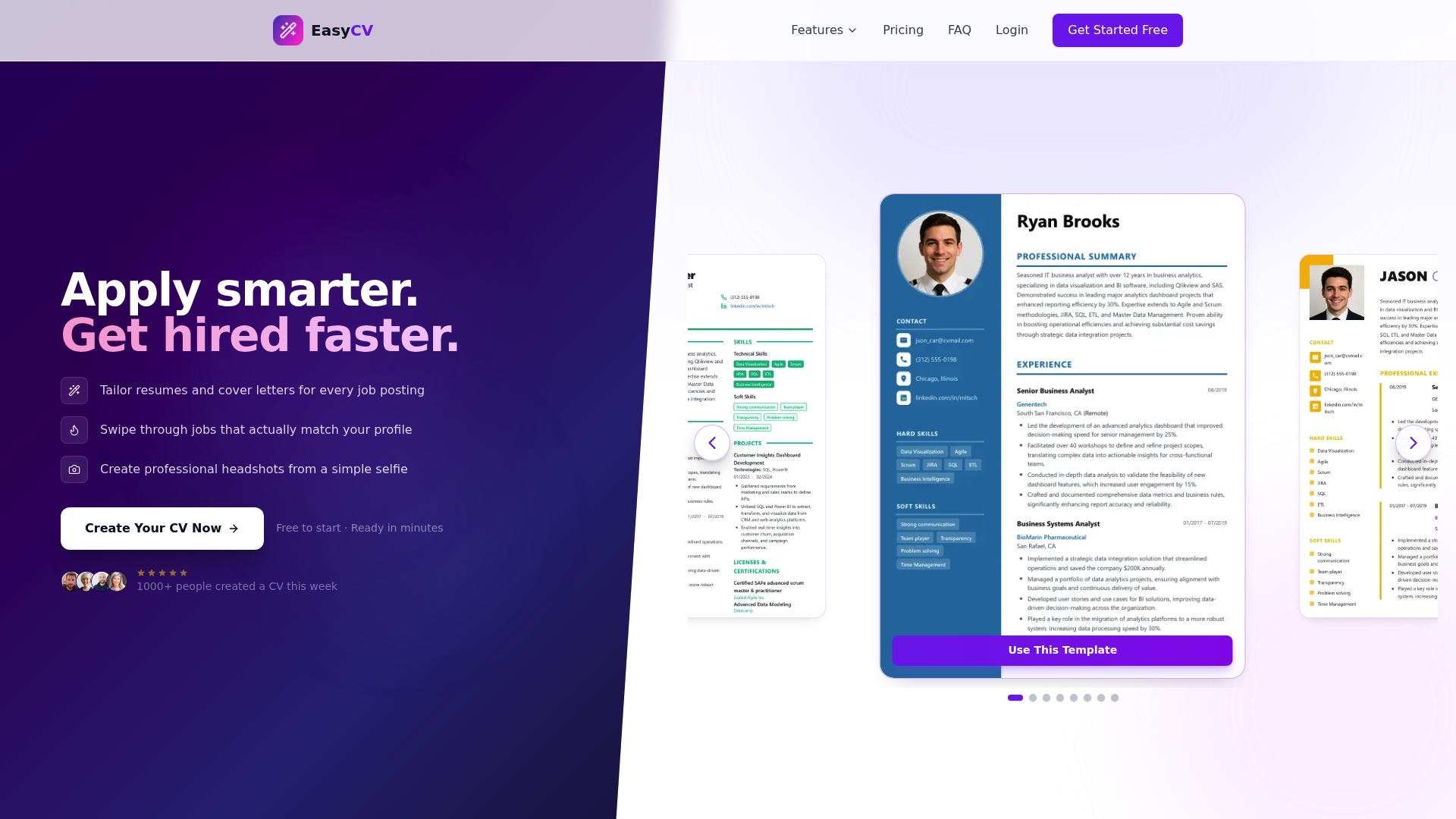
Easy-cv is an AI-powered CV builder that supports CV creation and translation across 30+ languages, with ATS-friendly templates designed for global markets. You can adjust formatting, swap content blocks, and export versions tailored to specific countries without starting over each time. The platform also aggregates over 10 million job listings per month, so you can find the role and build the right CV for it in the same place. For job seekers targeting multiple international markets, that combination of speed and accuracy is a real advantage. Explore the full feature set to see how it fits your search.
FAQ
Why does the US use “resume” instead of “CV”?
In the US, “CV” refers specifically to academic and research applications, while “resume” is the standard term for corporate roles. Submitting a document labeled “CV” to a US employer signals unfamiliarity with the market.
Should I include a photo on my international CV?
It depends on the country. Photos are expected in Germany, the UAE, and Japan, but including one on a US or UK application can trigger ATS rejection and create legal issues for employers.
How long should an international CV be?
Length varies by market. US resumes run 1–2 pages, UK CVs run 2 pages, and German CVs for senior roles can reach 3 pages. Matching the local expectation signals market awareness.
What paper size should I use for international CVs?
Use Letter size (8.5 x 11 inches) for the US and Canada, and A4 for Europe, the UK, and the UAE. A mismatch causes margin cutoffs that make the document look unprofessional.
How do I manage multiple CV versions without losing track?
Build one ATS-compliant master CV and apply country-specific tweaks from there. Track each version in a simple spreadsheet noting the country, paper size, photo status, and last update date.