Career Transition Workflow: Your Step-by-Step Plan
A career transition workflow is a structured, phase-based process that organizes your job change into clear, sequential steps, from self-assessment through targeted applications. Without this structure, most professionals waste months applying randomly, rewriting the same generic resume, and losing momentum. Treating a career change as a project with five distinct phases is critical for success and timeline management. The industry term for this approach is “career transition management,” and it draws directly from project management principles: define scope, set milestones, track progress, and iterate. Whether you are moving into an adjacent field or making a complete pivot, a structured job change process cuts wasted effort and gets you to offer faster.
What are the key phases of a career transition workflow?
Career transitions take 3–18 months depending on how far your target role sits from your current one. Adjacent moves are faster. Larger skill gaps mean longer timelines. Knowing this upfront prevents the panic that sets in around month three when nothing has happened yet.
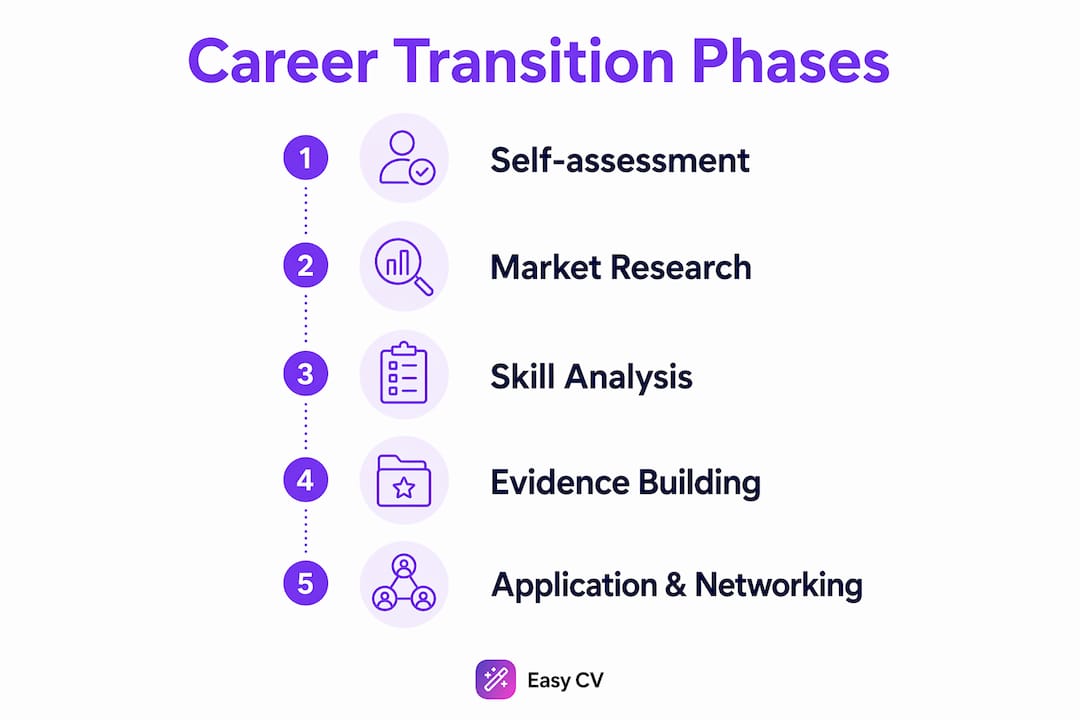
The five phases below form the backbone of any effective career change plan.

Phase 1: Self-assessment (Weeks 1–2) Define your motivation clearly before anything else. Ask what you want more of, what you want less of, and what problems you genuinely enjoy solving. Vague answers here produce vague job targets later.
Phase 2: Market and role research (Weeks 2–4) Target 5–10 informational interviews with professionals currently working in or hiring for your target role. These conversations reveal hiring signals and day-to-day realities that job descriptions never mention. They also build the relationships that produce referrals later.
Phase 3: Skill gap analysis (Weeks 4–6) Compare your current skills against the requirements you found in Phase 2. Rank gaps by frequency across job postings. Focus on the top three gaps first, not every gap at once.
Phase 4: Evidence building (Months 2–8) Build tangible proof through portfolio projects, freelance work, or certifications. Proof often outweighs formal qualifications alone during interviews. A data analyst candidate who ships a public dashboard carries more weight than one who only lists a course on their resume.
Phase 5: Strategic application and networking (Months 5–10) Apply to a focused list of target roles with tailored materials. Applying to 3–5 companies simultaneously within 48 hours of a posting maximizes visibility and gives you negotiation leverage when offers arrive close together.
| Phase | Duration | Key Output |
|---|---|---|
| Self-assessment | Weeks 1–2 | Motivation statement, target role list |
| Market research | Weeks 2–4 | Informational interview notes, role clarity |
| Skill gap analysis | Weeks 4–6 | Prioritized learning plan |
| Evidence building | Months 2–8 | Portfolio, certifications, freelance work |
| Strategic applications | Months 5–10 | Offers, referrals, negotiated salary |
What tools and techniques support managing your job change process?
The right tools turn a chaotic job search into a controlled operation. Running your transition like a sales pipeline with gate checkpoints prevents wasted effort and accelerates referrals. That means tracking every conversation, application, and outcome in one place.
The core toolkit for managing transitioning careers steps includes:
- A job application tracker. Use a spreadsheet or dedicated app to log company name, role, date applied, contact name, and current status. Update it after every interaction.
- A skills inventory template. List your current skills in one column and the target role’s required skills in another. The gap between them is your learning agenda.
- An informational interview log. Record who you spoke with, what you learned, and what follow-up you committed to. This prevents dropped relationships and surfaces referral opportunities.
- A weekly milestone list. Set three to five concrete deliverables each week: one informational interview, two job applications, one hour of skill practice. Specificity beats ambition.
- AI-powered resume and job matching tools. Platforms like Easy-cv generate role-specific resumes and score job listings against your profile, cutting the time you spend on low-fit applications.
Pro Tip: Track your pipeline metrics weekly: number of outreach messages sent, responses received, interviews scheduled, and rejections logged. A weekly milestone rhythm that includes these numbers helps you spot bottlenecks before they stall your search.
How do you execute each step of the career transition workflow?
Execution is where most career change plans fall apart. The steps below are ordered deliberately. Skipping ahead to applications before completing research and proof building is the single most common reason transitions drag on.
Step 1: Conduct an honest self-assessment
Write down your top five professional strengths, your three biggest frustrations in your current role, and the type of work that makes you lose track of time. Cross-reference these with roles that match at least four of the five criteria. This exercise produces a focused target, not a wishlist.
Step 2: Research real market data
Read 30–50 job postings in your target field before writing a single word of your resume. Note which skills appear in more than half the postings. Those are your priority gaps. Then conduct informational interviews to validate what you read. Job descriptions describe the role on paper. Practitioners describe the role in reality.
Step 3: Map your transferable skills
Translating transferable skills into target role language is non-negotiable. A project manager moving into product management does not list “managed stakeholders.” She lists “defined product requirements with engineering, design, and sales to ship features on schedule.” The language shift signals fluency to hiring managers who scan for it. Check out job search tips for 2026 for more on how language choices affect screening outcomes.
Step 4: Close priority skill gaps with proof
Choose one or two high-priority gaps and close them with something visible. A GitHub repository, a published case study, a completed certification with a project attached. Proof reduces the perceived hiring risk that every career changer faces. Starting a transition with applications only causes delays. Front-loading validation and proof building speeds up results.
Step 5: Rewrite your resume and LinkedIn profile
Write every bullet point in outcome-focused language: action verb, context, measurable result. Rewrite your LinkedIn headline and summary for the target role, not your current one. Hiring managers search LinkedIn by role keywords. If your profile still reads as your old job title, you are invisible to the people you need to reach.
Pro Tip: Use Easy-cv’s AI writing assistant to generate outcome-focused bullet points for your target role. The tool pulls industry-specific language and formats your experience so it reads as relevant to a hiring manager in your new field, even when your background is from a different industry.
Step 6: Apply with precision, not volume
Apply to roles where you meet at least 70% of the listed requirements. Personalize each application with a cover letter that addresses the specific role and company. Use your informational interview network to request internal referrals before submitting. Referred candidates move through hiring pipelines faster than cold applicants. For a broader view of improving your job search in 2026, the research is consistent: quality beats volume every time.
Step 7: Prepare for career changer interviews
Expect the question: “Why are you leaving your field?” Prepare a two-minute answer that frames your transition as a deliberate move toward something, not away from something. Use the STAR method (Situation, Task, Action, Result) to tell stories that demonstrate transferable skills in action. Research salary ranges in the target field before any offer conversation. Salary research and a clear negotiation plan are standard components of a complete job switching process.
What common pitfalls occur during career transitions and how do you avoid them?
Most career transition mistakes are predictable. Knowing them in advance lets you build guardrails into your plan.
- Quitting before validating. Planning your pivot while still employed maintains income and reduces pressure. Better decisions come from financial stability, not urgency.
- Applying too broadly. Sending 100 generic applications produces fewer results than sending 20 targeted ones. Broad applications signal confusion about your direction to hiring managers.
- Generalizing your resume. One resume for all roles is the fastest way to get screened out. Every application needs a version of your resume written for that specific role.
- Ignoring financial runway. Calculate how many months of expenses you can cover before your search begins. This number determines how aggressive or patient your timeline can be.
- Skipping networking. Networking should prioritize gaining insights first and referrals second. Professionals who lead with curiosity build stronger connections than those who lead with asks.
- Ignoring rejection data. Every rejection contains information. If you reach the phone screen but never the second interview, your resume is working but your pitch is not. Adjust accordingly.
“Successful transitions rarely require total reinvention. Pivoting into adjacent fields that leverage your existing skills is faster and lowers risk. The professionals who transition most effectively are not starting over. They are redirecting.”
Key takeaways
A career transition workflow succeeds when you treat the process as a project, front-load research and proof building, and track your pipeline with the same discipline you would apply to any professional deliverable.
| Point | Details |
|---|---|
| Phase structure matters | Transitions span 3–18 months; following five defined phases prevents wasted effort. |
| Proof beats credentials | Portfolio projects and freelance work reduce hiring risk more than qualifications alone. |
| Tailored applications win | Generic resumes get screened out; every application needs role-specific language. |
| Network for insights first | Informational interviews with 5–10 practitioners validate your direction before you apply. |
| Track your pipeline weekly | Log outreach, interviews, and rejections to identify and fix bottlenecks fast. |
Why workflow discipline changed how I think about career transitions
Most professionals approach a career change the way they approach spring cleaning: with good intentions, no system, and a pile of half-finished tasks two weeks later. I have seen this pattern repeatedly. The professionals who transition fastest are not the most talented or the most credentialed. They are the ones who treat the process like a project with a scope, a schedule, and a weekly review.
The mindset shift that matters most is this: uncertainty is not a problem to solve before you start. It is a condition you manage as you go. The workflow gives you a structure to move through uncertainty rather than wait for it to clear. Phases give you permission to focus on one thing at a time instead of trying to solve everything at once.
The other thing I have noticed is that most people underestimate how much their existing skills transfer. They assume they need to start from scratch. They do not. A marketing manager moving into customer success already knows how to read an audience, craft a message, and measure results. The gap is usually narrower than it feels at the start. The skill gap analysis step exists precisely to show you that.
Build the workflow first. The confidence follows.
— Andras
How Easy-cv supports your career transition at every phase
Executing a career change plan requires tailored materials for every application, and that takes time. Easy-cv brings the entire process into one place so you spend less time formatting and more time networking.
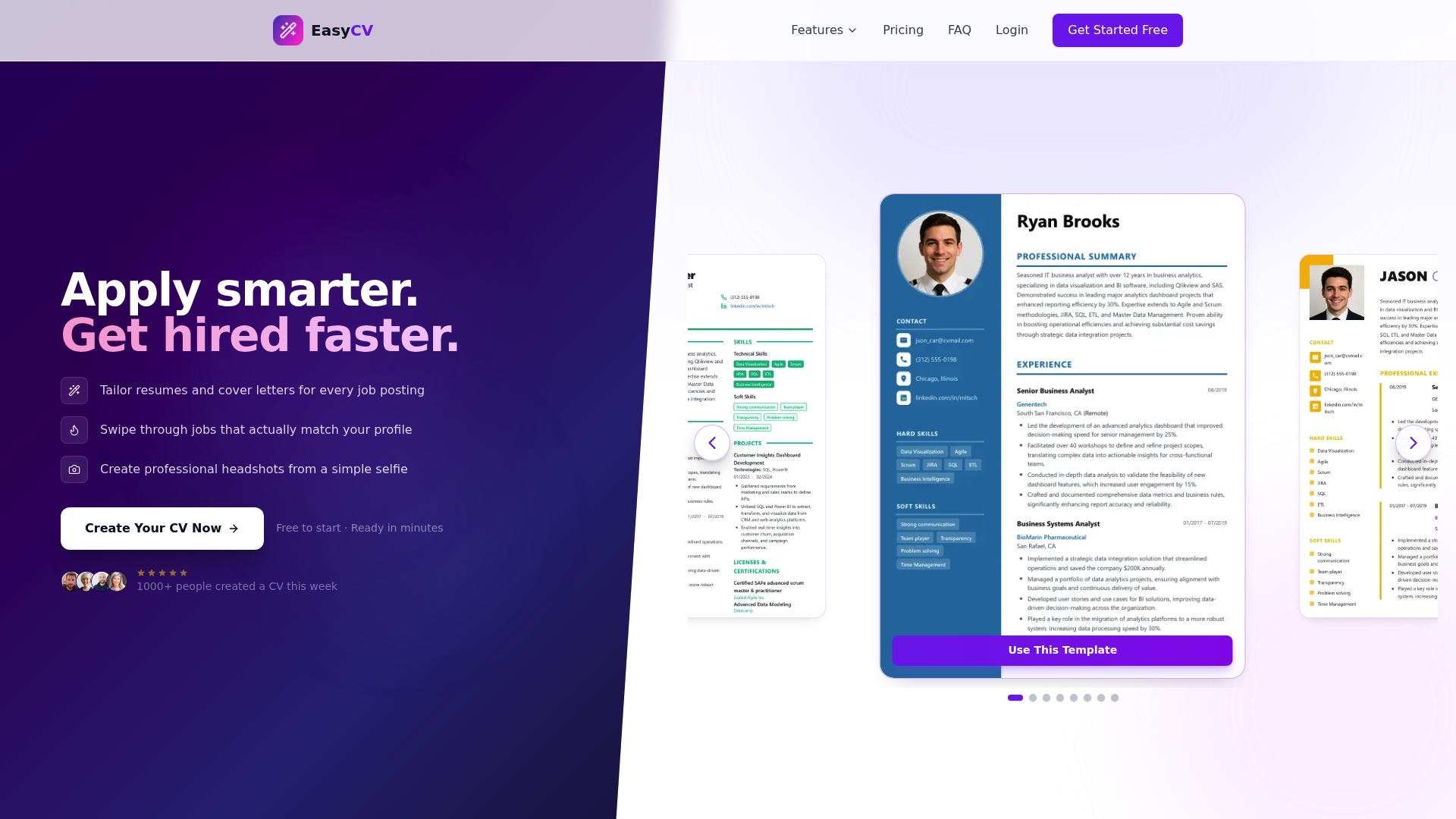
Easy-cv’s AI writing assistant generates outcome-focused resume content in the language of your target role, so your transferable skills read as relevant from the first screen. The Job Matcher tool scores live job listings against your profile, so you apply to roles where you are already a strong fit rather than guessing. For professionals moving across borders or language markets, the CV Translator converts your resume into 30+ languages without breaking the formatting. Easy-cv’s AI resume builder handles the application mechanics so your energy goes where it counts most.
FAQ
What is a career transition workflow?
A career transition workflow is a structured, phase-based process that organizes a job change from self-assessment through targeted applications. It applies project management principles to the job search to reduce wasted effort and improve results.
How long does a career transition take?
Career transitions take 3–18 months depending on the distance between your current and target roles. Adjacent moves with smaller skill gaps close faster than complete field changes.
When should I start applying during a career transition?
Apply during Phase 5, after completing research, skill gap analysis, and proof building. Starting with applications before validating your direction and building evidence causes delays and produces fewer offers.
How many informational interviews do I need?
Target 5–10 informational interviews with professionals currently in or hiring for your target role. These conversations validate market demand and produce the referrals that move you through hiring pipelines faster.
Should I quit my job before starting a career transition?
No. Planning and executing your transition while still employed maintains financial stability and reduces decision-making pressure. Most successful career changers complete the first three phases before leaving their current role.