CV Gap Explanation: What Job Seekers Need to Know
A CV gap is defined as any continuous period of three months or more without formal, paid employment. Knowing what is a cv gap explanation and how to deliver one confidently is the difference between a recruiter moving forward with your application and moving on to the next candidate. Gaps under three months are generally unnoticed, a three to six month break may need a brief note, and six months or more requires a clear explanation in your cover letter or interview. Since COVID-19, employment gaps have become far more common across every industry, and hiring managers have adjusted their expectations accordingly.
What is a CV gap explanation, and why does it matter?
A CV gap explanation is a short, professional statement that names the reason for your employment break and confirms the situation is resolved. The goal is not to apologize. The goal is to control the narrative before a recruiter fills the silence with assumptions.
Over 50% of resumes in some sectors now feature gaps or career breaks. That figure signals a structural shift in how careers actually unfold, not a red flag unique to struggling candidates. Employers today focus on your current readiness and skills, not on the gap itself.

A gap explanation serves two functions. First, it removes uncertainty. Second, it gives you a chance to show what you did with your time. Candidates who skip the explanation entirely leave recruiters guessing, and guessing rarely works in your favor.
What are the most common reasons for CV gaps?
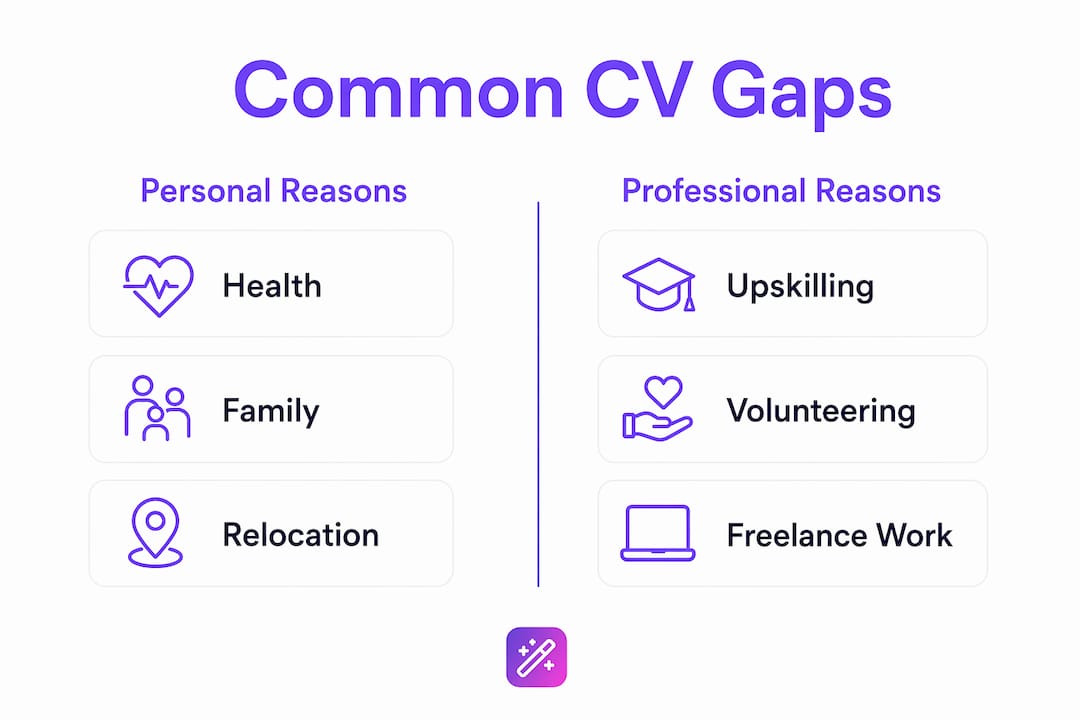
Most employment gaps fall into a handful of well-recognized categories. Recruiters encounter these regularly, and none of them are disqualifying on their own.
- Caregiving: Looking after a child, parent, or family member with a health condition is the most common gap reason across all age groups.
- Education or retraining: Completing a degree, certification, or professional course is viewed positively because it shows deliberate career investment.
- Redundancy or layoff: Economic downturns and company restructuring affect entire industries at once. Recruiters understand this context.
- Health issues: A personal illness or recovery period is a legitimate reason. You are not required to share medical details.
- Travel or sabbatical: Extended travel, especially when paired with language learning or volunteer work, reads as initiative rather than avoidance.
- Career change: Taking time to research a new field, complete bridge courses, or shadow professionals in a different sector is increasingly common.
- Furlough: Pandemic-era furloughs are still appearing on timelines and are universally understood.
The key is to categorize your gap clearly before you write a single word on your CV or cover letter. Vague language like “personal reasons” without any follow-up raises more questions than it answers.
Pro Tip: If your gap involved any upskilling, volunteering, or freelance work, list it explicitly. Visible activity during a gap reduces perceived risk and adds professionalism to your application.
How and when should you mention a CV gap on your resume and cover letter?
The threshold for where you explain a gap depends on its length. A gap under three months needs no mention at all. A gap of three to six months warrants a brief parenthetical note on your CV, such as “(Career break: family caregiving)” placed in the date column next to the relevant period. A gap of six months or more belongs in your cover letter with one to two sentences of context.
Your cover letter explanation should follow a simple structure:
- Name the reason in plain language. “I took time away from work to care for a parent with a serious illness.”
- Confirm it is resolved. “My parent has since recovered, and I am fully available and committed to returning to full-time work.”
- Pivot to value. “During that period, I completed an online project management certification through the Project Management Institute, which directly strengthens my fit for this role.”
Candidates are not obliged to disclose every personal detail. A professional, high-level summary is sufficient. Statements like “I took time for personal family matters” followed by an immediate pivot to professional value are the recommended standard.
“The biggest mistake candidates make is treating a gap like a confession. A gap explanation is not an apology. It is a one-sentence context setter followed by evidence that you are the right person for the job.”
Tailor your explanation to the job and industry. A tech company hiring for a fast-moving product role will respond differently than a law firm hiring for a compliance position. Read the culture and adjust your framing accordingly. For more on tailoring each application, custom CV versions make a measurable difference in response rates.
Pro Tip: Use the functional or hybrid CV format if your gap is recent and long. This format leads with skills and achievements rather than a strict chronological timeline, which naturally reduces the visual weight of the gap.
What is the best approach to explaining CV gaps during job interviews?
The interview is where most job seekers either recover or lose ground on a gap. The approach that works is built on one principle: brevity plus confidence.
Recruiters apply the 90/10 rule when evaluating gap explanations. Spend 10% of your answer on the gap itself and 90% on your skills, experience, and fit for the role. Your total explanation should run under 45 seconds. Anything longer shifts the conversation away from your strengths and toward your absence.
Use the three-beat response structure:
- Reason. State the cause in one sentence. Keep it factual and calm. “I left my previous role to complete a full-time master’s program in data analytics.”
- Resolution. Confirm the situation is behind you. “I graduated in june 2025 and have been actively applying since.” Hiring managers primarily want to know that the cause is resolved and unlikely to repeat.
- Value bridge. Connect the gap period to the role. “The program gave me hands-on experience with Python and SQL, which maps directly to what your team is building.”
Tone matters as much as content. Speak at a steady pace. Avoid defensive body language like crossed arms or looking away. Treat the question the same way you would treat any other competency question: prepare, practice, and deliver with calm authority.
Honesty combined with a quick transition to “what’s next” is the approach career experts consistently recommend. Evasiveness is the only answer that genuinely damages your candidacy.
Pro Tip: Practice your three-beat response out loud at least five times before the interview. Timing yourself against the 45-second target removes the temptation to over-explain under pressure.
Are CV gaps a disadvantage in today’s hiring landscape?
CV gaps are not the automatic disqualifier they were a decade ago. The post-pandemic labor market normalized career breaks at scale, and employers now focus on readiness and current skills rather than unbroken employment timelines.
The risk a gap creates is not the gap itself. The risk is evasiveness. Employers view gaps as risky only when candidates appear to be hiding something. Name the reason clearly, move quickly to your current value, and the stigma disappears.
Industry context still matters. Some sectors, including finance, law, and regulated healthcare, apply more scrutiny to gaps than others. Tech, creative industries, and nonprofit sectors tend to be more flexible. Knowing your industry’s norms helps you calibrate how much explanation to offer.
| Gap length | Typical recruiter response | Recommended action |
|---|---|---|
| Under 3 months | Rarely noticed | No explanation needed |
| 3–6 months | May prompt a question | Brief CV note or one cover letter sentence |
| 6–12 months | Likely to be raised in interview | Cover letter paragraph plus interview prep |
| 12+ months | Requires clear framing | Detailed cover letter section and strong interview answer |
Showing activity during a gap is the single most effective way to reduce recruiter concern. Certifications, volunteer roles, freelance projects, and even structured self-study all signal that you stayed engaged with your field. Candidates who can point to concrete activity during their break consistently outperform those who cannot, regardless of gap length.
“Recruiters are not looking for a perfect timeline. They are looking for a candidate who is honest, self-aware, and ready to contribute. A gap that is explained well often becomes a strength, not a liability.”
For job seekers returning after a longer break, pairing a strong gap explanation with a broader job search strategy built for 2026 hiring conditions gives you the best chance of cutting through.
Key takeaways
A CV gap explained with honesty, brevity, and a clear value bridge eliminates recruiter concern and keeps the conversation focused on your fit for the role.
| Point | Details |
|---|---|
| Define the gap threshold | Gaps under 3 months need no explanation; 6+ months require a cover letter and interview answer. |
| Use the three-beat structure | State the reason, confirm it is resolved, then connect the gap period to the role you are applying for. |
| Apply the 90/10 rule | Spend 10% of your interview answer on the gap and 90% on your skills and fit. |
| Show activity during the gap | Certifications, volunteering, or freelance work reduce perceived risk and strengthen your application. |
| Avoid evasiveness | Naming the reason clearly and moving quickly to your current value removes stigma faster than any other approach. |
The narrative is yours to control
Most candidates treat a gap question as a trap. I have watched job seekers with genuinely strong profiles stumble because they approached the question with apology instead of authority. The gap is a fact. Facts do not need defending. They need framing.
The candidates who handle this best are the ones who prepared a single, clean answer and practiced it until it felt natural. They did not rehearse a script. They rehearsed a mindset: “This happened, it is over, and here is what I bring to your team.” That mindset comes through in tone, pace, and eye contact in ways that no amount of clever wording can fake.
The mistake I see most often is over-explaining. A candidate who spends three minutes on a gap explanation has already lost the room. The recruiter stops listening to the content and starts wondering what is being hidden. Keep it under 45 seconds. Every second beyond that works against you.
One more thing worth saying plainly: if you used your gap time well, say so. Completing a course, building a freelance client base, or caring for a family member while staying current in your field are all legitimate achievements. Do not bury them in vague language. Name them, own them, and connect them to the job. That is the entire strategy.
— Andras
How Easy-cv helps you present your full story
Returning to the job market after a break means your CV and cover letter need to work harder than ever. Easy-cv gives you an AI writing assistant that generates professional CV content and cover letter language, including clear, confident framing for employment gaps.
With access to 10 million+ job listings added monthly and ATS-friendly templates that put your skills front and center, Easy-cv helps you build applications that get past automated screening and into recruiter hands. The built-in job tracker keeps your search organized so you can focus on preparation, not paperwork. Whether your gap was six months or two years, Easy-cv helps you present your full professional story with clarity and confidence.
FAQ
What counts as a gap on a CV?
A CV gap is any continuous period of three months or more without formal, paid employment. Breaks under three months are considered normal transitions and rarely require explanation.
How do I explain a gap in my CV without oversharing?
Use a one-sentence reason followed by confirmation that the situation is resolved, then pivot to your professional value. You are not required to share medical or personal details.
How long should a CV gap explanation be in an interview?
Keep your answer under 45 seconds. Spend 10% on the gap reason and 90% on your skills and fit for the role.
Does a CV gap hurt my chances with recruiters?
A gap explained clearly and confidently does not disqualify you. Recruiters focus on your current readiness and whether the cause of the gap is resolved, not on the gap itself.
Should I include a CV gap explanation in my cover letter?
Yes, if the gap is six months or longer. A one to two sentence explanation in the cover letter removes uncertainty before the interview and gives you control of the narrative from the start.