What Is CV Automation and How It Works in 2026
CV automation is the use of AI-powered technology to create, tailor, and manage CV's at scale, replacing the manual work of formatting, keyword matching, and version control with software that adapts your CV to each job posting automatically. The term “CV automation” is the popular search phrase for what practitioners call automated resume tailoring or AI-driven CV optimization. Understanding both terms matters because the tools built around this process, from open-source pipelines like cv-pipeline to platforms like Easy-cv, each implement the same core workflow differently. 82% of companies now rely on AI-based applicant tracking systems (ATS) to screen resumes before a human ever reads them. That single fact makes CV automation not a convenience but a competitive necessity.
What is CV automation and how does it work?
CV automation is a multi-phase technical process that ingests a job description, parses your existing CV, identifies keyword gaps, and rewrites or restructures your document to maximize ATS compatibility. The result is a tailored CV generated in minutes rather than hours, with each version matched to a specific role.
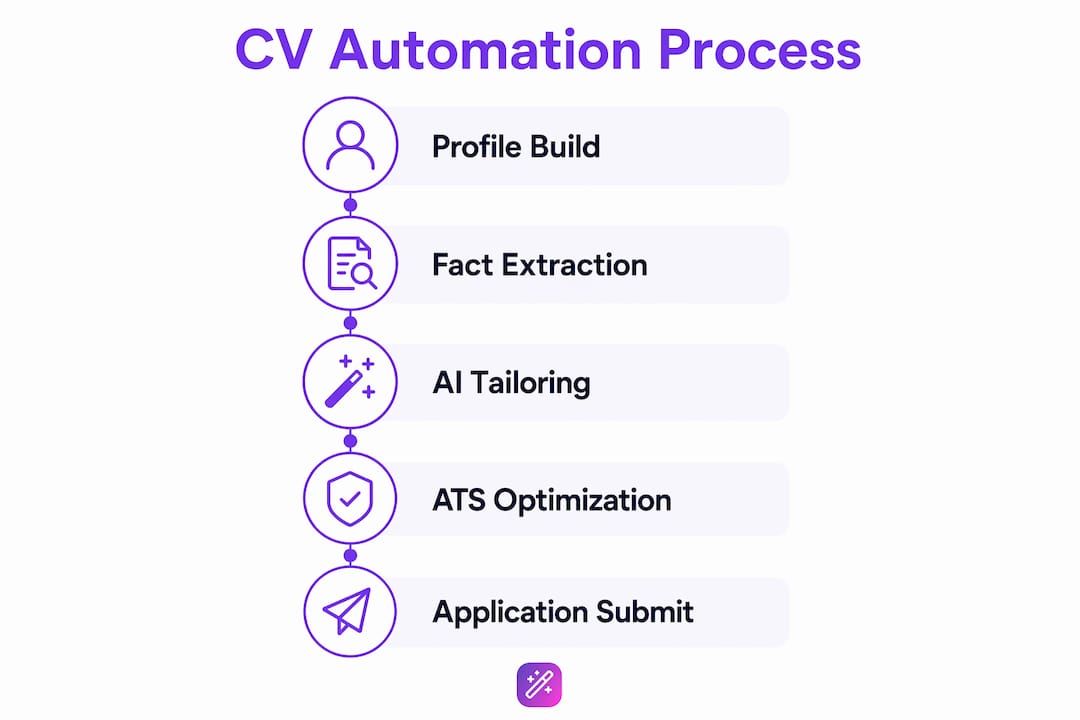
The workflow breaks down into five distinct stages:
- Job description ingestion. The software reads the posting and extracts required skills, qualifications, and preferred language patterns.
- CV parsing. Your source document is broken into structured data: work history, skills, education, and achievements.
- Keyword mapping. The system compares extracted job requirements against your parsed CV data to identify alignment gaps.
- Adaptive rewriting. AI rewrites bullet points and summaries to reflect the job’s language without inventing credentials. Tools like TailorCV include built-in guardrails that block fabricated claims and provide a match score alongside cover letter generation.
- Output and tracking. The finished CV is rendered as a PDF or formatted document, and the application is logged for later analysis.
The open-source cv-pipeline project demonstrates this end-to-end architecture in practice, using GitHub Actions and AI providers to automate tailoring and interview preparation in a real job search context. That example is worth studying because it shows exactly which steps require human input and which can run without it.
CV automation for job seekers differs fundamentally from recruiter-side automation. IBM describes recruitment automation as technology that reduces administrative work so HR teams can focus on strategic judgment. Job seekers face the output of that system: a keyword filter that decides whether a human ever sees their application. CV automation for candidates is the direct response to that filter.

What are the main benefits of CV automation for job seekers?
The core benefit is time recovered. Crafting a tailored CV for each application manually takes 45 to 90 minutes per role. Automation cuts that to under five minutes, which means you can apply to more positions without sacrificing quality.
Beyond speed, the measurable advantages include:
- Higher ATS pass rates. ATS systems tokenize text rather than reading it like a human. Effective CV automation aligns your language precisely with each job posting, increasing the probability that your document clears the keyword filter.
- Consistency across versions. When you manage multiple CV versions manually, factual errors creep in. Automation pulls from a single verified source profile, so every version reflects the same accurate career history.
- Cover letter generation. Most tools that handle CV tailoring also produce a matched cover letter, removing another manual task from the application process.
- Application tracking. Integrated analytics dashboards log which CV version you sent to which employer and track outcomes, giving you data to refine your approach over time.
Pro Tip: Before running any automation tool, build a master career profile that lists every role, achievement, and skill with precise dates and metrics. The quality of your automated output is directly proportional to the quality of this source document.
The importance of CV automation also shows up in competitive terms. Recruiters using automation shift their focus from screening volume to evaluating quality candidates. That means the bar for passing the initial filter is higher, not lower, and manual CVs submitted without keyword optimization are at a structural disadvantage.
You can read more about how tailoring affects your results in this breakdown of why optimizing your CV directly increases interview invitations.
How do CV automation tools compare?
The market for CV automation software ranges from open-source developer tools to consumer platforms built for non-technical job seekers. Choosing the right one depends on your technical comfort, the volume of applications you send, and whether you need features like multi-language support or ATS scoring.
| Tool | AI tailoring | ATS scoring | Application tracking | Cover letter | Best for |
|---|---|---|---|---|---|
| Easy-cv | Yes | Yes | Yes | Yes | Job seekers, all levels |
| cv-pipeline | Yes | Yes | Yes | No | Developers, technical users |
| TailorCV | Yes | Yes | No | Yes | Solo job seekers, accuracy-focused |
| Broad job platforms | Partial | No | Limited | No | High-volume auto-apply |
The table above highlights a meaningful split. Developer-oriented tools like cv-pipeline give you full control over the automation logic but require comfort with GitHub and YAML configuration. Consumer platforms like Easy-cv deliver the same core functionality through a visual interface, with no technical setup required.
Two features separate good CV automation software from mediocre options. First, fact extraction integrity: the tool must pull only verified claims from your source CV and never generate credentials you do not hold. Second, ATS scoring transparency: you should see a match score before submitting, not after. TailorCV’s architecture separates fact extraction from rewriting as distinct phases precisely to prevent overstating skills, a design choice that reflects best practice across the category.
Pro Tip: Test any CV automation tool by submitting a job description for a role you are clearly unqualified for. A trustworthy tool will return a low match score and flag gaps rather than fabricating qualifications to inflate the score.
Multi-language support is increasingly relevant for professionals targeting international markets. Some platforms now search across 30+ job boards and prepare applications in multiple languages, which is a significant advantage for candidates applying across borders. Easy-cv supports CV creation and translation in over 30 languages, making it one of the few consumer tools built for a genuinely global job market.
For context on how recruitment software categories differ across employer and candidate use cases, it helps to understand what hiring teams are running on their side of the process.
What best practices maximize the effectiveness of CV automation?
Automation amplifies what you put in. A weak source CV produces weak tailored outputs regardless of how sophisticated the tool is. The following practices separate professionals who see real results from those who are disappointed.
- Maintain a single source of truth. Store your complete career history in one structured document, whether that is a YAML file as used in cv-pipeline or a master Word document. Every automated version should derive from this single profile, never from a previous tailored version. This approach prevents compounding errors across multiple iterations.
- Review every output before submitting. AI rewrites can introduce subtle inaccuracies, particularly with technical terminology or role-specific metrics. A two-minute human review catches errors that would otherwise reach a hiring manager.
- Match language, not just keywords. ATS systems score on phrase patterns, not just individual words. If a job posting says “cross-functional collaboration,” your CV should use that exact phrase rather than a synonym. Automation tools handle this, but you should verify the output reflects the posting’s actual language.
- Track outcomes systematically. Application tracking integrated with CV tailoring creates a feedback loop. If a specific tailoring pattern consistently produces callbacks, you replicate it. If a version underperforms, you adjust the source profile.
Pro Tip: Create separate master profiles for distinct career tracks if you are applying across different fields. A single source document that tries to serve both a marketing role and a product management role will produce diluted tailored outputs for both.
The most common failure mode in the CV automation process is what TailorCV’s documentation calls keyword alignment drift: the rewriting phase overstates skills to maximize match scores, creating a CV that passes ATS screening but misrepresents the candidate in the interview. Separating fact extraction from rewriting, and reviewing outputs before submission, eliminates this risk.
For a deeper look at managing multiple CV versions without losing consistency, the approach of anchoring all versions to one master profile is the most reliable method available.
Key takeaways
CV automation works best when AI tailoring is grounded in a verified single-source career profile, reviewed by the candidate before submission, and tracked for outcome data that drives continuous improvement.
| Point | Details |
|---|---|
| ATS screening is the first barrier | 82% of companies use AI-based ATS, making keyword-optimized CVs a baseline requirement. |
| Automation has five core phases | Job ingestion, CV parsing, keyword mapping, adaptive rewriting, and output tracking form the complete workflow. |
| Fact integrity is non-negotiable | Tools must extract only verified credentials; keyword alignment drift is the leading failure mode. |
| Single source of truth prevents errors | One master career profile anchors all tailored versions and eliminates compounding inaccuracies. |
| Tracking outcomes closes the loop | Application analytics reveal which tailoring patterns produce callbacks, enabling systematic improvement. |
Why CV automation is more nuanced than most people realize
I have spent years watching professionals adopt automation tools with high expectations and mixed results, and the pattern is consistent. The people who see the biggest gains are not the ones using the most sophisticated software. They are the ones who treat automation as a system rather than a shortcut.
The uncomfortable truth is that most job seekers use CV automation tools the same way they used to use spell-check: as a final pass rather than a core part of their process. They upload a generic CV, run the tailoring tool, and submit without reviewing the output. That approach produces CVs that pass ATS filters but feel hollow in the interview because the language does not actually reflect how the candidate thinks or speaks.
What I have found actually works is building the master profile first, with real metrics and specific language from your actual experience, and then letting automation handle the mechanical work of matching that profile to each posting. The AI does not make you sound better than you are. It makes sure the right version of your real experience reaches the right reader.
There is also a timing dimension that most articles ignore. CV automation tools are most valuable early in a job search, when you are casting a wide net and need to apply to 20 or 30 roles quickly. Later, when you are targeting specific companies, the human element of your application matters more. Knowing when to rely on automation and when to write manually is itself a skill worth developing.
The future of this space points toward full workflow automation: job discovery, CV tailoring, cover letter generation, application submission, and outcome tracking in a single pipeline. That future is already partially here, and the professionals who learn to work within these systems now will have a structural advantage over those who resist them.
— Andras
Take your job search further with Easy-cv
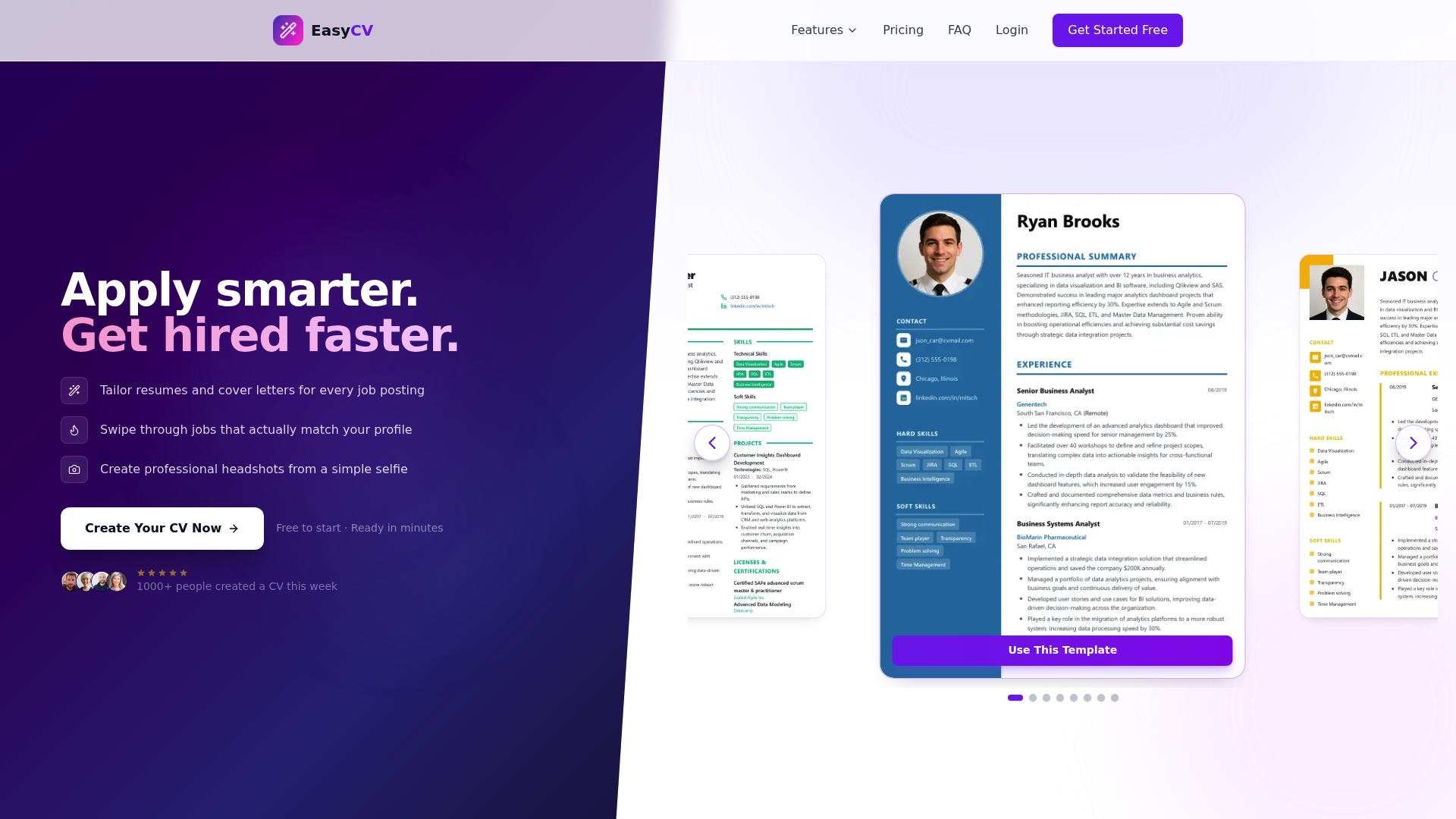
Easy-cv puts the entire CV automation process into one platform built specifically for job seekers. The AI writing assistant tailors your CV and cover letter to each job posting, the built-in ATS optimization checks keyword alignment before you apply, and the job tracker logs every application so you always know where you stand. With access to over 10 million job listings per month, ATS-friendly templates, and support for 30+ languages, Easy-cv covers every stage of the search from discovery to submission. Whether you are applying to five roles or fifty, the platform scales with your effort. Start building a stronger application today at Easy-cv and see the full feature set on the Easy-cv features page.
FAQ
What is CV automation in simple terms?
CV automation is the use of software to automatically tailor, format, and manage your CV for each job application, replacing manual editing with AI-driven keyword matching and rewriting.
How does CV automation help with ATS screening?
ATS systems filter resumes using keyword matching before a human reviews them. CV automation aligns your document’s language with each job posting, increasing the probability your CV passes the initial filter.
Can CV automation tools fabricate qualifications?
Reputable tools like TailorCV include guardrails that extract only verified facts from your source CV and block fabricated claims. Always review automated output before submitting to catch any inaccuracies.
What is the difference between CV automation for job seekers and for recruiters?
Recruiter-side automation, as described by IBM, handles posting, screening, and scheduling at scale. Job seeker CV automation focuses specifically on tailoring and optimizing the candidate’s document to pass through those recruiter-side systems.
How do I get started with CV automation?
Build a complete master career profile with accurate metrics and role descriptions, then use a platform like Easy-cv or an AI-powered CV tool to generate tailored versions for each application. Track your outcomes to refine your approach over time.