CV Parsing Explained: What Every Job Seeker Must Know
CV parsing is defined as the automated extraction of structured data from unstructured resume documents, converting free-form text into organized, searchable candidate profiles inside applicant tracking systems. Every time you submit a resume online, a parser reads it before any human does. Understanding how this technology works gives you a real advantage in the hiring process. The gap between a resume that parses cleanly and one that does not can determine whether a recruiter ever sees your name.
What is CV parsing and how does it work technically?
CV parsing follows a five-stage pipeline that transforms a raw document into a structured database record. Each stage builds on the last, and errors at any point compound through the rest of the process.
The five stages are:
-
Text extraction. The parser pulls raw text from your file. For DOCX files, this is straightforward. For PDFs, the system reads character data from glyph positions and reconstructs reading order. Multi-column layouts and text boxes cause garbled extraction because the parser cannot reliably determine which column comes first.
-
Tokenization. The extracted text is broken into individual words and phrases. This step prepares the content for classification.
-
Section classification. The parser identifies which block of text belongs to which resume section, such as Work Experience, Education, or Skills. Standard headings make this step accurate. Unusual headings like “My Story” or “What I Bring” confuse the classifier.
-
Named entity recognition (NER). The system identifies specific data types within each section: names, dates, company names, job titles, and skills. This is where machine learning and NLP do the heavy lifting, using patterns learned from millions of resumes.
-
Schema mapping. Extracted entities are mapped to database fields inside the ATS. Advanced systems extract up to 140 distinct fields, enabling granular filtering by recruiters.
The parser handles PDF, DOCX, and scanned image formats. Scanned images require optical character recognition (OCR) before text extraction, which adds another potential error layer.
Pro Tip: Save your resume as a single-column, text-based PDF or DOCX. Avoid tables, text boxes, and headers or footers. These formatting elements are among the most common causes of extraction errors.

What are the accuracy limits of CV parsing technology?
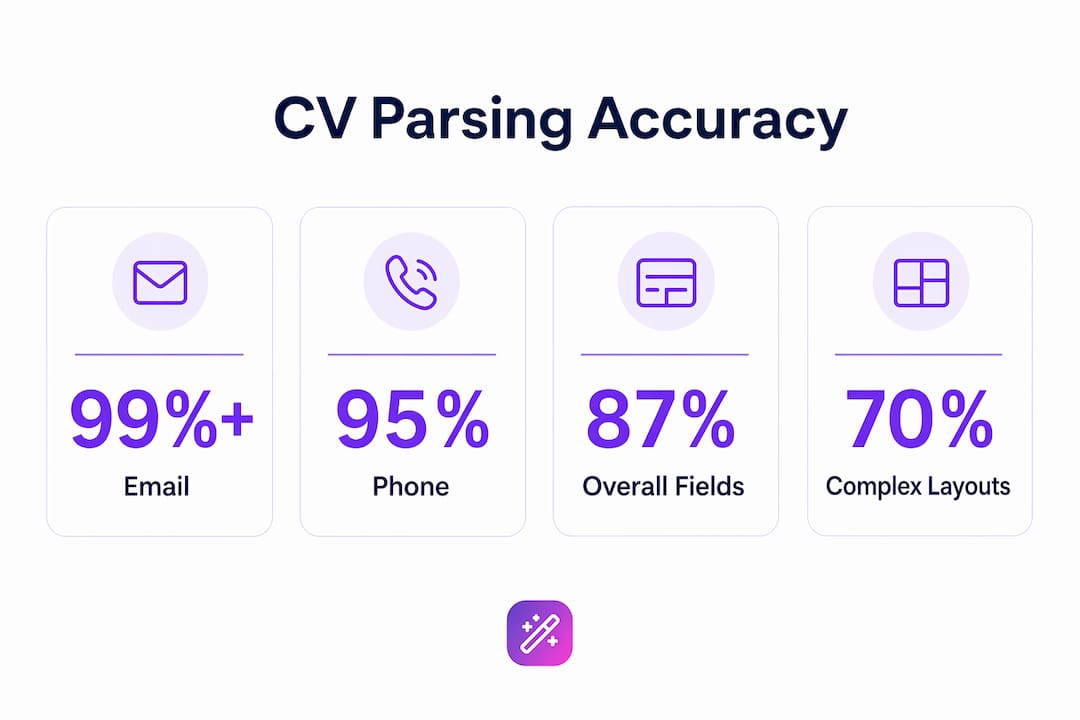
Modern CV parsing systems achieve field-level accuracy of approximately 87%, compared to roughly 96% for manual human data entry. That gap means about one in eight fields may be extracted incorrectly, even from a clean, well-formatted resume. For a resume with complex formatting, the error rate climbs higher.
Accuracy varies sharply by field type. Contact information such as email addresses and phone numbers is extracted with 99%+ accuracy because the formats are highly predictable. Complex fields like job titles and skills are far less reliable. A title like “Chief Happiness Officer” can be misclassified entirely, making that candidate invisible in searches for HR or people management roles.
| Field type | Typical accuracy | Main challenge |
|---|---|---|
| Email address | 99%+ | Virtually none |
| Phone number | 99%+ | Formatting variations |
| Employment dates | ~92% | Non-standard date formats |
| Job titles | ~80% | Creative or non-standard titles |
| Skills | ~75% | Context-dependent interpretation |
Parsing errors have real consequences. Poor parsing degrades screening quality regardless of how sophisticated the ATS ranking algorithms are. A qualified candidate whose job title was misclassified simply will not appear in a recruiter’s filtered search results.
Non-standard formatting is the leading cause of parser failure. Multi-column layouts, embedded images, and decorative fonts all interfere with text extraction. The parser cannot read what it cannot cleanly isolate.
Pro Tip: Use the exact job title from the job posting in your resume when it accurately reflects your experience. Parsers trained on industry-standard terminology perform significantly better with conventional titles than creative ones.
What benefits does CV parsing offer recruiters and job seekers?
CV parsing automates the most repetitive step in recruitment. A typical job vacancy receives around 250 applications, and manually entering each one into a database would consume days of recruiter time. Parsing compresses that work to seconds per resume.
The benefits split clearly between recruiters and job seekers.
For recruiters:
- Candidate profiles are populated automatically, eliminating manual data entry errors
- Structured data enables fast filtering by skills, location, years of experience, or education level
- Candidate databases become searchable at scale, supporting talent pipelines beyond a single vacancy
- Recruiters can compare applicants side by side using consistent data fields
- Parsing scales hiring volume without adding headcount to the recruitment team
For job seekers:
- Faster application processing means quicker responses from employers
- A well-parsed resume surfaces in more recruiter searches, increasing visibility
- Consistent data extraction reduces the risk of human transcription errors distorting your profile
- ATS-compatible resumes perform better across multiple platforms simultaneously
One critical distinction: parsing is strictly a data extraction process, not candidate evaluation or scoring. The parser populates database fields. A separate ATS function handles ranking and scoring. Understanding this distinction matters because optimizing for parsing and optimizing for scoring require different strategies.
How can you optimize your resume for better parsing results?
A resume that parses well gets seen. One that does not may never reach a human reviewer, regardless of how strong your qualifications are. The good news is that the changes required are straightforward.
A well-structured resume with standard headings and simple formatting consistently outperforms creative layouts in parsing accuracy. The parser is not impressed by design. It needs clean, predictable structure.
Follow these formatting rules:
- Use standard section headings. “Work Experience,” “Education,” “Skills,” and “Certifications” are universally recognized. Avoid invented headings.
- Stick to a single-column layout. Multi-column resumes cause the parser to read across columns rather than down them, scrambling your work history.
- Avoid text boxes and tables. Content inside these elements is often skipped entirely during extraction.
- Use conventional job titles. Match the terminology used in job postings and your industry. Review CV optimization tips to align your language with what recruiters actually search for.
- Submit as a clean PDF or DOCX. Avoid scanned images of resumes. OCR adds error risk that a text-based file eliminates.
- Include keywords in context. Place relevant skills and technologies within your job descriptions, not just in a standalone skills list. Parsers trained on NLP extract contextual meaning, not just keyword presence.
- Spell out acronyms at least once. Write “Search Engine Optimization (SEO)” before using the abbreviation alone. Parsers may not recognize every acronym variant.
Understanding how CV automation works at a technical level helps you make smarter formatting decisions. The goal is not to trick the system. The goal is to remove every obstacle between your qualifications and the recruiter’s screen.
Key Takeaways
CV parsing is the foundational data extraction step in modern hiring, and a resume that parses accurately is a resume that gets seen by human recruiters.
| Point | Details |
|---|---|
| Parsing accuracy is imperfect | Modern systems achieve roughly 87% field-level accuracy, meaning errors are common even on clean resumes. |
| Contact info parses best | Email and phone fields exceed 99% accuracy; job titles and skills are far less reliable. |
| Parsing is not scoring | Parsing extracts data only; candidate ranking is a separate ATS function downstream. |
| Formatting drives accuracy | Single-column layouts, standard headings, and text-based PDFs produce the cleanest parsing results. |
| Errors cost candidates visibility | A misclassified job title can make a qualified applicant invisible in recruiter searches. |
Why parsing is the hidden gatekeeper most job seekers ignore
Most job seekers spend hours crafting the perfect resume and zero minutes thinking about whether a machine can read it. I have seen this pattern repeatedly, and it produces a frustrating outcome: strong candidates who never get called because their resume failed at the extraction stage, not the evaluation stage.
The 87% accuracy figure sounds reassuring until you do the math. On a resume with 30 fields, that means roughly four fields may be wrong. If one of those fields is your most recent job title, you may not appear in the recruiter’s search at all. The recruiter relationship that could have led to an interview never starts.
My honest view is that creative resume design is often a liability, not an asset, in automated hiring workflows. A beautifully designed two-column resume with custom icons may impress a human who sees it. But if the parser reads it as scrambled text, no human will see it. Design for the machine first. Then refine for the human.
The distinction between parsing and resume scoring also matters more than most guides acknowledge. Candidates who understand this separation can optimize each layer independently. Clean structure for parsing. Relevant keywords and strong accomplishments for scoring. Treating them as one problem leads to mediocre results on both fronts.
Parsing is not going away. If anything, AI-driven recruitment tools are making it more central to hiring decisions. The job seekers who treat their resume as a data document, not just a personal narrative, will consistently outperform those who do not.
— Andras
How Easy-cv helps you build resumes that parse cleanly
Knowing the rules of CV parsing is one thing. Building a resume that follows them every time is another.
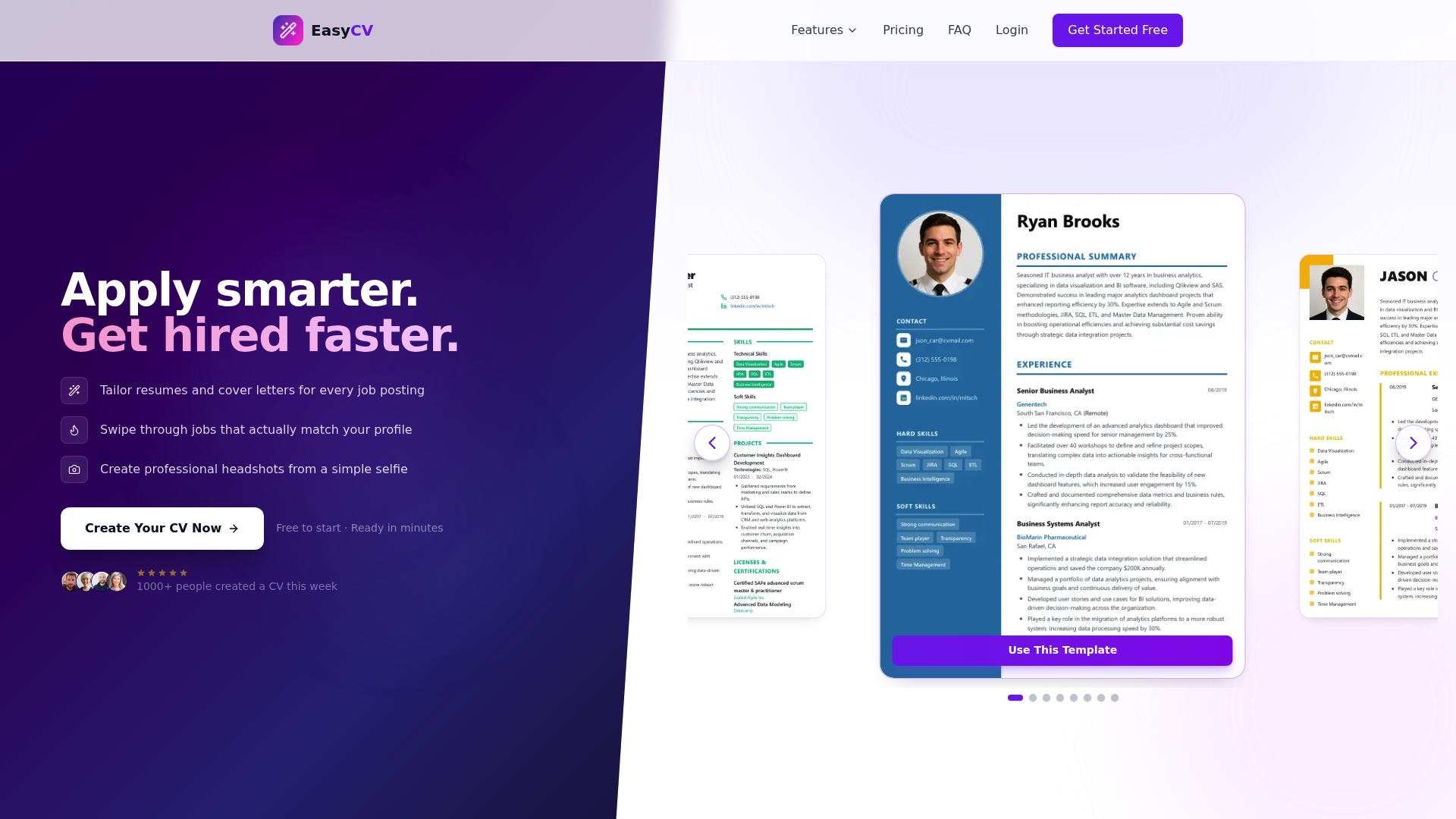
Easy-cv is built for exactly this challenge. Its AI-powered CV builder generates ATS-compatible resumes using templates designed around the formatting standards that parsers handle best. Single-column layouts, standard section headings, and clean PDF output are built into every template. The AI writing assistant helps you phrase your experience using industry-standard terminology, which directly improves how accurately parsers classify your job titles and skills. Easy-cv also tailors your CV and cover letter for each specific application, so your keywords align with the job posting the recruiter’s ATS is searching against. With support for 30+ languages and access to over 10 million job listings per month, it covers the full application workflow in one place.
FAQ
What is CV parsing in simple terms?
CV parsing is the automated process of reading a resume and extracting key information, such as contact details, work history, and skills, into structured database fields inside an applicant tracking system.
How accurate is CV parsing software?
Modern CV parsing systems achieve approximately 87% field-level accuracy. Contact information exceeds 99% accuracy, while complex fields like job titles and skills are less reliable.
Does CV parsing evaluate or rank candidates?
No. Parsing only extracts and organizes data. Candidate ranking and scoring are separate functions performed by the ATS after parsing is complete.
What resume formats parse best?
Single-column, text-based PDF or DOCX files with standard section headings parse most accurately. Multi-column layouts, text boxes, and scanned images cause the most errors.
Why does CV parsing matter for job seekers?
A resume that parses incorrectly may never appear in a recruiter’s search results, regardless of your qualifications. Optimizing your resume for parsing directly increases your visibility to hiring teams.