What Is Resume Scoring and How It Affects Your Job Search

Resume scoring is the process of assigning a numerical value to a resume based on how well it matches a specific job description, allowing recruiters to rank candidates automatically before any human reads a single line. ATS platforms are used by 98% of Fortune 500 companies to manage this process, and a typical job opening attracts around 250 applications. That volume makes automated ranking not a convenience but a necessity. Understanding how these systems evaluate your resume is the single most practical step you can take to improve your chances of getting an interview.
What is resume scoring and why does it matter?
Resume scoring is the automated resume evaluation process that sits between your application and a recruiter’s eyes. An Applicant Tracking System (ATS) such as Greenhouse, Workday, or Lever receives your resume, parses it into structured data, and compares that data against the job description criteria. The result is a compatibility score, typically on a scale of 0 to 100, that tells the recruiter how closely your background aligns with what the role requires.
The importance of resume scoring comes down to math. When 250 people apply for one position, no recruiter manually reads every document in full. The ATS ranks candidates by score, and recruiters focus their attention on the top tier. A resume that scores below the threshold simply does not get reviewed, regardless of the actual quality of the candidate behind it. That is why resume score analysis matters: it is not about being the best candidate on paper. It is about being visible at all.

Scores are not a judgment of your career worth. Job seekers often misread scores as career evaluations, when they actually reflect technical compatibility with a specific set of ATS requirements. A senior engineer with 20 years of experience can score lower than a recent graduate if the engineer’s resume uses outdated formatting or misses key terms from the job posting.
How does resume scoring work?
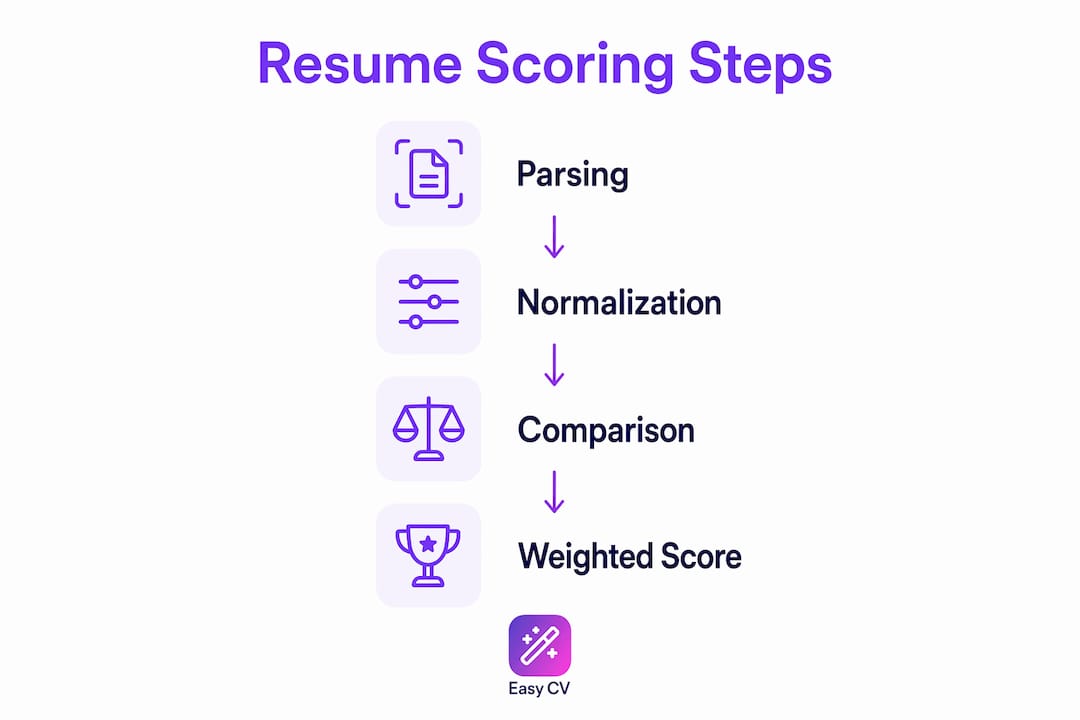
The mechanics behind resume scoring involve four core steps: parsing, normalization, comparison, and weighted scoring.
Parsing is where the ATS extracts raw text from your resume file and converts it into structured fields: name, contact details, work history, skills, education. This step is foundational. Resumes with complex layouts or graphical elements often fail to parse properly, causing the system to under-report your qualifications before scoring even begins.
Normalization maps synonyms and abbreviations to standard terms. The system recognizes that “JS” means JavaScript, or that “MIT” refers to Massachusetts Institute of Technology. This step determines how much context the ATS can actually understand.
Comparison measures your parsed resume data against the job description across multiple dimensions: hard skills, years of experience, job titles held, education level, and certifications. Each dimension carries a different weight in the final score.
Weighted scoring combines those dimensions into a single number. Hard skills can account for 30 to 40% of the score, while experience alignment contributes 15 to 25%, job title similarity 10 to 15%, education 5 to 15%, and format quality 5 to 10%. This means a candidate who nails the skills section but submits a poorly formatted file can still lose significant points.
| Scoring factor | Typical weight |
|---|---|
| Hard skills match | 30–40% |
| Experience alignment | 15–25% |
| Job title similarity | 10–15% |
| Education and certifications | 5–15% |
| Format and parsability | 5–10% |
Pro Tip: Mirror the exact phrasing from the job description in your skills section. If the posting says “project management” and you write “program coordination,” the ATS may not connect the two, even if the roles are identical.
Traditional ATS keyword matching vs. modern AI resume scoring
The original generation of ATS tools operated on a binary logic: a keyword was either present or absent. If the job description listed “Python” and your resume did not contain that exact word, you received zero credit for that skill, even if you had listed “Python 3,” “scripting,” or “data automation.” Pass/fail filtering was fast but crude, and it penalized candidates who wrote naturally rather than strategically.
Modern AI scoring systems work differently. AI detects context, mapping “React” to “JavaScript” or “MIT” to “Massachusetts Institute of Technology” through semantic understanding rather than string matching. This means a candidate who writes “built data pipelines using Pandas and NumPy” can receive credit for Python proficiency without using the word “Python” explicitly. The shift from keyword presence to semantic relevance is the biggest structural change in how does resume scoring work in 2026.
“AI resume scoring systems offer nuanced rankings using semantic analysis rather than binary pass/fail decisions, resulting in more objective candidate evaluations and facilitating efficient shortlisting.” — ResumerRank.io
AI systems also reduce one category of unconscious bias. Resume scoring tools provide an objective, data-driven filter that ranks candidates on demonstrated qualifications rather than name recognition or school prestige. That said, AI scoring is not neutral by design. The criteria it weights reflect the priorities of whoever configured the system, which means bias can still enter through the job description itself.
The remaining challenge is formatting. Even the most sophisticated AI parser struggles with multi-column layouts, embedded tables, and graphics. A beautifully designed resume that a human finds impressive can return a near-empty parse result in an ATS, producing a misleadingly low score.
What factors affect your resume score?
Several specific elements determine whether your score clears the threshold or falls short.
Keyword and skill alignment is the highest-weight factor. Your resume must reflect the language of the job description, not just the concepts. Read the posting carefully and identify the skills listed in the requirements section. Those exact terms belong in your resume.
Experience relevance and recency matter more than total years. A recruiter configuring an ATS for a cloud engineering role will weight recent AWS or Azure experience far more heavily than a decade-old on-premise infrastructure background. Custom configurations by employers make scoring criteria highly role-specific, so a resume that scores well for one position may score poorly for a different one at the same company.
File format and layout directly affect parsing accuracy. Single-column, text-based PDFs or DOCX files parse reliably. Complex formatting such as tables, images, and multi-column layouts negatively affects parsing accuracy, which lowers your score before the algorithm even evaluates your qualifications. This is one of the most common and most fixable mistakes candidates make.
Section headers and contact information also play a role. Standard headers like “Work Experience,” “Education,” and “Skills” are recognized universally. Creative alternatives like “Where I’ve Been” or “What I Know” confuse parsers and cause data to be misclassified or ignored.
Common scoring pitfalls include:
- Submitting a resume designed for visual impact rather than machine readability
- Using a single generic resume for every application instead of tailoring per role
- Listing skills in a graphic or icon-based format that parsers cannot read
- Including contact details only in the header image, which most ATS tools skip entirely
- Omitting certifications or licenses that the job description explicitly requires
Pro Tip: Before submitting, copy and paste your resume text into a plain text editor. If the result looks garbled or loses structure, your formatting will likely cause parsing errors in an ATS.
How can job seekers optimize their resumes for better scoring?
Improving your resume score is a repeatable process, not a one-time fix. Follow these steps for each application:
- Read the job description line by line. Identify every required and preferred skill, tool, and qualification. These are your scoring targets. Use resume keywords that mirror the exact language in the posting.
- Use a clean, single-column layout. Avoid tables, text boxes, graphics, and columns. A simple format maximizes parsing accuracy and protects your score from formatting penalties. Review resume formatting best practices before finalizing your layout.
- Standardize your section headers. Stick to “Work Experience,” “Education,” “Skills,” and “Certifications.” These labels are universally recognized across ATS platforms including Greenhouse, Workday, and Lever.
- Save as a text-based PDF or DOCX. Avoid image-based PDFs, which are essentially photographs of text that parsers cannot read.
- Use an AI-powered resume builder. AI-powered tools like Easy CV help candidates align keywords and maintain clean formatting automatically, improving both parsing success and semantic matching with job descriptions.
- Test and iterate. Run your resume through a scoring checker before submitting. Adjust based on the feedback, retest, and submit the improved version.
Pro Tip: Tailor your resume for every single application. One well-matched resume beats ten generic ones. The benefits of resume scoring become clear when you treat each application as its own optimization project.
Limitations of resume scoring and how recruiters actually use scores
Resume scores are diagnostic compatibility checks, not quality grades. A score of 72 on one platform and 88 on another for the same resume is not a contradiction. Different ATS platforms produce varying scores for the same resume due to differing algorithms and weighting schemes, so scores are only meaningful as relative benchmarks within the same system.
Recruiters typically see ranked candidate lists, not numeric scores. The ATS surfaces the top candidates by compatibility rank, and the recruiter reviews those profiles. Human judgment drives every decision from that point forward. A high score gets you into the review pile. It does not get you the job.
Score interpretation generally follows this pattern:
- 80 and above: Strong match. The resume aligns well with the job description in skills, experience, and format.
- 60 to 79: Fixable gaps. The candidate may be qualified but is missing specific keywords, has formatting issues, or lacks a listed certification.
- Below 60: Scores below 60 typically indicate parsing problems or significant keyword mismatches, not necessarily an unqualified candidate.
The practical takeaway is to focus on clearing the filter, not on achieving a perfect score. A resume that scores 82 and reads naturally will outperform a score of 95 built by stuffing keywords into every sentence. Recruiters who read both will immediately recognize the difference.
Key takeaways
Resume scoring is a technical compatibility test between your resume and a job description, not a measure of your professional value. Passing the filter requires deliberate alignment with each role’s specific language and format requirements.
| Point | Details |
|---|---|
| Scoring is role-specific | A resume that scores well for one job may score poorly for another due to custom ATS configurations. |
| Format affects score | Single-column, text-based files parse reliably; tables and graphics cause parsing errors that lower scores. |
| AI beats keyword matching | Modern systems use semantic analysis to understand context, not just exact keyword presence. |
| Recruiters see rankings, not numbers | ATS surfaces a ranked list; human judgment drives every hiring decision from there. |
| Tailor every application | One targeted resume per job consistently outperforms a single generic resume sent everywhere. |
Why I think most job seekers are solving the wrong problem
Most candidates I see treat resume scoring as a puzzle to crack once and forget. They optimize a single resume, run it through a checker, get a score they like, and send it everywhere. That approach misunderstands what the score actually measures.
Resume scoring is not a quality test. It is a compatibility test against one specific job description. The moment you submit that same resume to a different role with different requirements, the score resets. A resume scoring well for one job may perform poorly for a different position because the criteria are entirely different. This is the part most guides skip.
The other mistake I see constantly is over-optimizing for the machine and forgetting the human on the other side. A resume crammed with keywords in unnatural sentences will score well and read terribly. Recruiters notice. The goal is a resume that clears the ATS filter and then convinces a person. Those two objectives are not in conflict, but they do require separate attention.
My honest advice: use an AI resume writing workflow to handle the mechanical work of keyword alignment and formatting, then spend your real effort on making the content compelling for the human reader. The tools exist to handle the technical layer. Use them, then focus on what they cannot do.
— Andras
Build a resume that scores well and reads even better
Understanding resume scoring is only half the equation. The other half is having a tool that handles the technical requirements automatically so you can focus on telling your story.
Easy-cv brings the entire application process into one place. The AI-powered resume builder generates and refines professional content, applies ATS-friendly formatting automatically, and tailors your resume and cover letter to each specific job description. You get clean, parsable output that aligns with modern scoring criteria without manually adjusting every section for every application. Easy-cv also aggregates over 10 million job listings per month, so you can find the right roles, build targeted resumes, and track every application without switching between tools. Try Easy-cv free and see how your scores improve.
FAQ
What is resume scoring in simple terms?
Resume scoring is the automated process of assigning a number to your resume based on how well it matches a job description. ATS platforms like Greenhouse and Workday use this score to rank candidates before any human review takes place.
What is a good ATS resume score?
A score of 80 or above is generally considered a strong match. Scores between 60 and 79 indicate fixable gaps, while scores below 60 typically signal parsing problems or significant keyword mismatches rather than an unqualified candidate.
Does a low resume score mean I am not qualified for the job?
No. A low score reflects technical compatibility issues, not career quality. Resume scores are diagnostic compatibility tests, and the same resume can score 72 on one platform and 88 on another due to different algorithms.
How does resume scoring work with AI?
Modern AI scoring systems use semantic analysis to understand context rather than matching exact keywords. AI maps related terms like “React” to “JavaScript” and ranks candidates on a 0 to 100 scale with nuanced understanding of skills and experience.
Should I tailor my resume for every job application?
Yes. Custom configurations by employers make scoring criteria highly role-specific, so a resume optimized for one role will often score poorly for a different position. Tailoring your resume per application is the most reliable way to improve your scores consistently.